Vienna is more than just the palaces, museums, and boulevards of its central districts. The Austrian capital has 23 districts, each with its own unique character and architectural appearance. While the central districts are associated with imperial architecture and throngs of tourists, the north of Vienna is the preferred destination for those who prefer to live for themselves. It is here, on the left bank of the Danube, that Floridsdorf lies. Vienna's 21st district is considered one of the greenest and most spacious districts in the capital.
Floridsdorf covers an area of 44.5 square kilometers and is considered Vienna's second-largest district. Home to over 165,000 people, it is considered one of the capital's most populated areas. Nearly half of the area is covered by parks, forests, and vineyards.
Floridsdorf is known as "Vienna's wine district." Wine traditions are still alive here, and a stroll through the local heurigers is as unforgettable an experience as a visit to Schönbrunn.
Floridsdorf's unique feature is its preserved balance between city and nature. On the one hand, it's a fully-fledged urban district with schools, university campuses, hospitals, shopping centers, and residential complexes. On the other, it feels more like a suburb. The word "Dorf" ("village") is still present in the district's name. Here, you can still enjoy the atmosphere of rural life. Wide streets border vineyards, and modern residential areas are surrounded by quiet squares and old houses.
Location and transport role
If you look at Vienna's districts on a map, you'll notice that Floridsdorf is located in the northern part of the city, on the left bank of the Danube. It plays a vital role in the city's transportation system. Floridsdorf Bahnhof is one of the capital's major transportation hubs. S-Bahn trains, metro lines, trams, and buses depart from here, allowing passengers to reach the city center, the suburbs, and the main train station in just minutes. Residents appreciate living in Floridsdorf for its quiet surroundings, abundant parkland, and convenient access to anywhere in the city.
An area for living and investment
Floridsdorf is also attractive from a real estate perspective. There's still plenty of available land for development, and housing prices are lower than in the respectable 19th district (Döbling). Floridsdorf is also quite comfortable to live in. According to 2024 estimates, the price per square meter fluctuates between €5,800 and €6,000. This makes the area attractive both for buying an apartment for permanent residence and for real estate investment .
Floridsdorf has a diverse housing stock:
- low-rise new buildings
- municipal houses of "Red Vienna"
- private villas
- modern complexes built using environmentally friendly technologies.
Character of the area
Floridsdorf is known for its cozy, almost homey atmosphere . Families with children love it for its parks and schools. Students appreciate its accessibility and convenient transportation, and seniors value its tranquility and serenity. While there are no tourists here, there's a sense of boundless space, fresh air, and harmony. Unlike Vienna's less desirable neighborhoods, it's quite safe.
In this article, we'll take a detailed look at Vienna's 21st district. You'll learn a lot about its history, geography, population, housing, infrastructure, culture, parks, investment appeal, and future prospects. If you're considering renting an apartment, buying real estate, or simply want to know which Vienna neighborhoods are best for living, Floridsdorf may be a pleasant discovery.
Story

Floridsdorf is renowned for its rich history, reflecting all stages of Vienna's development. It arose on the site of ancient settlements and wine-growing villages and gradually transformed into a modern transportation hub with numerous residential areas. To understand how Floridsdorf's modern appearance was shaped, it's necessary to look back in time and trace its development.
Ancient settlements and Roman heritage
Archaeological finds indicate that the area of today's Floridsdorf was inhabited as early as the Neolithic era. The left bank of the Danube has always been considered a convenient place to live, with fertile land, water for agriculture, and favorable conditions for trade.
During the Roman Empire, northern Vienna was part of a strategic fortified zone. On the other side of the river stood the famous military camp of Vindobona (the future center of Vienna), and the lands of Floridsdorf were used to supply the army with food and wine. Many historians believe that the winegrowing traditions for which this region is famous date back to antiquity.
Medieval villages
After the fall of the Roman Empire, the area of modern-day Floridsdorf remained sparsely populated for a long time. However, as early as the 12th and 13th centuries, the first villages were built here, whose names remain to this day: Jedlesee, Strebersdorf, Floridsdorf, Leopoldau, Kagran, and others.
The main occupations of Floridsdorf residents were agriculture, horticulture, and winemaking. The vineyards of Strebersdorf were particularly prized, producing varieties renowned in Vienna and beyond.
The name "Floridsdorf" is associated with Bishop Floridus, who owned these lands. "Dorf" means "village" in German. The name of this area still references its origins.
16th–18th centuries: wars and restoration
Like many other parts of Vienna, the rural areas in the northern part suffered greatly during the Turkish invasions of the 16th and 17th centuries. The lands were abandoned, and many houses were destroyed. However, by the 18th century, a revival had begun. Vineyards and farm buildings reappeared, and churches and chapels were built.
At this time, members of the Viennese nobility increasingly chose Floridsdorf as a vacation spot. Country houses and wine taverns (Heuriger) began to be built in the surrounding area, where one could sample young wine.
19th century: railways and industrialization
The 19th century marked a turning point in the district's development. In 1837, Austria's first railway, the Nordbahn, passed through Floridsdorf, connecting Vienna with the northern regions of the empire. The arrival of the railway station transformed Floridsdorf into an important transportation hub.
At the same time, industrial enterprises began to develop in the villages. Mills, brickyards, and breweries appeared. The first factories were built in Leopoldau and Strebersdorf, and warehouses were erected along the Danube.
The railway also contributed to population growth. More and more workers settled on the left bank, where land and housing were cheaper than in central Vienna. Gradually, Floridsdorf lost its rural appearance and became a working-class suburb of the capital.
Late 19th – early 20th century: becoming part of Vienna
In 1904, a momentous event occurred: several villages on the left bank of the Danube became part of a single administrative district of Vienna called Floridsdorf. The district included Jedlesee, Donaufeld, Gross-Jedlersdorf, Leopoldau, Stammersdorf, and other settlements.
This event marked the beginning of large-scale transformations. City services arrived in the area, water pipes were installed, and tram lines were launched. Street lighting was also installed, and active development of municipal quarters began. The first "hofs"—residential complexes with spacious courtyards and green spaces—appeared. They were built in the "Red Vienna" style.
Wars and post-war times
Floridsdorf suffered greatly during World War II. Situated among strategic industrial facilities and railway junctions, the area was subject to bombing. Many buildings were destroyed.
In the post-war years, large-scale reconstruction began here. Because of the open space, the area recovered faster than the central districts. In the 1950s and 1960s, new residential areas, schools, and medical facilities were actively built here.
Floridsdorf in the 20th–21st centuries
In the second half of the 20th century, Floridsdorf developed a reputation as a working-class and family-oriented neighborhood. Affordable homes for the middle class were built here, and industrial plants and warehouses developed.
The late 20th and early 21st centuries saw a new wave of transformation. The area began to be actively developed with modern residential complexes, and shopping centers emerged, including SCN (Shopping Center Nord). New transportation lines and social facilities were also built during this period.
Particular attention is paid to environmental sustainability and green spaces. Today, more than 40% of the district's territory is covered by parks, squares, and vineyards. This makes Floridsdorf one of Vienna's greenest districts.
| Time | What happened | Why is it important? |
|---|---|---|
| Roman era | The first vineyards and settlements | The beginning of wine traditions |
| Middle Ages | Rural villages, churches, wineries | Formation of district identity |
| 19th century | Railways, factories, warehouses | Industrialization and population growth |
| 1904 | Incorporation into Vienna | The beginning of urban development |
| 20th century | War and reconstruction, new hofs | Transformation into a working-class district |
| 21st century | New buildings, shopping centers, parks | A modern "green" district |
Geography, zoning and structure
If you search Vienna's districts by number on a map, you'll see that Floridsdorf is the city's second-largest district (44.5 square kilometers). Its impressive size gives it a remarkable diversity. While the capital's central districts are very compact and densely populated, Floridsdorf offers ample space. The district extends to the Danube and the canal on one side, and to the slopes of the Vienna Woods on the other. This scale allows it to combine industrial zones, residential areas, and vast green spaces within a single district.

Location and natural conditions
Floridsdorf is located in the northern part of Vienna, on the left bank of the Danube. It borders the 22nd district (Donaustadt) and is separated from the city center by the Danube Canal to the south. These natural features have determined the development pattern. Industrial and transport zones are located along the river, while agricultural land and vineyards spread out toward the outskirts. Residential areas with shopping centers are located in the center.
Russbach River flows through here , and the old Danube riverbeds (Alte Donau and Neue Donau) have been preserved and converted into recreation areas. The area is rich in parks and waterways. It's no coincidence that more than 41% of its territory is made up of green space.
Framework district: from the center to the outskirts
When you visit Floridsdorf, you will see that this area can be roughly divided into three parts that smoothly flow into each other.
- The central area around Floridsdorf Bahnhof is a major transportation hub, offering access to the U-Bahn (U6), S-Bahn, trams, and buses. It is surrounded by shopping centers, offices, cafes, and municipal institutions. Numerous municipal housing projects and new residential complexes have been built here.
- Medium-density residential neighborhoods
in Leopoldau, Jedlersdorf, Gross-Jedlersdorf, and other parts of the district are characterized by buildings built to standard designs. Here you'll find low-rise residential complexes and modern new buildings. The architecture here is mixed. You'll see buildings from the "Red Vienna" period with green courtyards, new energy-efficient homes, and townhouses. - The outskirts: vineyards and a rustic atmosphere.
The districts of Stammersdorf and Strebersdorf still retain a rural atmosphere. Here you'll find vineyards, heurigers, and villas. Many Viennese come here for weekends to relax and sample young wine.
Architecture and urban appearance
The district's rich history has given it a unique architectural character. The settlements that existed within its territory gradually became part of Vienna. In one neighborhood, you'll find old farmhouses with tiled roofs, reminiscent of a distant past, while in another, you'll see monumental municipal buildings built during the "Red Vienna" era. They became a symbol of the social transformations of the early 20th century
- Old buildings remain in the villages that became part of the district in the early 20th century. Here you'll see narrow streets, small houses, and churches.
- Municipal housing (Gemeindebauten) appeared after 1904. These neighborhoods were built particularly intensively during the interwar period. You'll easily recognize them by their red-and-white façades, interior courtyards, and spacious floor plans.
- Modern residential complexes are being built using energy-efficient technologies. Their construction began in the 2000s. These are low-rise buildings (up to 5 stories) with terraces and gardens.
- Industrial zones are located along the Danube and railway lines.
Streets and areas of Floridsdorf
Every street in Floridsdorf reflects its diverse character. On the one hand, you can enjoy the benefits of city life, while on the other, you can live close to nature. Brünner Straße is considered the district's main artery. This kilometers-long street connects the district's center with its outskirts. On both sides of the street, you'll find numerous shops, cafes, restaurants, office buildings, and residential buildings. There's always a lively flow of traffic, and locals are everywhere, shopping or meeting friends at cafes.
Other major thoroughfares are also important in this area. Prager Straße is one of the oldest roads, running to Stammersdorf. This road has retained its unique historical character. Leopoldauer Straße connects the central part of the district with the northern neighborhoods. Angerer Straße is characterized by a calm pace and typical residential buildings. Numerous small shops are located along it.
However, Floridsdorf's greatest charm lies in its unique contrasts. Walk a few blocks, and the atmosphere changes dramatically. In the Leopoldau district or near the Shopping Center Nord , you'll feel like you're in a modern city. Numerous shopping centers and new residential complexes are located here, plus convenient transportation links. However, ascend to Stammersdorf, and you'll find yourself in another world. Here you'll encounter picturesque narrow streets, wine cellars, cottages, and traditional heurigen.
Floridsdorf is unique in that you can live in a modern building near a tram line and within 10 minutes be among vineyards or by the water. This makes the neighborhood particularly attractive to those who want to enjoy the comforts of city life and the proximity to nature. Unlike some of Vienna's Arab neighborhoods, it is quite multicultural.
Population and social structure

Floridsdorf is Vienna's second-largest district. It is also considered one of the city's most densely populated areas. As of 2023, approximately 165,000 people . The population is steadily growing. This district allows everyone to experience the comforts of Vienna. Although it has few tourist attractions, a modern, multicultural community is developing here.
Ethnic composition and multiculturalism
Floridsdorf's population composition deserves special attention. Around 17% of the population is foreign-born , slightly above the city average. Serbs, Turks, Romanians, Slovaks, Hungarians, and other nationalities live here. This gives the district a certain resemblance to a "little Babylon." Representatives of dozens of cultures can attend a single school, and several languages can be heard spoken at markets. However, unlike some dangerous areas of Vienna, this district is comfortable to live in.
For some, this is an advantage, as the area feels very vibrant. There are many restaurants serving cuisine from around the world, and a rich cultural palette. For others, it's a disadvantage, as multiculturalism sometimes creates social problems. It's important to find ways to integrate new groups, maintain dialogue, and create livable conditions. However, the city is actively working on this. The area boasts cultural centers and sports clubs, as well as integration projects that help new residents adapt more quickly.
Age structure of the population
Floridsdorf is home to people of all ages. There are many young families with children who appreciate the green spaces, schools, and affordable housing prices. This neighborhood is also popular with middle-aged people who work downtown but prefer to live in a quieter environment. Moreover, the neighborhood is not aging, as the number of retirees is no higher than the city average.
Thanks to this, Floridsdorf is experiencing a positive dynamic. In the morning, you'll see many children walking to school, during the day, offices and shops are open, and in the evening, families stroll through parks or relax by the Danube.
Education and employment level
The district performs well in terms of education. While it lacks university campuses like the city center, it does have good schools, gymnasiums, and branch campuses. Thanks to convenient transportation, many students commute to universities located in other districts.
Floridsdorf residents have a variety of work options to choose from:
- some residents work in the area itself (in trade, service, medicine, warehouses and industrial enterprises);
- The rest travel to the city center every day by metro and S-Bahn.
This allows the district to be considered one of Vienna's most prosperous areas and remain self-sufficient. Here you can live, work, study, and relax.
Income and social environment
Floridsdorf has traditionally been considered a middle-class neighborhood. Residents' incomes here are comparable to the Vienna average, but lower than, for example, those in the prestigious 19th district (Döbling). This is reflected in prices. Housing here is more affordable than in the city center, making the neighborhood particularly attractive to families and young professionals.
At the same time, the situation has changed over the past 10-15 years. New residential complexes built along the embankment have attracted more affluent residents. Floridsdorf now offers both municipal apartments and luxury apartments with views of the Danube.
Social integration
Small communities play a significant role in the district. Sports clubs and cultural centers are open here. Anyone can also join greening initiatives. These projects help bring residents together and create a small-town feel within the city.
Wine-drinking traditions play a special role here . People of all ages and professions come together at the heurigen in Stammersdorf and Strebersdorf. It's easy to see students, families with children, and retirees sharing a table. Over a glass of wine, differences disappear.
A neighborhood for different generations
Floridsdorf is appreciated by people of all generations:
- Young families find affordable housing and good schools here.
- Students and young professionals appreciate the area for its convenient transportation system and reasonable prices.
- Pensioners love it for its quiet, green areas and advanced healthcare.
This area is less crowded with tourists, so prices remain affordable. It's one of the best neighborhoods in Vienna because it always has a cozy atmosphere.
Floridsdorf is home to many nationalities and social classes. Families with children, students, and seniors will all find a place here. This neighborhood is favored by Vienna's middle class, giving it a unique cultural diversity.
Housing: social and luxury segments

Floridsdorf is often called a neighborhood where everyone can find a home to suit their taste. Unlike the historic center or prestigious Döbling, this neighborhood is characterized by a diverse development. Here you can see a wide variety of Viennese architecture: from the municipal buildings of "Red Vienna" to modern waterfront complexes. This allows the real estate market to offer options to suit every budget and taste.
Municipal housing and "Red Vienna"
Like other districts of the city, Floridsdorf has many municipal housing units (Gemeindebauten). Many of them were built in the 1920s and 1930s, during the so-called "Red Vienna" era. These residential complexes feature spacious courtyards, green spaces, and convenient infrastructure.
Municipal housing continues to fulfill its core function, allowing people of all income levels to rent apartments at affordable prices. These buildings are home to workers, retirees, and young families. The buildings are regularly renovated, with new elevators and heating systems installed, and playgrounds created in the courtyards.
Private houses and townhouses
Floridsdorf is attractive because entire neighborhoods of private homes with gardens have been preserved here. This is a rarity in Vienna, where most neighborhoods are dominated by apartment buildings. Such buildings are especially numerous in Leopoldau, Gross-Jedlersdorf, and the outskirts, closer to Stammersdorf.
Here you can admire ancient Austrian villas with tiled roofs and grape arbours. You'll also see modern townhouses built to energy-efficient standards. These neighborhoods are especially popular with families with children and those who want to enjoy country life without leaving Vienna.
Modern residential complexes
Since the 2000s, new complexes have been actively built in Floridsdorf. They are typically no more than five stories tall. Residents are particularly attracted by the large windows, terraces, and landscaped courtyards. These buildings are often built near water, for example, near the Alte Donau.
The new complexes focus on:
- energy efficiency (solar panels, heat pumps)
- eco-friendliness (green roofs, courtyards with gardens)
- family-friendly (playgrounds, bicycle parking, playrooms)
Many apartments have loggias or private gardens, creating a cozy atmosphere.
Housing prices
Compared to other districts of Vienna, Floridsdorf stands out for its affordable real estate prices. The average apartment price (as of March 2024) is:
- up to 50 m² — about €6120/m² ,
- 51–80 m² - about €5550/m² ,
- 81–129 m² - about €5960/m² ,
- more than 130 m² — about €7200/m² .
The average price in the district is around €5,845/m² . This is lower than in the prestigious 19th district (where prices often exceed €9,000/m²), but slightly higher than in districts like Simmering or Favoriten.
Rents are also relatively affordable: €16–18 per square meter per month . This makes the area attractive to those looking for long-term rentals or investment.

Comparison with other areas
Floridsdorf is often compared to the neighboring 22nd district (Donaustadt). These prestigious districts of Vienna are located on the left bank of the Danube, are undergoing rapid development, and are notable for their parklands. However, Donaustadt is developing more extensively. It has a more modern appearance thanks to its numerous skyscrapers and business centers. Floridsdorf retains a cozy atmosphere and allows residents to enjoy the benefits of living close to nature.
Floridsdorf also has much in common with upscale neighborhoods like Döbling. It's famous for its winemaking traditions and vineyards. However, while Döbling is primarily home to the very wealthy, Floridsdorf real estate is also affordable to the middle class.
New projects
New residential complexes are being built in Floridsdorf. Various building styles can be seen here, lending a unique architectural character to the area.
- Complexes near the Alte Donau. Apartments have terraces with views of the water;
- Low-rise houses in Leopoldau - here everyone can experience the benefits of country life;
- Renovated old municipal buildings – local authorities are renovating buildings while preserving their unique historical appearance.
This diversity has created a real estate market in Floridsdorf that can satisfy even the most discerning buyers – from students and young professionals to families with children and investors seeking promising properties with guaranteed appreciation.
A neighborhood for buyers and renters
Floridsdorf caters to a wide range of needs, making it one of Vienna's most versatile neighborhoods. Thanks to its wide variety of housing options, everyone can find a suitable option depending on their needs and budget. The following housing categories are available:
- for families - private houses with gardens and new apartment buildings with playgrounds in the courtyards;
- For young professionals - affordable apartments in buildings with convenient transport links;
- for investors - new buildings on the Danube and low-rise buildings in Leopoldau;
- For the elderly , there are quiet neighborhoods with green areas and good medical care.
If you're looking for the best neighborhoods to live in Vienna, consider Floridsdorf. Everyone can find a place to live here. Buyers can find comfortable homes and make a profitable real estate investment. Renters can choose from a variety of affordable rental options, while families and retirees can enjoy the tranquility and walks in the parks. This neighborhood also boasts well-developed infrastructure. Thanks to these advantages, real estate located in this area is consistently in demand.
Education

Floridsdorf is especially appreciated by families with children. This district of Vienna offers everything needed for a comprehensive education. It boasts a well-developed education system, ranging from kindergartens and primary schools to grammar schools and specialized educational institutions. This has led middle-class families to consider this district a convenient place to live. Here, children can receive a quality education without having to commute to the city center.
Kindergartens and primary schools
There are several dozen public and private kindergartens in the district. They are accessible to families living both in the district center and on the outskirts, as they are spread evenly throughout the district. Most of the kindergartens prioritize early development, including music, sports, and English language classes.
Floridsdorf's primary schools (Volksschulen) have an excellent reputation. Among the most well-known are:
- Volksschule Brünner Straße is a modern school with in-depth language and art studies;
- Volksschule Strebersdorf is a school with integrated classes, where children with different educational needs study together;
- Volksschule Jedlesee is one of the oldest educational institutions in the area. It combines traditional and modern teaching methods.
Secondary schools and gymnasiums
Floridsdorf is renowned for its educational institutions. One of the key elements of its education system is the Gymnasium (AHS), which is a popular destination for children living in Floridsdorf and other parts of Vienna.
- BRG 21 Ödenburger Straße is one of the largest gymnasiums in the area. It offers advanced mathematics and natural science courses.
- GRG 21 Franklinstraße is a school specializing in the humanities. It is renowned for its theater productions and literary projects.
- BG/BRG Groß-Jedlersdorf is a grammar school that offers intensive study of foreign languages: English, French and Italian.
In addition to gymnasiums, Floridsdorf has new secondary schools (NMS) and polytechnische Schulen ), which focus on applied learning. They allow students to gain practical knowledge in technology, economics, and trades. This allows them to better prepare for professional careers or further education at specialized colleges. Because students have the opportunity to gain theoretical training and practical skills, the district's education system is considered quite flexible and adaptable. Every child can choose the path that best suits their interests and abilities.
Floridsdorf is distinguished by its close connection to the social and cultural life of the district. Students participate in theater productions, concerts, sports tournaments, and environmental projects. At the district's schools, teachers go beyond the academic curriculum and strive to equip children with skills that will be in demand in the future.

Specialized schools
One of the advantages of this district of Vienna is the presence of a number of specialized educational institutions that prepare young people for various professions and allow them to develop in a variety of creative fields. Unlike classical gymnasiums, which prioritize academic education, these schools allow students to develop practical skills in demand in the labor market from an early age.
- HTL (Höhere Technische Lehranstalt) Floridsdorf is a technical college that trains specialists in mechanical engineering, electrical engineering, and IT. Graduates often continue their studies at the Technical University of Vienna.
- HAK Floridsdorf is a business academy that teaches economics, accounting, and entrepreneurship.
- Music and art schools – in the area, you can enroll in music classes, join choirs, and attend dance studios.
Additional education
The area has a well-developed Volkshochschule (VHS) . These are municipal adult education centers where anyone can improve their skills. Here, you can learn languages, do handicrafts, and take computer courses. These centers are especially convenient for families with children, as parents can improve their qualifications or learn new skills close to home.
International relations
Although Floridsdorf lacks any major international schools, many expatriate professionals with children choose this area. It offers easy access to international institutions, such as the Vienna International Center UNO City in the neighboring 22nd district. Children can study in bilingual classes and private language schools.
Floridsdorf is a district with a well-developed education system. Here, you can complete the entire education system—from kindergarten to technical college—without leaving the district. For families, this is a compelling reason to choose the 21st district as a place to live.
Infrastructure and transport

Floridsdorf is not just a residential neighborhood on the left bank of the Danube, but also one of Vienna's major transportation hubs. It's served by the U-Bahn, S-Bahn, tram, and bus lines. This allows travelers to feel part of the city and live closer to nature. Floridsdorf is considered one of Vienna's best neighborhoods to live in.
Central transport hub: Floridsdorf station
Floridsdorf station is the heart of the district's transportation system. It's a major transportation hub, where:
- The U6 metro line connects the northern and southern districts of Vienna;
- Several S-Bahn lines (S1, S2, S3, S7, S45) allow you to quickly get to the city centre, main station and suburbs;
- Tram routes (25, 26, 30, 31) and dozens of bus routes.
Thanks to a well-developed public transportation system, Floridsdorf residents can quickly reach any point in the city. A trip to the city center takes approximately 15–20 minutes, and Schwechat International Airport is just 40 minutes away.
Trams and buses
Floridsdorf has several tram routes. Routes 30 and 31, which run directly to the city center via Floridsdorfer Brücke, are particularly popular. These routes are popular among students and office workers, offering passengers quick and direct access to Vienna's central districts.
Bus routes allow residents to reach even the most remote neighborhoods of the district—Leopoldau, Strebersdorf, and Stammersdorf. During rush hour, buses run every 5–7 minutes, making these trips quite convenient. You don't need to transfer to the metro or S-Bahn.
Metro
The U6 is the only U-Bahn line that runs through Floridsdorf. It connects the north and south of the city, traversing key neighborhoods: Alser Straße, Westbahnhof, and Meidling . For residents of the neighborhood, it's the main way to quickly reach the university, office, or shopping centers.
The STEP 2025 urban infrastructure development program includes expansion of the transport network and modernization of boarding stations.
Bicycles and walking routes
Floridsdorf is a true cyclist's paradise. Dozens of kilometers of bike paths connect residential areas with Vienna's city center and the Danube River recreation areas. The convenient routes along the Alte Donau and Neue Donau are particularly popular, offering stunning views.
Walking is also safe and comfortable. Wide sidewalks, greenery, and good lighting make this area particularly suitable for families with children and the elderly. It's one of the most comfortable neighborhoods in Vienna to live in.
Motor transport
Despite the well-developed public transportation, many residents of the area use private cars. Parking is easier to find here than in central areas. Thanks to the highways, you can quickly connect to the autobahns heading towards the Czech Republic and Slovakia.
However, city authorities are gradually restricting the use of private transport. They encourage local residents to switch to public transport or bicycles.
Development plans: STEP 2025
As part of Vienna's strategic development plan for 2025, the following projects are being implemented in Floridsdorf:
- Improvement of transport links around Floridsdorf station;
- Expansion of bicycle routes;
- Improvement of streets to make them more accessible for pedestrians;
- Creation of additional parking zones.
The area is gradually becoming a convenient transportation hub. It remains accessible to car owners, has a well-developed public transportation system, and encourages cyclists.
Parking and parking policy

Floridsdorf differs significantly from the city's central districts in terms of area and structure. It offers more open space and less dense development. Local authorities have a unique approach to transportation and parking policy. While in the city center, a car is often considered a luxury, in the north of the capital, it remains an important part of everyday life.
Parking situation
Unlike the old narrow streets of Innere Stadt or Margareten, the streets of Floridsdorf are wider. New residential complexes are designed with modern requirements in mind. Most new buildings include underground garages and covered parking for residents. This allows for more efficient use of street space and makes courtyards and squares more inviting.
The situation is completely different on the older streets of the district. In Leopoldau or Jedlesee, you'll see many cars parked on the sidewalks. Finding a free space is especially difficult in the evening, when residents return home. The district needs to actively develop its own parking policy. Significant steps have been taken in this direction in recent years. Its safe parking spaces make it a distinct advantage among Vienna's more crime-ridden neighborhoods.
Parkpickerl: parking pass
Like the rest of Vienna, Floridsdorf operates the Parkpickerl . A parking permit for local residents allows them to park their car within their neighborhood without time restrictions. Visitors can use temporary parking zones with payment via parking meters or mobile apps.
The pass is relatively inexpensive, so most residents sign up for it. This is especially true for the area around Floridsdorf station, where not only locals but also suburban residents who transfer to the metro or S-Bahn park daily.
New projects
Green areas and public spaces are increasingly appearing in place of endless rows of parked cars . During the renovation of some courtyards and squares, some parking was replaced with playgrounds, benches, and bike racks.
Like other new districts in Vienna, it strives to accommodate the needs of car owners. Multi-level garages and underground parking are being built to compensate for the reduction in street parking. This balance allows residents to feel comfortable, while the district becomes more pedestrian- and family-friendly.
The balance between car and ecology
Many families in Floridsdorf are still reluctant to give up their personal transportation. This can be explained by the proximity to the suburbs, the active development of private housing, and the distance to the city center. At the same time, alternative modes of transportation .
Bike paths and convenient public transportation are gradually changing residents' habits. More and more families use their cars only on weekends or for trips out of town, preferring the metro and tram on weekdays.
Religion and religious institutions

| Confession | Examples of temples/centers | Role in the area |
|---|---|---|
| Catholicism | Pfarrkirche Floridsdorf, St. Leopold, Stammersdorf Pfarrkirche | Main religion, social event centers |
| Orthodoxy | Serbian and Romanian parishes | Diaspora support, cultural events |
| Islam | Mosques in Leopoldau and the surrounding area | Religious and social integration |
| Buddhism | Thai Buddhist Center | Meditations, cultural meetings |
Like other neighborhoods in northern Vienna, Floridsdorf is distinguished by its multi- ethnic and -religious . There is no dominant cultural tradition here. Catholic, Orthodox, Islamic, and even Buddhist communities exist in the neighborhood. Floridsdorf is often called "Vienna in miniature." During the day, you can see Catholic processions, attend services at an Orthodox church, and attend evening prayers at a mosque.
Catholic churches
The majority of the area's residents remain Catholic, so Floridsdorf has the largest number of Catholic churches. Among the most famous are:
- Floridsdorf parish church is a neo-Gothic parish church located in the center of the district. It was built in the late 19th century, when several villages were united into a single district.
- Pfarrkirche St. Leopold in Leopoldau is a church dedicated to Saint Leopold, the patron saint of Austria.
- Stammersdorf Pfarrkirche is a small church in the historic center of Stammersdorf. Its parishioners have been attending for generations.
Catholic parishes not only hold services but also actively participate in the social life of the area. They organize festivals, charity fairs, and children's clubs.
Orthodox parishes
Floridsdorf has a large Serb, Romanian, and Ukrainian population, so it has many Orthodox churches . They play an important role in maintaining the cultural identity of the communities. They host not only religious services but also cultural events, from language lessons to folklore performances.
Islamic centers
Floridsdorf is unimaginable without mosques and Islamic cultural centers . Several mosques are located in Leopoldau and its outskirts, attracting worshippers from Turkey, Bosnia, and other countries. These centers also serve a social function. They help new immigrants integrate, organize German language courses, and host family events.
Buddhist center
The Buddhist community is smaller but plays an important role in the religious life of the area. The Thai Buddhist Center is visited by both Asians and Austrians interested in Eastern philosophy and meditation.
Social integration and holidays
Floridsdorf is renowned for the fact that religion doesn't divide people, but rather unites them. Representatives of various religious communities often participate in neighborhood celebrations. Catholics invite representatives of other faiths to Christmas markets, Muslims to celebrate the end of Ramadan, and Orthodox Christians to Easter services. This openness creates a trusting atmosphere and makes the neighborhood welcoming to people of all cultures.
Culture, events and leisure

Unlike Vienna's central districts, Floridsdorf doesn't claim to be the city's cultural hub. It lacks the Vienna State Opera or world-class museums. However, this is precisely what makes it unique. The district is actively developing its own cultural scene, catering to local residents. The cozy atmosphere of intimate events lends a special warmth and intimacy to cultural events in Floridsdorf.
Theaters and stages
There are several theatre venues in the area that regularly host performances.
- Theater Forum Floridsdorf is the district's main stage. Here you can see productions of classics and contemporary plays. Unlike larger theaters, residents can participate directly. The actors often engage in dialogue with the audience, creating a comfortable atmosphere.
- Kulturzentrum Floridsdorf is a modern cultural center that hosts not only theater productions but also concerts, lectures, and exhibitions. It is the heart of the district's social life.
- Small amateur stages in Leopoldau and Stammersdorf, where locals of all ages perform in amateur performances. These productions draw entire neighborhoods, with audiences applauding the talented actors and applauding their courage.
Cinema and art spaces
You won't find many large cinemas in this area, but there are plenty of art spaces and open-air screenings . In the summer, screens and projectors are installed in Floridsdorf's parks. Residents come to watch films with blankets, chairs, and food baskets. These evenings turn into cozy family gatherings. Children can play on the grass while their parents watch a movie.
Art galleries also make a unique contribution to the area's cultural life. The area boasts several small galleries showcasing young artists. This is especially important for students and emerging artists, who gain a chance to gain exposure.
Holidays and festivals
The Floridsdorf district of Vienna is famous for its festivals. The most famous is the Stammersdorfer Weinfest , a wine festival that attracts thousands of people. The streets become one long avenue where wine flows freely. Wonderful music, dancing, and traditional food create an incredible atmosphere enjoyed by locals, tourists, and winemakers.
Besides wine festivals, other celebrations are held in this area:
- Markets on Brünner Straße, where you can buy everything from farm produce to handicrafts;
- Summer music festivals and events, including jazz nights in the parks;
- Christmas markets near churches selling homemade baked goods and mulled wine.
Everyday culture
Floridsdorf's cultural life is evident not only in theaters and festivals, but also in everyday life. Local cafes often host poetry readings or chamber concerts. Wine taverns are not just places for wine tastings but also social clubs where you can hear live music or watch a football match.
The area boasts numerous sports and music clubs . Choirs, brass bands, and amateur dance studios attract dozens of participants. Participation in such groups is an integral part of local identity. Local residents are proud that the culture here is born from within, not imported.
Openness and activity of residents
A distinctive feature of the district's cultural life is the involvement of the residents themselves . While in central Vienna they are more often observers, in Floridsdorf they become active participants. Some perform on stage, others organize art exhibitions, and still others organize festive events. In this way, everyone contributes to the cultural life.
Parks and green spaces

Floridsdorf is rightfully considered one of Vienna's greenest districts. Almost half of its area is covered by parks, forests, and vineyards. This district occupies a unique position in the capital's structure. Locals are accustomed to the fact that outdoor recreation is readily available. If you look at Vienna's districts on a map, you'll see that in Floridsdorf, you only need to walk a few streets to see picturesque slopes lined with vineyards or stroll along the riverfront.
Alte Donau and Neue Donau
The recreation areas along the old and new Danube riverbeds are particularly picturesque. The banks of the Alte Donau have long been a popular destination for families and athletes. In summer, people swim, boat, sail, or simply relax on the grass with a book. Beach clubs, watersports schools, cafes, and restaurants line the banks.
Neue Donau is a more modern recreation area, a result of hydraulic engineering work in the second half of the 20th century. Here you'll find bike paths, picnic areas, and jogging trails. The area near the dam has become one of the most popular spots for walks with children or outdoor sports.
Floridsdorfer Wasserpark
In the heart of the district lies one of Vienna's most unusual parks, Floridsdorf er Wasserpark . It covers over 14 hectares and features several ponds. It's a true natural oasis: here you can spot ducks, herons, and other waterfowl, and stroll along shady paths. Children are provided with playgrounds, while adults enjoy recreational and sports areas. Wasserpark is a wonderful example of the fusion of urban space and natural landscapes.

Dehnepark and Wienerwald
The slopes of the Vienna Woods begin on the western edge of the district. The wooded areas gradually give way to rural landscapes. With numerous parks and forested areas, these areas are ideal for long walks or bike rides. Residents of Leopoldau and Stammersdorf particularly appreciate these spots, as they can spend a weekend in a true village atmosphere without leaving the city.
Vineyards and Heurigers
Floridsdorf is famous not only for its parks but also for its vineyards. In Stammersdorf and Strebersdorf, wineries are located just outside the city, and traditional wine taverns—heurigers—attract locals and visitors alike. A stroll through the vineyards in September or October is a favorite pastime for Viennese. The air is filled with the aroma of fresh grapes, and the taverns offer young wine and local cuisine.
This green area of the district is not only culturally but also economically significant. Winemaking is an important industry that contributes to the local budget, and wine festivals create a truly festive atmosphere.
District parks and squares
In addition to extensive parklands and forests, Floridsdorf has numerous smaller parks and squares. Almost every block offers a green spot where you can relax with children, walk the dog, or simply sit on a bench. For example:
- Jedleseepark is a family park with modern playgrounds;
- Angerer Park is a small green area with walking paths;
- Squares near schools and gymnasiums, where children spend their breaks in the fresh air.
The abundance of parks creates the impression that nature is all around residents, even if they live in a densely populated area.
Environmental projects
In recent years, the district has been actively implementing improvement and landscaping projects. The city administration is investing in the renovation of old courtyards, transforming them into green spaces with playgrounds and recreation areas. Local authorities are installing benches, building bike racks, and planting young trees.
green roofs is also developing in Floridsdorf . New residential complexes are being designed with rooftop gardens, which not only improve the environment but also provide a wonderful place for residents to relax.
Floridsdorf's key distinction from many other Vienna neighborhoods is its harmonious blend of urban and natural environment. Residents can quickly reach the city center for work by metro in the morning. In the evening, they can stroll among the vineyards or exercise by the water.
Economy, offices and international relations

Floridsdorf was long considered Vienna's working-class district. It was traditionally home to families of artisans, small traders, and factory workers. To this day, the area retains the imprint of those times. However, over the past decades, its appearance has become more diverse. Modern office centers have emerged alongside traditional workshops. Thanks to its convenient transportation links, the area has become a favorite destination for many small and medium-sized businesses.
Small businesses and craft workshops
Floridsdorf thrives on local businesses . You'll see residential buildings, small shops, cafes, and family-run restaurants on almost every street. Many establishments have been in business for decades. Family businesses are passed down from generation to generation, making the neighborhood more welcoming. Every local has a favorite baker or cobbler, whose services they've been using for years.
The area is also known for its artisan traditions. Woodworking workshops, small furniture makers, and auto repair shops still operate in Leopoldau and Jedlersdorf. Tourists rarely notice these businesses, but they are a major contributor to the area's economic life and provide jobs for hundreds of residents.
Trade and service
Shopping Center Nord (SCN) is the largest shopping mall in the area. Locals love to visit it for entertainment or shopping. SCN employs several hundred people, from salespeople to managers. The mall is also popular with residents of the surrounding neighborhoods and makes a significant contribution to the local economy.
Besides the SCN, Floridsdorf has many local markets. For example, the market on Brünner Straße is known for its fresh produce. Here you can buy vegetables, meat, spices, and baked goods. It's a place where locals and traders from Turkey, Serbia, and Hungary work, each promoting their own cuisine and traditions.
Office centers and new companies
Although Floridsdorf isn't positioned as a business cluster, office centers . Several modern business centers have been built near Floridsdorf station, housing IT companies, logistics firms, and startups. The area is popular due to its well-developed transportation system. Workers here enjoy convenient access from various parts of the city, and rent is significantly cheaper than in the city center.
Floridsdorf is home to offices of international brands and local Austrian firms. Office space is gradually expanding, making the area increasingly attractive to entrepreneurs seeking a combination of affordability and high quality.
International relations
Although Vienna's main diplomatic center is UNO City in the 22nd district, Floridsdorf is located nearby. As a result, many employees of international organizations choose to live here. Expats appreciate the neighborhood for its tranquil atmosphere, green spaces, and convenient transportation.
Moreover, thanks to its large expat population, the area is known for its international connections. You'll often encounter people from different countries in the local cafes, shops, and clubs. This is a plus for investors and entrepreneurs, as it's easier to establish contacts and test business ideas in a multicultural environment.
Future economic development
Floridsdorf will become even more self-sufficient in the future. In the coming years, new office centers are planned near the U6 metro station and logistics centers are planned along the highways. Local authorities also plan to allocate grants to support small businesses. The district is focusing on services, IT, and environmentally friendly manufacturing .
Modern projects and investments
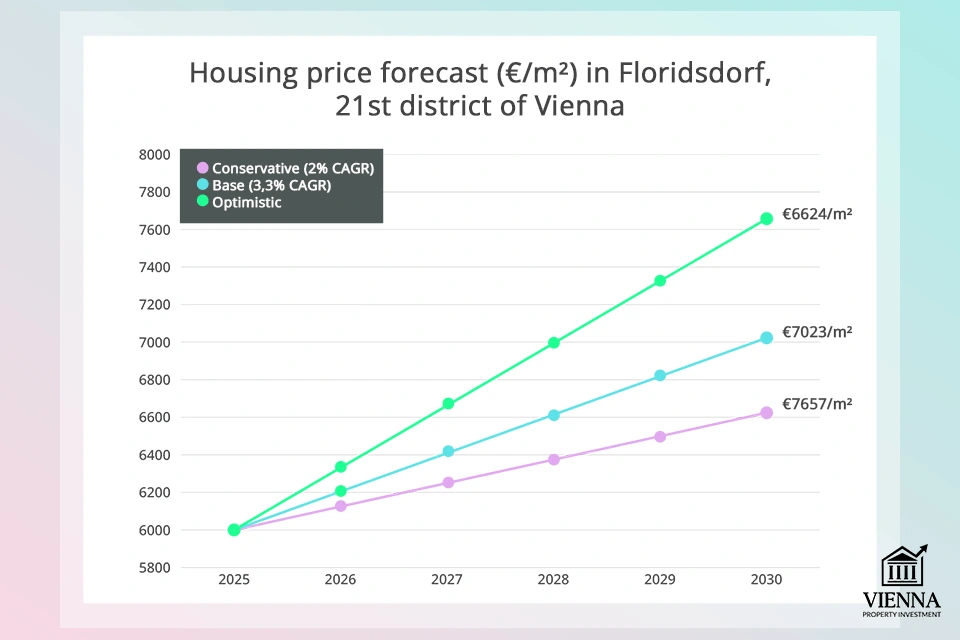
Floridsdorf is rapidly changing. Twenty years ago, it was perceived solely as a quiet working-class neighborhood. Today, new residential complexes and office centers are being built here.
Housing construction remains a key focus. Unlike the central neighborhoods, this area has ample available land for development. Therefore, modern complexes with green courtyards are springing up here. Particular attention is paid to energy efficiency. Solar panels and rainwater collection systems are being installed on new buildings. Green roofs are also becoming the norm for new homes.
along the banks of the Alte Donau , offering apartments with water views and private terraces. Family-friendly residential complexes are also being built near Leopoldau and Grossedlersdorf. They offer everything needed for comfortable family life, including playgrounds, bicycle parking, and play areas.
The city's development plans are also worth considering . The STEP 2025 plan calls for the modernization of transportation links in Floridsdorf, the development of pedestrian and bicycle routes, and the improvement of parks. These initiatives are expected to enhance the area's attractiveness for living and investment.
New office centers are being built near Floridsdorf station. Rents are more affordable here than in the city center, making the area especially convenient for startups and small businesses.
Investment attractiveness of the area
Floridsdorf stands out from other Vienna neighborhoods with its affordable prices and impressive prospects . The average home price here is lower than in prestigious areas like Döbling or Alsergrund, but the area is actively developing, and many expect real estate values to rise.
Benefits for investors:
- Stable rental demand . Thanks to excellent transportation infrastructure and numerous educational institutions, apartments in Floridsdorf are popular among students and young professionals.
- Affordable prices . The average price per square meter is around €5,800, so many people consider buying apartments here as an affordable alternative to more expensive areas.
- Construction permit . Unlike in the city center, new complexes will still be built here.
- Parks and recreational areas . Vineyards, the Danube, and parks make this area a pleasant place to live. This influences rental and real estate prices.
- Multiculturalism . This area is often home to international residents, including professionals working at UNO City and international organizations.
Floridsdorf is less prestigious than the elite neighborhoods, but it has undeniable growth potential.
Who is Floridsdorf suitable for?

Floridsdorf is impossible to sum up in just a few words. This district is too multifaceted. On the one hand, it's a major transportation hub with bustling streets and modern residential areas. On the other, it's here you'll find quiet streets, vineyards, and heurigers, where families and groups of friends gather.
This is a neighborhood where residents of old municipal buildings rub shoulders with owners of modern apartments built along the Alte Donau. Although there aren't any major festivals held here, you can still enjoy colorful local celebrations and fairs.
Thanks to such diversity, Floridsdorf can suit a variety of people. However, it does have its own unique characteristics that should be considered before deciding to move.
For families with children
Floridsdorf is one of the best neighborhoods for those looking for a quiet place to raise children. Here you'll find dozens of kindergartens and schools, including grammar schools and specialized institutions. The area is famous for its parks. You can stroll through small squares or visit the parks along the Danube. Families appreciate this neighborhood because they can walk here without worrying about their safety. Furthermore, there are many hospitals and clinics here, and housing here is cheaper than in central areas.
It's also easy to get to know your neighbors in Floridsdorf. Children go to school with neighbors, parents know each other, and entire families meet at neighborhood festivals. This creates a pleasant atmosphere of a small town within a metropolis. Unlike Vienna's most dangerous neighborhoods, Floridsdorf is a relatively safe place to live.
For students and young professionals
Young people are increasingly choosing Floridsdorf for a variety of reasons:
- Affordable rent . Living here is cheaper than in the city center or prestigious areas;
- A well-developed transport system . From Floridsdorf station, you can reach the universities in the city center ;
- A vibrant cultural scene . The area boasts numerous cafes, clubs, art spaces, and theaters.
For students and young professionals on a budget, Floridsdorf is a great opportunity to live in Vienna without feeling like you're living on the outskirts. The neighborhood is constantly changing, and its young population is a major influence on its development.
For pensioners
Floridsdorf is a quiet and green neighborhood, often chosen by seniors and not often visited by tourists. While there are no noisy nightclubs, it still has everything you need: hospitals, pharmacies, clinics, and convenient transportation. Residents can enjoy daily strolls through parks or vineyards.
Older residents especially appreciate wine taverns —they're not just places to relax, but also social gathering places where you can meet friends and neighbors. Floridsdorf is ideal for those who appreciate peace and quiet.
For investors
Floridsdorf has great investment potential . Unlike the city center, land for construction is still available for purchase here. New residential complexes built on the banks of the Danube or near Leopoldau are in high demand.
Investing in real estate in this area is attractive for several reasons:
- Low prices . Housing here is cheaper than in more prestigious areas (a square meter of real estate costs around €5,800, while in Döbling it would cost a buyer €9,000);
- Stable rental demand . The area is especially popular among students, young professionals, and couples with children;
- The area is developing , which means prices will rise;
- Natural areas and vineyards make it more attractive for long-term living.
Investors looking to the future are increasingly turning their attention to Floridsdorf. Unlike the expensive city center, this area has enormous growth potential.

The Pros of Living in Floridsdorf
- Parks and nature . Alte Donau, vineyards, Wasserpark—visit these places to create a healthy and balanced life.
- Housing affordability . Prices in this area are lower than in most upscale neighborhoods, making it attractive to both buyers and renters.
- Transportation . Floridsdorf station is one of the city's major transportation hubs. From here, you can quickly reach any district.
- Family atmosphere . The area is suitable for a relaxed family life. It's a peaceful place to raise children.
- Multiculturalism . Dozens of nationalities live in this area. You'll have the opportunity to meet people from other cultures.
- Prospects . Real estate prices are expected to rise thanks to infrastructure development and new projects.
The downsides of living in Floridsdorf
- The image of a "bedroom community ." For many Viennese, Floridsdorf remains a neighborhood "on the other side of the Danube." It is considered less prestigious than the central districts.
- Fewer attractions . Unlike the city center, there are no world-class museums or historical monuments.
- Multicultural challenges . The area is home to many immigrants, some of whom have difficulty integrating into society.
- The condition of the housing stock may vary . You'll see older municipal buildings next to new developments. This negatively impacts the neighborhood's perception.
- Distance from the city center . Although this area has a well-developed public transportation system, it will take you 20–30 minutes to reach Vienna's city center. This may be somewhat inconvenient.
Balance between city and suburb
Floridsdorf could be described as a neighborhood that exists at the intersection of two worlds. On the one hand, everyone will find what they need here: shopping centers, schools, hospitals, and transportation. On the other hand, it has a suburban atmosphere. You can live in a private house with a garden, drink wine in a Heuriger, and reach vineyards within 10 minutes.
It's precisely this duality that makes it so appealing. It's free from the bustle of the central districts, yet still offers a full taste of the delights of city life.
Floridsdorf isn't a tourist mecca, but rather ordinary Vienna. The neighborhood is perfect for those who value harmony in all things. Here you'll find affordable housing and parks, convenient transportation and corners free from the hustle and bustle of the city, a multicultural community, and a society steeped in centuries-old traditions. This is a place to raise children, enjoy retirement, build a career, or invest in your future. Therefore, for those considering where to buy an apartment in Vienna for a long-term life, Floridsdorf may be a practical and peaceful choice.
And while the central districts have their own attractions and historical symbols, Floridsdorf's main value is the atmosphere of real life .