Vienna is rightfully considered one of the largest educational centers in Europe. The city is home to leading public, technical, artistic, and private higher education institutions. Vienna's universities regularly rank high in global rankings and attract applicants from all over the world.
In this article, we've compiled useful information about Vienna's leading universities, compared them by rankings and specializations, and included practical advice for applicants.
Studying in Vienna: Why Students Choose This City
Higher education in Austria is distinguished by its high quality. This is the result of a harmonious blend of academic traditions and modern technologies. Vienna ranks first among all cities in the country in terms of student numbers. More than 190,000 students , of which approximately 30% are international .
The main reasons for the popularity of education in Vienna:
- International recognition of degrees – graduates of Viennese universities enter postgraduate studies and work all over the world.
- Affordable cost – public universities have affordable semester fees (around €380 for EU citizens and around €760 for citizens of other countries).
- Quality of life – Vienna is among the top 3 most livable cities in the world.
Because of this, many families plan ahead for where a student will live comfortably and are interested in how real estate in Vienna for long-term residence.
Student life and benefits

Prospective students in Vienna are attracted not only by educational opportunities but also by career opportunities. Universities actively collaborate with local companies, allowing students to participate in internships and dual degree programs. This is especially important for those who want to find work and stay in Europe after graduation.
Most universities, such as Webster University of Vienna, offer English-language programs . This makes the city attractive to applicants who don't yet have a perfect command of German. While studying in Vienna, they have the opportunity to improve their German among native speakers.
Students enjoy discounted public transportation
Leading universities in Vienna
| University | Base | Specialization | QS Ranking 2025 | Student satisfaction |
|---|---|---|---|---|
| University of Vienna | 1365 | Humanities, law, biology | #137 | ★★★★☆ (4.5/5) |
| TU Wien | 1815 | Technology, IT, engineering | #190 | ★★★★☆ (4.4/5) |
| MedUni Wien | 2004 (as an independent) | Medicine, pharmacology | #201 | ★★★★☆ (4.3/5) |
| WU Wien | 1898 | Economy, business | #946 | ★★★★☆ (4.7/5) |
| Akademie der bildenden Künste Wien | 1692 | Painting, architecture, sculpture, restoration | QS Art & Design #51–100 | ★★★★☆ (4.6/5) |
University of Vienna
The University of Vienna (Universität Wien ) is the oldest university in Austria. Founded in 1365 by Duke Rudolf IV, it is one of the oldest universities in Europe and the largest institution of higher education in Central Europe. Today, over 90,000 students , including approximately 25,000 international students . This makes the University of Vienna considered the country's most important educational institution and a significant international center for scientific research.
The university offers over 180 bachelor's, master's, and doctoral programs . Its core areas are:
- humanities and social sciences,
- philosophy and history,
- jurisprudence and political science,
- biology, mathematics and computer science,
- journalism, media and communications.
Research at the University of Vienna spans a wide range of fields, from cognitive science and genetics to cultural studies and digital technologies. It employs over 6,800 faculty and researchers , including Nobel laureates and world-class scientists.
The university places special emphasis on international cooperation. Vienna University of Applied Sciences is a member of the Circle U , which unites leading European universities. The university collaborates with more than 350 universities worldwide . In 2025, the university ranked 17th THE Most International Universities ranking .
Most of the faculties of the University of Vienna are located in the historic center of Vienna. The main building on the Ringstrasse was built in the 19th century. This building has become a symbol of Austria's university tradition.
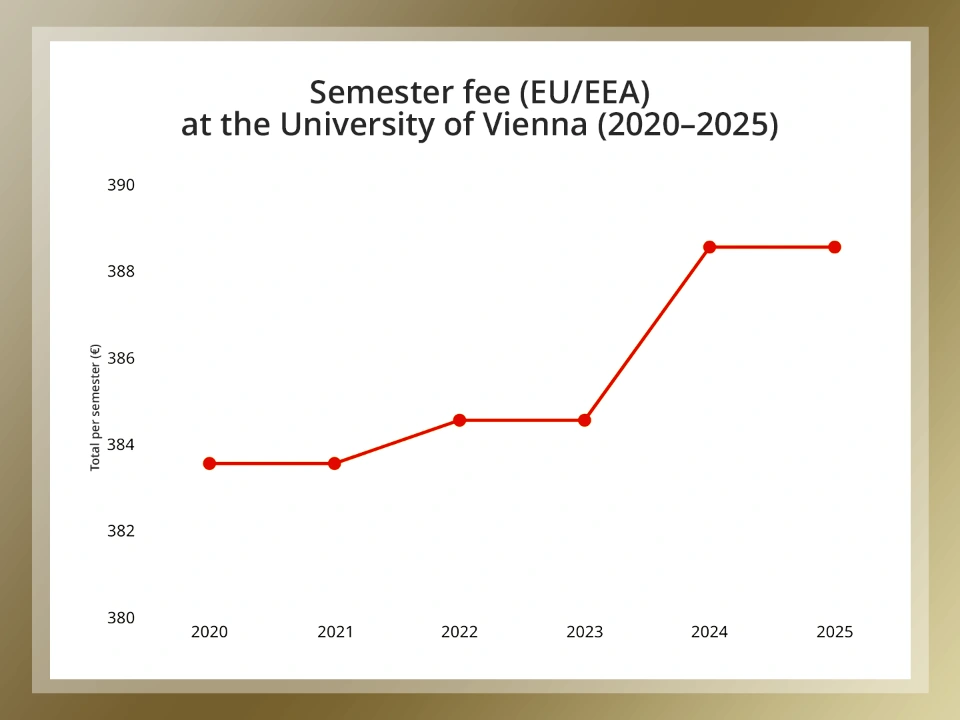
International applicants can enroll in English-taught master's programs in various fields (economics, international relations, cognitive science, and others). Tuition fees are approximately €760 per semester for students from outside the EU , which is cheaper than in many European capitals.
The University of Vienna combines academic traditions with high standards of modern education. The university offers courses in both classical philosophy and cutting-edge technology. A degree from the University of Vienna allows students to gain employment at leading companies and research centers in Europe and around the world.
Vienna University of Technology
Cost: €380/semester (EU), ~€760/semester (other countries).
Location: Karlsplatz, a central district of Vienna, close to the metro and cultural centers.
Suitable for: Those who want to build a career in engineering, specialize in IT or robotics, and work for large international corporations.
Admission requirements: High competition, especially for IT and architecture; students must have advanced mathematics skills and pass entrance tests.
The university is considered Austria's premier technical university and is ranked among the top 200 universities worldwide for engineering and IT. It has approximately 30,000 students , over 30% of whom are international.
The Technical University of Vienna has faculties in architecture and urban planning, mechanics and electronics, computer science, robotics, and quantum technologies. The university is a member of TU9 consortium , which brings together leading European technical universities. The university also regularly participates in Horizon Europe research projects.
TU Wien students work on real-world projects. The university collaborates with leading companies such as Siemens, Infineon, Bosch, and dozens of startups developing smart city projects and creating solutions using artificial intelligence technology. Applicants choose TU Wienbecause a degree from this university opens career opportunities in Austria and throughout Europe.
MedUni Wien
Cost: €380/semester (EU), ~€760/semester (other countries).
Location: The campus and clinics are located in the Alsergrund , on the grounds of Europe's largest university hospital, AKH Wien .
Suitable for: Applicants planning a career in clinical medicine, research, pharmaceuticals, and biotechnology.
Acceptance Rate: Only about 9% of applicants are accepted. Applicants take a mandatory entrance exam (MedAT), which includes tests in biology, chemistry, physics, and cognitive skills.

The Medical University of Vienna (MedUni Wien ) is the largest medical university in the country. What makes this university unique is that students begin their first year of study by completing an internship at the AKH Wien , Europe's largest university hospital.
The university has approximately 8,000 students and employs approximately 5,000 faculty and researchers . It is the leading university in Vienna offering medical programs. These programs allow students to specialize in key areas of modern medicine: oncology, neuroscience, pharmacology, molecular biology, and transplantation.
The Medical University of Vienna is highly competitive. Only about 9% of applicants are accepted. The university ranks 203rd in the US News Best Global Universities and first in Austria for medical research (Scimago). Parents often recommend this university to their children, knowing it will allow them to study medicine, gain clinical internships, and participate in innovative research.
WU Wien
Tuition: €380/semester (EU), ~€760/semester (other countries). MBA programs start at €15,000 per year.
Location: Campus in Leopoldstadt Leopoldstadt Prater ), close to the U2 metro and green areas of the city.
Suitable for: Students who want to create their own startup or build a career in international companies, consulting, finance, and business.
Admission requirements: Competitive selection for the bachelor's degree is based on average grades and results of a logic/math test; the university has a high competition for programs taught in English.

WU Wien is Europe's largest economics university, with over 23,000 students from 110 countries. The campus boasts stunning modern architecture. The university boasts business incubators, coworking spaces, and modern libraries, allowing students to immerse themselves in the corporate culture.
The Vienna University of Economics has received the prestigious Triple Crown accreditation (AACSB, EQUIS, AMBA) . Fewer than 1% of business schools worldwide hold this accreditation. The university offers English-taught programs: a Bachelor's degree in Business and Economics, a Master's degree in International Management (ranked among the top 20 globally), and an MBA.
WU Wien graduates work at McKinsey, BCG, Raiffeisen, Erste, and multinational corporations. This university is considered one of the best options for applicants seeking a successful career in international business and finance.
Academy of Fine Arts
Cost: €380/semester (EU), ~€760/semester (other countries). Materials cost €500–1500/year.
Location: Campus on Schillerplatz, in the center of Vienna, close to museums and galleries.
Suitable for: creative students—artists, architects, restorers, designers.
Entry points: competitive exams and a portfolio; only 10–15% of applicants are accepted to the most popular programs.

The Vienna Academy of Fine Arts (Akademie der bildenden Künste Wien ) is one of the most renowned art schools in Austria and one of the most prestigious universities in Vienna . Although the academy has approximately 1,500 students, it is considered a public university . The Vienna Academy of Fine Arts trains specialists in the fields of art, painting, graphics, restoration, architecture, and stage design.
Today, the Academy is popular not only among Austrians but also among foreigners. It competes for applicants with such educational institutions as the Angewandte and the MdW . However, it is the Academy that remains the symbol of the classical school and exerts a significant influence on Vienna's contemporary artistic life.
The academy offers departments of painting, graphics, sculpture, architecture, and restoration and conservation , considered one of the best in Europe. Students participate in exhibitions and projects from their first years. The best students' works are displayed at exhibitions in museums and galleries across the city.
The Academy fosters a vibrant artistic environment. Its students gain not only knowledge but also experience working on real-life art projects.
Tuition and other expenses

Studying in Vienna is considered quite affordable by European standards, especially considering the high level of universities. When planning a budget, students and their parents should consider not only the official semester fees but also the costs of accommodation, transportation, food, insurance, and course materials.
University fees
- Public universities charge modest tuition fees: around €380 per semester for EU students and ~€760 for non-EU students . This fee includes access to libraries, laboratories, gyms, and other services. By comparison, similar tuition fees in France or the Netherlands range from €2,000–3,000 per year, while in the UK, students pay €10,000–12,000.
- Private universities are significantly more expensive. Students pay between €6,000 and €15,000 per year . This often includes additional services, such as personal support, career counseling, and English-language programs. Furthermore, at universities like Webster University and other private institutions, students study in small classes.
Accommodation
- Dormitories (Studentenheime) are the most popular option. A room costs €350–500 per month . Modern campuses often have kitchens and laundry facilities. They also have gyms and study areas.
- Renting an apartment or room costs between €450 and €800 per month, depending on the district. Prices are higher in the city center, so many students rent in residential areas ( Favoriten , Donaustadt ), which are easily accessible by metro. Some parents and students, rather than renting long-term, consider buying a small apartment as part of a long-term investment strategy in Vienna .
Nutrition
- Grocery stores are cheaper than in London or Paris. Students spend around €250–350 per month .
- Lunch at the university cafeteria (Mensa) costs between €4 and €6 , making it affordable even for those on a budget.
Transport
Vienna is renowned for its modern public transportation system. Students can take advantage of a discounted travel card :
- ~€30–40 per month for unlimited travel on the metro, trams, buses, and commuter trains.
- The travel pass gives you the right to travel throughout the city without restrictions.
Medical insurance
All students are required to have health insurance.
- For EU citizens, the European Health Insurance Card (EHIC) .
- For other students, insurance costs around €65/month and covers most medical services.
Study materials and additional costs
- Books, copies, lab fees: ~€50–100/semester .
- Sports, clubs, cultural events: ~€30–60/month .
- Entertainment, cinema, concerts: ~€100–150/month .
Final budget:
On average, a student in Vienna needs €950–1,200 per month . This amount includes rent, transportation, food, and personal expenses. Parents should understand that while this level of expenses is comparable to Prague and Warsaw, the student is studying at a world-class university and living in a city ranked in the top three for quality of life.
Tip: Many international students live in dorms and work part-time. In Austria, students are allowed to work up to 20 hours a week while studying. This allows them to cover a significant portion of their expenses.
Safety in Vienna
Researchers traditionally include Vienna among the safest cities in the world (Mercer Quality of Living Ranking, Economist Intelligence Unit). This explains why so many international students come here.
What is important to know:
- Public safety. Police regularly patrol the streets of the city center and student areas. Street crime rates in the city itself are low. Statistically, Vienna has fewer crimes than Berlin, Paris, or Rome.
- Transportation. The metro and trams operate until late at night, and 24 hours a day on Fridays and Saturdays. Students have discounted travel with a travel card, which costs €30–40 per month. They frequently use transportation, even at night. Such trips are safe thanks to video surveillance and ticket control.
- Neighborhoods. Most of Vienna's neighborhoods are comfortable to live in. There are no dangerous "ghettos" or crime-ridden areas in the city. Only certain neighborhoods are considered less safe. For example, near Praterstern train station or in the Favoriten , you might encounter large groups of migrants or street parties in the evening, so caution is advised there.
- Student campuses. Universities (WU, TU, Uni Wien ) are located in areas with well-developed infrastructure and transportation systems. Campuses are guarded, and access to libraries and laboratories is possible with student cards.
- Healthcare and emergency services. Students can take out compulsory health insurance, which costs approximately €60–70 per month. It covers ambulance calls and treatment in public hospitals. Emergency services respond promptly to calls. You can call the police at 133, and an ambulance at 144.
Parents know that their child will be able to live and study in Vienna in a relatively safe environment. The most important thing for students is to observe standard safety precautions. It is not recommended to leave belongings unattended. It is also important to be careful with personal documents and avoid walking through residential areas at night.
Choosing a University in Vienna: 7 Rules
1. Don't rely solely on rankings. QS, THE, and other global rankings are important, but don't judge a university solely by them. A university may be in the top 200 but still lack the right degree program. If you want to understand whether a university is right for you, study the information on the official website, compare curricula, and read student and graduate reviews.
2. Set specific goals. If you're interested in fundamental knowledge and a scientific career, choose the University of Vienna or TU Wien . For a career in business and consulting, apply to WU Wien . For those interested in art and pursuing a creative profession, MdW or Angewandte . Having a clearly defined goal will help you choose the right university for your goals.
3. Consider the language of instruction. Most bachelor's programs at Vienna's public universities are taught in German. Master's and MBA programs are sometimes taught in English. English-language instruction is also available at private universities ( Webster, MODUL, Lauder Business School ). If you have a B2 level of German, you'll be sufficient for bachelor's programs. If your German proficiency is not yet sufficient, English-language programs may be more suitable for you.

4. Compare campuses and facilities. WU Wien is known for its futuristic campus. The university has modern libraries and coworking spaces. MedUni Wien Wien , Europe's largest hospital . This allows students to access internships from their first year. Uni Wien is located in historic buildings. Students at this university appreciate its classic university atmosphere. A campus isn't just a place to study. It's a place where you'll spend several years, so it's important that it's a good fit for you.
5. Learn more about partnership programs. A modern university offers many opportunities for students. TU Wien collaborates with Siemens, Infineon, and Bosch. Students work on research and business projects. WU Wien offers exchange programs with over 240 universities worldwide, including the London School of Economics and US universities. MedUni Wien participates in clinical research with international laboratories and pharmaceutical companies. Participation in such programs opens up a wide range of career opportunities for students.
6. Calculate your expenses. Tuition at public universities is relatively inexpensive. EU citizens pay around €380 per semester. Other students pay around €760 per semester. Private universities are more expensive (€6,000–€15,000 per year). They have smaller classes, so each student receives more personal attention.
Also, consider the cost of living. On average, students spend €950–€1,200 per month on housing, food, and transportation. Parents should plan their budget 3–4 years in advance to avoid any unpleasant surprises.
7. Talk to alumni. University brochures don't include information about potential downsides. Therefore, it's best to talk to those who studied there before you. You'll find many university reviews on Facebook and Telegram . Students are eager to share information about the difficulties they encountered during exams and talk about the quality of teaching. You can also ask them how easy it is for graduates to find work after graduation. Talking to them will help you understand whether a particular university is right for you.
Jobs and salaries after training
Studying at Vienna's universities allows students to receive a high-quality education and build successful careers in Austria and other countries. According to Eurostat , Austria is among the top 10 European countries for graduate employment rates. Many international students come to this country to obtain higher education and find employment.
Over 200 international organizations and corporations are represented in Vienna, including UNO, OPEC, OSCE, Siemens, Bosch, Raiffeisen, Erste, and PwC. With leading companies opening offices in the city, students will have the opportunity to complete internships with employers during their studies.
Average starting salaries for graduates:
| University | Main areas of employment | Average starting salary (gross/month) | Career prospects |
|---|---|---|---|
| TU Wien | IT, engineering, robotics, architecture | €3 300–3 800 | High demand at Siemens, Infineon, and GreenTech startups |
| MedUni Wien | Doctors, researchers, pharmaceuticals | €3 800–4 500 | Opportunity to work at AKH Wien, pharmaceutical companies Novartis, Boehringer Ingelheim |
| WU Wien | Business, consulting, finance, marketing | €3 200–3 700 | McKinsey, BCG, Deloitte, Raiffeisen, Erste, international corporations |
| University of Vienna | Humanities, law, education | €2 600–3 200 | Government agencies, schools, NGOs, research projects |
| Akademie der bildenden Künste Wien | Art, architecture, design, restoration | €2 200–2 800 | Career in art galleries, cultural institutions, participation in international exhibitions and projects |
TU Wien and WU Wien graduates are leaders in the labor market
Graduates of TU Wien and WU Wien quickly find employment in their fields after graduation. According to Eurostat and Statistik Austria, engineering and economics graduates are among the top five most sought-after specialists in Austria . Over 90% of graduates find employment within the first six months after graduation. This rate is significantly higher than the EU average.
TU Wien trains sought-after specialists in IT, engineering, and high technology Siemens, Infineon, Bosch, IBM, and Microsoft while still studying .
In recent years, graduates in fields such as cybersecurity and data science have become particularly in demand. Developers of smart city solutions are also quickly finding employment. Thanks to the university's close collaboration with leading companies, senior students often find employment even before defending their diplomas.

WU Wien trains specialists in finance, consulting, marketing, and international management . The Career Center, which operates at the Vienna University of Economics and Business, collaborates with Europe's largest employers, such as PwC, EY, McKinsey, BCG, Raiffeisen Bank, and Erste Group .
Students work on real business projects, and the Master's programs in International Management and Finance are ranked among the top 20 globally . WU Wien are in demand in the global labor market—many build successful careers in London, Frankfurt, Zurich, or Brussels.
Graduates of both universities start their careers earning approximately €3,200–3,500 gross per month , and after five years of work, they can expect a salary of €5,000 or more . By choosing TU Wien or WU Wien , students ensure a stable future. Studying at these universities opens up new career opportunities and prospects.
Doctors are in demand even before graduation
MedUni Wien is rightfully considered the largest center for medical education in Central Europe. At this university, students receive not only theoretical training but also daily access to practical training at AKH Wien —the largest university hospital in Europe, with over 9,000 employees and up to 100,000 patients treated annually .

This is a unique advantage of medical programs: students are exposed to real clinical cases in their first year.
Fact: According to the Österreichische Ärztekammer (Austrian Medical Chamber) , approximately 80% of MedUni Wien receive their first job offers before completing their residency . The most sought-after specialists are in oncology, surgery, general medicine, and cardiology. Austrian hospitals and private clinics actively compete for graduates, offering them paid internships and employment contracts.
Young doctors in Vienna earn between €3,800 and €4,200 gross per month during their residency. After five years of mandatory internship, doctors earn €6,000 and €7,000 gross per month.
Furthermore, MedUni Wien actively collaborates with international research projects such as Horizon Europe, the European Cancer Moonshot, and the Human Brain Project . This gives graduates the opportunity to work not only in Austria but also to become sought-after specialists in the international labor market and participate in research projects around the world.
How and when to apply to universities in Vienna
It's best to apply to Vienna universities early, as the process can take several months. If classes begin in October, applications are accepted in March or April . If classes begin in March, applications must be submitted in October or November . Registration for programs particularly popular with applicants, such as medicine or psychology, usually closes earlier. Entrance exams are held in the summer.
Documents required for admission:
- Certificate or diploma of education with a certified translation into German or English.
- Proof of eligibility to study (you must provide documents that prove that you can enroll in a higher education institution in your home country).
- Certificate of language proficiency:
- For programs in German, knowledge of the language at least at level B2 is required (TestDaF, ÖSD, Goethe),
- For programs in English, IELTS/TOEFL certificates are required.
- International passport and copies of all pages.
- Passport-size photo for a student card.
- A motivation letter and CV (for many Master's and MBA programs this is a mandatory requirement).
- Financial statements (D visa): a bank statement confirming sufficient funds to cover living expenses in Austria. Students will need at least €12,000 per year.
Budgets at Vienna Universities: Is It Possible to Get In?
The Austrian education system does not offer the state-funded form of education common in Russia or Ukraine. However, applicants can expect preferential terms :
- Citizens of the EU/EEA and Switzerland can study at public universities in Vienna (University of Vienna, TU Wien , MedUni Wien , WU Wien ) for a small fee. They pay approximately €380 per semester. If they complete the curriculum, complete their studies within the standard timeframe, and take two additional semesters, they do not have to pay tuition fees.
- Students from outside the EU are required to pay tuition fees, around €760 per semester . This is significantly less than in the UK or US, so many choose Austria to receive a quality education.
- Those planning to study at private universities in Vienna (Webster, Lauder Business School, MODUL University) should be prepared to pay between €6,000 and €15,000 per year . These institutions do not offer state-funded places.
- At universities specializing in creative arts (Akademie der bildenden Künste Wien , Angewandte, MdW), the rules are the same as at state universities: students from EU countries study at reduced prices, while others pay €760 per semester.
Useful resources for applicants
You'll need plenty of time to thoroughly prepare for admission to Vienna's universities. To avoid common mistakes and collect your documents on time, please review the information published on the official websites . It is updated every semester.
- Study in Austria is the definitive resource for international students, explaining every step of the application process in detail. Learn about application deadlines and find descriptions of available scholarship programs.
- City of Vienna – Education & Research – Explore statistics and information about student life in Vienna. You'll find out how many students study in the city and see a list of support programs.
- OEAD – Austrian Agency for Education and Internationalisation – is the website of the Austrian agency that deals with grants, exchange programs, and visa support issues.
- Official websites of universities (Uni Wien , TU Wien , WU, MedUni, Akademie der bildenden Künste) - these resources publish exact application dates, forms to fill out, and admission requirements.
Tip : Start preparing your documents at least 6-8 months before admission . This will give you enough time to translate and certify your documents, obtain language certificates, and apply for a visa or residence permit. Many applicants start preparing their documents too late and miss deadlines, which results in them losing an entire academic year.
To ensure you're on time, use this checklist: you'll need to check the application deadline, take a language test (Goethe, IELTS/TOEFL), translate your school certificate, prepare proof of income (approximately €12,000/year), book accommodation, and pay for your first semester. This approach to preparation will help you avoid any unpleasant surprises and secure admission to a university in Vienna.