Security has become one of the most important issues when choosing a country to live, work, or invest in long-term. In a world where geopolitical conditions are rapidly changing, many want to know which country is the safest and which countries consistently rank among the world's safest.
According to updated international indices, the top 10 safest countries in the world include Iceland, Switzerland, Denmark, Ireland, Austria, Liechtenstein, Norway, Finland, Portugal, and New Zealand. These countries are characterized by low crime rates, strong public institutions, high quality of life, and sustainable policies.
In this article, we'll explore why these countries are considered the safest, what's changed this year, and what factors determine modern country safety rankings.
Top safest countries in the world
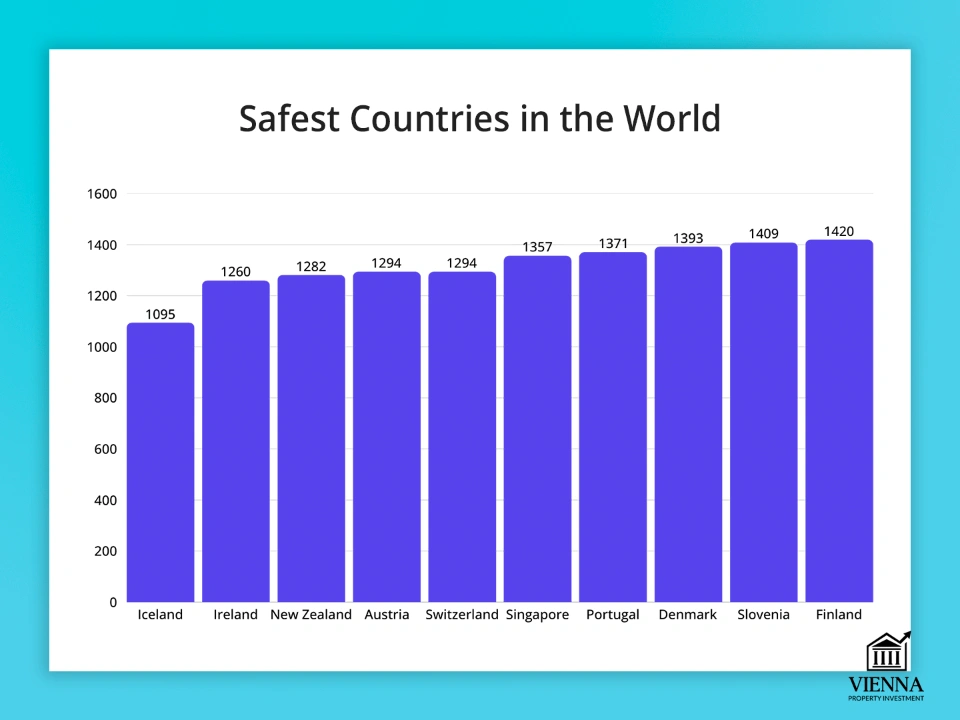
1. Iceland is the safest country in the world
Iceland has maintained its leadership position for over a decade thanks to its unique social model, where the level of trust between citizens and the government remains among the highest in the world. Serious crime is virtually nonexistent, the police are unarmed, and residents actively participate in local initiatives. The country's small size and political stability help maintain calm even during global crises.
2. Switzerland – stability that is bought
Switzerland has once again strengthened its position thanks to its strict legislation, high level of economic security, and traditional neutrality. This year, EU countries noted growing interest in the Swiss model of digital protection for citizens and businesses. It maintains very low crime rates, and its system of banking supervision and financial transparency has become a benchmark for other countries.
3. Denmark – Security of Life and Data
Denmark ranks among the top three thanks to its strong social policies and high-quality urban infrastructure. Copenhagen once again ranked among the safest cities in the world according to The Economist. The country invests in digital security, crime reduction programs in major cities, and maintains a high level of trust between the state and society.
4. Ireland is the new leader of the EU
Ireland unexpectedly strengthened its ranking this year. The German and Austrian press emphasizes the low level of violent crime, the resilience of the economy, and growing trust in the banking system. Ireland is actively implementing European cybersecurity standards and improving social support, making it one of the most secure countries in the European Union.
Austria and Liechtenstein are joint 5th.
Austria entered the top 10 safest countries in the world and shared fifth place with Liechtenstein, one of the most stable and least crime-ridden countries in Europe.
According to ORF , Kurier, Der Standard, and the WCR 2025 report, Austria remains a country with a very low rate of serious crime—approximately 0.7 cases per 100,000 inhabitants, significantly below the EU average. Thanks to its historical neutrality, the country does not participate in international conflicts, and its army focuses on internal defense and emergency response.
Austria's economy is showing steady growth, unemployment remains among the lowest in Europe, and the police employ a preventative approach, significantly reducing the likelihood of street crime. Vienna, Graz, Linz, and Salzburg are consistently ranked among the most comfortable cities in the world, confirming their high level of safety and quality of life.
The Austrian press regularly emphasizes:
"Austria remains a country where you can walk safely at night in almost any area."
Liechtenstein shares 5th place thanks to its near-zero violent crime rate, economic stability, and very high level of personal protection for its citizens.
Countries that lost ground

Despite growing global awareness of security, a number of major countries saw their positions in international rankings significantly decline in 2025. Experts emphasize that economic strength no longer guarantees stability: internal conflicts, social pressure, and political uncertainty have become key factors behind this decline.
USA – 64th place
The United States continues to lose ground due to rising domestic protests, political polarization, and increased violent crime in major cities. The American press notes widening regional disparities: some states are seeing a decline in crime, while others are facing record police strain.
Additionally, the rise in cybercrime is mentioned, which affects the overall security assessment.
Canada - 49th place
Previously, Canada consistently ranked near the top of the rankings, but in 2025, the country dropped its ranking due to an increase in violent crimes in Vancouver, Toronto, and Montreal. Canadian analysts attribute this to the rising cost of living, the affordable housing crisis, and pressure on social services.
Nevertheless, the overall level of safety remains relatively high, but is no longer as indisputable as it was several years ago.
India - 96th place
India faces an overburdened judicial system, protracted territorial conflicts, and a wide range of social problems. German and Austrian media highlight regional instability and challenges in ensuring women's safety. These factors continue to significantly impact the country's rankings in global indices.
China — 112th place
China's decline is linked to the secrecy of government data, restrictions on civil liberties, and increasing control over society. Despite low levels of domestic crime, international indices also consider information transparency, digital risks, and public trust in the government—all of which China performs poorly on.
Germany's fall below 15th place is the biggest European change
Germany has traditionally been considered one of the safest countries in Europe, but in 2025 the country fell below 15th place for the first time in eight years.
German sources (Spiegel, Zeit, Tagesschau) indicate several reasons:
- increasing migration burden on large cities;
- an increase in the number of street crimes, especially in large cities (Berlin, Hamburg, Frankfurt);
- growing political tensions and protest movements;
- declining trust in the police in some federal states.
It's important to note that Germany remains a safe country by European standards, but is no longer among the elite group of countries with minimal risks. Experts emphasize that in the coming years, Germany will implement reforms aimed at strengthening internal security and modernizing its police services.
Comparative table of country safety
To objectively assess why some countries rank among the world's safest while others fall down the rankings, it's important to compare key indicators: crime rates, political stability, quality of life, and the Global Peace . Below is a summary table of the countries that will occupy the top positions in 2025.
| Country | Place in the 2025 safety ranking | Crime rate | Political stability | Peacefulness Index (GPI) | Key safety factors |
|---|---|---|---|---|---|
| Iceland | 1 | Very low | High | №1 | Social cohesion, absence of armed conflicts |
| Switzerland | 2 | Very low | Very high | Top 10 | Neutrality, strict laws, financial protection |
| Denmark | 3 | Short | High | Top 20 | Reliable digital infrastructure, trust in the police |
| Ireland | 4 | Short | High | Top 15 | Social well-being, economic sustainability |
| Austria | 5 | Very low | Very high | Top 5 | Neutrality, low level of serious crime |
| Liechtenstein | 5 | Almost zero | Very high | Top 10 | Small size, strict law enforcement |
| Norway | 7 | Short | Very high | Top 15 | Social programs, high standard of living |
| Finland | 8 | Short | Very high | Top 15 | Low corruption, transparency of public administration |
| Portugal | 9 | Short | High | Top 10 | Tourist safety, soft crime environment |
| New Zealand | 10 | Short | High | Top 5 | Isolation, developed institutions |
These data demonstrate that in 2025, the leading countries will be those with the most predictable domestic situation, a stable economy, and a developed social system. Austria and Liechtenstein rightfully rank fifth thanks to a combination of low crime, neutrality, and high trust in public institutions.
Why security is becoming the main criterion for choosing a country

Experts note that security has effectively become the new "currency of trust," more important than rapid economic performance and income levels. The world is experiencing geopolitical changes, rising inflation, digital threats, and instability in certain regions—all of which make personal and family security a key factor influencing the decisions of individuals and investors.
People choose countries where:
- you can live peacefully and walk in the evening without feeling afraid;
- children receive a stable future thanks to quality education and predictable social policies;
- the state acts consistently and does not change the rules of the game every few years;
- the police are trustworthy and work proactively rather than reactively;
- there is no risk of forced mobilization and participation in international conflicts;
- low levels of corruption reduce everyday and administrative risks;
- the society is socially stable and not subject to sharp internal upheavals.
The new trend of 2025 is "protective migration"
One of the most notable global trends has become so-called "protective migration." Analysts from Europe, the US, and Asia note that high-income individuals are increasingly deciding to move not for tax advantages, but for predictability and personal security. Even countries with traditionally high taxes—Switzerland, Denmark, and Austria—are proving more attractive than countries with lower financial burdens but higher crime risks and political uncertainty.
According to the updated World Citizenship Report, security has become the top criterion for investors and families choosing a new place to live. Quiet, neutral European countries are preferred, where government institutions operate stably and legislation is not subject to sudden changes. Interest in countries such as Austria, Switzerland, Iceland, and Ireland has grown significantly: the number of requests for relocation and residence permits has increased by an average of 14-22% over the past year.
-
Experts emphasize that a new migration logic is emerging: people are seeking not to maximize income, but to minimize risks. And the main asset is no longer a tax break, but a guarantee of a peaceful and secure life for many years to come.
How security affects life and the real estate market

Safety directly determines the quality of life in a country. When crime rates are low, people feel more confident in everyday situations: they can take evening walks, use public transportation, and safely send their children to school and activities. This atmosphere creates a sense of stability that economic growth or high incomes cannot provide.
Economic influence
A stable domestic environment attracts international companies—they value opening offices in regions free of political upheaval, social pressure, and sudden legislative changes. Businesses need predictability, and safe countries provide just that. This accelerates technological development, fosters innovation, and creates new jobs, enhancing the economic security effect.
Real estate market
According to Austrian and German analytical portals, apartments and houses in safe countries appreciate in value faster than in countries with higher crime rates. Even if the global economy slows, the real estate market in Austria, Switzerland, and Denmark remains resilient. Families and investors perceive housing as a long-term refuge—a place where they can live peacefully and pass on their assets to their children.
In such countries, not only do prices grow more steadily, but the liquidity of properties is also higher: real estate sells faster, and rentals remain in demand all year round.

Impact on the social environment
Security fosters a high level of trust between people and the state. When citizens have confidence in the police, the judicial system, and the transparency of institutions, social tensions decrease. Streets become cleaner, neighborhoods are better organized, and the quality of services improves.
It's a vicious cycle: the safer a country is, the more actively its society develops infrastructure, education, and services, and vice versa—the stronger the social base, the lower the crime rate.
Countries with the best ecology in Europe
Europe has traditionally held a leading position in environmental quality, and this situation remains unchanged in 2025. According to a study by researchers at the University of Celje, who assessed the environmental status of 180 countries across 58 different indicators—from air quality and emissions to biodiversity and the sustainability of natural systems—European countries formed the group of global leaders.
Estonia stands out as one of the cleanest countries in Europe. It has some of the lowest levels of methane and CO₂ emissions, and its waste management system is regulated at the state level and considered one of the most efficient. Scientists predict that by 2050, Estonia will be completely zero emissions—along with the UK, Finland, and Greece.
Luxembourg demonstrates an excellent balance between technological development and environmental stewardship. Its air and rivers remain exceptionally clean thanks to a rigorous wastewater treatment system and the active implementation of renewable energy sources. The country has placed a strong emphasis on eco-friendly mobility: public transportation is free, and car ownership has been reduced by electric and hybrid vehicles.
Germany is also among the world's greenest countries thanks to its high water quality standards and strict environmental regulations. Tap water undergoes multi-stage filtration and meets the highest European standards, making it safe to drink without additional treatment. Furthermore, Germans actively support local farms, choosing products produced in environmentally friendly regions and without excessive processing.
-
These countries demonstrate that environmental well-being is not only a natural resource, but also the result of sound government policy, technological solutions, and citizens' conscious attitudes toward the environment.
Countries with low crime rates
According to the latest data from Numbeo , the lowest crime rates are found in a number of European and Asian countries. These countries combine strict laws, a well-developed legal system, and a high level of social trust. Meanwhile, regions of South America and Southern Africa traditionally exhibit higher crime rates.

Andorra
Andorra consistently ranks among global safety rankings thanks to its strict monitoring system and the near-total absence of serious crime. The country has a population of approximately 85,000, and its prison population is less than 60, a figure considered a record low by European standards.
Police patrol the streets 24/7, and traffic violations carry hefty fines, helping to maintain order. Geography is another factor: Andorra can only be reached via Spain or France, so border control is particularly rigorous.
age of 84 in 2024–2025 , reflecting its high level of healthcare and environmental sustainability.
The country issues golden visas to investors willing to invest at least €600,000 , and residence permit holders can obtain UK, US, and Schengen visas significantly faster than in most other countries.
UAE
The United Arab Emirates is considered one of the safest countries in the Middle East. Safety is ensured by a combination of strict laws, video surveillance in public places, and a clear system of penalties.
Even minor violations, including foul language or drinking alcohol in unauthorized places, are recorded by smart cameras, and fines and penalties help maintain a virtually zero level of street crime.
Qatar
Qatar has a strict criminal code, including harsh penalties for drug offenses, violence, and serious misdemeanors. The death penalty is still used, although rarely. Sharia law is one source of law, but its application to foreigners is limited.
A strict system of control ensures one of the lowest crime rates in the world, both domestic and organized.
The safest countries for women
| Place | Country | Features of gender safety |
|---|---|---|
| 1 | Denmark | High sense of security, minimal level of violence |
| 2 | Switzerland | One of the lowest rates of crimes against women |
| 3 | Sweden | High employment of women, low discrimination |
| 4 | Finland | Strong social system, gender equality |
| 5 | Luxembourg | Safe cities, quality infrastructure |
| 6 | Iceland | High level of trust and social support |
| 7 | Norway | Advanced women's rights protection policy |
| 8 | Austria | Low levels of violence, high-quality public services |
| 9 | Netherlands | Stable social environment, equal career opportunities |
| 10 | New Zealand | High legal protection and low level of street danger |
Women's security is an important indicator taken into account by international stability indices. Scandinavian countries traditionally hold leading positions: women there tend to feel more secure, face less discrimination, and have high levels of participation in public and economic life.
In Denmark, Sweden, and Switzerland, more than 75% of women report feeling comfortable navigating the city even late at night. By comparison, in Russia this figure is around 50% .
In addition, Switzerland has one of the lowest rates of violence against women – about 2% , while Denmark has about 3% .
Sweden also has one of the highest female employment rates in Europe – around 80% – reflecting strong gender security, equal access to jobs and high levels of social support.
Where to move with the whole family

When choosing a new country, families most often consider stability, crime rates, the environment, attitudes toward foreigners, and accessible pathways to residency. Below are the countries that were considered the most attractive for family relocation in 2025.
Portugal – a quiet life by the ocean
Portugal remains one of the most comfortable options for family relocation. Russian expats note the friendliness of the locals, the mild climate, and the country's lack of involvement in international conflicts.
For those planning to live on passive income, there's the D7 visa program: renting a place to live and earning a stable income allows you to become a resident and move to the Atlantic with your entire family.
Austria – safety and high standard of living
Austria combines a peaceful policy, a green environment, and one of the lowest crime rates in Europe. Prevention plays a key role: the country's Ministry of the Interior actively informs citizens about fraudulent schemes and ways to protect themselves, helping to maintain a high level of security.
Families often obtain residence permits through the Financially Independent Persons by renting housing and proving income.
New Zealand is a friendly and peaceful country
New Zealand ranks highly in global safety indices. It has low levels of violence, stable relations with neighboring countries, and a welcoming attitude toward foreigners.
Tourism is an important part of the economy, so visitors are welcomed. The country is suitable for families who value nature, safety, and a quiet, relaxed lifestyle.
Canada - Multiculturalism and Easy Adaptation
Canada is considered one of the safest and most comfortable countries for relocating with family. The local society is multicultural, making it easy for foreigners to integrate.
Many Russians choose a startup visa , which allows them to create a business and obtain permanent residency status. Families note the high quality of healthcare, education, and overall sense of security.
Luxembourg is a small but very safe country.
Luxembourg is renowned for its high standard of living, quality education and ideal public order.
The small size of the country allows for effective security control, while natural areas—like the so-called "Switzerland of Luxembourg"—make it a great place for family outings and green tourism.
Safe cities to travel to

The American insurance company BHTP annually determines the safest cities for tourists, focusing on two factors: travelers' personal perceptions and official crime rates. This approach provides a more honest picture, as people evaluate not only statistics but also how comfortable they felt in the destination.
According to the latest ranking, cities in Hawaii, Canada, and the United Arab Emirates received the highest scores. Tourists note a complete lack of discrimination based on nationality, religion, or appearance, which is especially important when traveling with children and elderly relatives.
The UK and Iceland, in turn, stand out for their safe transport and well-thought-out infrastructure – it's calm both day and night, and public transport remains convenient and predictable.
-
And in some Asian countries, talking loudly on the street or showing excessive emotion can attract unwanted attention.
However, choosing a safe city is only half the battle. To ensure a truly relaxing trip, especially if you're traveling with children, it's important to prepare in advance.
For starters, it's worth taking out health insurance: in many countries, it's a mandatory entry requirement, but even where it's not required, it can help avoid unexpected expenses and unnecessary worries. A standard policy is sufficient to cover basic medical services, but for active travel, it's best to choose a more comprehensive option.
Another important part of preparation is familiarizing yourself with the country's culture . What's considered normal at home may be perceived differently in another country. For example, in the United Arab Emirates, during Ramadan, tourists are advised to avoid eating in public places during the day—this isn't prohibited by law, but is a matter of respect for local culture.
-
Interestingly, Venice and Sydney have remained among the top ten safest destinations for many years running, thanks to a combination of tourism, strict laws, and cultural openness.
When traveling with children, it's especially important to discuss etiquette with them in advance: where to go, what to do if you get lost, and how to react to strangers. Young children often lose interest in long excursions, so it's worth planning your route in advance: alternate museums with playgrounds, and short walks with breaks.
It's considered good practice to use special bracelets with parents' phone numbers—children see them as an accessory, and adults feel much more at ease.
Safe travel is always a combination of two factors: choosing the right destination and careful preparation. When these elements come together, a trip turns from a series of organizational tasks into an enjoyable and memorable adventure for the whole family.
Conclusion

In the world of 2025, the issue of safety is no longer just one criterion for choosing a country to travel to or live in—it has become the central point on which all other decisions depend: where to raise children, where to build a career, where to invest, and what future to create for your family.
International rankings— from the Global Peace Index to the Women, Peace and Security and Crime Index Numbeo —show that the boundaries between “comfortable life” and “risks” are becoming increasingly visible.
Some countries strengthen their positions thanks to transparent legislation, crime prevention, neutrality, and social trust, while others, on the contrary, lose points due to internal instability, protests, and the inability to adapt government systems to new challenges.
Safety isn't just the absence of crime. It's a combination of predictable laws, a stable political environment, high-quality healthcare, a clean environment, social support, and respect for people. This is why countries like Austria, Iceland, Switzerland, Denmark, and New Zealand maintain their leading positions year after year: they create conditions in which people can live peacefully, plan for the future, and feel secure in a wide range of life situations.
For families considering a move, safety is a top priority. Parents want to be sure their children will be able to safely explore the city, receive a quality education, and live in a respectful environment—free from fear, pressure, and the threat of instability.
This explains the growing popularity of residency programs in neutral, peace-loving, and environmentally friendly countries. Residency in Austria through financial independence, relocation to Portugal on a D7 visa, a startup visa in Canada, and long-term programs in Switzerland are all becoming a way not just to change countries, but to ensure predictability and peace of mind for yourself and your loved ones for many years to come.
The same applies to travel: families choose cities where public transportation is reliable, the police are trustworthy, the culture is welcoming to tourists, and the atmosphere feels safe even late at night. That's why Hawaii, Venice, Sydney, Iceland, Toronto, and cities in the UAE top the rankings: they offer not only beauty and infrastructure, but also the confidence that the trip will be a memorable one.
Ultimately, security is a new global resource, valued above tax breaks, climate benefits, or economic opportunities. It builds trust, and trust creates prosperity.
Therefore, when choosing a country for travel, temporary residence, or relocation with the entire family, it is important to take a broader view: consider political stability, attitudes toward foreigners, women's and children's safety, the environmental situation, and the extent to which the state is prepared to protect its residents.
-
Tip: Before making a final decision about moving or choosing a safe country to travel to, be sure to do some "field research." Spend at least a week in your chosen city: evaluate the neighborhoods, transportation, prices, and atmosphere, and talk to locals and expats.