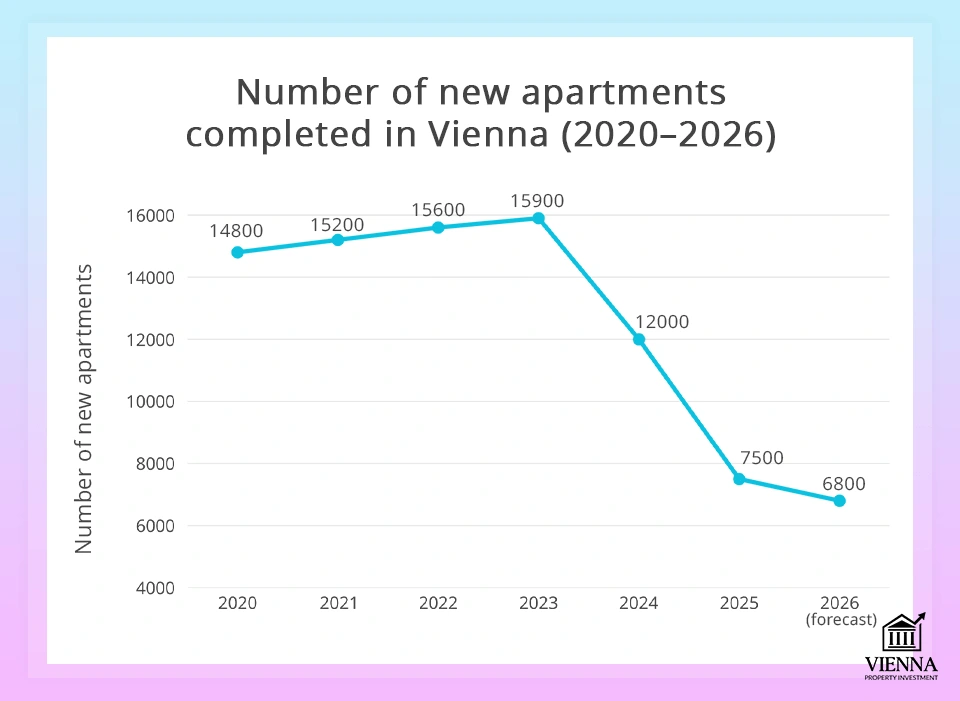
Vienna's real estate market is changing. While nearly 16,000 new apartments were delivered in the city in 2023, this figure has dropped to 12,000 by 2024, and to approximately 7,500 in 2025. A further decline in construction is predicted for 2026. This means that renovation and renovation of existing properties is becoming increasingly important.
At the same time, the city is actively investing in infrastructure. In 2024 alone, over €220 million was spent on renewing tram lines and modernizing the metro, and the program will continue in 2025–2026: dozens of kilometers of rails will be replaced, bridges and central streets will be repaired.
For future residents and investors, this is an important signal: the condition of the property and the quality of the renovation are becoming key factors when choosing real estate in Vienna .
In this article, we'll explore the most popular types of renovations in Vienna, who performs them, how much they cost, and how renovations directly impact investment attractiveness. I'll also share my personal observations and practical advice.
Renovation and construction in Vienna: what's happening on the market
To understand why renovation in Vienna has become so important, it's important to look at the big picture: the state of housing, the pace of construction, and urban projects.
Housing and Roads: Why Repairs Are Becoming a Priority
The number of new buildings in Vienna declines each year, while demand for housing remains high. This leads many investors and owners to focus on renovations and capital improvements of older buildings.
In historic districts, apartments in 19th- and 20th-century buildings are particularly in demand, but almost all of them require serious modernization: from replacing utilities to insulating facades.
The city is also investing heavily in maintaining roads and public transportation. In 2024, Wiener Linien replaced over 8.5 kilometers of tram tracks and over 50 switches, and several more key routes are planned for renovation in 2025–2026.
The Municipal Roads Department (MA 28) has allocated approximately €60 million for the repair of streets, sidewalks and bridges in 2025.

Vienna combines a dynamically developing new-build market with an active renovation segment.
The Vienna market is characterized by a large number of historic buildings, an extensive municipal housing stock (the city owns hundreds of thousands of apartments), and a tradition of comprehensive services (from major building renovations to urban infrastructure projects).
This creates a variety of work and services, as well as significant competition in the field of construction and repair services.
Repair contractors: companies and subcontractors

In Austria, renovation and construction are primarily carried out by licensed firms and certified professionals. There are several types of organizations:
General contractors (Generalunternehmer). Large companies (e.g., PORR, Strabag, Porr-König & Heinrich, etc.) that undertake turnkey construction and major renovations of buildings.
Such companies have all the necessary licenses (Baufirma or Baumeisterbetrieb – qualified construction designer), engineers and teams of various specialties.
Craft firms and artisans. These specialize in specific types of work (electrics, plumbing, carpentry, painting, windows, etc.). Each such firm must have a corresponding "Meisterbrief" or "Befähigungsnachweis" for their specific field (e.g., a certified electrician, a certified plumber).
Full-cycle (All-round-Handwerker). Private craftsmen or small firms that offer a complete "from A to Z" service (often these are small contractors who perform all major apartment improvement work).
What kind of renovations are being done in Vienna: apartments, houses, and roads
Renovations in Vienna come in a wide variety of forms, from cosmetic touch-ups in a small apartment to complete renovations of an entire building or replacing tram tracks. Let's take a closer look at the main types.
Apartment renovations: from cosmetic touches to major renovations

Austria's capital has a large number of older residential buildings (so-called "Grinderstein" buildings from the late 19th and early 20th centuries) and relatively few new buildings per capita. Therefore, apartment renovation and renovation is a highly relevant topic. The main types of renovation are:
Cosmetic renovations (Oberflächenrenovierung). The simplest type involves painting walls, replacing wallpaper and flooring, updating sockets and switches, repairing doors, and simple plumbing work. These renovations are typically done to freshen up the exterior.
The cost of cosmetic repairs for a small apartment (30–50 m²) can range from 5,000 to 15,000 euros, and the duration can range from several weeks to a month (including wall preparation and paint drying time).
Major renovation (Komplettrenovierung). This involves completely replacing utility systems (electrical, plumbing, heating), leveling walls, replacing windows, and completely remodeling or demolishing non-load-bearing partitions.
In older homes, old gas boilers are often replaced with modern combination systems or the heating system is converted from gas to electric. A major renovation is practically like a turnkey new build in a limited space. It typically takes 2-6 months and requires strict adherence to building codes.
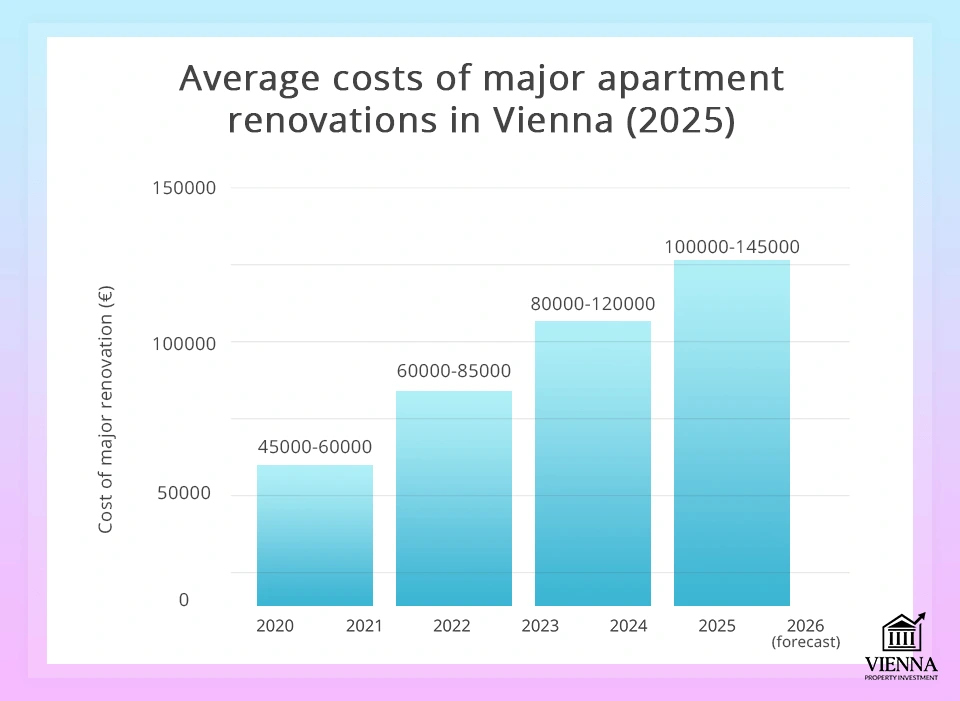
The average cost of a complete renovation of an older apartment in Vienna is €800–1,200 per square meter (or approximately €80,000–120,000 for a 100-square-meter apartment). This depends on the condition of the walls and floors, the complexity of the work, and the materials chosen.
When renovating a Viennese apartment, additional difficulties often arise:
Weather and architectural restrictions. For example, in the city center, changing the color of the façade, installing air conditioners in visible locations, etc. are prohibited. Windows in the historic center sometimes require preserving their vintage frames (spechtrat), which is more expensive.
Coordination and permits. Remodeling (e.g., combining rooms, moving a kitchen/bathroom) must be approved by the relevant authorities (DA27, MA 40). In Vienna, remodeling a living room may require paying a "green tax" or obtaining a zoning permit.
Old utilities. Many older homes still have cast iron or asbestos pipes. Replacing them can be a major, separate renovation project.
-
A practical example: One of my clients bought a 70 m² apartment in the 9th district (Alsergrund) and began renovations a month after the purchase. The walls needed plastering, the floors needed beam replacement. They also decided to completely replace the electrical system (the risers were 60 years old).
The turnkey renovation took almost four months and cost approximately €65,000 (≈€930/m²), which included the design project and a built-in kitchen. The price seemed steep to the client, but after the work was completed, she received a practically new apartment with European-style windows and a new electrical panel (which immediately increased her comfort and the market value of the property).
Typical prices and timeframes. According to the latest expert estimates, apartment renovations in Vienna will cost approximately as follows (approximately):
- Cosmetic repairs (painting, tiles, flooring) 30–50 m²: €5,000–10,000, 2–4 weeks.
- Major renovation (100 m², including replacement of kitchen/bathroom): €80,000–120,000, duration 3–6 months.
- Window replacement (unit 1 m²) – €200–400/m².
- Installation of a new door (interior) – from €500 per piece.
- Complete replacement of bathroom plumbing (complex of works): €8,000–15,000.
Renovation of private homes in Vienna

Viennese private homes (usually on the outskirts and outside the city, as well as in the suburbs and regions surrounding the city) follow a different renovation schedule: These renovations typically involve more extensive work. The main stages of a major home renovation ("Kapitalsanierung") are:
Design and permitting. This is especially important when renovating a roof, adding on new structures, or replacing supporting structures. In Austria, a permit ( Baubewilligung ) is required for most major projects. An architect or structural engineer is often hired to perform the calculations.
Demolition and rough repairs (Rohbauarbeiten). This includes dismantling old structures (removing the old roof and walls, leveling surfaces, and pouring the foundation or foundation for an extension).
Roof and Facade (Dach und Fassade). Roof repair or replacement (tiles, metal, bituminous shingles – the choice affects the cost) and façade insulation for energy savings. For example, bituminous shingles cost ~20–30 €/m², classic ceramic tiles – 10–25 €/m², copper sheets – 80–100 €/m².
Utility systems (Hausinstallation). Complete redesign of the systems: a new gas boiler or heat pump, replacement of pipes and wiring. This can cost tens of thousands of euros (installing a modern Buderus or Vaillant boiler costs €5,000–10,000, plus installation costs).
Insulation and energy efficiency (Sanierung der Gebäudehülle). This includes insulating the roof, façade, and floor, as well as replacing windows with energy-efficient ones (triple-glazed windows). Such work is often partially subsidized by the state (I'll discuss this in more detail below).
Finishing work (Innenausbau). Construction of interior partitions, installation of utilities, flooring, painting and plastering, kitchen and appliance installation.
Landscaping and final construction (Fertigstellung). Houses in the Vienna region often have private gardens: landscaping, garden paths, and parking are all included in the final stage.
Capital construction (Kapitalbau) is more than just a renovation; sometimes it's referred to as a "rénovation complète" or a complete rebuild. However, with proper planning, modern technologies can transform an old house into an energy-efficient one: completely replacing the façade, installing solar panels, and insulating the floors.

Special nuances for country houses:
Major renovations and extensions. Many buildings may require the addition of an attic or a garage; in such cases, planning decisions require approval from local housing authorities (especially if the property is privately owned, not municipally owned).
Sanitary and utility requirements. In cottage areas, there may be no central sewerage system (septic tank), so local utilities must be taken into account when planning renovations.
Financing. Renovating large homes typically costs hundreds of thousands. Many finance such projects with mortgages secured by real estate. Energy efficiency subsidies help reduce costs.
Example of home renovation stages:
| Repair stage | Description of work | Approximate cost* |
|---|---|---|
| Project and permissions | Architect, engineer, and documentation services (Papierkram) | €2–5k |
| Dismantling/rough | Demolition of old partitions, pouring/strengthening the foundation | €10–30k |
| Roof | Removing the old roof, installing a new one and insulating it | €10–40k (depending on area) |
| Facade | Plastering/insulation (10–20 cm) and new cladding | €5–15k |
| Networks (gas/electricity) | Installation of a new boiler, electrician, plumbing | €15–30k |
| Interior renovation | Alignment of walls, floors, plumbing, doors | €20–40k |
| Finishing | Finishing coatings (paint, floors, tiles) | €10–20k |
| Landscape, etc. | Roads, parking, landscaping | €5–15k |
| Total | Complete renovation of a house 150–200 m² | ~€100–200k |
*Depends on region and trim level.
As you can see, a major renovation of a private home is a large-scale and expensive undertaking. However, the investment is fully recouped with high-quality work: the home becomes energy-efficient and comfortable, easily rented out, or sold profitably.
In addition, owners often take out loans for renovations, as interest rates are currently falling, making such investments more affordable.
Road works and road repairs in Vienna
Vienna is a large metropolis with a vast network of roads, trams, and sidewalks. The city's street and road infrastructure is regularly updated:

Major street repairs. This includes removing old asphalt or cobblestone pavement, reinforcing the base, and laying new layers of asphalt or paving stones. Typically, the city completely repairs a street every 20–30 years.
Project parameters can vary: for avenues with trams (e.g., Hauptstraße, Ring), complete track replacements are also undertaken. Larger projects (bridges, overpasses) can cost tens of millions of euros.

Sidewalks and bike paths. In recent years, Vienna has been actively expanding its network of bike paths and improving pedestrian areas. These projects include replacing curbs and paving, and adding drainage systems.
For example, the " Raus aus dem Asphalt " project involves greening old squares – this is also part of street renovations (see city improvement initiatives).

Tram and subway renovation. As mentioned, Wien er Linien undertakes dozens of small and large projects annually: in 2025, they plan to replace approximately 11 km of rails and 45 switches.
Each such construction project impacts traffic, with road closures and detours occurring during the work. Residents can monitor current traffic conditions through city websites and apps (such as ARBÖ or VerkehrsInfo ).
Timelines and costs for road construction in Vienna are monitored through public contracts and tenders. All stages, from design to acceptance, are regulated by the Traffic Police (MA 37) and the road workers' union MA 28.
Projects are financed from the city budget and often partly from federal and European funds (for example, for noise protection walls or eco-projects).
Why road repairs are necessary: The most important thing is transport safety and sustainability. New pavement reduces accidents and extends the lifespan of streets. For example, Wien er Linien was able to improve tram punctuality after replacing old tracks (the investment was approved in 2024 and paid for itself with increased service reliability).
The city is also striving for sustainability: work to expand bike networks and plant greenery is linked to climate objectives (less asphalt means cooler summers).

-
Examples of large projects:
- Brigittenauer Bridge ( Brigittenau er Brücke). Since 2025, one of the main bridges across the Danube Canal (North Canal) has been undergoing phased renovation. Work began in the summer of 2025; the entire bridge will be restored by May 2026.
- Overpass to Gyurami: Hauptstraße. Large-scale rail and asphalt replacements will be carried out on Landstraßer Hauptstraße in 2024–2025.
- Streets of the city's districts. Dozens of minor repairs are carried out daily in every district of the city: manhole covers are replaced, asphalt patches are repaired (in 2022, there were more than 9,000 such "laboratory" repairs on the streets of Vienna).
In general, road works in Vienna are a continuous process, designed for an annual cycle: in the summer, asphalting is most active (the weather is favorable), and in the winter, internal city projects are carried out.
Repair and finishing services: what the market offers
To understand the options available to property owners in Vienna, it's important to consider the range of services available. Here, you'll find options for virtually any need.
From minor repairs to turnkey renovations

Vienna's renovation market offers a full range of services, from minor repairs to complete renovations and finishing touches. Key types of work and services include:
- General renovations. Painting (painting, tapestry), flooring (parquet, laminate, fleece), plastering and drywall, new wall construction.
- Plumbing (Installateur). Installation and renovation of plumbing fixtures – pipe replacement, installation of bathtubs and shower stalls, toilets, sinks, and heating installations.
- Electrical installation. Moving or adding sockets, switches, lighting, installing distribution boards, connecting household appliances.
- Heating and ventilation (Heating/Luftung). Installation and repair of boilers, radiators, and underfloor heating; modern heat pump or solar collector installations.
- Carpentry and cabinet making (Tischlerei/Schreiner). We manufacture doors, built-in cabinets, custom kitchens, staircases, and parquet flooring.
- Specialized services. Facade sealing, soundproofing, smart home system installation, balcony landscaping (grünanlage), and more.
- Finishing work (Innenausbau). Decorative interior finishing – mosaic tiling, artistic wall decoration, rare high-quality plasters (e.g., marble textured).

Almost every renovation company in Vienna offers these services either independently or through subcontractors. For major apartment renovations, the general contractor most often assembles a team of laborers and oversees all stages.
Residential and commercial property improvement services deserve special mention Large companies have departments dedicated to business clients, from offices to restaurants.
They redesign offices; Swiss law often requires workplace adaptations (for example, barriers and elevators for disabled people). In Vienna, rebranding renovations for cafes and boutiques—designer interiors—are popular.
The market also offers additional special services:
- Window and door installation. Often done on a turnkey basis, with measurements taken and glass selection included.
- Security. Installation of video surveillance, alarms, and safe doors.
- Cleaning services. After renovations, many companies offer site cleaning services.
- Transportation services. Transportation of construction materials and demolition equipment available for rent.
Thus, today's renovation in Vienna is a complex process requiring the participation of numerous specialists and companies. The main advantages are quality and responsibility: in Austria, the contractor and their insurance are responsible for any major work.
Construction companies and contractors in Vienna

Finding a reliable construction company or contractor is an important task for a homeowner. As mentioned earlier, it's best to focus on experience and reputation. Official ratings are few, but there are several guidelines:
Top Companies. The largest Viennese general contractors are PORR Bau, Strabag (an international holding with a division in Austria), König & Heinrich, Wien erberger (primarily a brick builder, but also with construction divisions), and a number of smaller firms (such as LeBe Bau, Obenauf, and Rudolf Hödl).
They most often work with large projects (high-rise buildings, offices), but some also work with luxury renovations.
Specialized companies. Some firms focus specifically on major renovations of old buildings—for example, Wohnfonds Wien partners with trusted contractors for social projects.
There are also many local family-run companies (with "Baugeschäft" in their name) with a long history and knowledge of the specifics of the Viennese market.
How to choose a reliable contractor in Vienna?

From practice, the following steps can be recommended:
Check licenses and memberships in professional associations. All construction companies and large firms must be registered with the Wirtschaftskammer (Chamber of Commerce and Industry) and hold a license for their specific activity. An additional sign of quality is membership in the Baumeisterinnung (Union of Construction Masters).
Use trusted channels. For example, Wirtschaftskammer Wien maintains lists of registered construction companies. Professional websites and directories (competition is difficult to find in independent directories; for example, active companies are usually listed on the official portal zurzbauen.at)
Read reviews and ask questions. On German-language forums, such as Houzz people post examples of their renovations. Word-of-mouth recommendations are a valuable resource. For example, residents recommend contractors who respond quickly to comments and meet deadlines.
Check their portfolio. Visiting the contractor's completed projects (with their consent) will give you a better idea of the quality. Some companies produce video reports of their work.
Compare estimates. Order 2-3 independent estimates. If the discrepancies are significant, find out the reason. Sometimes a cheaper contractor cuts corners on materials or timelines. It's best when several related companies (epoxy, tile, painter) work together in a coordinated manner.
The contract covers risks. Include clear terms in the contract: a payment schedule for project milestones, penalties for missed deadlines, and a warranty clause (in Austria, construction work is guaranteed for up to three years, with an inspection after one year).
Local considerations. Many renovations in apartment buildings require a building permit (Hausverwaltung) and approval from the relevant authorities (for example, when changing the façade, a "positive Begutachtung" is required). A reputable contractor will help you complete all the necessary paperwork.
Vienna doesn't welcome illegal "guest workers": most reputable apartment and home owners require official registration. Furthermore, projects in older buildings often require consultation with architects and zoning (for example, to avoid damaging the historic façade).
Quality certificates are crucial : an electrician should have an Elektromeister, a gas fitter should have an Installateurbefähigung, and builders should have a Baumeisterprüfung or Gewerbeschein. Make sure the contractor is familiar with local regulations (city authorities MA37 require strict compliance).

The main recommendation: don't chase the lowest price, but rather seek a balance between price, deadlines, and the contractor's reliability.
In general, a professional company is more expensive but more reliable. Local private contractors usually charge less but offer no guarantees. They may have "wooden windows" made "by eye," while larger companies work with trusted suppliers (euro doors, certified pipes).
When I recommend that clients hire professional construction companies in Vienna, I explain that this guarantees that the renovation will meet all standards. For example, only a licensed electrician knows how to safely install wiring in an old house.
Finally, recommended companies: although there are no established "official" ratings, experience shows that it's common to trust companies with a good reputation. These include:
- PORR Bau GmbH is one of the leaders in the Austrian construction market (projects ranging from infrastructure to residential areas).
- König & Heinrich is a large Viennese company that builds and renovates houses, offices, and has experience in multi-apartment construction.
- Wohnfonds Wien (which finances projects through procurement) is not a contractor itself, but works closely with reputable companies to modernize Vienna's dormitories.
For minor repairs, you can turn to renowned Viennese artisans: for example, the firms "Allround Handwerker Wien" (all types of work) or "Malermeister Wien" (painting work) - they often provide guarantees for work of up to 3 years.
How much does renovation cost in Vienna: benchmarks and examples

Renovation costs in Austria are always a concern for those planning projects. While they are higher in Vienna than in neighboring countries, the quality of services is traditionally very high.
What does the cost depend on?
The cost of repairs in Vienna depends on many factors:
The scope and complexity of the work. The more square meters and the more stages (dismantling, remodeling, utility work), the more expensive it is. Repairing a "warm light bulb" in a room is much cheaper than renovating the entire apartment.
Material quality. Prices vary depending on the brand and type of materials. For example, budget ceramic tiles cost €15–30/m², while designer tiles cost €60–100/m². Classic Austrian oak parquet can cost €80–150/m². The more expensive the materials (windows, radiators, plumbing), the higher the final estimate.
Property location. Work in central areas ( Innere Stadt , Josefstadt ) may be more expensive due to the increased risk of damage to the historic core, exterior requirements, and permitting requirements. In the outskirts or suburbs ( Favoriten , Donaustadt , Niederösterreich), prices for the same work are often 10-20% lower.
Choosing a contractor. Large companies charge more due to their reliability and warranties, but sometimes charge lower prices for materials (bulk purchases). Private contractors may offer lower prices for the work, but without a formal contract or warranty.
Current market conditions. Construction costs in 2025 are higher than in 2020–2021 due to inflation and rising energy and material prices. Construction materials in Austria have increased in price by 5–10% over the past three years. The rise in steel and timber prices is particularly noticeable (due to global economic conditions).
On average, labor costs for specialists in Vienna are relatively high: the average rate for a skilled worker (excluding materials) ranges from €30 to €60 per hour (depending on the profession: an electrician can charge more than a painter). This means that installing one door (two hours of work) costs at least €100–150 per hour, excluding the door itself.
Approximate breakdown of prices for popular types of repairs
Below are average indicative prices to help you estimate how much renovations might cost in Vienna:

Cosmetic renovation of an apartment (30–50 m²):
- Wall painting: €8–15/m² (including primer and two coats of paint).
- Laminate or parquet: €30–50/m² (material + installation).
- Tiles (kitchen/bathroom): €25–40/m² (plus grout).
Total: approximately €5,000–10,000 for the entire renovation (labor plus materials). Example: painting two rooms and replacing the floor in a small apartment – €6,000; plastering and wallpapering – €3,000.

Major apartment renovation (80–100 m²):
- Electricity: €100–150 per point (socket/light), plus €150–300 for the distribution board and automation.
- Plumbing: replacing pipes on a 7–12 m riser – up to €3,000, installing a new bath/shower – €1,500–3,000, toilet – €500–1,000.
- Kitchen: body and facades – €3,000–8,000 (IKEA style or order from Schreiner).
- Demolition and hidden work: ~€10–15k (costs for construction waste, short-term contractors).
In total, a complete turnkey renovation of a 100 m² mid-range apartment can cost €80,000–120,000. This includes labor, materials, and furniture. Including the design project can add another €2,000–5,000.

Major renovation of a private home (150–200 m²). Costs vary depending on the extent of the renovation, but typically range from €150,000 to €300,000 (turnkey). For example, a major renovation of a 150 m² house, including roof replacement, façade insulation, and complete utility system replacement, often costs around €200,000–250,000. Without "luxury" elements (advanced panels, designer finishes), the cost starts at €150,000.
Road and street repairs:
- Asphalting 1 km of a city street (two-lane with complete renewal of the base) - approximately €1–2 million.
- Laying a sidewalk (1,000 m²) – €50–100 thousand (depending on the type of tile).
- Replacement of tram tracks (1 km) – approximately €3–5 million (including foundation preparation and electrical work).
- Repairing a small section of a street (up to 100 m long) costs tens of thousands of euros.
These figures are guidelines. The final project price may vary in all cases. When calculating the estimate, it's important to obtain a detailed breakdown from the contractors: separate estimates for rough work, finishing, waste removal costs, and commission fees (for example, for small jobs, renovators often keep the remaining materials for themselves).
Renovation and Investment: How Upgrades Affect Real Estate
For investors, renovations aren't just about comfort, they're also about money. Properly executed renovations can significantly increase the value of a property and speed up its rental potential.
Why renovations are beneficial for investors
When it comes to investing in Viennese real estate , renovation is one of the key factors: it influences the sale price, rental speed, and rental rates. Here's why:
Rising property values. After a quality renovation, home prices typically increase significantly.
In my experience, a renovated apartment in Vienna (with a new kitchen and bathroom) can be worth 10-20% more than the original price. For example, by investing €20,000 in a major renovation, the owner can increase the apartment's market value by €30-40,000.
Increasing rental attractiveness. Young renters and families are willing to pay more for modern housing without hassles like electricity, heating, and plumbing. Renovated apartments with energy-efficient windows attract long-term renters.

In Austria, energy efficiency is also important: apartments with a “green passport” (Ecopassport) can be rented for 5–10% more.
Accelerated payback. If the goal is rental, renovations reduce downtime (the property sits vacant for less time waiting for a tenant) and increase the monthly rental rate. Furthermore, renovations reduce operating costs (efficient heating), which is beneficial for the owner.
Meeting housing requirements. Vienna is actively updating building codes (for example, mandatory wall insulation and the installation of meters). Investors who renovate according to the new standards avoid the need for urgent renovations and receive housing "with room to grow."
Clients often ask me: is it worth buying a “freshly painted” apartment or one that still needs to be done?
What to consider when renovating for a move

For those planning a move to Vienna and looking for housing, renovation is an important issue:
Plan ahead. If you're moving from another country, it's best to consider in advance whether you'll be renovating after purchasing or renting. I recommend timing your move to at least a month before you're ready to move into your final apartment.
For example, if you rent an apartment "under renovation," agree with the landlord that you will move into the already renovated apartment in X months.
Legal aspects. Unlike some CIS countries, in Austria, rental agreements are typically concluded unfurnished ("unmöbliert"). Landlords rarely pay for repairs; in long-term leases, this is more the tenant's responsibility (and a clause regarding "koenergie"—annual accident insurance—is often included in the contract).
Mortgages and loans. When purchasing an apartment for renovation, keep in mind that the bank will issue a loan secured by the "completed home."
Therefore, purchasing a one-room apartment with bare walls may require a larger down payment or force you to use a mortgage loan for the purchase and renovation (in Austria, banks are quite lenient on loan terms for renovations, seeing the increase in the cost of housing after the work).
Many of my clients moving to Vienna have noted: “It’s important to have parking and know exactly where and how construction materials are stored – we’ve encountered several instances of equipment being late due to a lack of parking near the building.”
Small everyday details, such as the operation of the elevator during a move or residents of other apartments, should also be taken into account.
The Viennese market is tightly regulated, but with the right approach, renovations can be completed quickly: in my experience, proper planning (step-by-step processes, purchasing materials in advance) allows a 50 m² apartment to be completed in 2-3 months after a major renovation.
The key is to work with an experienced project coordinator (this could be an architect or a contractor manager). Then, when you move in, you'll have a ready-made, comfortable home, not a "half-renovated" one.
Conclusion

To sum it up: renovating in Vienna is a challenging, but entirely doable, task. Despite the high cost and bureaucratic complications, everything you need is available here: qualified craftsmen, modern materials, and government support.
Repairs should often begin and end the year, taking into account seasonal factors (simple cosmetic work in winter, asphalt paving and roofing in summer).
Advice for readers: approach renovations prepared. When buying or renting a home, inquire about the condition of the walls, windows, and utilities. Budget at least 10-20% for "unforeseen expenses" (old wood or mold often crops up during major home renovations).
From the very beginning, choose reputable contractors (preferably through recommendations rather than off the cuff) and sign a contract. If necessary, take advantage of subsidies—the state and city help reduce energy efficiency costs.
This way, you'll not only ensure reliability and convenience, but also make a profitable investment in your future capital. And remember: renovations are an investment in your quality of life in a new country.