Austria is traditionally among the most attractive countries for real estate purchases thanks to its stable economy, high quality of life, and picturesque natural surroundings. Real estate in Austria is often viewed as a sustainable and long-term asset. You can purchase land in the mountains or by lakes—or, for example, in a quiet village with clean air and well-developed social infrastructure.
Investors value Austria as a reliable haven for their capital and a source of long-term land appreciation. However, purchasing a property abroad requires careful preparation: it's important to consider legal nuances and local specifics before signing the contract.
In this article, we'll cover everything from land types to property registration, so you know what to expect when buying land in Austria.
Buying land abroad is not an easy task, so I approach each client individually, determining the purchase goals and potential risks. Austria offers a wide variety of land plots, so I always recommend carefully analyzing them before deciding which plot to buy in Austria.
Types of land in Austria: from construction sites to forests
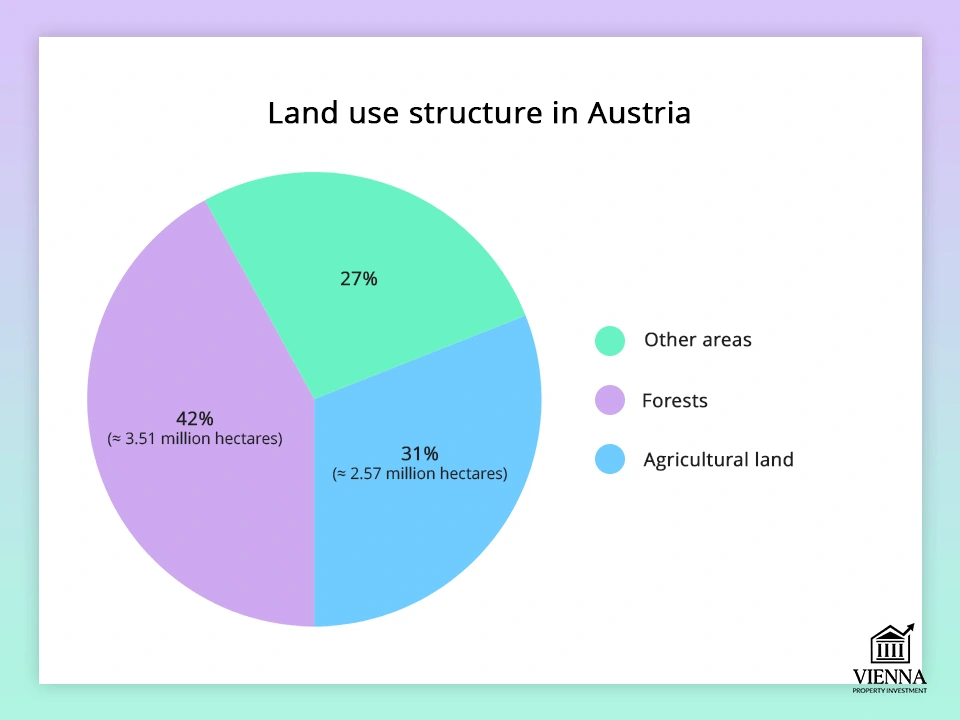
Austria's lands are quite diverse. According to Statistik Austria , the country's total area is approximately 8.36 million hectares, of which over 3.50 million hectares are forested and approximately 2.57 million hectares are agricultural land.
This means that forests cover almost 42% of the country's territory, and arable land accounts for about 31%. The rest is made up of mountains, water bodies, cities, and infrastructure. If you decide to buy land in Austria, the most important thing is to determine its intended use.
Construction sites (Bauland)

These are Austrian lands designated for residential or commercial construction. Before purchasing, they must be checked against zoning plans: each municipality has a Flächenwidmungsplan and Bebauungsplan, which indicate whether construction is permitted on a particular plot and the regulations governing it.
If a plot is located in a free-use zone (Freiland), it must be rezoned before construction can begin, which is the responsibility of the local administration. Therefore, the first step when choosing a plot in Austria is to obtain information on zoning plans, which can usually be done directly from the municipality or on its website.
Agricultural land

These include arable land (Ackerland), meadows and pastures (Grünland), and vineyards/garden plots (Dauerkulturen). Such investments in Austrian land are generally cheaper, but these plots can only be used strictly for their intended purpose: without special permits, they cannot be converted for construction.
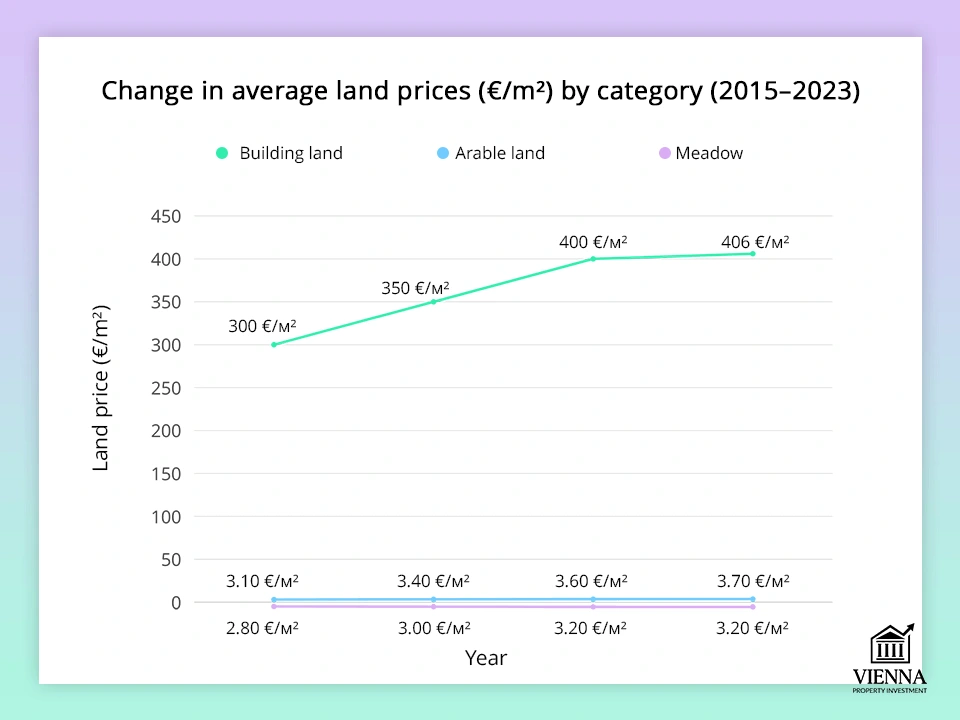
Arable land prices in Austria are very low – in 2023, the average price per square meter of arable land was just €3.70, while meadow land cost €3.20 per square meter. By comparison, the average price of building land is approximately €406 per square meter.
-
The restrictions apply to everyone: both Austrians and foreigners. For example, even Austrian residents (like EU citizens) require permission from local authorities ( Grundverkehrsgenehmigung ) to purchase agricultural land. Foreigners face even more challenges, but we'll discuss that below.
Forest lands

The purchase of timber is particularly strictly regulated. In many federal states, "forest" is almost always designated exclusively for forestry: logging can only be carried out under very strict conditions, and the purchase of timber (especially large quantities) must be approved.
Such plots are often acquired by forestry or hunting companies. Ordinary buyers are not interested in forests, as they are extremely difficult to convert to other uses.
Land by the lake, in the mountains, resort land

These are special, often very expensive categories. Many investors are interested in purchasing lakeside land in Austria (Wörthersee, Seefeld, Zell am See) or in mountainous regions (Tyrol, Salzburg), as it is ideal for residential buildings, hotels, and cottage complexes.
Prices here are significantly higher, especially closer to the resort center or the water. For example, a plot of land near Lake Salzburg can cost several times more than a similar plot in the countryside. Moreover, such plots may fall within conservation areas where construction is restricted. Therefore, it's always important to check local regulations to determine which land in Austria is suitable for construction.
Rules
Each land type has its own rules: for example, only land already listed in the Bauland (construction land) register can be converted for construction. Other land types must be reclassified, which can be very time-consuming.
Embankments or forested areas may have additional environmental restrictions. Therefore, before purchasing, be sure to research the specific site's intended use (or consult the zoning plan).
Restrictions
Finally, it's important to understand that foreigners cannot purchase any land they wish. Austrian land acquisition law requires a special permit (Grundverkehrsgenehmigung) for non-residents to purchase land.
These controls were introduced to prevent speculation and preserve agricultural land. Most transactions involving foreigners must be approved by the authorities (the Land Resources Department).
-
An exception is EU/EEA citizens: they don't need a separate permitting procedure to purchase a plot of land; they are treated the same as Austrian buyers. This means that citizens of Germany, Poland, or the UK (after Brexit, the British also received "EWR-gleichgestellt" status) can purchase land under almost the same conditions as Austrians.
However, citizens of "third countries" (for example, from Russia or Ukraine) will have to submit an application to the local commission and wait for approval. For example, the acquisition of agricultural land or plots in mountainous areas very often requires such permission .
All the details are in the article “ Restrictions on the purchase of real estate by foreigners in Austria .”
Choosing a site: regions, infrastructure, and prices

So, you've decided to buy a plot of land in Austria. Where should you go first? The choice depends on your goals: are you planning to move and build a house, are you looking for a summer cottage, or are you looking for an investment plot for recreational use?.
Location and infrastructure. First and foremost, consider the availability and proximity to:
- Roads
- To the shops
- Schools
- Hospitals
- Railway stations
- Buses
- Utilities (electricity, water supply, sewerage)
A plot of land in a remote village may be cheaper, but Austria's lowest land prices do not take into account connection costs and distance to infrastructure and social services.
I always remind clients: while dreaming of a quiet village is great, make sure the nearest road is accessible year-round and that electricity and water are always available. Otherwise, you could face additional expenses and hassles during the paperwork.
The site's topography is also important here. An uneven mountain slope may require leveling (which is expensive), and a site near water should be checked for flooding risks (make sure there are no waterlogged areas).
Before purchasing land in the Austrian mountains, order a geological or hydrogeological assessment. Austrian land registry and municipality websites often provide brief information about the plot (size, topography, presence of structures).
Regions and investment potential
Different regions of Austria offer different opportunities. For example:

Vienna and its surrounding area. Within Vienna, "Bauland" land is almost never available for sale (the city is already fully developed). Therefore, those simultaneously exploring Vienna real estate should often look at plots in Lower Austria: it's more feasible to find land for construction there while remaining within the capital's demand and infrastructure zone. However, in the surrounding area, in Lower Austria, you can find plots for residential construction or business projects.
Prices there are lower than in the capital. However, anyone purchasing land for construction should check the urban development plans (Flächenwidmungsplan) and any "green zone" restrictions.

Tyrol and Salzburg. Ski areas (Ischgl, Kitzbühel, Sölden, etc.) are primarily expensive land for hotels, apartments, and luxury cottages.
Prices here are high: in Innsbruck (the capital of Tyrol), building plots already cost an average of €1,043 per square meter, and in Kitzbühel, even more. It's no coincidence that record-breaking offers appear in such locations: the most expensive homes in Austria are usually listed in premium Alpine resorts, indirectly fueling demand for land in the region. However, such projects often require mountain building permits and compliance with local architectural regulations.

Lakeside land. Land for a house in Austria near popular lakes (Wörthersee, Seefeld, Achensee) is considered premium. For example, plots near Lake Constance in Vorarlberg are among the most expensive, especially those with a water view.
In small lakeside villages in Carinthia (Gröbel, Wapresch) or Upper Austria (on the Schlossgebirge), a plot of land on the shore is an excellent location for a home or hotel. Such land is often protected by the state, so restrictions may apply.

Rural regions (Steiermark, Burgenland, Niederösterreich). There are fewer tourists here, but there are plenty of open fields and vineyards. Land is cheaper (in Styria, an average of €360/m²). This is an excellent option for those looking to buy land in the Austrian countryside for a quiet life, or to invest in agritourism or winemaking.
For example, in Burgenland and neighboring Niederösterreich, prices are low, offering a unique opportunity to buy land in Austria at a low price, with potential for future growth.
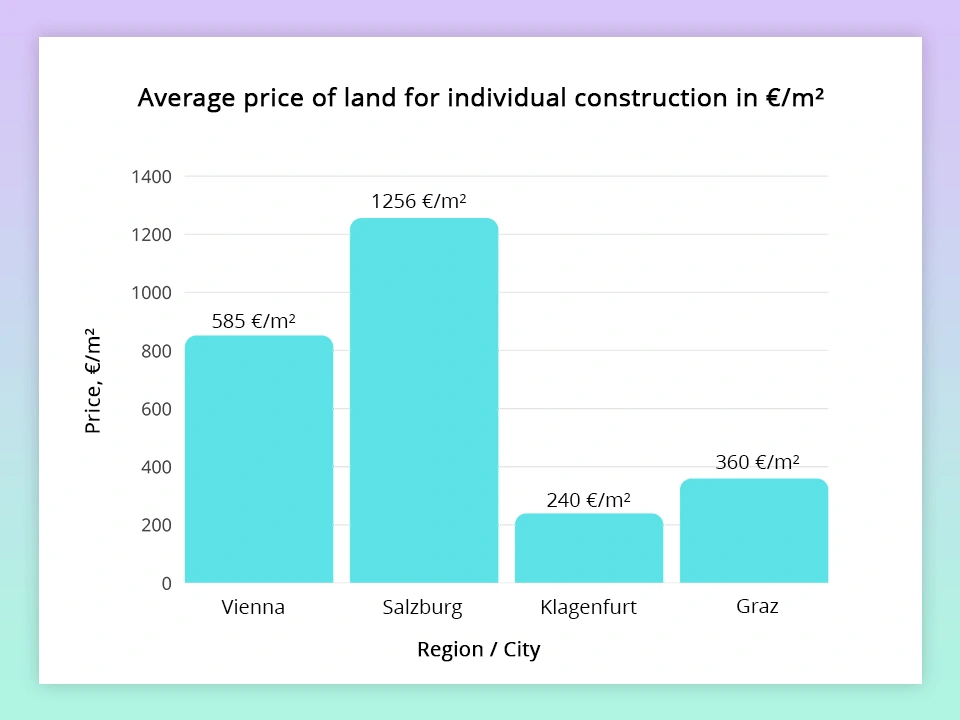
Land prices in Austria's mountains and valleys. For context, the average house plot price in Innsbruck is currently around €1,043/m², while in the rural part of the neighboring district of Reutte, it's only €188/m². In Styria, Graz is €360/m², and in the Klischeilen district of Southern Styria, it's around €50–70/m². This proves that land prices are highly dependent on location and infrastructure.
Keep in mind the specifics of local architecture. Particularly in Alpine regions, there are often requirements for facades, roofs, and energy efficiency (compliance with Austrian OIB and Energoausweis standards).
Austrian authorities are encouraging the construction of energy-efficient homes: for example, the Umweltförderung (environmental financing) program subsidizes new buildings with high energy efficiency and “green” materials.

Legal aspects: terms of purchase and registration

Let's look at the legal aspects of buying and selling land in Austria. Austria has clear rules governing who can become a landowner and how.
Buyer status. As mentioned earlier, EU/EEA citizens are treated the same as Austrians: they do not require special permission to purchase land. Citizens of other countries are required to obtain approval from local authorities (Grundverkehrsgenehmigung) before the transaction.
-
Exceptions: If one of the spouses is Austrian and the purchase is made as joint property, then permission is not required (special rules have been developed for such cases). Incidentally, EU residents are advised to have or obtain a residence permit (Meldezettel) to be able to purchase real estate without any restrictions.
Registration of rights (Grundbuch). Purchasing land in Austria is completed by entering the new owner's information into the land register (Grundbuch). Only then will you become the full owner . It's important to understand: even a signed purchase agreement under Austrian law does not grant ownership until registration.
Therefore, before transferring the entire amount, make sure that there are no unexpected encumbrances (mortgages, restrictions on use rights, etc.) in the land register and that your application for registration (Grundbuchsantrag) is submitted as soon as possible.
-
The procedure is as follows: after signing the preliminary agreement and receiving the permits, the buyer submits an application to amend the register through the court at the location of the property (Bezirksgericht). The date the court receives the application determines the order of priority: if someone submits documents earlier, their right to it becomes a priority.
A purchase and sale agreement. It is executed as a notarial deed. The agreement describes the plot in detail (usually the cadastral number and address), the agreed price, the payment terms and conditions, and the terms of the transfer of rights and obligations of the parties.
The contract often includes a section on a "deposit" or advance payment (e.g., 5-10% of the total amount), which the buyer pays as a guarantee. This deposit can be retained if the parties subsequently decide not to proceed with the transaction (usually if the buyer withdraws). The approval process includes a land clearance check: an extract from the Grundbuch is obtained, encumbrances are verified, and the development plan is checked.
Notary and lawyers. In Austria, real estate transactions require the participation of a notary or authorized lawyer (local notary chambers). The notary drafts/certifies the contract, verifies the identity and authority of the parties, and ensures that all formalities are observed.
Notary fees are charged for their services: on average, notary fees amount to 1-3% of the transaction price. The lawyer often helps with due diligence and obtaining all necessary permits.
-
Advice: contact specialists (notary, lawyer), especially if you do not speak German.
Taxes and payments

Purchasing Austrian land involves a number of significant payments:
Transfer tax (Grunderwerbsteuer). A 3.5% tax on the transaction price is levied on almost every property transfer (under standard conditions). So, if you buy a plot of land for €100,000, the tax will be approximately €3,500. In some cases, exemptions are offered (for transactions between close relatives, a progressive rate applies), but under normal circumstances, the standard rate is 3.5%.
State registration fee. In addition to the tax, 1.1% of the purchase price is charged when filing an application with the land court.
It's worth noting that a tax exemption will be in effect in 2024-2025. For ordinary residential properties, this duty has been waived until July 2026 (provided the buyer registers it as their primary residence).
Tax on sale. If the owner decides to sell the property and makes a profit, a real estate gains tax (Immobilienertragsteuer) is levied on this profit.
Since 2016, the rate has been 30% of the difference between the sale price and the expenses included. However, if the property was used as a primary residence (house-flat) for two to five years, the owner may qualify for a full or partial tax exemption.
Other expenses. If a realtor (broker) is handling the transaction, their commission typically amounts to an additional 3-4% of the total price plus VAT. There may also be costs for mandatory land insurance or an escrow account (an account where funds are temporarily held until the transaction closes) – these aren't significant, but it's worth being prepared for.
For more information, see our article “ Property Taxes in Austria .”
Precautionary measures. During negotiations and deal preparation, a preliminary agreement (Kaufanbot) is often used, along with the payment of a deposit or the opening of a special escrow account.
This guarantees that the plot will be removed from sale (it will be "reserved" for you), and the funds will be held by a third party (for example, a notary) until the contract is fully executed. This mechanism reliably protects the buyer's interests: they pay the money but do not risk losing it if the deal falls through for a valid reason.
-
It's important to remember: until the title deed is registered in the land register, you are not the owner, even if the contract has already been signed and the money has been paid. Many problems arise when the buyer trustingly transfers the money, only to discover later that the property is still encumbered by debts or that someone else has already registered their rights.
Practical steps for purchasing a plot of land

Let's walk through the buyer's journey from start to finish, ensuring we don't miss a single detail.
Searching for a plot. This begins with contacting a realtor or browsing listings on local real estate websites, such as:
- ImmobilienScout24
- ImmoWelt
- local newspapers
When choosing, it is important to personally visit several options, evaluate the area, neighbors, entrance and insolation (solar illumination).
The online cadastral register (Kataster) can be helpful here – you can see the exact boundaries of the plot and neighboring plots there. Don't hesitate to ask the owner to show you documents: a plot map and an extract from the Grundbuch (a necessary document for every buyer).
Offer and agreement. Once you've found a suitable property, you make an offer (Anbot) to the seller. In Austria, this is usually formalized in writing—a Kaufanbot, or preliminary agreement. It specifies the purchase price, payment term, and deposit amount.
In Russian terminology, this is something like a purchase and sale agreement, but without the final transfer of ownership. It simply establishes a commitment to conclude the transaction. As collateral, you deposit a deposit (e.g., 5-10% of the purchase price) into a trust account (Treuhandkonto) held by a notary or lawyer.
Once you sign the Kaufanbot, the plot is considered "reserved" for you: if the seller refuses without a valid reason, they are obligated to return double the deposit.
Inspections and permits. A site clearance inspection is also being prepared: you hire a specialist (for example, a surveyor) or lawyer who will analyze:
- Grundbuch (land register) — checks for debts, encumbrances (mortgages, easements), and whether third parties have claims on the property. This information is available on the websites of regional courts.
- Zoning plan – whether the site meets your plans. Find out what zone it's in (Bauland, Wald, Alm, etc.) and what kind of construction is permitted on it.
- Financing - you apply for a loan (if needed) taking into account the escrow account and the mandatory approval of the bank.
- Obtaining state permits is the most time-consuming step for non-residents. Depending on the location and type of land, approval from the Land Registry (Grundverkehrsbehörde) is required. For example, if the land is in the mountains or designated for agricultural use, the relevant land department or district administration must grant permission for the foreigner to purchase it. This is usually handled by a lawyer or notary: they gather documents (passport, proof of residency, purpose of purchase, etc.) and submit the request.

The main transaction takes place before a notary. Once all checks have been completed and permits have been obtained, the notarial deed (Beurkundung) is scheduled. In Austria, the absence of a notarial deed for a real estate transaction is illegal.
At this stage, you and the seller come to the notary's office (the meeting is usually open and the contract is read aloud). The notary verifies your identities and signatures and certifies the transaction. After signing, you transfer the remaining amount through escrow or directly, as previously agreed.
Registration and acquisition of rights. The notary or your lawyer submits documents to the regional court. There, an application for registration (Einverleibung) is completed—the entry of your ownership rights into the register.
-
Important: First of all, you need to pay off existing encumbrances (remove or transfer mortgages), and also pay the transfer tax and filing fees.
After accepting the documents, the court registers you as the new owner. From this point on, the plot is officially yours—you can collect the keys (or simply begin construction, if that was stipulated in the contract).
Taxes and Settlements. At this stage, it's time to complete all remaining payments: transfer funds to the seller (usually after or simultaneously with filing the lawsuit), pay taxes, and notary fees.
Once the court registers the change of ownership, you only need to pay the registration fee (1.1% of the property's value), unless it has already been withheld from the escrow account. Essentially, the keys to the property are "transferred" once the main contract is certified and the deposit is collected.
Moreover, at various stages (financial transfers, insurance, etc.), experts can answer many questions for you. They can help you feel more confident, especially if you don't speak German.
If you follow the steps outlined above, purchasing land in Austria should go smoothly. It's important to take your time, carefully review the documents, and adhere to Austrian registration procedures.
Sustainable Development and the Environment: Green Investments in Land

In recent years, the Austrian land market has increasingly become greener. This isn't just a trend: Europe has become more stringent in requiring more environmentally friendly construction and land use. When choosing a site, many investors now consider the potential impact of their construction plans on the climate and the environment.
Why this matters: According to environmental reports , approximately 27% of Austria's total energy consumption comes from the residential sector (heating and hot water), with buildings generating approximately 10% of national CO₂ emissions. In recent decades, harmful emissions have already been reduced by more than a third.
At the same time, Austrians must make even greater efforts to meet their Paris Agreement commitments. Accordingly, the authorities are encouraging energy efficiency: for example, new buildings often require energy certification, and taxes and subsidies are awarded only to projects with high energy efficiency standards.
Laws and restrictions. Environmental land use regulations are enshrined in building codes. When planning construction, an environmental impact assessment (Umweltverträglichkeitsprüfung) is conducted.
In special conservation areas (such as national parks), there may even be a complete ban on construction. In regular building sites, standards have been introduced regarding minimum acceptable thermal insulation and mandatory consideration of solar gain.
These standards are being tightened regularly: by 2025, virtually all new homes must achieve near-zero energy consumption (requiring their own or “green” heat source).
Government programs. To attract developers, Austria offers grants for green projects. For example, the Climate and Energy Fund (Klima- und Energiefonds) finances initiatives for energy conservation and the use of renewable energy sources in building construction.
Subsidies are available for the installation of solar panels, heat pumps, energy-efficient windows, and the like. There are also incentives for green investments, including partial mortgage interest reimbursement for green construction and tax deductions for green technologies.
All this makes projects with an environmental focus more profitable.
-
Practical advice for investors:
- When purchasing a plot, look for plots with a south-facing orientation (to ensure enough sun for the panels) and with the ability to connect to “clean” energy (wind or geothermal in some areas).
- Try not to fill the ground with excess concrete: keep trees or hedges on the site - they will reduce the negative impact on the climate.
- Today, the profitability of "green" projects is well calculated: a house with low energy consumption and its own solar power plant is significantly cheaper to operate and is in higher demand.
In recent years, I have increasingly recommended that clients plan projects with environmental aspects in mind from the outset.
Globally, in Germany and Austria, green buildings are in high demand: the government subsidizes passive houses and solar panels, and buyers value the savings on heating. For example, Passivhaus-class homes consume 5-10 times less energy than conventional buildings—an important consideration when choosing a site and design.
Examples of successful projects. In Austria, there are numerous cases where land was purchased for "green" projects—for example, a winery using solar panels or a hotel with geothermal heating.
Another trend is the development of agritourism. Investors are buying land in the Austrian mountains, building eco-homes, and organizing cycling tours. These properties are very popular: for example, farmhouses in Tyrol often sell for more than standard ones if they have a green certificate (such as Green Building).
Land for various types of construction: houses, lakes, mountains
Now let's look at specific options in more detail.
Residential land (Bauland-Wohngebiet). This is the standard option for families: a plot suitable for a one- or two-story house. Such plots usually include utilities (at least electricity and water) and are designed for a single family.
The house's architecture is coordinated with local regulations (considering neighboring buildings and the overall visual appearance of the neighborhood). Average land prices in Austria for a house range from ~€240 (Klagenfurt) to >€1,250 (Salzburg) per square meter.
-
Please note: If a large building or multi-story building is planned, such a property is classified differently (Bauland-Wohngebiet class II/III) and requires additional checks of insolation and building density.
Prices vary here: in Carinthia, lakeside plots (Wörthersee) can cost hundreds of euros per square metre, while in Upper Austria they cost around €200-300/m².
Land in the mountains. Mountain properties (such as chalets or mountain cottages) have their own specific regulations. Many areas have established a "Bauzone" (elevation level) based on their altitude. Residential buildings are typically built only within the boundaries of Siedlungsgebieten (settlements) or villages.
In the "open mountains" (Hochgebirge), construction is prohibited almost everywhere. If you're looking for a site at altitude, be sure to find out whether residential construction is permitted there at all.

It is also important to consider landscape constraints: on steep slopes, additional inspection of retaining walls is necessary.
The advantages of purchasing land in the Austrian mountains include excellent views and resort potential: a plot of land near a ski lift or ski slope can be a very profitable investment for building a hotel or residence.
Architectural restrictions. Austrian regions often have regulations that require the preservation of the traditional appearance of buildings. Metal and thatched roofing are unofficially prohibited. Wood or shingles are recommended instead. The height of buildings in rural areas is often strictly limited (maximum 1-2 stories above ground, sometimes set at 7 meters).
In the Vienna Woods or historic settlements, façade design approvals may be required. These regulations must be strictly followed for your project to be approved.
Approximate prices (2025). Let's summarize:
- The average price of a rural plot for a house in Austria is ~€400/m².
- In the mountains (Tyrol, Salzburg) in popular resort areas, prices can be several times higher - Innsbruck €1,043/m², Salzburg €1,256.
- A plot of land by a lake is a rare and expensive asset: in Burgenland on Neusiedler See it can cost €250-400/m², and on Wörthersee (Carinthia) – over €600/m².
Finding affordable land to buy in Austria is nearly impossible. The closer it is to a lake, the more expensive it is. To save money, investors often choose plots a little further from the resort center (2-5 km), but this comes at the cost of losing access to water.
Peculiarities of purchasing agricultural land
Purchasing agricultural land (arable land, pasture) is fundamentally different from investing in residential land.
Who can buy? As already mentioned, even Austrian citizens formally require permission. Foreigners have a lesser chance: only those who will be directly involved in agricultural work will be allowed to purchase arable land. This means that a pure investor without plans to farm will likely not be allowed to purchase arable land.
The purpose of this law is to keep land in circulation and ensure that it produces food rather than sits idle in the hands of speculators. The exception is "agricultural orchards" and vineyards: these are easier to convert to commercial use and are sometimes purchased as investment projects (for example, for a tourist farm).
Advantages and risks. Farmland is a relatively stable asset. Arable land can be leased to agribusinesses or receive annual subsidies from the EU (agricultural programs). Prices for such land are lower: in Austria, the price per hectare of arable land is a few euros per square meter.
-
Risks: Climate change may impact harvests (Austrian agriculture is adapting to new crops and technologies). There are also risks of administrative restrictions: some federal states have introduced "no-take zones" (Vorbehaltsgebiete), where selling agricultural land to foreigners is either reluctant or subject to very strict controls.
Trends. Prices in the Austrian agricultural market are growing slowly. According to statistics, the average price per square meter of arable land increased from €3.50 to €3.70 in 2023. This means there is no significant speculative growth.
Wine-growing land in Styria can be significantly more expensive due to the higher demand for vineyards.
-
Please note: EU environmental trends (biofarming, organic farming) are making "clean" farmland more attractive. Therefore, if you are investing in agriculture, it's better to consider land in "organic" zones or with eco-certification.
Conclusion
Buying land in Austria is a carefully regulated process, but with proper preparation it is quite manageable.
It's important for foreigners to remember that, despite Austria's investment appeal, it has a strict permitting system and protections for local residents. This is why it's so crucial to plan ahead and consult with specialists such as lawyers, notaries, and architects.
On the other hand, the advantages of investing in Austria are also numerous: a stable market, investment security, and ease of maintaining clean documents (thanks to the unified database of regional courts). Concluding a transaction with a notary in Austria is transparent and usually proceeds without surprises, especially if you've carefully inspected the property and complied with all formalities.
In short, do your due diligence on land plans and legislation, and use expert advice, and your land purchase will bring you the benefits you expect without unnecessary stress or hassle.
Now is truly the perfect time to take advantage of Austrian real estate, which offers everything from picturesque mountain slopes to tranquil countryside.