Vienna is one of the few European cities where historic architecture has not only been preserved but has become a key part of the city's identity. Strolling through the central streets, you'll see dozens of Gründerzeit buildings, sumptuous 19th-century facades, elegant stairwells, high ceilings, parquet floors, and double doors—all of which are known today as "Altbau."
For real estate buyers and investors, the question remains: is it worth buying an apartment in an old building in Vienna?
There are many other pressing questions:
– How safe is such an investment?
– What changes have occurred on the Viennese market in 2024-2025?
– How has local legislation changed?
– What are the risks and pitfalls?
– And most importantly, what should you check before buying?
If you're planning to buy an apartment in Vienna , this article will help you create a checklist and identify typical Altbau risks in advance.
In this article, we'll cover all aspects of purchasing an Altbau in detail: from technical nuances and legal restrictions to repair costs, energy efficiency, and potential price increases.
What is Altbau?

In Austria, the word "Altbau" has no literal translation. In everyday speech, we might call any building with a shabby façade or an apartment that hasn't been renovated in a long time "old." However, in Viennese real estate, this term has a much deeper and more formal meaning. It describes not age, but a whole layer of urban culture, construction technologies, and legislation that determine value, worth, and restrictions for future owners.
That's why in newspapers like Der Standard or Kurier you'll see phrases like:
“Altbau ist kein Alter, sondern eine Kategorie.”
(Altbau is not an age, but a category.)
This category determines your tenancy rights, your obligations to the Eigentümergemeinschaft, operating costs, restrictions on modernization, and even what rent you can charge in the future.
What is considered Altbau at the official level?
In terms of the Austrian construction and housing system, Altbau generally refers to buildings constructed before 1953. However, within this long period, there is a distinct scale of "value.".
- Houses before 1945
It is this time limit that has legal significance. Houses built before the end of World War II are subject to completely different standards than post-war construction. They may have conservation status, special restoration and finishing requirements, and most leases in such buildings are governed by the MRG law.
- Gründerzeit era (1870–1914)
This is the pinnacle of Viennese Altbau – the houses that command the highest price on the market.
Gründerzeit buildings have a distinctive architectural style: wide façades, massive stairwells, artistic ornamentation, and high-quality brickwork that amaze even modern engineers.
This type of housing provides a sense of space that no new building can match: ceilings reach 3.2-3.8 m, rooms often have an enfilade structure, windows let in a huge amount of light, and walls 50-80 cm thick create a unique microclimate and natural sound insulation.
Why is it important to distinguish between an “old apartment” and an Altbau?
Most foreigners make a mistake when trying to distinguish between these two concepts.
"Old apartment" ( alte Wohnung ) is a colloquial term and refers only to the condition of the property. Such an apartment may be located:
- in a 1970s house,
- in a panel structure,
- in the post-war reconstruction building.
It may be poorly maintained, have poor electrical wiring, and have not been renovated for decades, but legally it still won't be considered an Altbau. The main criterion for determining an Altbau is not the house's age, but its character.
How do Austrians differentiate between these concepts?
In Austria, concepts related to "old housing" have distinct legal and cultural differences. What sounds the same to a foreigner may be completely different categories of real estate to an Austrian.
| Term | Meaning | Example |
|---|---|---|
| Altbau | Historical development before 1953, special status | Gründerzeithaus, Biedermeierhaus |
| Altbestand | Old fund, legally significant | All houses built before the war |
| alte Wohnung | The apartment is in an “old”, unkempt condition | A 1970s house without renovation |
The main thing to understand is that “Altbau” is not about age, but about architectural and legal status.
When an Austrian sees this word in an ad on Willhaben or ImmoScout24, they immediately understand that they are looking at a property with certain characteristics: high ceilings, thick walls, strict renovation regulations, possible heating restrictions, and a specific rental regime.
An interesting detail: many Austrians consider Altbau not just real estate, but a sign of "architectural quality." Therefore, such properties are often prized by buyers for their "atmosphere" and the prestige of the area. However, it's important to remember that along with the charm, the buyer also assumes additional legal and technical obligations.
What does a typical apartment in Vienna's Altbau look like?

It's not just the beauty that's important here, but also the structure of the building. Historic buildings were constructed according to different principles, and that's what makes these apartments unique.
In the Viennese Altbau you can expect:
- Very high ceilings are the first thing you notice. Ranging from 320 to 380 cm, they create a feeling of open space.
- Massive wooden windows – they often require repair, but they visually transform the room and allow for plenty of natural light.
- Piece-laid parquet – laid 100-120 years ago, and still amenable to restoration.
- Double doors – there are even triple doors between rooms.
- The stucco decoration ranges from minimalist medallions to complex rosettes in the style of Viennese classicism.
- Wide staircases – wooden or stone steps, wrought iron railings, windows in the entrance hall.
- Thick walls – brickwork provides natural thermal capacity and good acoustics.
All this creates a feeling of “Viennese charm”, for which buyers are willing to pay significantly more.
Tip: How to tell if you're standing in a real Altbau
If you're visiting an apartment, pay attention to three features that are rarely found in post-war buildings:
- Window sill depth – if the window sill is more than 40 cm, it is almost certainly pre-revolutionary masonry.
- The height of the doors – in Altbau it is often 2.4-2.8 m, and not the standard 2.0.
- Indirect details include old handles, bronze overlays, mosaics in the entrance hall, historical doorbells, and mailboxes in the Gründerzeit style.
Why are these homes more valuable than new buildings?

The popularity of Altbau in Vienna is a phenomenon that's almost impossible to explain with figures alone. Austrian architects call it the "Nerv der Wien er Architektur" —the nerve of Viennese architecture, its emotional and cultural core. For many city residents, such buildings aren't just "old stock," but part of the city's identity, a material continuation of history and a certain way of life.
This is why prestigious apartments in Gründerzeithaus can cost more than ultra-modern apartments in new buildings. Not because they are more technologically advanced, but because they offer a unique combination of space, aesthetics, and atmosphere that cannot be replicated with modern construction methods.
Atmosphere and sense of space
Altbau's main advantage is its sense of scale. Vienna is one of the few European cities where ceilings in late 19th-century residential buildings could reach four meters. The space "breathes," the rooms feel spacious even with a standard area of 80-100 square meters, and the proportions of the rooms create a sense of harmony that is lacking in new buildings with their height restrictions, energy efficiency standards, and compact layouts.
Tall doors, wide enfilades, large windows, skylights, and courtyard galleries create the feeling of an "architectural theater," where even ordinary, everyday life seems more measured and aesthetically pleasing. Many buyers appreciate the character of Altbau—a sense of time, a unique history—that can't be bought in a new concrete block.
Quality of materials
The second reason is the quality of ancient structures.
Austrian builders often say that brick from the 1890s and 1910s is still superior in quality to most modern materials. It:
- more dense,
- accumulates heat better,
- moisture resistant,
- provides natural sound insulation.
The thick walls create a pleasant microclimate: Altbau does not overheat in summer and cools down slowly in winter.
It is no coincidence that many modern architects acknowledge that the durability of such houses is in many ways superior to that of new buildings designed for the standard 50-70 years of operation.
Gründerzeit houses have survived more than 120-150 years, including bombings, periods without heating, redevelopment, and dozens of major renovations – and continue to remain stable structures.
Location
Almost all of Vienna's historic buildings are located in districts that are considered the most attractive today. These are:
- 7th arrondissement (Neubau),
- 8th (Josefstadt),
- 9th (Alsergrund),
- parts 3 and 4,
- most of the 6th,
- prestigious lines of the 2nd and 5th districts.
These areas developed as the city grew rapidly, and it was here that Vienna's cultural and intellectual life flourished. They are home to top schools, theaters, parks, cafes, universities, and transportation hubs—all of which create high demand among expats, families, creative professionals, and investors.
It is no coincidence that the most prestigious addresses, including those considered “ Austria’s most expensive home ,” are concentrated in historic districts, and this clearly demonstrates why “location” in Altbau is often a key asset.
New developments are often located in the outskirts due to a lack of available land, but Altbau is located in areas where "location works for itself." Demand for such areas is growing every year, while supply is limited by the city's historic boundaries.
Investment value
Altbau is considered the most stable segment of the Viennese real estate market. Even during periods of economic instability, prices for historic apartments fall more slowly and recover more quickly. The reason is simple: Altbau cannot be replicated.
Economists call such objects “unique assets”.
Furthermore, historic apartments appreciate in value after high-quality renovations – much faster than new buildings. Renovations at Altbau increase prices more significantly because buyers are willing to pay a premium for a property that combines:
- the aesthetics of an old house,
- modern comfort,
- historical location.
Prices are also rising because many Gründerzeit apartments are unaffordable. They are rarely sold, often passed down through inheritance, and owners hold on to such properties for decades.

The shortage of supply creates steady pressure on price growth – making Altbau an attractive investment asset, especially compared to new buildings, which are built in large volumes every year and lose their exclusivity over time.
When Altbau is a minus, not a plus

Despite its prestige and architectural value, an Altbau building isn't always a "dream apartment." Historic buildings can conceal serious technical and legal issues that aren't always apparent upon inspection but can dramatically increase the cost of ownership.
The German and Austrian press often emphasizes that Altbau is "beautiful, but not always practical." Therefore, a savvy buyer should understand that the romance of old Vienna and the actual condition of a particular building are sometimes two different realities.
Below is an expanded list of situations where Altbau may be a financially dangerous or inconvenient purchase.
1. A house without renovation of the facade, roof or utility joints
If the façade, roof, or internal utilities have not been updated for a long time, the house is almost guaranteed to be included in the Eigentümergemeinschaft (Capital Works) plan.
The problem is that such work is usually financed not from the city budget, but from the owners' reserve funds. If the reserves are low, the owners are required to contribute additional fees (Sonderumlagen).
Estimated costs in such cases:
| Type of work | Approximate cost for the owner |
|---|---|
| Facade repair (without insulation) | 8 000-20 000 € |
| Facade renovation with insulation | 20 000-40 000 € |
| Complete roof replacement | 25 000-60 000 € |
| Replacing risers in a house | 4 000-10 000 € |
| Entrance hall renovation | 2 000-8 000 € |
Why is this a problem? Because Altbau buyers often lose two budgets at once:
- money for the apartment itself,
- money to participate in the renovation of the entire building.
In some cases, the overall cost of the work is more than the cost of the property itself.
2. A house with outdated gas heating
In 2025, Austria tightened requirements for gas heating systems. Gas boilers will be phased out, and new gas connections to residential buildings will be prohibited.
For the Altbau owner, this means that in the coming years it may be necessary to switch to:
- central heating,
- heat pump,
- hybrid systems.
Replacement cost:
| Element | Price |
|---|---|
| Dismantling a gas boiler | 1 200-2 000 € |
| Connecting to Fernwärme | 5 000-15 000 € |
| Complete replacement of the heating system in the house | 50,000-300,000 € (shared between all owners) |
For some buildings, this becomes almost inevitable, especially if the city plans to modernize entire areas.
Why could this be a disadvantage?
– You buy a beautiful apartment, but a year later you learn that the building must upgrade to a new system;
– This increases your expenses without the ability to defer or avoid such expenses.
3. A house with illegal redevelopment
This problem is especially prevalent in Altbau, as these buildings have undergone dozens of renovations throughout their history. In the 1970s and 1990s, many owners expanded kitchens, combined rooms, rearranged walls, and moved bathrooms—all done quickly, without filing paperwork with the local authorities.
Why is this critical in Vienna?
The Austrian regulatory authorities – Magistrat and Baupolizei – act strictly.
If redevelopment:
- not reflected in the plans,
- affects wet areas,
- violates the static structure,
- or does not comply with fire regulations..
New owners may face consequences even if the changes were made 30 years ago.
What can happen?
1. The demand to return the apartment to its original condition.
Yes, this is a reality. Especially if the kitchen was moved to the room above the neighbor's bedroom.
2. Fines.
Fines are often between €1,000 and €10,000, but can be higher.
3. Ban on tenant registration.
If the property is being used improperly, the city may prohibit further leasing.
4. Problems with Grundbuch.
If the structure of the premises does not comply with Nutzwertgutachten, legal conflicts may arise.
The most common problematic redevelopments in Altbau
| Type | Why is it dangerous? |
|---|---|
| The kitchen has been moved into the living room | wet zone violation |
| A bathroom moved into a niche | problems with ventilation and fire regulations |
| Combined rooms without static analysis | risk of damage to the load-bearing wall |
| False balconies or galleries | violation of the building's appearance |
| Closed old chimneys | This is the property of the building, not the owner of the apartment |
Maintenance costs: Why Altbau almost always costs more than it seems
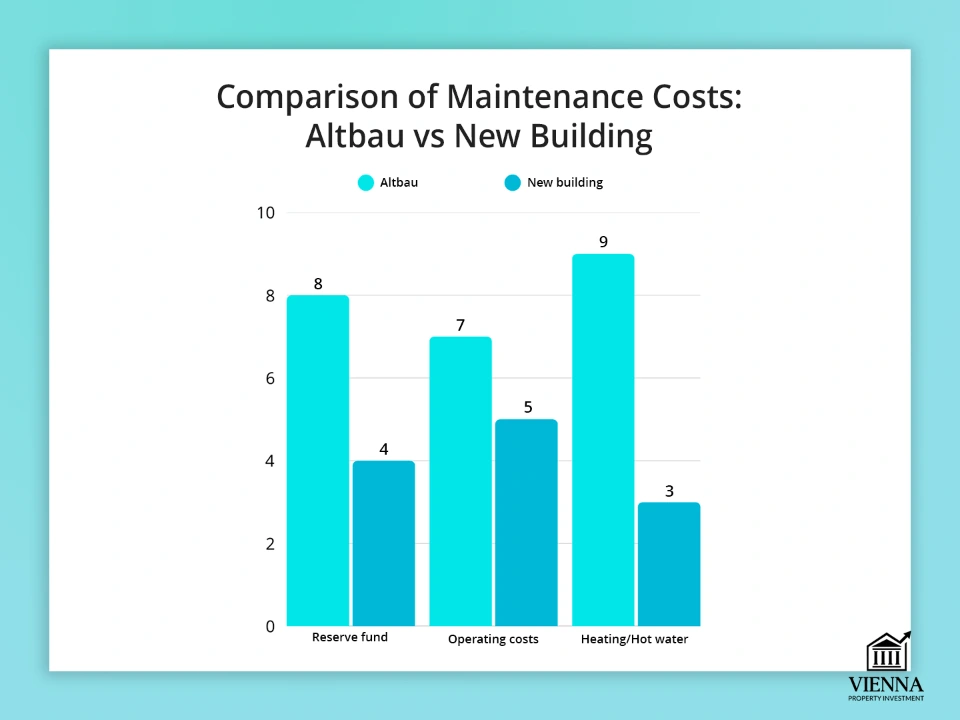
Owning an apartment in a historic building always comes with more responsibility than buying a new building. Not only the initial budget is important, but also ongoing costs, which can differ significantly from the Vienna average.
Firstly, the Rücklage (reserve fund)
This isn't just "savings for the future," but a mandatory payment made by all building owners. At Altbau, this fund is especially important because such buildings require regular renovations:
- facade renovation,
- roof repair,
- replacement of risers,
- modernization of electrical panels,
- installation or maintenance of an elevator,
- bringing the building into compliance with modern fire safety standards.
If the Rücklage is small, any repair automatically turns into a Sonderzahlung – a large one-time payment. This means your monthly payment could be supplemented by bills of €3,000–€20,000, and sometimes even more.
Secondly, Betriebskosten
Utility bills in Viennese Altbau apartments can be higher than in modern buildings for several reasons:
- Large stairwells require more cleaning and lighting,
- Old buildings are more expensive to insure
- Maintenance of historical elements (doors, windows, railings) is more expensive,
- Hausverwaltung often has an extended list of works.
New buildings offer lower utility bills thanks to energy efficiency, new-generation elevators, modern heating systems, and insulated facades.
Thirdly, heating and hot water
Old houses can be heated:
- gas water heaters,
- individual boilers,
- less efficient radiator systems of the 20th century.
Due to the low energy efficiency class (often G or F), heating costs can be significantly higher than in a new building in the Seestadt or Sonnwendviertel area.
Moreover, government programs require a gradual phase-out of gas. This means that in the coming years, modernization may become mandatory, and its cost will be shared among all homeowners.
Why reading the Eigentümerversammlung protocols is a mandatory step
Key facts are often hidden in the minutes:
- is roof repair planned?
- are there any problems with the facade,
- are the risers clogged?
- is the installation of an elevator being discussed?
- Are fire safety inspections expected?
- have the tenants accumulated debt?
- what contractors worked in the past,
- Are there any legal disputes within the house?.
Sometimes a single sentence like “Discussion über notwendige Sanierung des Daches” means future expenses of tens of thousands of euros.
Is the object part of the Eigentumswohnung?
This is one of the most critical aspects of buying an apartment in an old building in Vienna. You need to ensure that you are purchasing a legally registered property (Eigentumswohnung) , not a share or an object with an uncertain status.
Why is this important?
In 2025, the Vienna market was actively discussing cases where buyers purchased not an apartment, but a "share in a building" converted into a separate space. At first glance, this appears to be a fully-fledged property, but legally, it has no:
- the right to self-registration in the Grundbuch,
- clear Nutzwert (share of ownership),
- the ability to freely rent or resell the property.
What you should always check:
1. Entry in the Grundbuch – availability of an apartment as a separate unit (Top-Nummer) with its own cadastral number (EZ).
2. Nutzwertgutachten – a document that defines your share in the common property of the house.
3. No encumbrances:
- pledge,
- debts on the house fund,
- litigation,
- restrictions on use.
4. The actual correspondence of the apartment to the plans in Bauakt.
If the apartment was previously rented (Mietwohnung), converting it to Eigentum is a long and complicated process. If the seller is planning to do this at the last minute before the sale, you should check the documents especially carefully.
Repair, redevelopment and restoration

When you buy an apartment in an old building in Vienna, you get not only high ceilings, massive doors, and parquet floors, but also a whole host of restrictions that protect the building's architectural integrity. Vienna takes a very strict approach to its old housing stock: it is considered a cultural heritage site, and any changes are subject to much stricter controls than in buildings from the 1970s to 2000s.
Moreover, Altbau has a completely different architectural logic: walls can be load-bearing even where you don’t expect them, and technical areas are strictly tied to the historical layout.
Therefore, renovations in Altbau are divided into two categories: those changes that can be made freely, and those that require permits or at least approval from the building management and the city council.
What can usually be done without problems
Works that are considered internal changes and do not affect static elements and do not impact the building structure are permitted.
1. Cosmetic repairs
Painting walls, replacing wallpaper, restoring parquet floors, and refinishing decorative panels—you can do all of this without restrictions. The main thing is to adhere to general house rules, such as those regarding noisy work.
2. Updating a kitchen or bathroom in existing areas
Whether you leave the kitchen exactly as it was in the Bauakt plans, replace appliances, or install new cabinets, all of this is permitted.
But it is important that the kitchen remains in a place that is logically connected to the ventilation and risers.
3. Replacing internal electrical wiring within the apartment
New sockets, cable replacement, and modern electrical panels are permitted as long as you don't change the common house wiring routes.
Usually, only a licensed electrician (Konzessionierter Elektriker) is required.
4. Replacing the floor covering without changing the floor level
You can renew the parquet flooring, install cork or tiles – the main thing is not to raise the floor level above the norm, so as not to violate fire safety requirements.
5. Rearranging furniture and changing non-load-bearing partitions
Lightweight plasterboard partitions can be dismantled and installed without approval.
But it's important to know: in Altbau, even "thick" walls can turn out to be load-bearing, so it's best to check the static plan.
What requires permits or approvals

Work that affects the Altbau structure, wet areas, common utility systems, or the building's exterior is overseen by the Baupolizei, Hausverwaltung, and sometimes the historic preservation office.
1. Moving the kitchen to another room
This is one of the most problematic interventions.
The kitchen is connected to:
- ventilation,
- water risers,
- sewerage.
If it were moved into a former bedroom or living room, it would violate the building's technical layout, and the magistrate would almost certainly require everything to be returned to its original state.
2. Expanding or moving the bathroom
This is the most “dangerous” zone because:
- Wet areas in Altbau are strictly regulated;
- old houses have limited load on the floors;
- sewer risers are located only along certain walls;
- The transfer may cause leaks in neighboring apartments.
Baupolizei intervenes particularly frequently in such cases, especially in buildings built before 1945.
3. Installation of new pipes, risers, ventilation or heating systems
Any interference with common house communications requires:
- consent of the owners of the house,
- engineering report on heating or plumbing,
- magistrate's permission.
We are talking not only about risers, but also about gas lines, ventilation shafts, and chimneys.
4. Combining rooms by removing walls
In Altbau, load-bearing walls are found in the most unexpected places.
Even if the wall appears “thin”, it may actually be made of brick with a thickness of 15-30 cm and play an important role in the overall statics of the building.
To demolish a wall you need:
- order Statikgutachten (statistical report),
- get permission,
- coordinate the work with the house.
In some buildings, such changes are prohibited entirely.
5. Changes affecting the appearance of the building
If the house has a protected status, even the replacement of windows must be approved by the Bundesdenkmalamt.
The facades of historic buildings are the “face” of Vienna, and the city strictly monitors that they are not damaged.
The following rules apply here:
Why are Altbau so strict about repairs?
In Altbau, any intervention can disrupt the functioning of the entire building. The structure of these buildings is different from that of new construction: even a thin wall can be load-bearing, and moving a kitchen or bathroom often leads to leaks and damage to neighboring properties. Ventilation systems, risers, and ceilings run through several floors at once, so a single owner's mistake affects the entire building.
Vienna also protects the historic appearance of its Gründerzeit buildings. The facades, windows, doors, and stucco are considered part of its cultural heritage, so any changes are subject to particularly strict controls.
-
Interesting fact: in some gated communities, even the exact shade of window frames is documented, and repainting them without permission is prohibited—it's punishable by a fine.
This is why the city and Baupolizei are so attentive to any renovations: Altbau is beautiful, but it requires the utmost precision and respect for the original structure.
The final step is document verification

Before purchasing an Altbau, it's crucial to ensure that the legal part of the transaction is transparent and reflects the actual condition of the apartment. A Grundbuch extract alone is insufficient: it confirms ownership, but doesn't reflect the property's history.
It's essential to study the Bauakt —an archive of all permits for redevelopment, renovation, and any alterations ever made to the building. This is where you can see whether the current layout is legal and whether there have been any changes that could create problems in the future.
Equally important is the Nutzwertgutachten ), a document that defines your share of the property and influences your monthly payments, participation in repairs, and voting rights at owners' meetings. It demonstrates how fairly expenses are distributed and whether there are any hidden nuances the seller may have overlooked.
It's also worth carefully reading the Hausordnung (house rules). They govern noise levels, use of common areas, storage, repairs, and even minor details like bicycle storage. Sometimes these rules play a much more important role than you might think, especially if the building has a strict community of owners.
At this stage, the assistance of a professional realtor or lawyer who specializes in Austrian real estate can be crucial. They know which documents most often cause problems, what should alert you, and how to correctly interpret the data from the Bauakt and Grundbuch to ensure you don't regret your decision to buy an apartment in an old building in Vienna.
Conclusion
Altbau apartments offer more than just the architecture, style, and atmosphere of Old Vienna. They are also complex technical entities that require a high level of attention, knowledge, and preparation. Historic buildings can be a wonderful investment and a source of aesthetic pleasure, but only for those prepared to navigate all the paperwork, thoroughly inspect the building's condition, and interact with city authorities.
If you appreciate classic architecture, see long-term potential, and are willing to invest in renovation, Altbau will become more than just a home, but a unique property with its own character and history. However, you should approach the purchase with the utmost care and discretion: then the charm of the old house will become an asset rather than a source of surprises.