In Austria, a vignette payment system—special permits confirming payment of a mandatory toll fee—is used for motorways and expressways. This model was introduced to support the development of road infrastructure and ensure a high level of traffic safety. These nuances are important not only for tourists: for those interested in real estate in Vienna , road quality and ease of travel often become factors in choosing a region and lifestyle.
History of the system's development
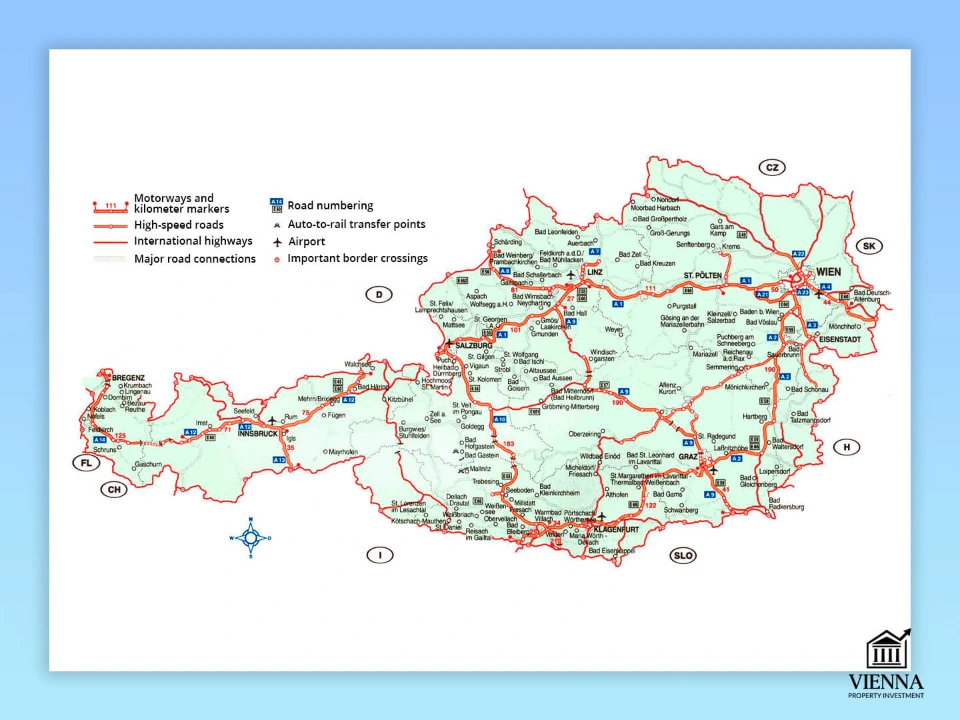
A mandatory vignette system has been in effect in Austria since 1997. Initially, these were paper stickers that drivers were required to place on their windshields. Since 2018, a digital vignette (E-Vignette) has been introduced alongside the traditional format.
The electronic version quickly gained popularity, especially among foreign tourists, as it can be purchased in advance through the official ASFINAG . This eliminated the need to search for sales points at gas stations or border crossings.
Advantages of a digital vignette:
- no need to stick and remove paper stickers;
- linking to the vehicle's license plate;
- Possibility of purchasing in advance online with choice of start date.
For which vehicles is a vignette mandatory?
The obligation to pay by vignette applies to all vehicles weighing up to 3.5 tonnes, including:
- passenger cars,
- motorcycles,
- light commercial vehicles (e.g. small vans).
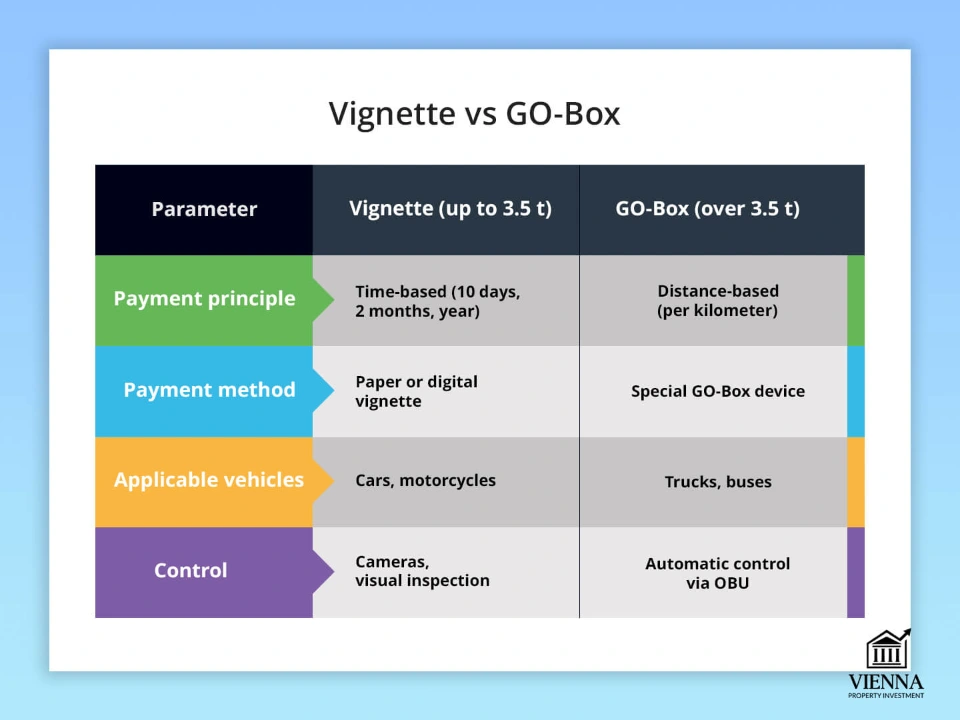
Trucks and buses over 3.5 tons have a separate payment system, GO-Box, which is based on mileage. Unlike a vignette, which is valid for a specific period of time (time-based toll), GO-Box is a distance-based toll system.
The difference between a vignette and a GO-Box
How to check for a vignette
Austria has a multi-tiered verification system:
- Automatic cameras on highways record the license plate number and compare it with the digital vignette database;
- ASFINAG mobile patrols conduct random checks in parking lots and exits;
- The police have the right to stop a vehicle and check both an electronic and a paper vignette.
Without a vignette, the violation is recorded immediately. A fine may be issued on the spot or through an administrative procedure.
Categories and types of vignettes in Austria
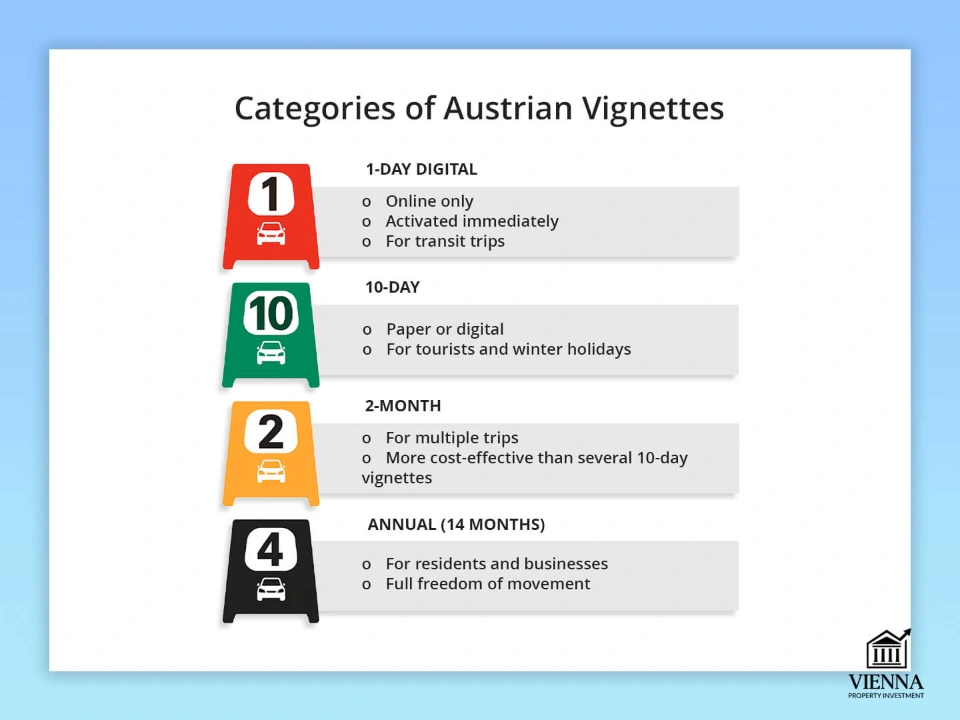
The Austrian vignette system is recognized as one of the most convenient and flexible in Europe. A key change in 2025 was the introduction of a one-day digital vignette. This solution has proven particularly popular among tourists and transit drivers who only travel through the country for a few hours.
A vignette is a mandatory fee for using motorways (Autobahn) and expressways (Schnellstraßen), and applies to cars, motorcycles, and vehicles up to 3.5 tons. Trucks are charged a GO-Box, the price of which depends on the distance traveled.
Basic types of vignettes
| Vignette type | Validity period | Format | Who is it suitable for? | Average price 2025 |
|---|---|---|---|---|
| 1-day (new for 2025) | 24 hours from the moment of activation | Digital only | Tourists and transit drivers | €8,60 |
| 10-day | 10 calendar days | Paper or digital | A popular option for short breaks and travel | €11,50 |
| 2 months | 60 calendar days | Paper or digital | For those who come to Austria several times a season | €28,90 |
| Annual | From December 1 of the current year to January 31 of the next | Paper or digital | Residents, active travelers, business | €96,40 |
Features of each category
The one-day digital vignette was introduced in January 2025 and is considered an excellent option for transit carriers.
- intended for short-term crossings of Austria, for example when travelling from Germany to Italy or Croatia;
- can be purchased exclusively online through the ASFINAG service or mobile application;
- activated automatically at the time you specified during purchase;
- published in electronic format only.
10-day vignette. The most popular option among tourists.
- ideal for a holiday in Austria or a trip to ski resorts;
- can be either paper or digital;
- When choosing the digital option, the driver independently sets the start date.
A 2-month vignette. Ideal for those who travel to Austria frequently during the same season, for example, for business meetings.
- More economical compared to other options.
Annual Vignette. A great choice for residents, entrepreneurs, and active travelers.
- validity period – from December 1 of the current year to January 31 of the following year (14 months in total);
- Provides unlimited access to all motorways and expressways at no extra cost.
Important: When purchasing a digital vignette online, it only becomes effective on the 18th day after purchase. This is due to the consumer's right to return the product within 14 days.
- The exception is the one-day and 10-day digital vignettes, which are valid immediately after issue.
If immediate activation of a different vignette is required, the buyer can indicate that the purchase is being made as a commercial customer. In this case, the waiting period does not apply.
Digital vs. paper vignette
Since 2018, drivers have been able to choose which vignette format they prefer to use to pay toll roads in Austria.
A digital vignette is assigned to a vehicle's license plate and purchased online. It cannot be lost or accidentally damaged, making it more secure.

The paper vignette remains in demand. Many tourists prefer it because it's easily purchased at gas stations, border crossings, or auto parts stores.
| Criterion | Digital vignette | Paper vignette |
|---|---|---|
| Method of purchase | Online (ASFINAG Shop, mobile app) | At the border, gas stations, auto shops |
| Binding | To the car's license plate | To a specific physical sticker |
| Risk of loss | Missing, because the data is in the database | Possible loss or damage |
| Activation | Within 14 days (or immediately for commercial purchases) | Immediately after gluing |
| On-road testing | Automatic – cameras read the number | Visual inspection by an inspector or camera |
| Convenience for carsharing | Suitable – easy to transfer to another car (if changing the number) | Cannot be transferred, tied to an individual |
| Price | Same as paper | Same as digital |
How to choose the best option
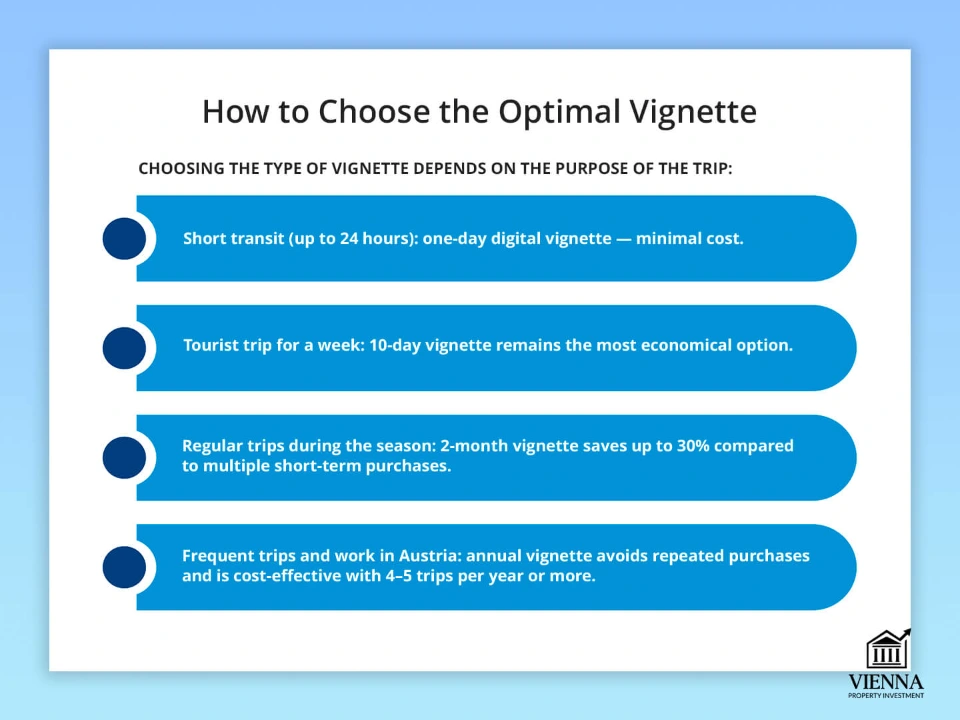
The type of vignette depends on the purpose of the trip and the frequency of use of Austrian toll roads:
- short-term transit (up to 24 hours): a one-day digital vignette allows you to minimize costs;
- Weekly tourist trip: 10-day vignette remains the best solution;
- regular travel during the season: a two-month vignette costs up to 30% less than purchasing several short ones;
- Frequent travel or work in Austria: the annual vignette pays for itself after just 4–5 visits to the country per year.
How to buy a vignette – all channels and pitfalls
It's important to remember that purchasing a vignette is not a formality, but a mandatory requirement for everyone using Austria's autobahns and expressways. In 2025, the purchasing process became significantly easier thanks to digital services, but there are still a number of nuances that must be taken into account to avoid fines and unnecessary expenses.
ASFINAG collects funds and oversees the vignette system. Drivers have two main options: a digital vignette attached to their license plate or a paper vignette affixed to the windshield.
Official channels for purchasing vignettes

It is safest to purchase a vignette only through official channels.
The ASFINAG Toll Shop online store is the primary resource for selecting any vignette. Payment can be made by credit card, PayPal, or Apple Pay, and confirmation is sent via email. The site is available in multiple languages, making it convenient for tourists.
Another option is the ASFINAG mobile app, available for iOS and Android and designed for those who prefer to make purchases while driving. It not only allows you to pay for your vignette but also notifies you when it's about to expire, helping you avoid accidental violations.
For those who choose the traditional option, paper vignettes can be purchased at gas stations, border crossings, and auto dealerships even in neighboring countries —Germany, the Czech Republic, Hungary, and Slovakia. The ASFINAG website features an interactive map of all sales locations.
Correct indication of vehicle data
One of the most common mistakes when purchasing a digital vignette is entering the vehicle's registration number incorrectly. Even one incorrect letter or number will result in the ASFINAG system failing to validate the payment, and the trip will be considered a violation. As a result, the driver faces a fine of at least €120.
To avoid such situations, please enter your data only in Latin characters and carefully check the accuracy of your entries. If you notice an error before activating the vignette, you can cancel it and issue a new one at no additional cost. After activation, data changes are only possible through ASFINAG customer support, and this service requires a fee of approximately €18.
Refund and re-issuance of a vignette

If a driver purchased a vignette online but changes their mind about using it, they have 14 days to request a full refund. After this period, a refund is only possible in exceptional cases, such as when selling a vehicle. In such situations, ASFINAG requires documentary proof of the change of ownership.
It's important to remember that it's recommended to purchase vignettes exclusively through the official ASFINAG website or app. Third-party sites often charge hidden fees or are scams. A secure site should have an .at domain and a secure https:// connection.
Fines and consequences for driving without a vignette
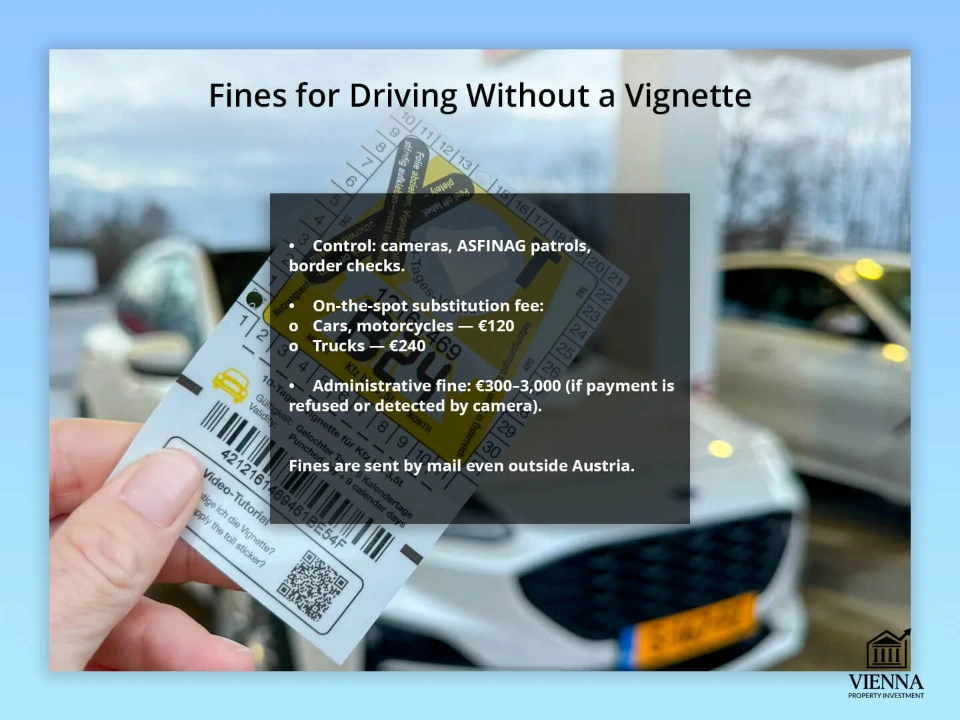
Road toll enforcement in Austria is highly organized. The country's motorways and expressways are equipped with automated cameras that verify in real time whether the vignette has been paid using the vehicle's license plate number. Additionally, ASFINAG mobile patrols are stationed in parking lots and exit ramps, and random checks are conducted at certain points, including border crossings.
If a vehicle is caught without a valid vignette in Austria, the driver faces a fine. The penalty system is structured on a two-tiered model: the Substitute Toll (also known as a "substitute toll") is an accelerated fine that can be paid immediately on the spot. For cars and motorcycles, the fine is €120 ; for trucks, it is €240.
The replacement board closes the issue without any additional consequences.
The second level is an administrative fine. It is imposed if the driver refuses to pay on the spot or the violation is recorded by a camera. The fine typically ranges from €300 to €3,000. Failure to pay may result in the case being taken to court, which can lead to even greater costs and even a ban on entry into the country.
Let me give you a practical example. A tourist entered Austria from Germany without a pre-purchased vignette. However, after only 15 kilometers, his car was spotted by a camera. A few weeks later, an official notice arrived at his home address demanding a €300 fine. Had the driver stopped at the nearest parking lot and purchased a vignette immediately after crossing the border, this situation could have been avoided.
It's worth remembering that Austria is strict about this. Austria actively exchanges data with other EU countries. Therefore, fines can reach even those living far outside Austria. It's best not to ignore them, as this will only lead to more problems. You can view the fines on the official Asfinag website.
Stages of sanctions and types of fines

The fine system in Austria has two levels: a substitute toll and an administrative fine. Which type of fine is applied depends on the stage at which the violation is detected.
| Type of sanction | Amount (2025) | When is it applied? |
|---|---|---|
| Substitute toll | €120 (cars, motorcycles) / €240 (trucks) | The driver is stopped on the spot by ASFINAG officers or the police and immediately agrees to pay the fine. |
| Administrative fine | €300 – €3 000 | If the violation was recorded by cameras, or the driver refused to pay the replacement fee. |
A substitute payment is essentially a simplified version of a fine that can be paid in cash or by card. It's essentially an opportunity to "settle the matter on the spot," without unnecessary bureaucracy and lengthy proceedings.
An administrative fine differs significantly from a replacement payment. It is significantly higher in amount and is always associated with official administrative proceedings. In this case, the driver or vehicle owner receives a written notice and is required to pay the fine within the specified time limit.
How does camera recording of violations work?
If the camera detects a vehicle without a valid vignette, the algorithm operates as follows:
- the license plate is read and checked in the database of active digital vignettes;
- if there is no recording, a violation recording report is generated;
- A fine notice is sent to the vehicle owner.
The letter states:
- place and time of the violation,
- photos from cameras,
- amount of the fine,
- Payment details and appeal procedure.
Appealing a fine
It is possible to challenge a fine only if there are serious grounds, for example:
- the state registration number is incorrectly indicated in the notification;
- the vignette was paid, but the data did not have time to be updated in the system;
- Error while registering digital vignette.
To file an appeal you must:
- prepare evidence – a receipt, electronic confirmation or a photo of the car with a paper vignette attached;
- contact ASFINAG;
- submit an application within the specified time frame (usually within two weeks from the date of receipt of notification).
It's important to understand: ASFINAG considers complaints solely on the basis of the facts. If guilt is obvious, the likelihood of a successful appeal is extremely low.
Common mistakes drivers make
Incorrect entry of the state registration number when purchasing a digital vignette – even one incorrect letter or number makes it invalid;
Late activation – annual and bi-monthly vignettes purchased online become active only 18 days after purchase;
Incorrect placement of the paper vignette – it must be affixed to the inside of the windshield in an area visible to cameras. If the sticker is stored in the glove compartment or incorrectly affixed, it is considered a failure to pay.
Financial consequences of the violation

Ignoring a fine can lead to serious problems:
- increase in the amount of the recovery;
- entry ban to Austria;
- difficulties when crossing EU borders, as fines are transferred to the European bailiff system.
Advice for drivers: Always check for a valid Austrian toll road vignette before driving. If you purchased a digital version, save the email and screenshot of the confirmation from ASFINAG.
Special toll sections and panoramic roads
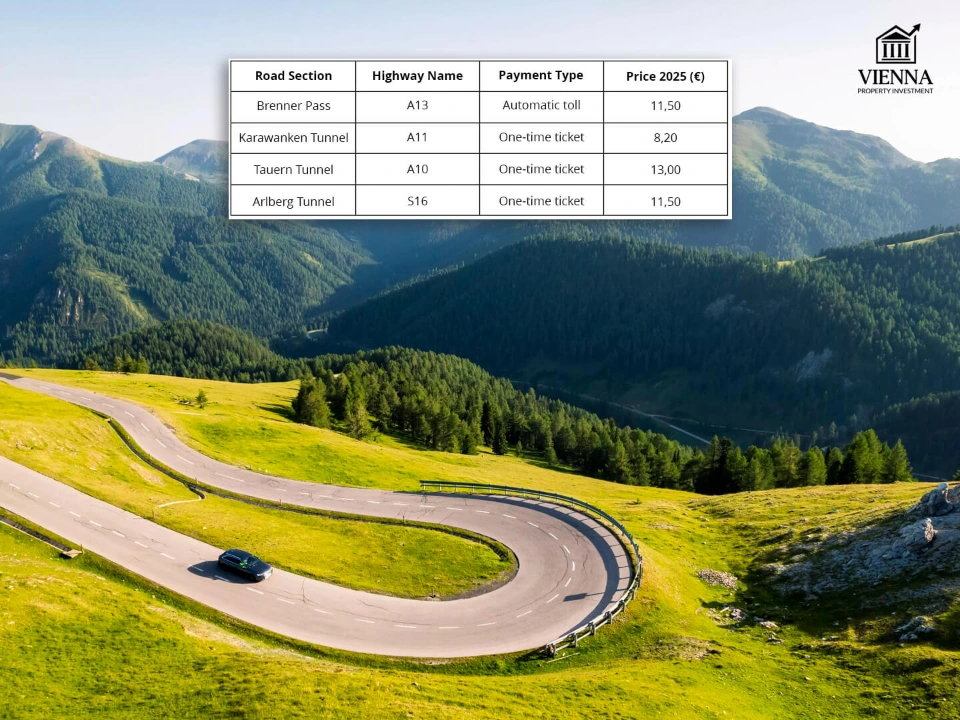
The vignette covers the vast majority of motorways and expressways in Austria. However, there are certain sections where an additional toll is charged. These roads are called section tolls. These include, first and foremost, complex engineering projects such as tunnels, mountain passes, and other unique infrastructure solutions.
The most famous example is the Brenner Pass (A13), which connects Austria with Italy. The current toll is €11.50. The Karawanken (A11), Tauern (A10), and Arlberg (S16) tunnels also fall into this category.
It is important to remember that even if you already have a valid vignette, these roads are subject to additional charges.
In addition to motorways, Austria has a special category of roads that serve not only as transport routes but also as tourist attractions.
The Großglockner High Alpine Road is one of the most famous routes leading to the country's highest mountain, Grossglockner. Entry fees are as follows: passenger car – €45; electric car – €35 (reduced rate); evening rate (after 6:00 PM) – €35.
The road operates seasonally – from May to October, depending on weather conditions.
The Timmelsjoch High Alpine Road (Passo Rombo) is a popular Alpine pass connecting Austria and Italy. The toll is €19 for cars and €12 for motorcycles. This Austrian toll road is also only open during the summer and fall (June to October) and is closed in winter due to snowfall and avalanche danger.
The fare is driven not only by the high cost of infrastructure maintenance but also by its tourist value. Funds raised from tickets are used to develop services, improve safety, and preserve the natural environment.
For those planning an active Alpine adventure, there's the option of purchasing a season pass. For example, the Großglockner High Alpine Road €125 pass allowing unlimited use of the road throughout the season. This is a great deal for mountain biking enthusiasts.
Special roads and tolls
| Object | Type of collection | Price 2025 (approx.) | Notes |
|---|---|---|---|
| Großglockner Hochalpenstraße |
Entry ticket | €45 (passenger car) €38 (electric car) €35 (evening rate, after 6:00 pm) |
Open only during the warm season (May–October). Discounts for electric cars and motorcycles. |
| Timmelsjoch (Passo Rombo) | Seasonal toll travel | from €19 (motorcycle) from €19–€25 (passenger car) |
Private trail with vehicle weight and width restrictions (up to 3.5 tons). Open from late May to October. |
| Brenner A13 (Brenner Autobahn) | Toll section / tunnel | ≈ €11 for passenger cars | Payment can be made on-site or online through ASFINAG. This is used for transit to Italy. |
GO-Box and cargo transportation (>3.5 t)

the GO-Box, is used instead of a vignette system
The GO-Box is an on-board unit (OBU) that attaches to the windshield of a truck. It communicates with road sensors and records every passage through toll roads. Tolls are deducted automatically based on actual mileage.
Thus, unlike a vignette, which is valid for a certain period of time, GO-Box is based on payment per kilometre.
Rates and classes:
The fee amount depends on three factors:
- number of vehicle axles (2, 3, 4 or more);
- engine environmental class (from Euro 0 to Euro 6) – the higher the class, the lower the tariff;
- Time of day – during rush hour, the cost of travel on toll roads in Austria may be higher.
In 2025, the average rate for a Euro 6 truck with two axles is around €0.22–€0.25 per km, and for older Euro 0 engines it is up to €0.40–€0.45 per km.
| Number of axles | Euro 6 (€ per km) | Euro 4 (€ per km) | Euro 0 (€ per km) |
|---|---|---|---|
| 2 axles | 0,22 | 0,27 | 0,40 |
| 3 axes | 0,29 | 0,33 | |
| 4+ axles | 0,38 | 0,43 |
Advice for carriers: Using eco-friendly vehicles can reduce travel costs by up to 30%.
Where to buy and register GO-Box

The device can be purchased at special GO-Vertriebsstellen sales points located at border gas stations, transport hubs, and along major highways.
To register you will need:
- vehicle registration certificate;
- documents confirming the engine’s environmental class (for example, Euro 6 certificate);
- company or driver details.
The device costs €5 and requires a deposit, which is used to deduct the fare as you travel.
Responsibility for incorrect data
One of the most common errors when using the GO-Box system to pay for Austrian roads is incorrectly indicating the number of axles or the vehicle's emission class. Even a minor inaccuracy, such as registering a truck as a two-axle vehicle instead of a three-axle vehicle, can lead to serious consequences. In such cases, ASFINAG reserves the right to charge additional fees for all kilometers traveled and impose an additional fine.
Penalties range from €240 to €3,000 and depend on the nature and scale of the violation. In the case of systematic errors, the carrier risks legal action and even entry restrictions into Austria.
A practical example: a transport company made a mistake when registering ten trucks, incorrectly indicating the emission class. As a result, the organization received an additional tax assessment of over €15,000, as well as an administrative fine.
Practice for tourists and transit drivers
Despite the widespread use of the vignette system, there are road sections in Austria where they are not required. These are primarily short border crossings that allow you to enter the country and immediately exit the motorway. This feature is especially convenient for residents of border villages or for those visiting for shopping.
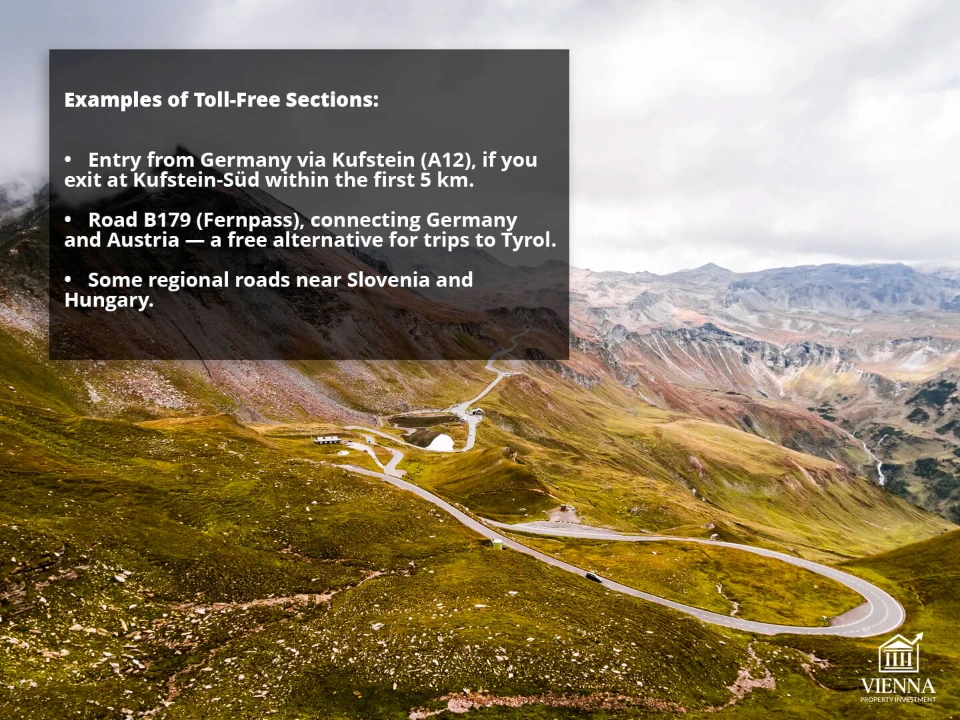
Examples of free routes:
- entry from Germany via Kufstein (A12) with the possibility of exiting onto Kufstein-Süd within the first 5 km;
- B179 (Fernpass) road linking Germany and the Tyrol region;
- some regional highways near the borders with Slovenia and Hungary.
How to save on vignettes and fees
For tourists planning a short stay in Austria, the optimal solution is a 10-day vignette, which costs €11.50 in 2025.
A new option, the one-day digital vignette, will be introduced in 2025. It costs just €8.60 and is ideal for transit or short trips.
Another way to reduce costs is to plan your route wisely. For example, if your route takes you through the Brenner Pass, you can take the regional road ahead of time and avoid the €11.50 surcharge.
Car rental features
Those renting a car should carefully check for a valid vignette for Austrian toll roads. This is easy to do: if using a paper vignette, simply inspect the windshield; if using a digital vignette, check with the rental company.
Rental agreements usually specify who is responsible for fines. If a vignette is missing, a fine will be sent to the rental company, and the amount, along with an additional commission, will be deducted from the customer's bank card.
Tip: At Vienna and Salzburg airports, most rental cars are already equipped with digital vignettes. However, in German border cities, this is not always the case.
Driving Safely on Austrian Toll Roads
Austria is a country of magnificent natural landscapes, where highways and alpine roads pass through national parks, mountain passes, and protected areas. Therefore, the government pays special attention to environmental and safety issues.
The system of vignettes and additional charges serves as a tool for regulating traffic flow, protecting the environment and supporting infrastructure.
In 2025, authorities will actively develop initiatives to support owners of electric and hybrid vehicles, as well as strengthened enforcement of traffic regulations on mountain routes such as the Großglockner High Alpine Road or the Timmelsjoch Pass.
Environmental initiatives: incentives for electric vehicles
In recent years, Austria has confidently established itself as one of the European leaders in the development of environmentally friendly transport. The state and local authorities are actively implementing incentives and special programs to encourage drivers to switch to electric vehicles.
Examples of benefits (valid as of early 2025):
- Großglockner High Alpine Road: Electric car owners can expect a discount of up to 50% on the toll. A standard ticket for a passenger car costs around €45, while for an electric car the price drops to €22–25.
- Autobahns: On some sections, such as the Brenner A13, pilot programs are in place with discounts for electric vehicles.
- Parking: Many cities, including Vienna and Salzburg, offer free or discounted parking for electric cars.
- Charging stations: ASFINAG is actively developing a charging infrastructure network along the motorways.
The terms of these discounts are periodically revised. For example, in 2024, Timmelsjoch only offered discounts during the summer season, but starting in 2025, these discounts may be valid year-round. Therefore, it's important to check the latest information on the official websites before traveling:
- ASFINAG – for motorways and toll roads,
- Großglockner – for panoramic routes,
- Timmelsjoch – for passes.
Example: route via Großglockner
A Tesla driver is planning a trip from Salzburg to Großglockner to Lienz. After checking the Großglockner website, he learns of a 50% discount for electric vehicles.
On descents, the car uses energy recovery, saving battery life. On narrow switchbacks, the driver makes stops at designated areas to avoid disturbing other road users. The end result is a scenic and eco-friendly ride, as well as safe.
The relationship between ecology and road tolls
The funds collected from driving on Austrian roads are used not only for repairs and maintenance of roads.
Part of the budget is used for:
- support for national parks and protection of rare animals,
- construction of noise barriers along highways,
- development of a network of charging stations for electric vehicles,
- projects to reduce CO₂ emissions in the transport sector.
This is particularly noticeable on tourist routes such as the Großglockner High Alpine Road, where fees go directly to preserving the Alpine nature.
Safe driving on mountain roads

Austria's Alpine roads are some of the most beautiful in Europe, but they require special attention from drivers.
1. Speed limits
- On narrow serpentines: 40–60 km/h,
- On wider sections: about 80 km/h.
In bad weather or during winter, speed limits are relaxed. Enforcement is carried out by patrols and cameras. Fines for speeding range from €150 to €400, and higher for serious violations.
2. Rules for motorcyclists
- Mandatory protective equipment: helmet, protective jacket, gloves.
- In Tyrol and Salzburg, motorcycles with noise levels above 95 dB are prohibited in summer.
On certain passes (for example, Timmelsjoch), restrictions are periodically introduced for motorcycles with powerful engines.
Parking in Vienna and other cities
In Austria, parking is no less a pressing issue than toll roads. This is particularly noticeable in major cities such as Vienna, Salzburg, Graz, and Innsbruck. Parking regulations are carefully regulated and strictly enforced by city authorities.
-
Read more – practical guidelines: parking in Vienna : where the Kurzparkzonen operate, how long you can park, and how to pay.
Violations are quickly recorded and can result in substantial fines. Illegal parking not only disturbs other road users but is also considered a serious administrative violation. Vienna, with its high population density and huge tourist flow, has one of the most sophisticated parking systems in Europe.
Large cities have so-called Kurzparkzonen (short-term parking zones), which limit parking times. Their main goal is to relieve city centers from excessive congestion and make parking more accessible.
In Vienna, such zones cover almost all of the central districts (1st–9th Bezirk) and some of the outskirts. In most cases, parking is limited to two hours.

For those planning to leave their car for a longer period, other solutions are available:

- Parkhäusers are multi-level indoor parking garages. They are typically located near shopping centers, train stations, or tourist attractions.

- Park & Ride parking is available on the outskirts of cities with convenient access to metro, commuter trains, or trams. This is especially convenient if you plan to use public transportation in Vienna and don't want to drive into the city center. This option is especially convenient for tourists and business travelers: you can leave your car for the entire day for free or for a modest fee without the risk of a fine.
| Zone | Opening hours | Price for 30 min (€) |
|---|---|---|
| Center (districts 1–9) | 8:00–22:00 | 2,20 |
| Outer districts | 8:00–20:00 | 1,10 |
| Night | 22:00–8:00 | For free |
Parkpickerl system (resident permits)
Local residents can sign up for a Parkpickerl pass, which allows them to park within their area without time restrictions.
Peculiarities:
- Registration is possible through the district office or online on the Wien .gv.at ,
- the cost in 2025 is about €10 per month (depending on the area),
- the action is limited to a specific area only.
Kurzparkzonen operating rules
Short-term parking zones in Vienna operate on weekdays from 9:00 AM to 10:00 PM, and in some areas until 6:00 PM. Parking is generally free on weekends and holidays, but exceptions may apply near train stations and popular tourist attractions.
There are two ways to pay for parking:
- using Parkscheine (paper tickets), which are sold at Tabak-Trafik kiosks, post offices, hotels and tourist centres,
- through mobile applications, for example
Important: You can find tips on "free parking" online, but most of them are unofficial and risky. Fines for violating the rules range from €36 to €90.
Tips for tourists: Hotels and tourist information centers offer free 15-minute passes, convenient for short stops. If you're planning a full day in Vienna, it's cheaper to park at a Park & Ride than to pay for several hours at the Kurzparkzone.
Parking rates in Vienna (2025)
| Parking type | Price per hour | Peculiarities |
|---|---|---|
| Kurzparkzone (short-term zone) | €2,50 | Maximum 2 hours |
| Park & Ride | €4 per day | On the outskirts of the city, close to public transport |
| Underground parking (Parkhaus) | €3–5 | No time limit |
| Free zones | €0 | Usually outside the center |
Features and benefits for citizens of Ukraine (temporary measures 2024–2025)
Austria, as part of the European Union, actively supports Ukrainian citizens stranded in Europe due to the war. One of the areas of assistance is special transport benefits, which significantly reduce travel costs within the country. In some cases, Ukrainian drivers are not even required to pay for toll roads or parking in Austria.
From 2024 to 2025, Austrian autobahn operator ASFINAG has introduced a temporary exemption from tolls for vehicles with Ukrainian license plates. This measure applies to passenger cars and small vans with a maximum permissible weight of up to 3.5 tons.
Duration of the benefit
According to official regulations, the exemption will last until October 31, 2025. After this date, the system will be revised: if the exemption is not extended, owners of vehicles with Ukrainian license plates will be required to purchase a vignette on a regular basis.
Important: This exemption applies exclusively to vehicles registered in Ukraine. Vehicles registered in another EU country are not exempt from the fee. No exemption applies to trucks over 3.5 tons: to use toll roads in Austria, Ukrainians must use the GO-Box system.
Conditions for using the benefit
To take advantage of this benefit, you must meet several conditions:
- the vehicle must have Ukrainian license plates and valid registration documents;
- if necessary, confirm that the transport is used for humanitarian purposes (for example, transporting aid);
- When checking on the road, present your registration documents to the police or ASFINAG officers.
The discount covers all motorways and expressways where a vignette is required. However, it's important to remember that payment remains mandatory on certain sections with sectional tolls (such as the Brenner Pass or Tauern Tunnel).
| Category | The exemption is in effect | Note |
|---|---|---|
| Passenger cars (up to 3.5 tons) | Yes | Only with Ukrainian numbers |
| Trucks (>3.5 t) | No | The GO-Box system is mandatory |
| Toll tunnels and passes | No | Brenner, Tauern, Arlberg – paid separately |
Practical instructions: how to apply for and confirm benefits

The ASFINAG system automatically recognizes Ukrainian license plates in most cases, but it is still recommended to pre-register your exemption on the official portal.
How to obtain a tax exemption for Ukrainians in Austria:
1. Go to the official ASFINAG Toll Exemption
2. Find the tab “Mautbefreiung Ukraine”.
3. Fill out the form, indicating:
- vehicle registration number (in Latin),
- type of car,
- purpose of travel (personal, transit or humanitarian),
- Upload copies of registration documents and driver's license.
4. Wait for confirmation to arrive by email.
Tip: Always carry a printed copy of your confirmation with you, especially when travelling through mountainous regions or border areas.
Upon entering Austria, border inspectors check license plates. If your vehicle is registered in Ukraine, you don't need to purchase a vignette. If in doubt, simply present your registration documents or proof of exemption.
Frequently Asked Questions (FAQ)
The Austrian toll road system is complex and nuanced. Therefore, I've compiled answers to the most frequently asked questions from tourists and transit drivers.
- Do I need a vignette if I only drive on a short section of the motorway?
Yes, even if it's just a few kilometers. Exceptions include certain free zones near the border (for example, in the Kufstein area on the A12). These areas are marked with special road signs.
- Is it possible to purchase a vignette retroactively?
No. The vignette must be valid from the moment you enter the motorway. If your vehicle is caught without it, a fine is inevitable and cannot be waived.
- What should I do if I made a mistake in the number when purchasing a digital vignette?
If an error is detected before activation, it can be corrected through ASFINAG support. After activation, changes are no longer possible; you will need to purchase a new vignette.
- What should I do if a vignette was applied to my windshield and it had to be replaced?
A paper vignette can only be transferred through an ASFINAG service center. If this is not possible, the driver is required to purchase a new one.
Conclusion
Austria's toll road system continues to change in 2025. The introduction of a one-day digital vignette has made travel more affordable for tourists, while temporary tax breaks for vehicles with Ukrainian license plates have significantly eased the financial burden for refugees and transit drivers.
At the same time, control remains strict: fines for violations are high, and the inspection system is fully automated.
Therefore, before every trip to Austria, it is recommended:
- Check current rates and rules on the official ASFINAG website,
- plan your route in advance, taking into account individual toll sections and passes,
- Take into account the parking peculiarities in Vienna and other large cities.
This approach will allow you to travel around Austria safely, comfortably and without unnecessary expenses.