Vienna's construction market offers a unique balance of historic buildings and modern new construction. The city's central districts retain 19th- and 20th-century buildings with their characteristic Altbau architecture, which are highly sought after by buyers who value style and cultural heritage.
At the same time, new residential complexes that meet modern standards of comfort, energy efficiency, and safety are actively appearing in suburban and developing areas.
The demand for new buildings in Vienna is driven by several factors. Firstly, the city's population is steadily growing, requiring increased living space.
Secondly, the business infrastructure is developing, with new business centers and coworking spaces emerging, attracting young professionals and investors. Thirdly, foreign buyers view the Austrian capital as a reliable location for long-term investment, supporting high demand for modern apartments.
The main goal of this article is to provide a detailed explanation of the process of purchasing a new apartment in Vienna, explaining the specifics of the legislation (Bauträgervertragsgesetz, BTVG), the mechanisms for protecting buyer funds, and key points to consider to minimize risks and ensure a safe investment.
Vienna's New Construction Market: Trends and Prospects
Vienna's current new-build market is developing amid limited supply in central areas. Dense development and the high level of preservation of historic buildings limit opportunities for new construction in the city center, so developers are focusing on suburban and developing neighborhoods.
New development areas:
| District | Main characteristics | Infrastructure features | Target audience |
|---|---|---|---|
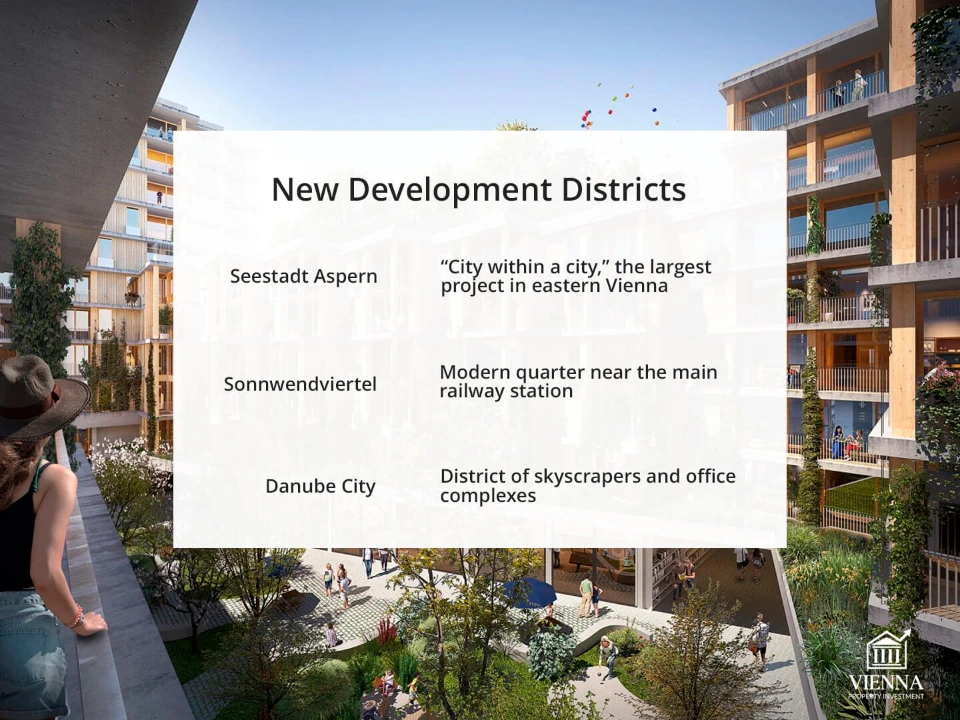
| Seestadt Aspern | "City within a City", the largest project in the east of Vienna | Schools, kindergartens, parks, lake embankment | Young families, professionals, investors |
| Sonnwendviertel | A modern quarter near the main station | Proximity to transport, shopping and business centers | Young professionals, urban residents |
| Danube City | An area of skyscrapers and office complexes | Financial center, international companies, Danube embankment | Professionals, international investors |
Government programs play a key role in stimulating construction. A key focus is on energy-efficient housing: new buildings are required to meet the klimaaktiv standard, which includes modern heating systems, thermal insulation, solar panels, and smart energy management technologies.
Five- to ten-year forecasts suggest further price increases for new buildings, especially near business and transport hubs. Smart homes and buildings with high environmental standards are expected to gain popularity, as well as the active adoption of green technologies such as geothermal heating systems and intelligent energy management systems.
Thus, Vienna's new-build market combines stable demand, thoughtful planning of new districts, and government support for innovative and environmentally friendly solutions, making investments in the city's modern housing reliable and promising.
BTVG and Treuhandkonto: How your funds are protected
In Austria, the process of purchasing an apartment in a new building is regulated by the Bauträgervertragsgesetz (BTVG), a law governing contracts with developers that has been in effect since 1997. The primary purpose of the law is to protect the interests of buyers who are investing in a property that is under construction or has not yet been transferred to ownership.
BTVG applies when a buyer purchases:
- right of ownership (Eigentum),
- building right (Baurecht),
- or a share in the right to use the apartment (Wohnungseigentum).
The law guarantees that the buyer will not lose funds even in the event of the developer's bankruptcy. The funds are protected through a trust account (Treuhandkonto), which is opened in the name of a trusted person (Treuhänder) – a lawyer or notary.
Basic principles of BTVG:
- Staged payment: funds are released only after each construction stage is completed.
- Notary/lawyer control: The Treuhänder checks the completion of the construction phase before transferring funds to the developer.
- Insurance and guarantees: With alternative financing, the developer is required to provide a bank guarantee or insurance.
- Contract transparency: the buyer receives clear information about the terms, cost, and mechanism for transferring the property.
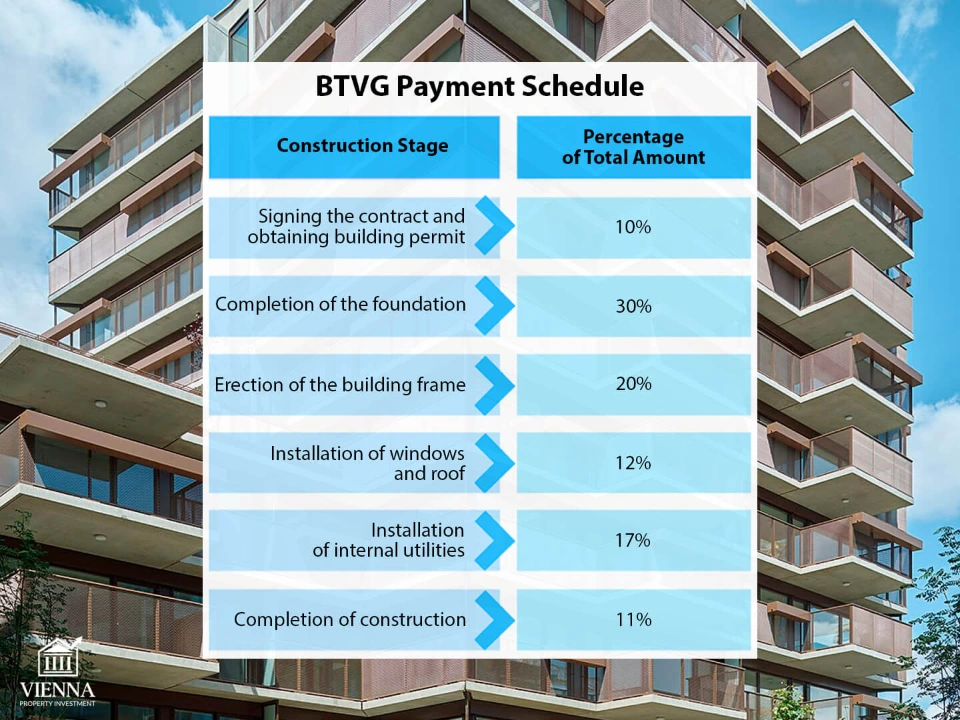
Model payment scale for BTVG
| Construction stage | Percentage of total amount | Peculiarities |
|---|---|---|
| Signing the contract and obtaining a building permit | 10% | Basic advance, funds remain in the Treuhandkonto |
| Completion of the foundation | 30% | Checking the quality of the foundation |
| Construction of the building frame | 20% | Control of compliance with design documentation |
| Installation of windows and roofs | 12% | Checking tightness and thermal insulation |
| Installation of internal communications | 17% | Electricity, plumbing, heating |
| Completion of construction | 11% | Final inspection and registration of ownership transfer |
All payments are processed through Treuhandkonto, which protects the buyer's funds from unfounded demands from the developer.

Treuhandkonto: opening and operating procedure
Key points:
- The account is opened not by the buyer, but by a lawyer or notary (Treuhänder).
- The buyer's funds in the account are fully protected by the BTVG law and insurance.
- The Treuhänder is responsible for releasing the funds only after confirmation of completion of each construction stage.
- The transaction is registered in the Grundbuch (land register) to record the ownership rights.
Documents required to open a Treuhandkonto
| For individuals | For legal entities |
|---|---|
| Passport or ID | Extract from the commercial register |
| Proof of Residence (Meldezettel) | Constituent documents of the company |
| Purchase and sale agreement | Power of attorney for a representative |
| Confirmation of source of funds | Beneficiary Data (UBO) |
| Bank statements/income (if necessary) | Explanation of funding sources |
All documents must be up to date and translated into German or English, notarized if necessary.
Advantages of the BTVG and Treuhandkonto mechanisms:
- Full investment protection – even if the developer goes bankrupt, funds remain in the account.
- Control over construction stages eliminates the risk of receiving a poor-quality project.
- Transparency and security of the contract – clear rules and legal control at every step.
- Possibility of engaging experts – a lawyer or architect can accompany the buyer during the construction quality inspection stage.
A step-by-step process for buying an apartment in a new building
Purchasing an apartment in a new building in Vienna is a multi-stage process that requires careful consideration. The transaction extends from the selection of the property to the final registration of ownership in the land register (Grundbuch).
A key role in the process is played by the Treuhander —a lawyer or notary licensed to open and maintain a Treuhandkonto. They perform the following functions:
- Monitors compliance with the BTVG agreement.
- Checks the compliance of construction stages with design documentation.
- Unlocks payments only after confirmation of stage completion.
- Provides legal protection for the buyer and registration of ownership rights in Grundbuch.
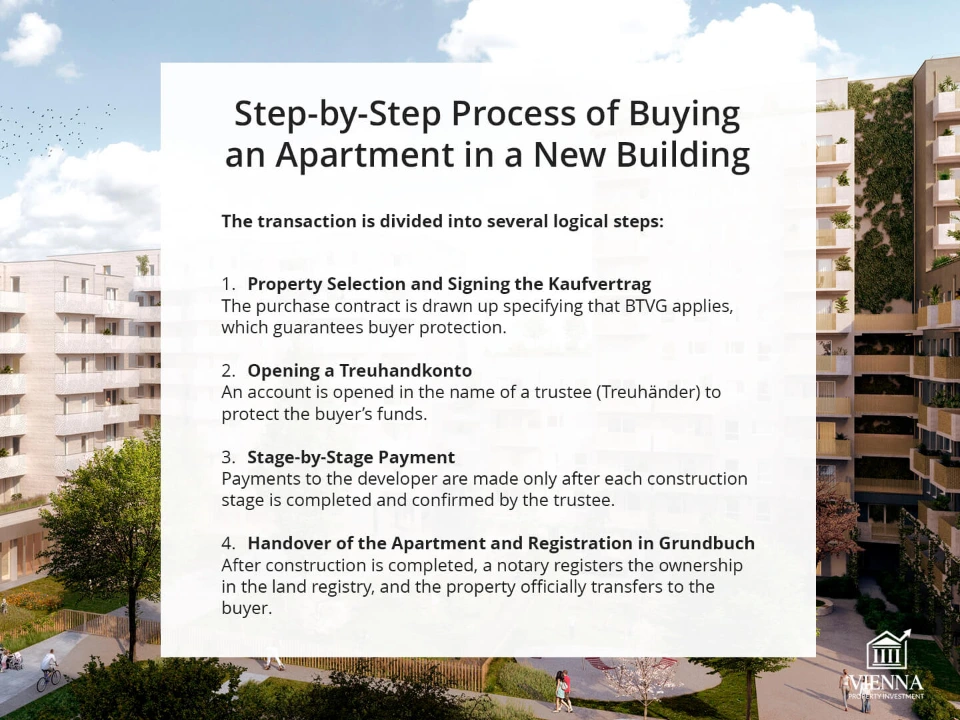
The transaction is divided into several logical steps:
1. Selecting an object and signing the Kaufvertrag
The sales contract is drawn up with an indication that the BTVG applies, which guarantees the protection of the buyer.
2. Opening a Treuhandkonto
The account is opened in the name of a trusted person (Treuhänder) to protect the buyer's funds.
3. Payment in installments
Payments to the developer are made only after the completion of each stage of construction and confirmation by the Treuhänder
4. Transfer of the apartment and registration in the Grundbuch
Once construction is completed, the notary registers the ownership in the land register, and the property officially passes to the buyer.
Model payment scale
| Construction stage | Payment share (%) | Comment |
|---|---|---|
| Obtaining a building permit | 10% | Basic advance payment at the start of the project |
| Foundation | 30% | Checking the strength and quality of the foundation |
| Building box | 20% | Monitoring compliance with design and construction standards |
| Windows and roof | 12% | Checking the tightness, thermal insulation, and reliability of structures |
| Internal communications | 17% | Electricity, plumbing, heating, ventilation |
| Completion of construction | 11% | Final inspection, handover of the property to the buyer |
Treuhandkonto: a guarantee of transaction security

A Treuhandkonto is a special trust account that protects the buyer's funds when purchasing an apartment in a new building. This account is opened exclusively by lawyers or notaries licensed as a Treuhänder. Banks do not open these accounts directly for buyers.
Benefits for the buyer
- Protection of funds from the developer's bankruptcy - the funds are held in an account under the control of the Treuhänder.
- Transparent payment mechanism – funds are released strictly according to construction stages.
- Additional insurance – if an alternative financing model is used, the developer is required to provide a bank guarantee.
Main banks working with Treuhandkonto
| Bank | Comment |
|---|---|
| Erste Bank | A large commercial bank with experience working with Treuhandkonto |
| Raiffeisen | Regional offices support transactions with new buildings |
| Bank Austria (UniCredit) | Serves large projects in Vienna |
| Volksbank | Works through Treuhänder to protect buyers' funds |
| Notartreuhandbank AG | A specialized bank under the supervision of the Federal Chamber of Notaries |
What should a buyer pay attention to?

Before purchasing an apartment, it is important to carefully check the property and documents to minimize risks.
Checking the object
- Make sure the developer has a building permit.
- Research the developer's reputation – past projects and customer reviews.
- Check the project's compliance with city codes and BTVG requirements.
Important documents
| Document | Purpose |
|---|---|
| Kaufvertrag | Sales contract specifying the application of the BTVG |
| Grundbuch | Land register confirming ownership |
| Bauakt | Archive of building permits, plans and approvals |
How to avoid risks
- Work with an independent lawyer or notary who specializes in Austrian new builds.
- Check the payment schedule for the Treuhandkonto and the compliance of the construction stages.
- Find out what guarantees and insurance the developer provides so you don't end up unprotected in the event of an unforeseen situation.
Popular new building projects in Vienna
The Austrian capital's real estate market is rapidly developing, and new projects are constantly appearing in Vienna, becoming not only residential complexes but also symbols of modern architecture.
1. Seestadt Aspern – “a city within a city”

Seestadt Aspern is one of the largest urban developments in Europe, located in the east of Vienna.
This is a fully autonomous district, including residential areas, a business zone, educational institutions, medical centers, and its own infrastructure. The project is designed to accommodate over 20,000 people and create 20,000 jobs.
Project Features:
- A large artificial lake in the center of the district.
- Priority is given to pedestrians and cyclists, with minimal vehicle traffic.
- Active implementation of green technologies, including solar panels and energy recovery systems.
| Characteristic | Information |
|---|---|
| Type of housing | Apartments of various classes, including affordable housing |
| Height of buildings | 5–8 floors (some towers up to 12 floors) |
| Location | Vienna's 22nd district, the eastern part of the city |
| How to get there | Metro U2, Seestadt station |
| Infrastructure | Schools, kindergartens, shopping centers, business buildings |
| Peculiarities | An artificial lake, pedestrian zones, and traffic minimization |
| Target audience | Families with children, young professionals, investors |
2. Trienna Living – a modern residential complex near Hauptbahnhof

Situated near Vienna's main train station (Hauptbahnhof), this project is ideal for those who appreciate the city's vibrant rhythm. Trienna Living consists of several multi-story buildings with spacious apartments and business-class suites.
The complex includes:
- Underground parking.
- Fitness room and recreation areas for residents.
- Modern shops and cafes on the ground floors.
- Easy access to the city center thanks to convenient transport links.
| Characteristic | Information |
|---|---|
| Type of housing | Business class apartments |
| Height of buildings | 10-12 floors |
| Location | The Hauptbahnhof district, near the center of Vienna |
| How to get there | Subway U1, station Hauptbahnhof |
| Infrastructure | Underground parking, shops, a fitness center, and a cafe |
| Peculiarities | Contemporary design, convenient access to business districts |
| Target audience | Businessmen, young families, premium tenants |
3. Danube Flats – skyscrapers on the Danube

Danube Flats is one of Vienna's most ambitious residential tower projects on the banks of the Danube. This premium development is designed for buyers who value prestige, panoramic views, and access to modern amenities.
The complex includes:
- Elite apartments with panoramic windows.
- Fitness center and SPA.
- Private recreation areas and restaurants for residents.
- Direct access to the Danube embankment.
| Characteristic | Information |
|---|---|
| Type of housing | Premium apartments |
| Height of buildings | Up to 150 meters (one of the highest in Vienna) |
| Location | Danube City, 22nd district of Vienna |
| How to get there | Metro U1, station Kaisermühlen VIC |
| Infrastructure | Fitness center, spa, restaurants, private recreation areas |
| Peculiarities | Panoramic windows, direct access to the Danube embankment |
| Target audience | Premium buyers, high-end investors |
4. HoHo Wien – a unique wooden project

HoHo Wien is the world's first multi-story wooden skyscraper, standing 84 meters tall. The project has become a symbol of Vienna's transition to sustainable architecture, focused on reducing its carbon footprint and using renewable resources.
Project Features:
- 75% of the structures are made of wood.
- Significant reduction in CO₂ emissions compared to traditional construction.
- The buildings have mixed uses: hotels, offices, restaurants and residential apartments.
- HoHo Wien has become a model for future green projects across Europe.
| Characteristic | Information |
|---|---|
| Type of housing | Mixed use: apartments, offices, hotels |
| Height of buildings | 84 meters |
| Location | Seestadt Aspern, Vienna's 22nd district |
| How to get there | Metro U2, Seestadt station |
| Infrastructure | Restaurants, office spaces, hotel rooms |
| Peculiarities | 75% timber construction, sustainable architecture |
| Target audience | Investors who love innovative and green solutions |
5. LeopoldQuartier – ecology and innovation

Vienna is opening the LeopoldQuartier , an innovative quarter and part of an urban development along the Danube Canal. The project focuses on sustainable construction and mixed-use: office, commercial, and residential spaces, with an emphasis on sustainability.
Why this project is interesting:
- LeopoldQuartier is one example where urban development combines with ecological solutions: wooden structures, resource efficiency, and a reduced carbon footprint.
- This is not just a residential complex; the project also features offices and business space, making it multifunctional and suitable for mixed-use living, working, and leisure.
- The use of wood in the frame elements is rare for multi-story buildings of this scale in Vienna, making the project a model for the future of sustainable construction.
| Characteristic | Information |
|---|---|
| Type of housing | Mixed use: residential apartments, offices, commercial premises |
| Height of buildings | Up to 10 floors |
| Location | LeopoldQuartier, along the Danube Canal, central Vienna |
| How to get there | Metro U4 and U2 (station Schottenring), |
| Infrastructure | Offices, residential buildings, shops, restaurants, green areas for recreation |
| Peculiarities | Hybrid timber construction (~2800m³ timber), 2800 tonnes CO₂ reduction, solar panels, geothermal energy, green roofs |
| Target audience | Investors, companies, startups, and residents who value an environmentally friendly and modern urban lifestyle |
Financial and legal nuances for foreign investors

Purchasing real estate in Austria is a transparent and reliable process, but there are certain legal and financial nuances for foreign investors. Vienna attracts buyers from around the world thanks to its stable economy, high standard of living, and safe investment climate.
However, before entering into a transaction, it is important to consider the legal specifics and financial obligations associated with purchasing a home.
Restrictions for foreign buyers
In Austria, regulation of real estate purchases by foreigners is carried out at the federal state level, and each state has its own rules. Therefore, restrictions on the purchase of real estate in Austria by foreigners can vary significantly depending on the region.
Vienna has the most lenient conditions—foreign citizens, including those from non-EU countries, can purchase apartments with virtually no restrictions. However, other federal states, particularly tourist regions such as Tyrol or Salzburg, have stricter regulations.
The main requirements that may be presented are:
- Obtaining special permission from the state government (Landesregierung) for the purchase.
- Proof that the property will not be used for speculation or short-term resale.
- In some cases, confirmation that the property will be used for personal residence and not for unlicensed tourism business.
These measures are aimed at protecting the local housing market and preventing excessive price increases due to foreign demand.
Taxes and additional expenses
Purchasing real estate in Austria involves mandatory taxes and additional transaction costs. Below is a summary of the key real estate taxes in Austria and typical expenses that typically arise during the transaction.
| Type of tax/fee | Bid | Comment |
|---|---|---|
| Grunderwerbsteuer – acquisition tax | 3.5% of the cost | Payable upon purchase, mandatory tax for all buyers |
| Grundbuch – registration fee | 1,1% | Payment for entering the property rights into the land register |
| Notary and lawyer services | 2–3% | Transaction control, opening of Treuhandkonto, registration of Kaufvertrag |
| Real estate services (if necessary) | 3% + VAT | Not always required, depends on the method of purchase |
Tip: When planning your budget, it's recommended to include an additional 8-10% of the apartment's cost for taxes and professional services.
Investment options

The Austrian real estate market allows foreign investors to choose different strategies depending on their goals:
For personal use
- A classic option for families planning a long-term stay in Vienna.
- This is especially relevant for those planning to move or obtain a residence permit.
For rent
- Vienna is one of the largest educational and business centers in Europe.
- There is a high demand for rentals in areas close to universities (Alsergrund, Währing) and business centres (Leopoldstadt, Donaustadt).
- Renting out your property allows you to generate a stable passive income and recoup your investment.
Investments in the premium segment
- Purchasing apartments in prestigious residential complexes, such as Danube Flats, with the intention of reselling them in a few years.
- This segment is particularly interesting for investors focused on capitalization growth.
The future of new buildings in Vienna
Vienna's new construction market is rapidly developing and adapting to modern environmental and technological challenges. In the next 10-15 years, the city plans to become a leader in sustainable and innovative construction.

Green architecture. The main trend of the future is the transition to environmentally friendly technologies and a reduced carbon footprint.
- Phasing out gas in favour of geothermal heating, solar panels and heat pumps.
- Implementation of rainwater collection systems and green roofs.
- New buildings are designed as Zero Emission Buildings – with a zero or even negative carbon balance.
Examples of this approach are the projects in the Seestadt Aspern and Sonnwendviertel areas.

Timber and hybrid structures. Austria is actively implementing multi-story timber construction, which combines aesthetics, durability, and environmental friendliness.
- The most famous example is HoHo Wien, an 84-metre-tall building made of 75% wood.
- Such projects reduce CO₂ emissions and create a comfortable indoor microclimate.

Smart Home Technologies. Modern new buildings in Vienna are increasingly equipped with intelligent systems:
- control heating and lighting via smartphone;
- automatic ventilation with heat recovery;
- smart security and video surveillance systems;
- Real-time energy consumption control.
These technologies improve living comfort and attract young buyers.
Rising prices for energy-efficient homes. Demand for modern, eco-friendly apartments is growing annually.
- Energy-efficient homes are already selling for 10-15% more than traditional properties.
- In the long term, such apartments will provide higher rental income and sustainable value growth.
Conclusion: Investing in new buildings in Vienna is not only a profitable way to preserve and increase capital, but also an opportunity to become part of the global trend toward sustainable development.
For foreign buyers, the key to success remains careful selection of the property, verification of all legal aspects, and cooperation with professional lawyers and developers.
Conclusion
Vienna's new-build market remains one of the most stable and secure in Europe. Thanks to a transparent legal framework, the BTVG, and the Treuhandkonto system, buyers and investors enjoy a high level of asset protection. New projects such as HoHo Wien, Danube Flats, and Seestadt Aspern demonstrate how Vienna combines innovation with respect for tradition.
However, a successful investment requires careful selection of the property, document verification, and working only with reputable developers and experienced lawyers. Purchasing an apartment in a new building is more than just a transaction; it's a long-term investment in the future, where not only square footage matters, but also quality of life, stability, and sustainable development.