Linz is Austria's third-largest city and the capital of the state of Upper Austria. The city proper has a population of approximately 205,000–220,000, while the suburbs and agglomeration are significantly larger. It is a major industrial and technological hub, a transportation hub between Vienna, Passau, and Salzburg, with a strong economy, universities, good infrastructure, and a high quality of life.
The Linz real estate market has been growing in recent years, with demand stable and prices rising moderately. The city is particularly attractive to those considering buying a home in Austria and comparing different scenarios: for example, buying a home in Vienna with maximum liquidity or choosing Linz as a quieter and more affordable alternative with good living and rental potential.
Why Linz Attracts Buyers
Economy and Jobs. Upper Austria is one of the world's strongest economic regions. Linz boasts strong mechanical engineering, metallurgy, industrial manufacturing, and technology sectors. Recently, interest in IT, startups, and service development has grown, attracting professionals seeking housing close to work.
Universities and students. Linz boasts universities, colleges, and institutes of higher education, creating a constant demand for apartments from students and young professionals. They value proximity to public transportation, good connections to the city center, and amenities.

Infrastructure and quality of life. Linz is a cultural center with museums, concerts, and theaters; the city is located on the Danube River and surrounded by green spaces. Transportation is well-developed: buses, trams, regional trains, and access to highways. All this makes Linz a comfortable city and attractive for families.
Prices are lower than in Austria's largest cities. Housing prices in Linz are lower than in Vienna and Salzburg, especially in the central, prestigious districts of those cities. This allows for entry into the market with a smaller investment and still enjoys a stable income.
Rental market structure. There is demand for both long-term rentals (families, working professionals) and short-term rentals (tourists, business travelers, students). Some areas offer particularly favorable rental yields.
Investment potential. Stable price growth in Linz, especially in popular and central areas, moderate risk compared to highly competitive markets, and great opportunities for those looking to invest with growth and rental potential.
What areas are worth considering?
| District / County | Character | Average purchase price (€ per m²) | Average rent (€ per m²/month) | Who is it suitable for? |
|---|---|---|---|---|
| Altstadt / Innenstadt | Historical part, good status, near the center, architecture, view of the Danube and the center | ≈ 5 500 – 6 500 | ≈ 14-16 | Foreigners, culture lovers, those who want prestige |
| Urfahr | Apartments with views, green slopes, good views, a quieter character, yet close to the center | ≈ 4 800-5 500 | ≈ 13-15 | Families, those who want greenery + access to the center |
| Bindermichl, Ebelsberg | Suburbs/sleeping areas, quieter, with green areas, more accessible | ≈ 4 000-4 800 | ≈ 11-13 | Families, budget shoppers |
| St. Magdalena / Kleinmünchen | The character is more residential, good infrastructure, schools, transport | ≈ 4 500-5 200 | ≈ 12-14 | Families, long-term rentals |
| Neue Heimat / periphery | New construction, outskirts, a little further from the center | ≈ 3 800-4 500 | ≈ 10-12 | Those who are looking for cheaper accommodation are ready to compromise on location and transport |
In central Linz (Altstadt/Innenstadt), prices depend on the building's condition and location: apartments in historic, restored buildings are more expensive, while options above busy streets are cheaper. In Urfahr, views of the Danube and green slopes are prized, while family apartments with a balcony or terrace sell the fastest.
In quiet neighborhoods like Bindermichl, Ebelsberg, and Neue Heimat, affordability and maintenance costs are more important. Families and budget-conscious buyers choose these areas. St. Magdalena and Kleinmünchen are attractive for their good schools and transportation, so long-term rentals are always in demand.
Prices in Linz
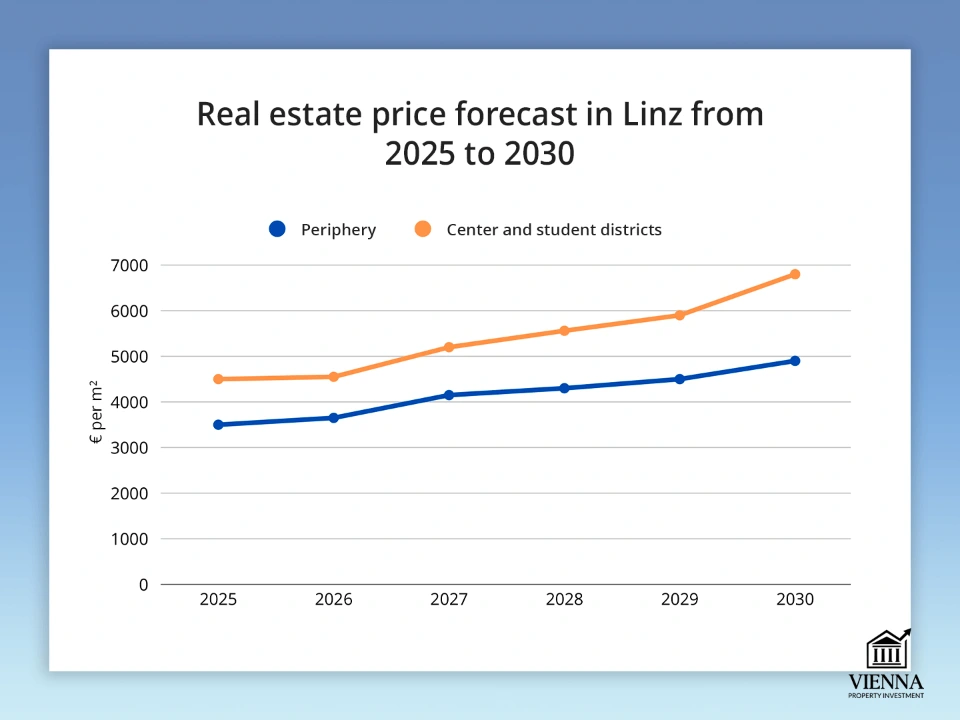
Currently, the Linz market remains relatively balanced: the average price of approximately €5,060 per square meter is significantly more affordable than in Vienna or Salzburg, while still retaining growth potential. According to EHL, yields in the 3.5–4.5% per annum range make the city attractive to investors, especially for apartments near universities or the city center.
New buildings in Linz are increasingly entering the market, and they are driving the price ceiling. Residential properties in projects with modern layouts, underground parking, and energy efficiency ratings of A often sell for above-average prices, as demand for such properties remains consistently high. Meanwhile, in the outskirts, where older buildings predominate, price growth is slower.
The forecast for 2025–2030 is moderately positive: in the central districts and student clusters (Urfahr, St. Magdalena), growth of around 4–6% per year can be expected, while in the outskirts the figure could decline to 2–3%.
The trend is clear: the higher the quality of housing and the lower the utility costs, the faster such apartments appreciate in price. This is due to Austrian buyers and renters increasingly prioritizing energy efficiency, environmental friendliness, and transport accessibility.
Features for foreign buyers
Buying real estate in Linz is a fairly transparent process, but much depends on the buyer's origin. Austria strictly separates the rules for EU/EEA citizens and those for foreigners from third countries. This is done to ensure the housing market remains accessible to local residents, while foreign investment remains under state control.
The purchase process itself is convenient and secure: transactions are recorded in the land registry ( Grundbuch) , eliminating the risk of hidden debts or double sales. The buyer receives official confirmation of ownership, and the process is supervised by a notary or lawyer responsible for the legality of the transaction. This guarantees protection for both local and foreign buyers.
For EU/EEA citizens
Residents of EU and EEA countries have it easiest: they can buy apartments and houses in Linz with virtually no restrictions. The purchase process is almost identical to that of Austrians. No special permits or lengthy approvals are required—simply select the property, check the documents, and formalize the transaction with a notary. This saves time and makes entering the market quick and straightforward.

For buyers from non-EU countries
For buyers from third countries, the rules are stricter— restrictions apply to foreigners purchasing real estate in Austria . Before purchasing, you must obtain permission from the Grundverkehrsbehörde (regional land commission). It is the commission that decides whether a plot of land or an apartment can be purchased. The Grundverkehrsgesetz ( regulates such transactions and is particularly strict in tourist regions (Tyrol, Salzburg, Vorarlberg), where efforts are made to preserve real estate for local residents.
To complete the process, you need to gather a package of documents: a passport, a preliminary purchase agreement, proof of income, and sometimes a certificate of no criminal record. On average, the process takes several months, so it's best to plan your purchase in advance.
Additional expenses
It is important to remember that you need to add another 8-10% in additional costs to the price of the apartment:
- property transfer tax - 3.5%,
- registration in the land register - 1.1%,
- notary services or lawyer - about 1.5-2%,
- agency commission - up to 3.6%.
In addition, the future owner faces monthly expenses: utilities, heating, and building maintenance. The building's condition and energy efficiency directly impact these costs, so it's worth clarifying in advance how much it will actually cost to live in the apartment.
Comparison: Linz and other Austrian cities
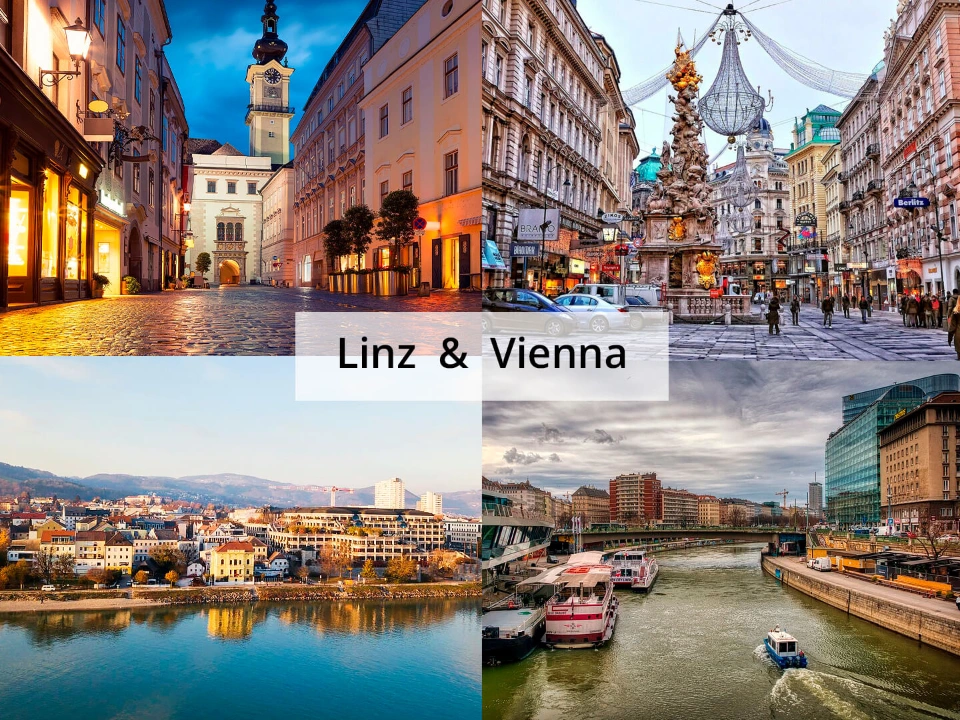
Compared to Vienna, Linz remains a more affordable option: the entry barrier is lower, and rental yields are slightly higher. This makes it attractive for those looking for a practical investment without the added cost of capital status.
Graz, in turn, benefits from student demand and its university, which ensures a steady flow of tenants. Linz, on the other hand, boasts a balanced market structure: families, young professionals, and investors all buy here, making its market more diverse.
| Parameter | Vienna | Graz | Linz |
|---|---|---|---|
| Price per m² (center) | €8 000–10 000+ | €5 500–6 500 | €5 000–6 500 |
| Rental yield | 3–4 % | 4–5 % | 3,5–4,5 % |
| Entering the market | Very tall | Average | More accessible |
| Demand | International | Students, youth | Mixed |
Work and quality of life in Linz
Linz is a city where economic stability is closely intertwined with a comfortable and healthy lifestyle. It's not as "loud" or touristy as Vienna or Salzburg, but this is precisely what makes it attractive to those looking to build a long-term life, find work, and enjoy nature at the same time.
Below, we'll explore why Linz is considered a convenient place to work, what career prospects are available, and how residents combine business with leisure.
Economy and jobs

Upper Austria is considered one of the most developed federal states in the country, and is home to a center of industry, science, and technology. Major factories, logistics centers, and international companies provide thousands of jobs.
Voestalpine remains the region's symbol , building a whole ecosystem of suppliers and contractors. But it's not just steel: the city is also rapidly developing mechanical engineering, electronics, logistics, and the chemical industry.
This diversity of sectors offers employment opportunities for engineers and technicians, as well as managers, marketers, and financiers. Several key industries are concentrated here:
- Metallurgy and industry. Linz is known as the home base of voestalpine, one of the largest steel and metalworking manufacturers in Europe. The company employs thousands and has relationships with dozens of contractors and suppliers.
- Mechanical engineering and logistics. The city is home to mechanical engineering plants, transport companies, and enterprises operating in river and rail transport. The Danube makes Linz a convenient logistics hub for Austria and neighboring countries.
- Innovation and IT. In recent years, Linz has begun to develop its digital technology sector. It is home to startup incubators, IT companies, and university-affiliated research centers. In particular, the Johannes Kepler University Linz is active in applied computer science and business technology.
- Education and medicine. Universities and hospitals also create jobs for teachers, doctors, researchers, and administrative staff.
For example, an engineer who comes to Linz on a contract with voestalpine gets the opportunity not only to develop his career but also to provide his family with a stable life in a city where everything is close by—schools, parks, and cultural centers.
Work-life balance
Linz has a distinct advantage over Vienna in its size: it's large enough to offer everything you need for a career, but isn't overloaded with traffic or crowds of tourists.
Benefits of life:
- You can get to work in 15–25 minutes by public transport or bicycle.
- The Danube River divides the city into two parts, creating a sense of space and openness.
- There are many green areas around Linz: Botanischer Garten Linz , parks along the river, the Pöstlingberg hills with panoramic views.
- For sports enthusiasts, there are bicycle paths along the Danube, hiking trails, and sports complexes.
For example, an IT employee might take the tram to work in the morning for 10-15 minutes, and then meet friends on the Danube embankment or go jogging in the park in the evening. This kind of lifestyle is impossible in large cities.
Nature and recreation nearby
Although Linz is known as an industrial center, it is also called a "green city." It boasts a striking combination of factories and innovative parks, spacious green spaces, and a river that bisects the city. It's a rare example of industry not displacing nature but existing alongside it, creating a comfortable living environment.
The Danube and its embankments
The river is a true calling card of the city. Its banks are lined with well-maintained embankments where you can stroll, bike, picnic, or simply relax by the water. In summer, the Danube's venues host festivals and open-air concerts, from classical music at the Brucknerhaus to contemporary street events. For residents, this means cultural events and nature are always within easy reach.
Pöstlingberg – the symbol of the city
Pöstlingberg Hill, with its white church at its summit, is visible from almost anywhere in Linz. It can be reached on foot, but residents and tourists often take the funicular, considered one of the oldest in Austria. At the top, a viewing platform with panoramic views of the Danube and the city center awaits. For families, the Grottenbahn amusement park offers a miniature Linz with fairytale decorations. It's a place where residents come not only for the views but also for the weekend atmosphere.
Cycling and walking routes
Linz is conveniently located on the Donauradweg , one of Europe's most famous cycle paths, which connects Germany, Austria, Slovakia, and Hungary. For locals, it's not only part of an international route but also a daily way to spend time actively.
Cycling along the Danube is a favorite pastime for city residents, and for renters of apartments in these areas, proximity to the highway is a major plus. Furthermore, the surrounding area offers numerous hiking trails through forests and hills, perfect for hiking or taking easy strolls with children.
The Alps are an hour away
Those who love mountain views and sports are especially lucky: the nearest Alpine slopes are just 60–90 minutes away. In winter, skiing and snowboarding are available, while in summer, hiking, swimming in the lakes, and outdoor recreation are available. This location makes Linz an ideal compromise: on the one hand, it's a business and industrial city, and on the other, a gateway to the Austrian countryside.
Family and education

One of the main reasons families choose Linz is the convenient combination of work, study, and a quiet life. Unlike large cities, everything is close by: schools, sports clubs, and workplaces are usually within a 15-20-minute drive, and sometimes even within walking distance. This creates a sense of compactness and makes everyday life less stressful.
Kindergartens and primary schools
Upper Austria's preschool education system is well developed: parents can choose between public and private kindergartens. Much attention is paid to language development and creative activities. Linz also has bilingual kindergartens where children are taught both German and English—a convenient option for families with foreign parents.
Primary schools (Volksschule) are located in almost every district. For example:
- VS Urfahr is a popular school in the northern part of the city that actively collaborates with cultural centers.
- Volksschule Ebelsberg is located in a residential area with convenient infrastructure for families.
Middle and high schools
Linz offers various types of secondary schools: Gymnasiums (academic schools), Realschule (high schools), and vocational schools. Among them, the following are worth noting:
- Bischöfliches Gymnasium Petrinum is a Catholic grammar school with a long history and modern teaching methods.
- Europagymnasium Auhof is a school with a focus on languages and international programs.
- HBLA Lentia is a school with a focus on business and economics, preparing students for university entrance.
Universities and Higher Education
Linz is a university centre, and this has a strong influence on the real estate market.
- Johannes Kepler University Linz (JKU) is the region's leading university, renowned for its faculties of economics, law, social sciences, and especially IT. The university collaborates with large companies and startups, opening up real career opportunities for students.
- Kunstuniversität Linz — University of Arts and Design, which trains specialists in architecture, media, and artistic practices.
- The Catholic Privat-Universität Linz is a small but prestigious university focusing on philosophy, theology, and the humanities.
-
Interesting fact: JKU has a "city within a city" campus, housing academic buildings, a library, research labs, restaurants, and sports facilities. For students, it's an environment where they can simultaneously study and live.
Information for investors
Imagine a city where industry and innovation go hand in hand, and housing demand is driven by several audiences: students, young professionals, families, and expatriate employees of large companies. That's exactly what Linz looks like. It's not overheated Vienna or the student-centric Graz, but a balanced market where you can buy an apartment for less without worrying about it sitting idle.
Demand that never goes away
In the area around the Johannes Kepler University campus, apartments are renting out in a matter of days. Students and young IT professionals are literally lining up for small studios and two-bedroom apartments.
In family-friendly neighborhoods, the situation is reversed: tenants are in no rush to move out, signing contracts for years in advance. For investors, this means one thing: rent is stable and predictable. Yields average 3.5–4.5%, and in student neighborhoods, they can reach up to 5%.
Price increases - without sharp jumps
Linz is gradually increasing in value, and that's a good sign. Apartments can appreciate by 15-20% over five years, especially in the city center and new buildings with energy-efficient systems. Buyers are increasingly choosing homes where utility bills don't eat up half their income, and these properties are becoming market favorites. Older buildings are losing out in this regard—they're cheaper to start with, but require more investment.
What is more profitable to buy?
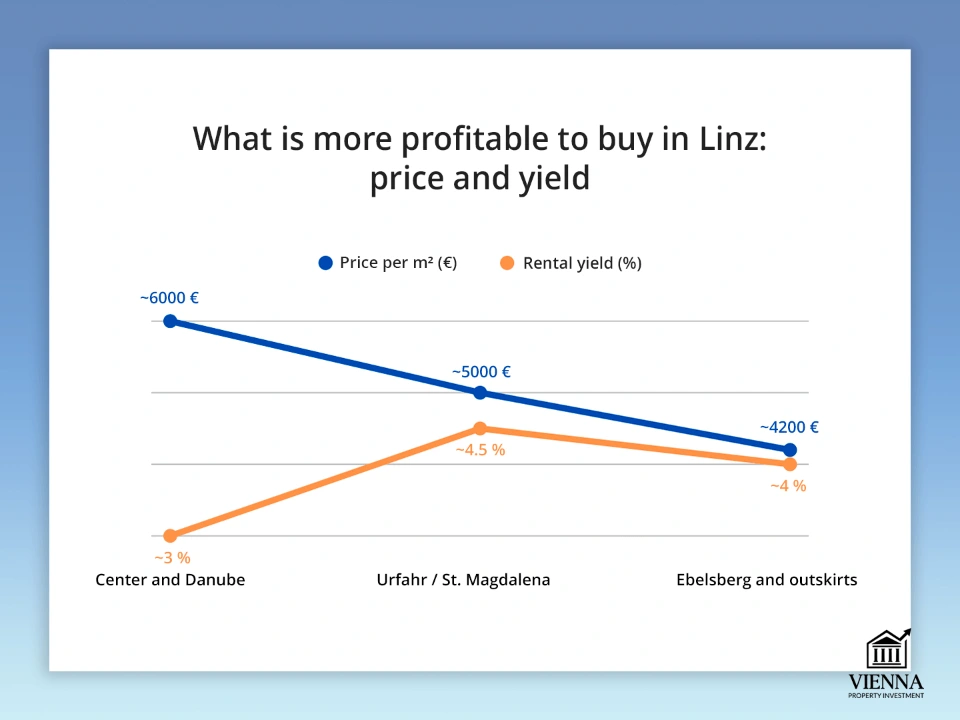
- The city center and the Danube embankment are synonymous with prestige. Rental yields are lower there, but resale value is very high.
- Urfahr and St. Magdalena are a versatile solution. They can be rented to students, families, and young professionals. The apartments are always vacant and appreciate in value faster than average.
- Ebelsberg and its outskirts offer a chance to enter the market with minimal investment. While price increases are modest, there are still tenants, and the entry barrier is significantly lower.
New rules – what to consider
Austria is gradually restricting short-term rentals through Airbnb and Booking. In Linz, the restrictions are currently more relaxed, but the trend is general. More and more owners are opting for long-term rentals—it's more secure, reliable, and protects against seasonal fluctuations. Another issue is rising mortgage rates. For investors, this means it's important to carefully calculate not only income but also expenses before buying.
Tips for Shopping in Linz
Buying an apartment in Linz always begins with the question: why do you need it? It's one thing to look for a family home, and quite another to view it as an investment . The city's market is flexible: there are prestigious apartments in the center, new buildings on the outskirts, and studios near universities.
When the goal is renting
For investors looking for income, compact apartments are a key choice. A studio or small two-room apartment in Linz is almost always in demand. The reason is simple: the city is not only an industrial hub but also a university town, home to thousands of students and young professionals working in IT, medicine, and science.
Apartments near Johannes Kepler University (JKU) or in areas with convenient transportation links, such as trams and buses, offer the best value. For example, in Urfahr, demand is stable year-round: students seek housing closer to campus, and professionals seek it closer to offices and research centers. Even a small apartment here rents out within a few days.
It's also important to consider the rental format. Young tenants often choose apartments with basic furnishings: a kitchen, a closet, a bed, and a workspace. This allows for quicker occupancy and reduces the risk of the apartment being empty. Investors should budget for furnishings from the start—this will make renting out the apartment easier and more expensive.
When price matters
Families and buyers looking for spacious homes often turn to the outskirts. In Ebelsberg or Neue Heimat, the price per square meter is lower than in the center, but new buildings offer modern layouts and low utility costs. This is a good option for those who want more square footage for the same price.
Things to remember
- Energy efficiency. New windows, insulation, and efficient heating directly impact your bills and the apartment's appeal.
- Additional costs. In addition to taxes and registration with Grundbuch, notary fees and agency commissions are added—an average of 8–10% to the price.
- Legal protection. Even if everything seems transparent, a notary and a lawyer are still necessary. Non-EU buyers often require permission from the land commission.
Financial side
Most real estate transactions in Linz involve a mortgage. Austrian banks readily provide loans to buyers, but terms can vary greatly: the interest rate depends on the chosen bank, the loan term, and the size of the down payment. On average, the starting capital should be at least 20-30% of the apartment's value, but the requirements are sometimes higher for foreign buyers.
It's important to remember that in addition to the loan principal and interest, there will be additional costs , such as property insurance, bank fees, and mandatory charges. Therefore, before signing the contract, it's important not only to compare rates but also to calculate the total cost of the loan for the entire term.
-
For example, even a 0.5% difference per annum on a €300,000 loan means an overpayment of tens of thousands of euros over 20–25 years. Therefore, choosing the right bank and financing terms wisely is an investment that directly impacts the final return.
Final opinion
Linz is the golden mean of the Austrian real estate market. It doesn't have the inflated prices of Vienna, nor the heavy reliance on tourism of Salzburg. The city's economy relies on industry, universities, and culture, which creates a steady demand for housing.
For investors, Linz offers the opportunity to enter the market with a lower investment than in the capital, while still earning a return of 3.5–4.5% per annum. For families, it's a convenient and green city where work, schools, and recreational areas are all close by.
Factors such as the following are becoming especially important for foreign buyers:
- the opportunity to gain access to the European real estate market ;
- stable demand for rentals from both students and families;
- availability of new buildings with good quality and energy efficiency;
- predictable price growth over a 5-10 year horizon.
If you consider Linz as a long-term option, it can satisfy two goals at once: living comfortably and investing securely in the future.