Vienna is Austria's largest city and also a federal state with special powers in areas such as social security, urban planning, and integration. Changes in Vienna's population influence not only urban policy (housing, transportation, and healthcare) but also federal indicators. In 2024-2025, Vienna was the main contributor to Austria's overall migration growth.
The city is showing steady growth after years of stagnation. This is due to a combination of internal and external migration, as well as a relatively stable birth rate.
Total numbers and recent trends

As of January 1, 2025, Vienna's official population was 2,028,289. This number increased by 22,529 in 2024. For Vienna, a large, developed, and already densely populated city, this is significant growth. Importantly, it was achieved through two key factors:
Natural increase (births minus deaths): +2,153 people
This is a small but steady increase, driven by relatively high birth rates in multicultural areas and low mortality rates among young people. For a developed European capital, positive natural growth is more the exception than the norm.
Migration influx: +20,715 people (including adjustments)
Migration remains the main driver of Vienna's population growth. This includes both international migration (citizens of the EU, Eastern Europe, and other countries) and internal migration from other regions of Austria. Many move to Vienna for education, work, or family reasons.
According to Deutsch, 72% of foreign citizens in Austria have lived in the country for five years or more.
Fifteen percent of foreigners living in Vienna were born in Austria. This means they are the children of immigrants and belong to the second generation.
This means that migration is not a temporary phenomenon, but a "persistent component" of social life. It has a long-term impact on the labor market, the education system, culture, and integration processes.
A historical reversal: Vienna is a metropolis again

These modern changes mark a turning point in history. Throughout the 20th century, Vienna experienced a long period:
- population decline after the collapse of the Austro-Hungarian Empire,
- period of stagnation in the mid-20th century,
- and gradual growth that began in the 1980s.
Only in the last 15-20 years has the capital resumed its rapid growth, and the 2 million mark symbolizes Vienna's return to its status as a major European metropolis. Furthermore, demographers predict that growth will continue, although perhaps not at the same rapid pace as in the 2010s and 2020s.
Population growth is more than just a dry statistic. It leads to significant changes in a city's economy, infrastructure, and social life.
Growing burden on social and urban services
Vienna's growing population is leading to greater demand for:
- kindergartens and schools,
- medical services, primarily clinics and hospitals,
- public transport and transfer hubs,
- social services and support programs.
As a result, the city is forced to expand its infrastructure: building new schools and medical facilities, as well as developing the metro, tram lines, and S-Bahn network. With the number of families growing, the issue of education quality and access to places in Vienna's best schools .
Changing employment structure
Vienna, as a highly developed service centre, continues to strengthen the following sectors:
- IT and digital technologies,
- science and research,
- education and healthcare,
- culture and creative industries,
- tourism and hotel business.
This effect is reinforced by the influx of students and researchers through Vienna's universities . Young migrants and specialists from Europe and other countries increase the flexibility of the labor market and give the city's economy a new impetus.
Territorial unevenness of growth
The growth is distributed very unevenly:
- The outer districts ( Favoriten , Donaustadt , Floridsdorf , Simmering ) are growing the most actively – most new housing is being built here.
- The central districts ( Innere Stadt , Josefstadt , Neubau ) are growing more slowly due to the almost complete development and the large number of offices and commercial properties.
- Areas with traditionally high proportions of migrants are showing particularly significant growth, which is changing the cultural and social structure of the city.
This unevenness has implications for transport policy, infrastructure construction and the development of new urban centres.
Why is Vienna growing so rapidly right now? Key reasons:
- a stable economy and a comfortable standard of living;
- the city's status as one of the most livable in the world;
- strong universities and research centers;
- a developed system of social housing accessible to many residents;
- high cultural value and sense of security;
- large urban development projects, thanks to which many new apartments appear every year.
Citizenship, origin and ethnic diversity

Modern Vienna is one of the most multinational cities in Europe, and this is clearly reflected in the composition of its population. As of January 1, 2025, the city had a population of 2,028,289. Of these, 63.6% (approximately 1.29 million) hold Austrian citizenship, and 36.4% (approximately 739,000) are foreign nationals.
Thus, over 30% of the capital's population are not Austrian citizens, and approximately every second resident has a migration background—either born in another country or holding a foreign passport. This underscores Vienna's exceptional demographic diversity and strengthens its reputation as a resilient multicultural hub.
One of Vienna's defining characteristics is its impressive multinationality. The city is home to people from almost every corner of the planet—as of 2025, it was home to passport holders from 178 different countries. This diverse ethnic composition is the result of a number of historical and ongoing waves of migration.
The largest diasporas have historically been represented by immigrants from the countries of the former Yugoslavia (primarily Serbia and Croatia), Turkey, and Eastern European countries—Poland, Romania, Ukraine, and Hungary. These communities have formed the backbone of Vienna's ethnic landscape for many years, beginning with the waves of immigration from the 1960s to the 1990s, which intensified following the enlargement of the European Union.
Top countries of origin (by number of citizens/residents as of 2025)

Below is an approximate ranking of the largest national groups for 2025, based on citizenship:
| Country/citizenship | Total (men + women), people. |
|---|---|
| Serbia | 75 998 |
| Syria | 62 915 |
| Germany | 62 441 |
| Türkiye | 47 521 |
| Poland | 44 373 |
| Romania | 43 723 |
| Ukraine | 39 361 |
| Hungary | 29 948 |
| Croatia | 28 144 |
| Afghanistan | 24 130 |
Alongside long-established communities, the number of citizens from the Middle East and South Asia—primarily from Syria and Afghanistan—has recently increased significantly. The growth of these groups is due to the events of 2015–2025 and global humanitarian crises.
Vienna has become one of Europe's leading centers for the reception and adaptation of refugees, which has significantly influenced the composition and cultural makeup of several city neighborhoods. These movements are not uniform: alongside humanitarian flows, labor migration from EU countries is also growing, particularly from Germany, which has one of the largest numbers of its citizens residing in Vienna.
It's worth noting that the majority of foreigners in Vienna are not newcomers, but long-time residents. Over 70% have lived in Austria for five years or more, and approximately 15% were born in the country. This speaks to strong intergenerational ties, deep involvement in the city's economy and social life, and the gradual emergence of new cultural layers in Viennese society.
Many families use German as their primary language for work and communication, but they also continue to uphold traditions and speak the native languages of their ancestors. This makes Vienna a truly multilingual city.
Language environment

In addition to German, Turkish, Serbo-Croatian, Romanian, Ukrainian, Arabic, and other languages are widely used in everyday communication in Vienna. This diversity manifests itself in everyday life, in the workplace, and in educational and government institutions. This situation impacts city governance, creating a need to develop multilingual services, integration projects, and cultural events.
The population's religious diversity is also rapidly changing. The number of Catholics in the capital is steadily declining—a result of both general secularization and migration flows. At the same time, the proportion of Muslims, Orthodox Christians, and people who identify with no religion is increasing.
These trends are creating a new structure for the cultural and spiritual life of the capital, enriching the spectrum of religious communities and influencing the spheres of education, social welfare, and intercultural dialogue.
Intra-urban vs. migrant origin

Residents with migrant backgrounds are distributed unevenly throughout Vienna. In some districts, they account for more than half the population, while in others, their share is significantly lower. This creates local cultural centers with distinct languages and customs, reinforcing the need for a tailored approach to urban development, infrastructure, and integration programs.
The Austrian capital thus creates a special type of European multiculturalism, characterized by a rich migration history, a diversity of cultural communities, a significant level of their inclusion in the life of the city, and a continuing influx of new residents.
This diversity becomes a key element of the capital’s demographic structure and serves as a fundamental condition for its social, economic and cultural progress.
Age and sex composition

The age and gender distribution of residents is an important part of Vienna's demographic makeup. According to the Wien in Zahlen 2025 report, at the beginning of the year, the capital had 2,028,289 registered residents, with an average age approaching 41. This indicates a relatively young and fairly stable age distribution.
The gender composition is balanced: women account for approximately 51% of the population, while men account for approximately 49%. This distribution is typical of large European cities with effective healthcare and stable longevity rates.
Age groups

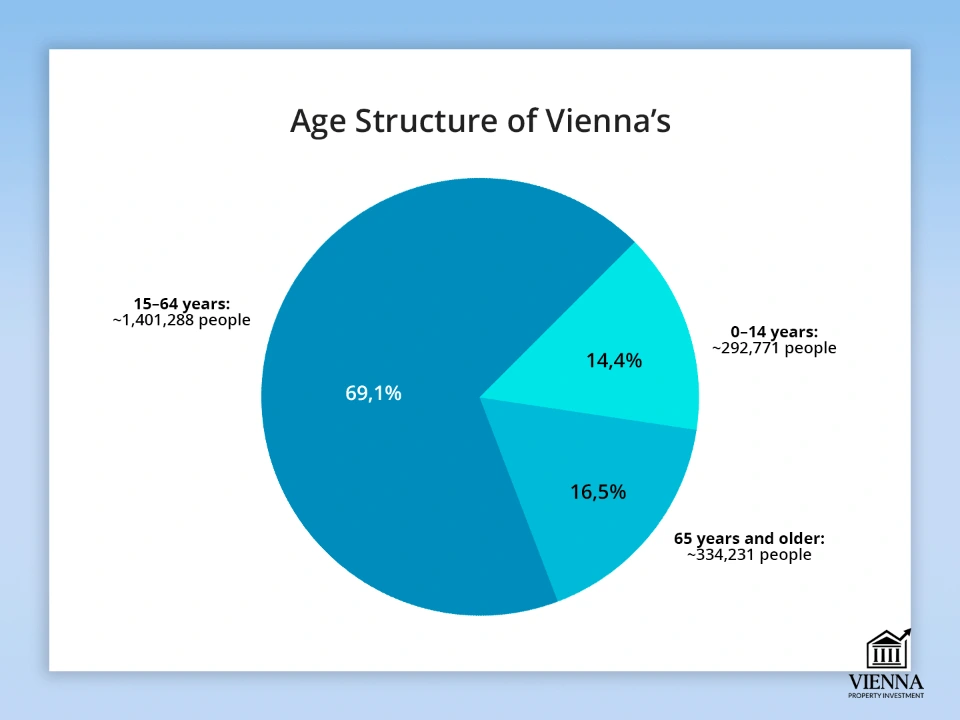
Vienna's population age structure appears balanced: children, working-age adults, and senior citizens are represented in comparable proportions. There are approximately 292,800 children and adolescents under 14, indicating a large number of families and a stable need for schools, daycare centers, and social support.
The largest group is made up of residents aged 15 to 64—approximately 1.4 million people. They form the bulk of the workforce, drive business activity, and support the city's economic development. People over 65 number approximately 334,000, and their numbers significantly influence decisions regarding healthcare, social protection, and urban infrastructure development.
| Age group | Number (approximately) | Share / comment |
|---|---|---|
| 0–14 years (children) | ~ 292,771 people | a significant proportion of children and adolescents |
| 15–64 years (working age) | ~ 1,401,288 people | the bulk of the population, the "workforce" of Vienna |
| 65 years and older | ~ 334,231 people | a significant group of elderly residents |
The capital's age distribution has remained relatively stable in recent years. The proportion of children in the population remains virtually unchanged, demonstrating Vienna's attractiveness to families with children and its high birth rate, which is also supported by migration flows.
A significant portion of the population growth is attributed to the active working-age population—the result of both internal migration and the arrival of foreign specialists, students, and young workers. The number of elderly people is increasing gradually, but remains large enough to create a stable demand for healthcare and senior care programs.
Demographic balance of Vienna

The capital's demographic balance is maintained by several factors. The active attraction of young migrants helps maintain a relatively low median age and ensures a regular replenishment of the workforce. Stable birth rates and Vienna's attractiveness for families with children contribute to the significant proportion of children among residents.
At the same time, long life expectancies and high standards of healthcare mean the city has a large elderly population. Vienna doesn't experience a sharp skew toward the elderly, as is the case in many other European capitals, but it still has a significant and stable proportion of elderly residents. This creates a more balanced demographic picture and has a positive impact on social stability.
This demographic composition directly impacts various aspects of the capital's life. The economy benefits from a large share of working-age citizens, which fosters the growth of innovation, services, industry, and education. Urban planning must account for the growing demand for housing, transportation, schools, and hospitals, as the increasing number of young and working-age residents places additional strain on this infrastructure.
At the same time, a significant proportion of elderly residents prioritize the creation of a barrier-free environment, provision of medical care, social assistance, and the development of projects for active living in old age.
Fertility, mortality and migration
If we talk about 2024 and Vienna specifically, the picture is as follows: 19,070 people were born, 16,917 died. As a result, the city's population grew naturally by 2,153 people.
Meanwhile, the situation is worse in Austria overall—nationwide, deaths still outnumber births, and 2024 will be a negative year again. Vienna, by comparison, fares better, largely due to the influx of migrants and its unique urban demographics.
Migration component:
- Internal migration: people move to Austria from other regions – most often students and young professionals looking for study or work.
- External migration: people from other countries come to the country—some to earn money, others fleeing war or danger (for example, Ukrainians after 2022, previously—residents of Syria and other countries).
Migration increases the number of people and workers, but it also requires additional efforts to integrate them, such as language training and recognition of education and professions.
In the long term, there is a risk that the influx of people from abroad will decrease—for example, due to political restrictions or economic changes. In this case, urban population growth may slow, and domestic factors such as birth rates and population aging will begin to play a decisive role. Such scenarios are taken into account in the MA 23 forecasts.
Spatial distribution by districts of Vienna

Vienna consists of 23 municipal districts (Bezirke). These districts vary greatly in population density, development type, social composition, growth rates, and migration and economic characteristics. Below are key observations and data for several major districts as examples.
Key significant areas - population size and dynamics
| District (Bezirk) | Population as of January 1, 2025 (estimate) | Comments: growth, development characteristics, features |
|---|---|---|
| Donaustadt (22) | ~ 228,158 people | The largest district in Vienna by population: it has many modern residential areas and the population is growing rapidly. |
| Simmering (11) | ~ 112,149 people | The population has been growing rapidly in recent years, primarily due to new construction and more affordable housing. |
| Favoriten (10) | ~ 223,190 people | One of the large residential areas that has long attracted families, migrants and working people. |
| Floridsdorf (21) | ~ 189,551 people | The northern district on the outskirts of the city: here there are both residential buildings and green areas, and housing is relatively inexpensive. |
| Meidling (12) | ~ 102,393 people | A typical residential area with medium building density and a stable number of residents. |
| Innere Stadt (1, center) | ~ 16–17 thousand people (significantly less than in residential areas) | The historic city center: densely built-up areas with many offices, shops and tourist attractions, but few permanent residents. |
What this data reveals is that the fastest-growing areas with the largest populations are typically located on the outskirts and in the suburbs—for example, Donaustadt , Floridsdorf , and Simmering —as well as large residential areas like Favoriten . Meanwhile, the city center, despite its dense development and well-developed infrastructure, remains relatively sparsely populated.
Spatial and socio-economic patterns
1. Suburban and outer areas: growth zone
Vienna's outlying districts—such as Donaustadt, Floridsdorf , and Simmering —are rapidly growing in population. This is due to several factors: the construction of new residential complexes, relatively affordable real estate prices, convenient transportation links, an influx of migrants (from other regions of Austria and from abroad), and high demand for family housing.
The most populated areas and the fastest growing ones are on the outskirts and in the suburbs—such as Donaustadt, Floridsdorf , and Simmering—as well as large residential areas like Favoriten. The city center, despite its many buildings and well-developed infrastructure, remains sparsely populated.
2. Classic residential areas: stability and mixed composition
Neighborhoods like Favoriten and Meidling have long been established as residential areas and have developed a full-fledged infrastructure. Their populations remain relatively stable, and the residents themselves are very diverse—they include families, workers, and people of varying social status and cultural backgrounds.
The residential environment is also heterogeneous: modern apartment buildings, prefabricated residential areas, and old historical buildings can be found side by side. This maintains the districts' diverse and heterogeneous social structure.
3. Center: density, but few permanent residents
The city's central districts, including Innere Stadt, form its core. They are home to government offices, office buildings, cultural venues, and tourist attractions. Despite their dense development and historical value, these districts have few permanent residents.
Most of the buildings are used for offices, hotels, and tourist attractions, so the number of permanent residents is smaller. As a result, the city center is primarily used for work and tourism, while the main residential areas are located on the outskirts, creating a noticeable contrast between the two.
4. Socioeconomic and ethnic diversity by district
The outer and southern districts often have a higher proportion of families with migrant backgrounds, a high population density, and relatively affordable housing. This creates a distinctive social and cultural environment, primarily inhabited by young families, migrants, and workers.
The western, northern, and central areas tend to attract professionals, have older buildings, and housing costs in some areas are significantly higher.
This heterogeneity between districts reveals differences in income levels, housing costs, occupations, and cultural traditions among their residents. These differences directly determine where funds for transportation, utilities, and social support are prioritized, and also shape the city administration's approach to budget allocation.
Context and relevance for urban policy and planning
Vienna's uneven population distribution across districts is a key factor in urban planning. Population growth in peripheral areas creates a need for expanded transportation routes, new housing, and additional schools, healthcare facilities, and social services.
Stability and diversity in residential areas require supporting utilities, renovating housing stock, and improving social and living conditions. As for the city center, a balance must be struck: preserving the historical and cultural heritage, developing trade and tourism, and avoiding the area becoming a "lifeless core."
Furthermore, the social, economic, and cultural diversity between districts requires a tailored approach to urban policy. It is important to consider the needs of migrants, families, youth, seniors, and various professional groups by offering appropriate support, integration, housing, and education measures.
The growth of suburbs and residential areas is an opportunity for sustainable growth, but also a responsibility for the municipality: to ensure an even distribution of funding, utilities, and public services across all urban areas.
Population forecasts and development scenarios
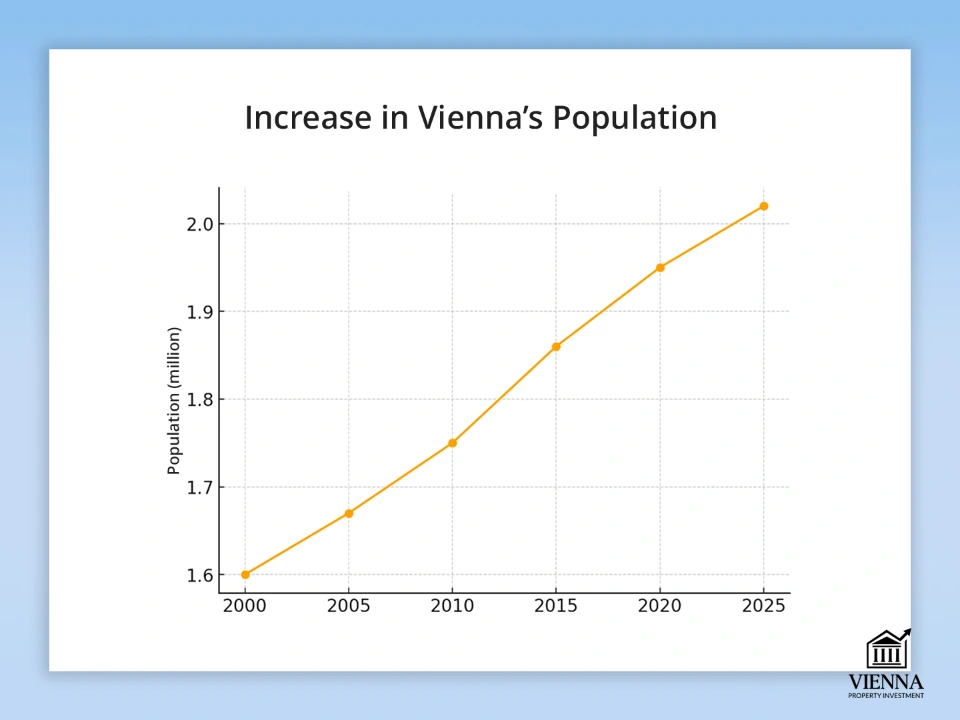
Demographic projections for Vienna indicate continued population growth beyond 2025, although the rate of increase will fluctuate depending on economic conditions, migration flows, and social dynamics.
Vienna's population has grown steadily over the past two decades, from approximately 1.6 million in the early 2000s to over 2.02 million in 2025. Migration, rather than natural reproduction, has been the main contributor to this growth, and analysts expect this trend to continue for the foreseeable future.
Most forecasts compiled by city and government agencies agree that Vienna has the potential for further population growth by 2030–2040.
However, the scale of the increase depends on a number of factors: the activity of international migration, the economic situation in Austria and the EU, the need for labour, birth rates, and the effectiveness of housing policy.
The forecast assessments include both positive and moderate development options to predict the future load on urban systems and the social sphere.
One of the main factors is the timing of migration flows. During periods when people were especially active in migrating from other countries, such as 2015–2017 and 2022–2023, the population increased significantly. Since Austria's economy is growing steadily and the country needs labor, migration remains the main source of Viennese population growth.
While the city's birth rate is fairly stable, it only partially offsets the aging population. Therefore, the contribution of migration to population growth becomes even more important.
Vienna's population composition will also change in the future. An increase in the elderly population is expected as people live longer. At the same time, Vienna will continue to attract young migrants, students, skilled professionals, and families with children, so the influx of young people will continue.
This will help maintain a more or less balanced age structure of the population, but it will still increase the burden on the healthcare system and services that provide long-term care for the elderly.
Several forecast options are used to analyze a city's long-term development. Below is a simplified analytical table showing typical development scenarios used in demographic planning.
Vienna's population forecast scenarios
| Scenario | Forecast for 2030 | Forecast for 2040 | Basic assumptions |
|---|---|---|---|
| Basic (moderate) | 2.10–2.12 million | 2.18–2.22 million | Many migrants, a rapidly growing labor market, a high demand for specialists, more students and exchanges. |
| High (optimistic) | 2.14–2.17 million | 2.25–2.30 million | There are many migrants, stable employment growth, and there remains a demand for skilled workers and students. |
| Low (conservative) | 2.06–2.08 million | 2.10–2.15 million | Migration is declining, the EU economy is slowing, and people are moving less within the country. |
| Stagnation | 2.03–2.05 million | 2.03–2.07 million | There is almost no migration, few children are born, the economy is growing weakly, more people are moving to the suburbs. |
Even under the most conservative projections, Vienna's population remains above 2 million, confirming its position as the largest city in Austria and one of Europe's most important cities.
From a municipal management perspective, these forecasts point to the need to adapt urban systems: constructing new residential areas, expanding the transportation network, and upgrading educational, preschool, and healthcare facilities. The focus is on developing Vienna's outlying districts, where the largest future population growth is expected.
Furthermore, Vienna's population growth is not simply a population increase, but also a change in its composition: there are more young couples with children, older people, and foreign nationals. This has a direct impact on education, the labor market, housing, the social security system, and cultural integration processes.
The socio-economic consequences of population growth and Vienna's policy responses
Vienna's growing population has a complex impact on the housing market, labor force, social security, education, healthcare, and public utilities. In recent years, the strain on the city's key systems has increased, requiring a balanced and comprehensive management approach.
The arrival of new residents—both from other parts of the country and from abroad— spurs economic growth, but also puts pressure on housing, education, transportation, and hospitals.
The municipality is responding to these changes by developing long-term strategies and modernizing urban infrastructure to accommodate the new demographic situation. Below, we examine the key socioeconomic factors, their impact, and regulatory approaches.
Housing Sector: Demand Pressure and Affordability Strategy
The Vienna real estate market has historically stood out for its extensive supply of affordable housing, a unique feature in Europe. However, rapid population growth is increasing pressure on the rental sector and driving up housing prices. This has a direct impact on the Vienna real estate , leading to increased competition for rentals and increased sensitivity to location and transport accessibility.
The highest demand for housing is observed in areas with convenient transportation links, modern residential neighborhoods, and proximity to universities and major business districts. This is driving up rents and increasing competition among tenants.
City authorities are taking measures to alleviate this situation. Construction of public housing and rent-regulated properties continues, and Europe's largest municipal real estate operator, Wiener Wohnen, is operating.
Control over short-term rentals, including restrictions on the commercial use of platforms like Airbnb, is becoming an important focus. Rental support for young families, students, and vulnerable groups is also being increased.
The main consequences of population growth for the housing sector
| Factor | Consequences | Political measures |
|---|---|---|
| Growing demand for housing | Increase in rental rates | New housing and expansion Wiener Wohnen |
| Migration influx | Increased competition in the rental market | Subsidies for vulnerable residents |
| Transport accessibility | Price increases in metro-linked areas | Investments in new metro and tram lines |
| Short-term rental | Shortage of long-term housing | Airbnb Regulation and Commercial Rental Restrictions |
Vienna's growing population makes housing affordability a key concern for politicians. The municipality intends to maintain the concept of a "social Vienna," whereby the majority of residents can access high-quality, affordable housing.
Labor Market: New Jobs and the Need for Integration
The influx of residents supports business activity, creating new job openings in the service, healthcare, education, retail, transportation, and information technology sectors. Vienna maintains its status as Austria's leading economic hub, attracting skilled professionals, students, and workers from both the EU and internationally.
However, in parallel, there is a growing need for effective migrant adaptation programs that cover language training, diploma validation, and the acquisition of new professional skills.
In Vienna, unemployment is generally lower than in other European capitals because of its diverse economy. However, among some groups, especially recent immigrants without recognized education, unemployment is higher than average, so social and educational services need to pay attention to this.
Key trends in the labor market in the context of population growth
| Aspect | Current situation | Consequences | City Answers |
|---|---|---|---|
| Services sector | Rapid growth | More jobs | Retraining and advanced training programs |
| Healthcare | Staff shortage | Increased burden on institutions | Attracting specialists from abroad |
| IT and science | Growing demand | Competition for skilled workers | University programs and startup incubators |
| Migration | Influx of workers | Uneven qualifications | Language courses and integration projects |
Thus, the labor market benefits from demographic growth, but requires a flexible system of personnel training.
Education and social services: expansion and adaptation
The increasing number of children, especially in neighborhoods with a predominance of young families and migrants, is creating a need for more preschools, comprehensive schools, and extracurricular activities. The capital is actively expanding the number of educational institutions, renovating their facilities, introducing educational courses in multiple languages, and strengthening early adaptation. Particular emphasis is placed on training teachers prepared to work in an intercultural environment.
Social services are also facing growing demands. Migrant families often require additional psychological support, counseling, integration support, and assistance in validating their vocational skills. Youth centers, women's support programs, and projects for families from armed conflict zones or humanitarian disasters are being developed.
Healthcare: Growing Demand and Modernizing the System
Vienna's healthcare system is experiencing a growing patient population, both due to the overall population growth and the aging of certain population groups. The need for basic medical care, highly specialized services, mental health support, rehabilitation treatments, and long-term care for the elderly is growing.
The city is investing in increasing the number of outpatient clinics, developing mobile medical services, renovating hospitals, and opening new palliative care facilities. At the same time, digital infrastructure is being improved, including electronic medical records, remote consultations, and coordination between district services. These measures help distribute the workload more evenly.
Infrastructure and Sustainable Development: The Need for Strategic Planning
Vienna's growing population requires significant investment in transportation, communications, energy supply, parks, and environmental initiatives. The districts with the most rapid growth— Donaustadt, Floridsdorf, and Simmering —are becoming focal points for infrastructure investment.
The capital is extending metro lines (such as the U2 and U5), laying new tram lines, developing parklands, and focusing on climate adaptation—reducing overheating, improving air circulation on the streets, and creating “green corridors.”.
Political challenges and municipal measures
Effectively managing population growth requires a strategic and balanced approach. Vienna, pursuing one of the most stable and socially responsible policies in Europe, strives to maintain a high standard of living while simultaneously developing infrastructure and ensuring access to basic resources.
Main challenges and political solutions
| Call | The nature of the problem | Political measures |
|---|---|---|
| Housing affordability | Rising prices and demand | New housing construction, rent regulation, social housing |
| Integration of migrants | Diversity of qualifications and languages | Language courses, recognition of foreign diplomas, integration centers |
| The burden on schools | Increasing number of children | Construction of new schools, teaching in several languages |
| Population aging | Growing need for care | Expanding long-term care services |
| Environmental sustainability | Increase in building density | Creation of green zones, climate adaptation programs |
| Balance between the center and the outskirts | Uneven growth | Budget redistribution, new transport projects |
The key political challenge is how to simultaneously stimulate development and maintain social stability. Active settlement of new districts must take into account the interests of the local residents, and investment in the suburbs must be balanced with the preservation of the city's historic core and its cultural heritage.
The City of Vienna is implementing a comprehensive strategy focused on long-term stability and the creation of a comfortable urban environment. The growing population is becoming not only a challenge but also an opportunity for the city's renewal and economic strengthening.

Conclusion
Vienna's population is steadily growing, reflecting a strong economy, comfortable living conditions, and a robust social system. The city's population is becoming more diverse and age-balanced, driving demand for new housing, schools and kindergartens, healthcare facilities, and urban infrastructure.
Vienna is one of the few large European cities where population growth is accompanied by balanced development and sound city management. For investors, this offers a clear picture of the future: continued interest in real estate, predictable conditions, and minimal risks, making the Viennese market one of the most reliable and attractive in the region.