If you're thinking about moving to Austria or already living in Vienna with children, one of the first practical questions you'll ask is, "Where should I send my child to school?" And this makes perfect sense: school isn't just about learning, it's also about the environment in which a child will spend a significant part of their childhood.
According to research by Economist Intelligence, Vienna is one of the most comfortable and safe cities in the world for living with children. It has a nine-year compulsory school system: all children aged 6 to 15 are required to attend school, and public schools are free.
Vienna is unique in this regard: public schools are free, and dozens of private and international educational institutions coexist alongside them. Add to this the Ukrainian Saturday schools, the Russian school at the embassy, and cultural centers, and you have a true educational mosaic.
This issue is particularly pressing for families from Ukraine and Russia, who have been moving to Austria en masse in recent years. Many want not only to quickly integrate into the system but also to maintain a connection with their native language and culture. Parents want their children to feel safe and comfortable at school, and for the environment to help them adapt rather than complicate their lives.
In this article, I'll explain how the Austrian school system works, what options are available for children of foreign nationals (from free public schools with integration classes to international IB schools), how Russian-language and Ukrainian educational initiatives work, and what to consider when choosing.
You'll also find the top 9 best schools in Vienna, including both state gymnasiums and international projects.
How the Austrian school system works

To understand how to choose a school in Vienna, you first need to understand how education in Austria works. At first glance, the system may seem a bit confusing, but in reality, it's quite logical.
Education is compulsory for all children aged 6 to 15. It is divided into three main stages:
Primary school (Volksschule). From ages 6 to 10, four grades in total. This is our equivalent of elementary school: they teach reading, writing, and arithmetic, with a strong focus on play, socialization, and basic skills.
Secondary school (Mittelschule or AHS-Unterstufe). From ages 10 to 14, there are four more grades. This is where the division begins: some go to a regular school (Mittelschule), while others go to a gymnasium (AHS), where the academic standards are higher. There are also special schools (Polytechnische), which provide a year of basic training before vocational school.

Upper secondary school (Oberstufe). From 14/15 to 18 years old. Here, a child can either attend an academic gymnasium and complete it with the Matura exam (similar to the Unified State Exam and a high school diploma), or a vocational school.
-
Important: German is the primary language of instruction. However, if a child arrives without knowledge of the language, they won't be left to face these challenges alone. Schools offer special classes for intensive German instruction.
To ensure children don't lose touch with their native language, Vienna offers "native language and culture lessons" programs. In the evenings or on weekends, students can attend classes in Russian, Ukrainian, or another native language. This way, children can simultaneously learn German while also staying connected to their roots.
Another advantage of the Austrian system is that textbooks and school materials are free in public schools. Parents only need to buy stationery, while the school provides basic books.
For high school, there are also international programs: IB, A-Level, and the American High School Diploma. However, these are primarily options for private schools or gymnasiums with bilingual programs. For most children from Ukraine and Russia, the path begins with a regular Volksschule or Mittelschule—and that's fine.
Adaptation of foreign children in Viennese schools
If your child has just arrived in Vienna and German still sounds like "hieroglyphics" to them, don't worry. The Austrian system is accustomed to this: one in five students in Vienna speaks a language other than German at home, and teachers are well-versed in working with a multilingual environment.
Integration classes – a “soft entry” into the system
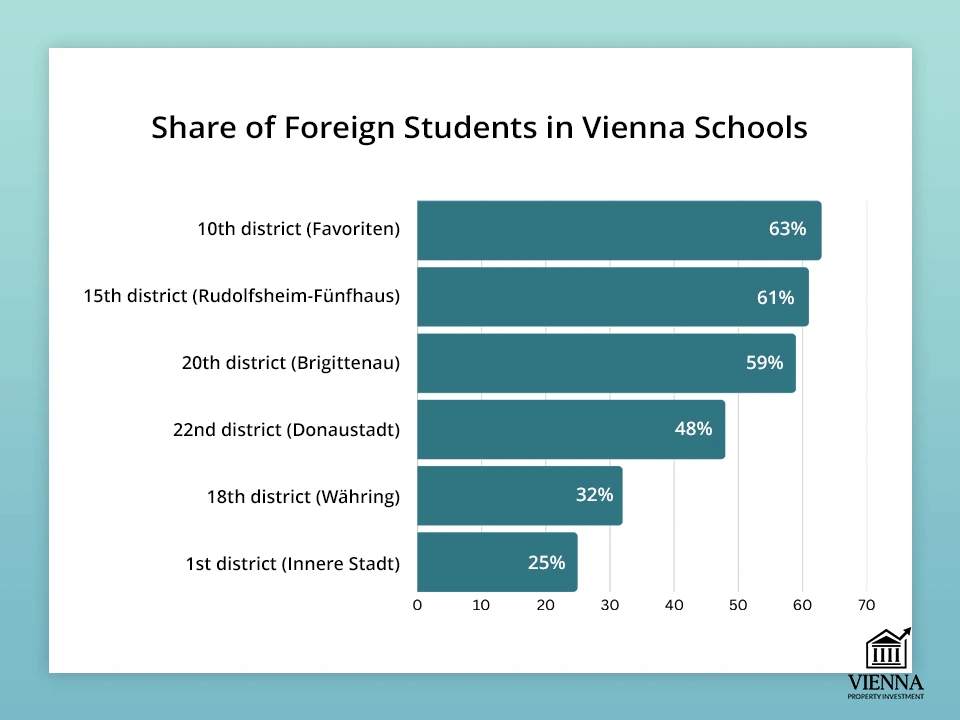
State schools offer special Deutschförderklassen (also known as integration classes). These groups emphasize intensive German language learning. Children are typically enrolled for one to two years, gradually adding regular subjects in parallel. After this, they seamlessly transition to a mainstream class.
-
A practical case: a mother from Kyiv recounted how her daughter spent the first six months in an integrated class. There were only 12 children there, and the teacher focused exclusively on language. A year later, the girl was already studying comfortably alongside her classmates and even made best friends among the locals.
Adaptation tips
Don't be afraid to ask for help. The Vienna School Authority has a dedicated Integration Center for families of foreigners: they offer consultations and even help with filling out paperwork.
Use our parenting hotlines. Consultations are available in Russian and Ukrainian.
Maintain your native language alongside German. It will be easier for your child if they can read and write in both.
Vienna Public Schools: Free Education and Opportunities

Public schools are the backbone of the Austrian system. And for many families, especially those who have just moved here, they're the ideal solution: education is free, the quality is high, and integration for foreigners is seamless.
What's included for free:
- Tuition is entirely at the expense of the state.
- Textbooks and basic materials are provided at school.
- There are even full-day schools (Ganztagsschule), where children stay until the evening: lunch, clubs, help with homework.
Parents only need to buy stationery and pay symbolic fees (for example, for an excursion or a school carnival).
Classes and infrastructure
There are typically 20–25 students per class. Schools in Vienna vary greatly in appearance: there are old buildings steeped in history, and there are modern campuses in new districts. Particularly in the 22nd district (Donaustadt) and the 18th (Währing), you can find very well-equipped buildings—with new gyms, computer labs, and libraries.
Extracurricular activities play a huge role here. Many schools collaborate with music schools, sports clubs, and clubs. For example, at one school in the 9th district, children have a separate music section in their schedule, and the school choir even performs at the Rathaus (town hall).
Language support

As I mentioned above, the main advantage of state schools is the Deutsch als Zweitsprache (DaZ) , German as a second language.
- When registering, parents are not required to provide any German language proficiency certificates – the child will be accepted just like everyone else.
- If the language barrier is high, he is enrolled in an intensive German course and then gradually transferred to a regular class.
The Ministry of Education emphasizes that such children are given up to two years to adapt, after which they are integrated into the general educational process. After this period, the child either continues in a regular class or can be permanently placed in a "support module" (Deutschförderklasse).
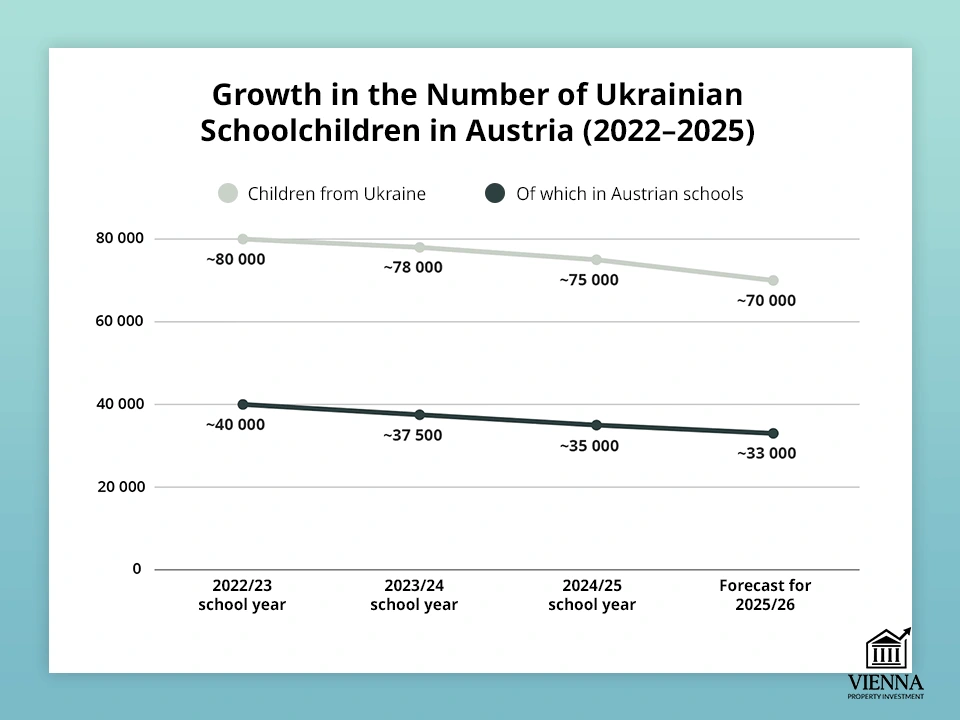
The statistics are interesting: in 2023/24, only 1.2% of children in Austria attended such integration courses, but a whopping 82% of Ukrainian schoolchildren did. This suggests that the government has truly adapted the system to the new conditions.
Where to find good public schools
Austria doesn't have formal rankings like Russia or Ukraine. However, schools have long had established "reputations" among parents.
- In the 18th district (Währing), the Wasagasse Gymnasium is highly praised.
- In the 9th (Alsergrund) there are strong grammar schools with a focus on languages.
- In 19th (Döbling) there are many schools with good mathematics and natural sciences.
- In 22nd (Donaustadt) new schools are being actively built in the Seestadt area.
How to get into a public school
The system is simple: a child is assigned to a school based on their place of residence. The documents required are standard: birth certificate, passport or ID, Meldezettel (Austrian registration), and insurance (e-card).
Important: For elementary school, registration must be completed in advance—as early as the fall of the previous year. You'll receive an invitation from the school department, and in February, your child will be invited to a school readiness assessment.
Private Schools in Vienna: A Variety of Formats and Prices

While public schools offer a stable and free option for everyone, private schools offer choice, individuality, and opportunity. Vienna is literally a boutique: you can find a school to suit every taste, from a historic Catholic grammar school to a state-of-the-art campus offering the IB program.
What types of private schools are there?
International (English + IB, A-Level, American system). These are chosen by expat families who move frequently or by parents planning to attend university abroad.
Examples: Vienna International School, American International School Vienna, Danube International School.
Classic German-language gymnasiums, such as the renowned Theresianum. They offer an atmosphere of rigor, tradition, and high academic standards.
Religious (Catholic and Protestant). Tuition here can be much cheaper – from €80 to €480 per month – but there is a greater emphasis on the humanities and spiritual values.
National schools— the French Lycée, the Japanese School, the Italian School—preserve the culture and language of a particular country.
Alternative methods. Waldorf and Montessori are for those seeking a gentle, creative, and less judgmental environment.
How much does private education cost?
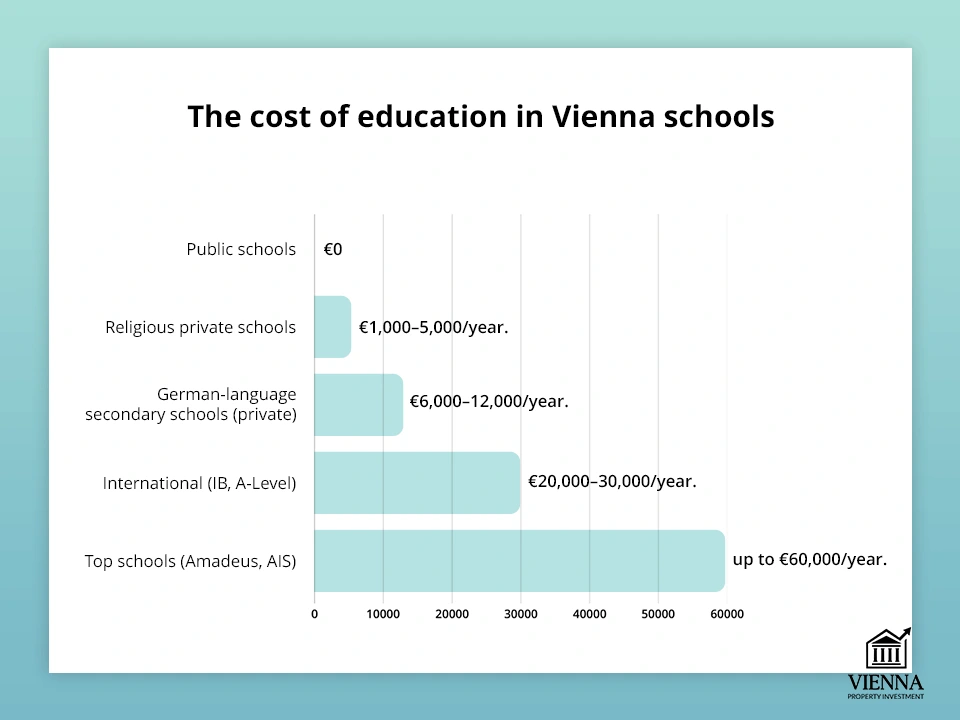
The price range is very wide:
- religious schools – €1,000–5,000 per year;
- German-language grammar schools – €6,000–12,000;
- International IB schools – from €15,000 to €60,000 per year.
And that's just the base cost. Application fees (€300–€4,000), meals, school bus, excursions, and uniforms are often added.
-
A real-life case: a family from Canada was choosing between Vienna International School and Danube International School. They ultimately chose Danube because it was closer to home and slightly cheaper in terms of bus fare. This once again demonstrates that sometimes practical details are more important than a school's brand.
Why Families Choose Private Schools
- Individual approach: classes of 10–15 people.
- Modern infrastructure: laboratories, gyms, music studios.
- International diplomas: IB, A-Level, High School Diploma.
- Multicultural environment: children from dozens of countries.
There's one drawback, but a significant one : the price. Even the most "affordable" private school will cost several thousand euros per year, while international schools can cost tens of thousands. Therefore, many families choose a private school only if it's truly necessary for their child's future.
Russian-language and Ukrainian-language schools and programs
Vienna is an international city, and here you can find options to help your child stay in touch with their native language.
Ukrainian programs
Ukrainian Saturday schools. For example, the largest school, named after Ivan Franko , gathers over 500 children and adults every Saturday. They study Ukrainian language, history, and literature, and host cultural events. For many families, it's a true "little Ukraine in Vienna."
An online platform from the Ministry of Education and Science of Ukraine. It launched in 2025. A child can study at an Austrian school while simultaneously taking an online course based on a shortened Ukrainian curriculum—language, literature, history, and geography. This allows them to retain their Ukrainian diploma and, if desired, later enroll in Ukrainian universities.
-
A practical case: one family from Lviv decided that their son would attend an Austrian Volksschule and attend a Ukrainian school on Saturdays. At first, the workload seemed overwhelming, but within a year, the child was confidently reading and writing in both German and Ukrainian.
Russian-language schools
The Russian School at the Russian Embassy is a fully-fledged school following the Russian curriculum. Instruction is in Russian, but children also study foreign languages to facilitate their subsequent education in Austria or Russia.
Meridian Gymnasium. A private Russian-language center where bilingual children can study additionally according to the Russian curriculum. An excellent option if you want your child to maintain written Russian and pass Russian exams.
The role of community
There are parent chats and clubs for Russian-speaking and Ukrainian-speaking families in Vienna. They discuss specific schools and teachers, and even create joint "mini-groups" for tutors. This is informal but invaluable support: advice from those who have already gone through this process is often more helpful than any instruction manual.
International Schools: When English Is Needed

The German system isn't suitable for all families. Some plan to move on in a couple of years, while others want their child to study in English right away. For these situations, Vienna offers international schools—there are quite a few, each with its own distinctive accent. Here's how they differ:
- The language of instruction is English.
- Programs are international: IB (International Baccalaureate), A-Level (British), American High School Diploma.
- There are children from dozens of countries in the classes.
- Lots of attention to sports, art, leadership skills.
Examples:
Vienna International School (VIS). Over 100 nationalities represented, IB programs for all ages. The school is affiliated with the UN, so the atmosphere there is very global.
Danube International School. Smaller than VIS, but also an IB school, it's friendly and intimate.
American International School Vienna. It combines the American system with the IB, and the curriculum includes a variety of sports and creative clubs.
Who is it suitable for:
- For expat families who frequently change countries.
- For those planning to attend university abroad.
- For parents who value an English-speaking environment.
What is the price:
- International schools are the most expensive. For example, VIS and AIS cost around €20,000–30,000 per year, plus additional fees for buses, uniforms, and meals.
-
Case study: A Russian family chose Danube International School for their daughter because they were planning to move to Canada. According to the mother, it was important for them to have the IB diploma recognized internationally and for English to become their native language. And so it turned out: their daughter is already considering university in Toronto.
Living and studying in Vienna with children

Vienna is not only about its schools and programs, but also about the city's atmosphere. Parents often say it's one of the most family-friendly cities.
Neighborhoods. When choosing a school, many people focus on the convenience of the neighborhood. Each district of Vienna has its own character:
- 18th ( Währing ) . Green, quiet, with parks and several good schools (such as Gymnasium Wasagasse). Many families look for housing here.
- 22nd (Donaustadt) New and dynamic, with new schools and modern residential areas.
- 19th ( Döbling ) . Elite, green, with vineyards and hills nearby, as well as prestigious schools.
- 9th ( Alsergrund ) . Closer to the center, nearby are universities, theaters, and cultural life.
Transportation and safety. Getting to school is easy: trams, buses, and the metro run on schedule. Vienna is considered one of the safest cities in the world for children – many students walk or bike to school without any problems.
Extracurricular activities. Your child will definitely have plenty to do here:
- sports (football, hockey, tennis, equestrian sports, swimming);
- music (orchestras, choirs, individual lessons – not surprising for the city of Mozart and Strauss);
- creativity (theater, drawing, dancing, robotics).
Many clubs are available at schools, and public schools often offer free or nominal fees. Meanwhile, separate clubs and summer camps are often held for children of migrants, where they learn German through play.
New trends in education in Austria (2025)

Austrian education is constantly evolving. Recent years have seen a real leap forward in digitalization and simplification for foreign families.
Digitalization. Since 2023, a new subject, "Digital Literacy" ( Digitale Grundbildung ), has been introduced in schools. This isn't just a dry computer science course, but a course covering everything from internet safety to basic programming. Now, every student learns how to work with modern digital tools.
Currently, over 1,540 schools (95% of all schools) are participating in this program. Schools are developing their own digital curricula and actively implementing online courses (such as LernMax) and interactive platforms. Already, 27% of schoolchildren in Vienna use non-traditional learning methods with gadgets (under the Digitales Lernen ).
Support for refugees. Ukrainian children are guaranteed admission to school, even if their documents are incomplete. The main thing is to have a birth certificate and passport, and then everything is resolved on the spot.
International standards. Gymnasiums are increasingly implementing international exams (IB, Cambridge) so that students can apply not only in Austria but also abroad.

Top 9 Best Schools in Vienna: Where to Send Your Child
Ranking schools in Vienna is no easy task. There are no official "rankings" because all public schools are considered equal.
But parents still share their experiences and create informal lists of their "favorite" schools. I've compiled nine options that are most frequently recommended by families with children—both local and international.

1. Bundesgymnasium und Realgymnasium Wasagasse (18th district). One of the most prestigious state gymnasiums in Vienna. The school is known for its academic rigor and history: many famous Austrians have studied here.
- Languages: The main language is German, but there are advanced programs in English and French.
- Focus: Mathematics and science.
- Features: active cultural life, school orchestras, theatrical performances.
- Cost: free (symbolic fees for excursions).
Parents note that competition for admission is high. The school isn't elite in the financial sense, but many people want to get in.

2. BG/BRG Strudlhofgasse (9th district). A state grammar school in the Alsergrund district. Very popular with foreign families due to its emphasis on languages.
- Focus: English and French, plus advanced literature.
- Infrastructure: modern library, digital classrooms, robotics clubs.
- Features: students participate in international exchanges, often traveling to France and the UK.
- Cost: free.
-
Case: A mother from Lviv said that her son's English teachers helped him a lot – they raised him from zero to B1 in just a year.

3. BG Landstrasser Hauptstraße (3rd district). This school is considered one of the most digital in the city. It's ideal for children who enjoy technology.
- Focus: computer science, technology, digital literacy.
- Features: robotics clubs, school e-sports team (!).
- Infrastructure: new classrooms, computer labs, gym.
- Cost: free.

4. Amerlinggymnasium (BG XIX, 19th district). A historic gymnasium in the prestigious Döbling district. Amerlinggymnasium students regularly win English language competitions.
- Focus: advanced English, humanities.
- Features: the school actively collaborates with universities and offers preparation programs for Cambridge Exams.
- Cost: free.

5. Amadeus International School Vienna (18th district). A private school with an IB curriculum and a strong focus on the arts. If your child is interested in music or art, this is probably the best choice in Vienna.
- Languages: English + mandatory German as a second language.
- Focus: music, theatre, art.
- Features: collaborates with the Vienna Conservatory; boarding school available.
- Cost: €20–25 thousand/year.

6. Vienna International School (22nd district). This school is affiliated with the United Nations and is one of the most renowned international schools in Vienna.
- Focus: IB programs (from primary to high school).
- Features: more than 100 nationalities, multicultural environment.
- Infrastructure: campus with a swimming pool, stadium, theater.
- Cost: about €25 thousand/year.
Parents note that VIS gives children a "global" mindset—the child studies in a class where everyone has their own cultural background.

7. Danube International School Vienna (20th district). An international IB school, but more intimate than VIS. Ideal for those who want an international education but don't like giant campuses.
- Focus: English language, project work.
- Features: about 60 nationalities, small classes.
- Cost: €22–26 thousand/year.

8. Theresianum Wien (4th district). One of the oldest and most prestigious schools in Vienna.
- Focus: Classical Catholic boarding school.
- Features: strict discipline, emphasis on humanities, international exchange programs.
- Cost: €10–15 thousand/year.
Parents often call Theresianum an “elite school” – families from all over the world strive to get in.

9. Campus Sacré Coeur Wien (8th arrondissement). A private Catholic school that combines academics with a rich cultural program. Ideal for those who want their child to learn in a creative yet disciplined environment.
- Focus: English and French languages, music.
- Features: school choirs, theatrical productions.
- Cost: €8–12 thousand/year.
Practical advice for parents
Start early. It's best to submit your applications 8-12 months before the school year. This is especially important for grammar schools and private schools. Many people apply to international schools after the New Year, in September.
-
Case study: One family from the US started looking for a school six months before moving. Ultimately, the American International School was full, so they had to choose Danube International. It's a good thing they applied there too.
Collect the correct package of documents.
For public schools:
- birth certificate,
- child's passport or ID,
- Meldezettel (registered in Austria),
- medical insurance (e-card).
For gymnasiums and private schools additionally:
- report cards for the last 2 years (with translation),
- teacher recommendations,
- sometimes tests in language and mathematics.
Choose the language of instruction. If you plan to stay in Austria for a long time, it's best to attend a German-language school. This will help you integrate more quickly. If you're leaving in a couple of years, an international school offering IB or A-Level courses will offer flexibility.
-
A combined option: studying at a German state school and attending a Saturday Ukrainian or Russian school. This way, the child learns German and maintains their native language.
Consider a "Plan B." There may not be enough spots. Apply to several schools at once. When applying in Vienna, you can indicate up to three preferences.
Pay attention to the neighborhood. Choose a school not only based on ratings but also on distance. If your child has to commute an hour each way every day, it can quickly become tiring.
Get help. Vienna has an Integration Center for Parents , which provides consultations in Russian and Ukrainian. They can help with documents and choosing schools.
Attend an open day. It's the best way to get a feel for the school's atmosphere. Often, the impressions of the teachers and students are more decisive than the curriculum.
Conclusion: School as an investment in the family's future

Choosing a school in Vienna isn't a formality, but a step that will profoundly impact the life of a child and the entire family. The system here is designed so that a quality education can be obtained both free of charge at a public school and at a private gymnasium for tens of thousands of euros.
What's important is something else:
- find a balance between the language of instruction,
- take into account family plans (to stay in Austria or to leave),
- think not only about “prestige”, but also about the child’s comfort.
Many families from Ukraine and Russia choose public schools: they're free, accessible, and help them adapt quickly. But others consciously choose international or Russian-language programs to maintain flexibility and their native language.
Plan ahead, don't be afraid to ask for advice, and take advantage of all the resources Austria has to offer. Then, school won't be stressful, but a new stage in your child's life—and perhaps the best reason to move to Vienna.