If you're here, you're probably already considering buying property in Styria, one of Austria's most picturesque and underrated regions. As an investment consultant, I often see clients tired of the hustle and bustle of big cities (where real estate in Vienna is typically significantly more expensive) seeking peace and quality of life in places like Styria.
It combines Alpine scenery, rich culture and affordable housing prices, making the region ideal for families, retirees or investors seeking stable rental income.
Styria is a land of green hills, vineyards, and mountains, where the air is fresh and the people are hospitable. Located in southeastern Austria, it borders Slovenia and Hungary, adding to its borderland charm.
The capital, Graz, the country's second-largest city, is more than just an administrative center, but a true hub for education, business, and tourism. In 2025, the real estate market here stabilized after a slight decline in 2024, and experts predict price growth of 1-2%, thanks to the economic recovery and an influx of tourists.
Why is Styria profitable?
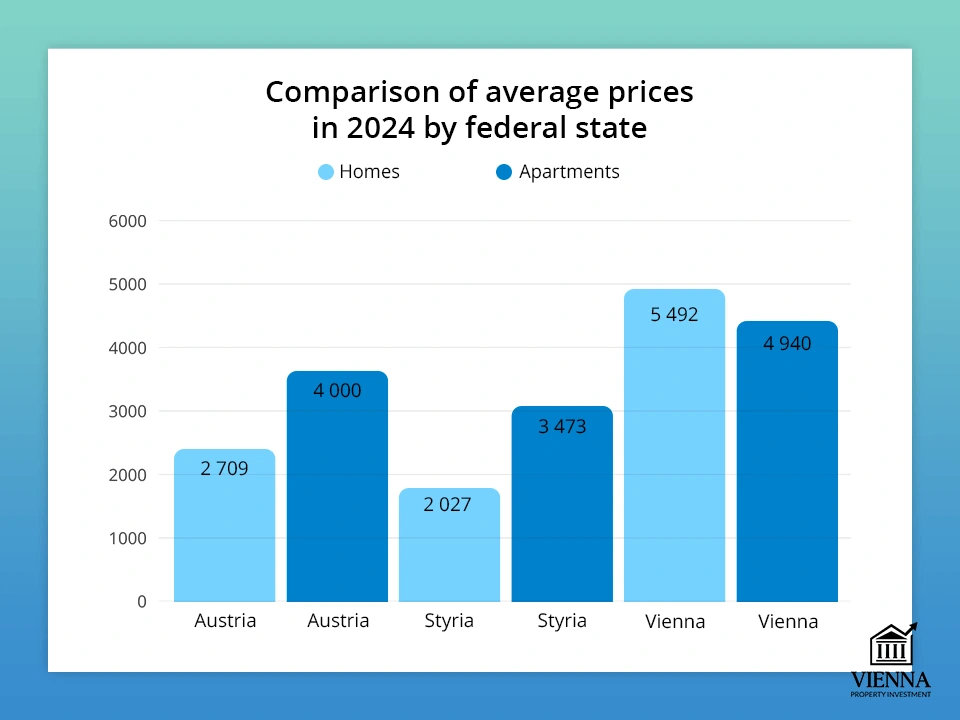
Firstly, prices are lower than in Vienna or Tyrol – the average price per square metre in Graz is around 3,000 euros, and even less in rural areas.
Secondly, it's an excellent investment option: rental yields of 3-4%, plus the possibility of obtaining a residence permit for foreigners under certain conditions. Finally, here you can buy not just a house, but a piece of idyllic tranquility – with views of castles and wine cellars.
In this article, I'll break it all down: from getting to know the region to legal nuances and investment strategies. You'll learn how to choose an apartment for sale in Styria, buy a house, or even land, what housing prices in Styria will be in 2025, and how to minimize risks.
If you're a foreigner, don't worry – I'll tell you how real estate in Styria for foreigners is becoming a reality. Let's explore why this could be your best decision in 2025.
Getting to Know Styria: The Region's Peculiarities

Styria is more than just a spot on the map of Austria; it's a world of contrasts, where mountains meet plains, and tradition meets modernity. If you're planning to buy property in Styria, it's worth first understanding what makes this region special.
Where is Styria and what's special about it?
Styria is located in southeastern Austria, covering approximately 16,400 square kilometers—the country's second-largest state. It is surrounded by other Austrian regions to the north and west, Slovenia to the south, and Hungary to the east.

The landscape here is varied: in the north there are the majestic Alps with peaks up to 2,700 meters, covered with dense forests, where people go skiing in winter and cycling in summer.
The central part is hilly, with vineyards and the Mure River, which divides the land into two halves. The south is milder, with warm valleys ideal for agriculture. According to Statistik Austria , forests cover 60% of the territory, making Styria the "green lung" of Austria.
The climate in Styria is mild and pleasant: summer temperatures hover around 20-25°C, winter temperatures range from -5 to +5°C in the lowlands, but the mountains are snowy and frosty. This allows for four seasons to be enjoyed: spring, with blooming meadows, and autumn, with the wine harvest (Styria is one of the leading wine producers in Austria).
culturally rich, boasting hundreds of castles, such as Schernberg and Reisenburg, and festivals, including the famous Styriarte in Graz. Tourism is thriving – 5.5 million tourists visited the region in 2024, an 8% increase over the 2023 target – thanks to ecotourism and wine routes.
The capital, Graz, is the heart of Styria. With a population of approximately 300,000 as of 2025, it is a university city with 60,000 students, creating a vibrant atmosphere. Graz was a European Capital of Culture (in 2003), with a UNESCO-protected Old Town, a clock tower (Uhrenturm), and modern museums like the Kunsthaus.
The real estate market here is active: 4,500 properties were sold in 2024, and growth of 5% is expected in 2025 due to an influx of young professionals. Graz is a business hub, with IT clusters and logistics, making it an attractive location for buying apartments in Styria.

Types of real estate in Styria: what you can buy
Styria's real estate market is diverse, ranging from cozy city apartments to luxurious mountain villas. If you're looking to buy a home in Styria, options are available for both permanent residence and vacation rentals.
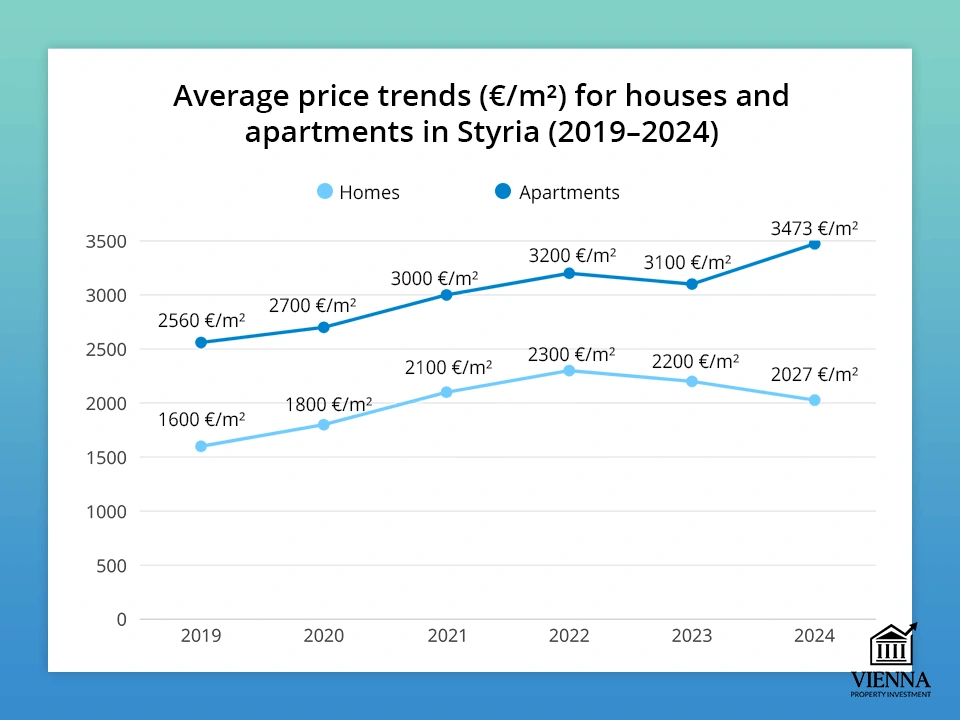
Apartments. They are popular in Graz and the surrounding area. The average size is 70-100 m², with prices ranging from €2,000/m² in the suburbs to €4,000/m² in the city center. New buildings with energy-efficient systems (Class A) are a hit in 2025, especially for families.
Houses and villas. These are country options: traditional farmhouses (Bauernhaus) in Murtal or modern villas by the lakes. Prices for houses in Styria start at €300,000 for 150 m², with a garden and garage. Premium villas, like those in the Waidhof area, start at €800,000, with mountain views.
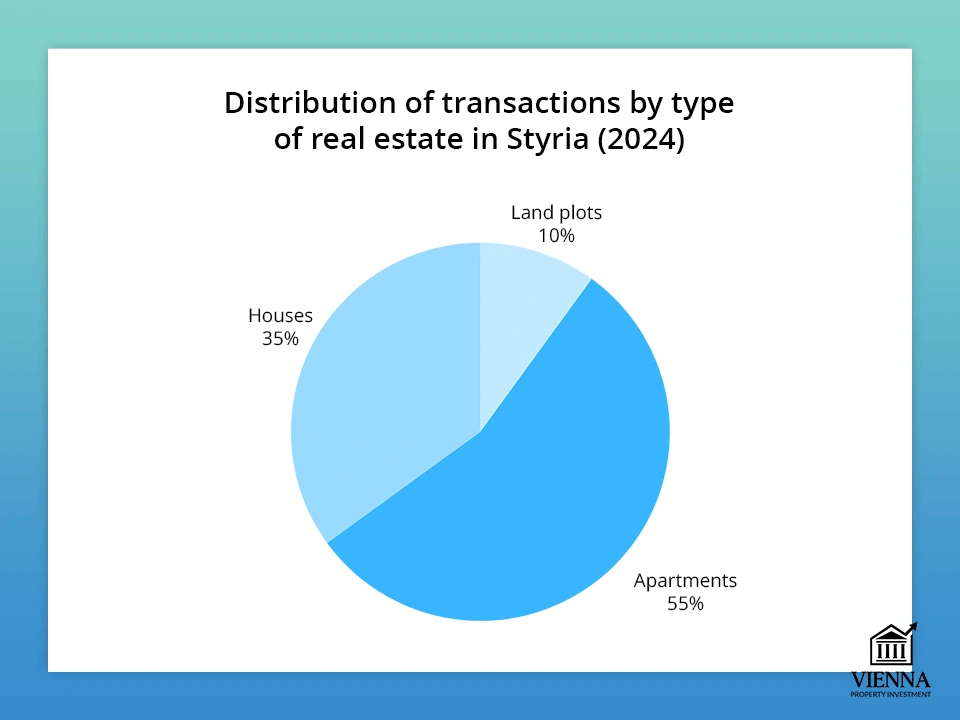
Land plots are also in demand: land in Styria can be purchased for construction or farming, with prices ranging from €50-150 per square meter. Resort properties – in Murau or near the thermal springs – are ideal for tourist rentals. According to 2024 estimates, 40% of transactions are for vacation rentals, with a 10% increase in 2025 due to tourism.
- For permanent residence, people choose city apartments or houses in the suburbs – close to schools and transportation.
- For vacations, consider villas or apartments in the mountains. In 2025, the trend is toward sustainable real estate: solar panels and green spaces.
-
Case study: A family from Ukraine purchased a villa in Styria for €450,000 in 2024. They used it as a second home, renting it out in the summer – generating an annual income of €25,000. "It's not only an investment but also a vacation spot," they shared.
How to choose real estate: prices and areas
Choosing a property is like finding the perfect partner: you need to consider budget, location, and prospects. Housing prices in Styria are affordable, but vary by district. Let's figure out how to avoid making a mistake.
Property price ranges in different parts of Styria
In 2025, real estate prices in Styria remain among the most affordable in Austria, especially when compared to the overheated market in Vienna or the luxury resorts of Tyrol.
According to recent data from Statistik Austria , the average price per square meter of housing here is around 2,411 euros – 50% lower than in the capital, where it easily exceeds 5,000 euros.
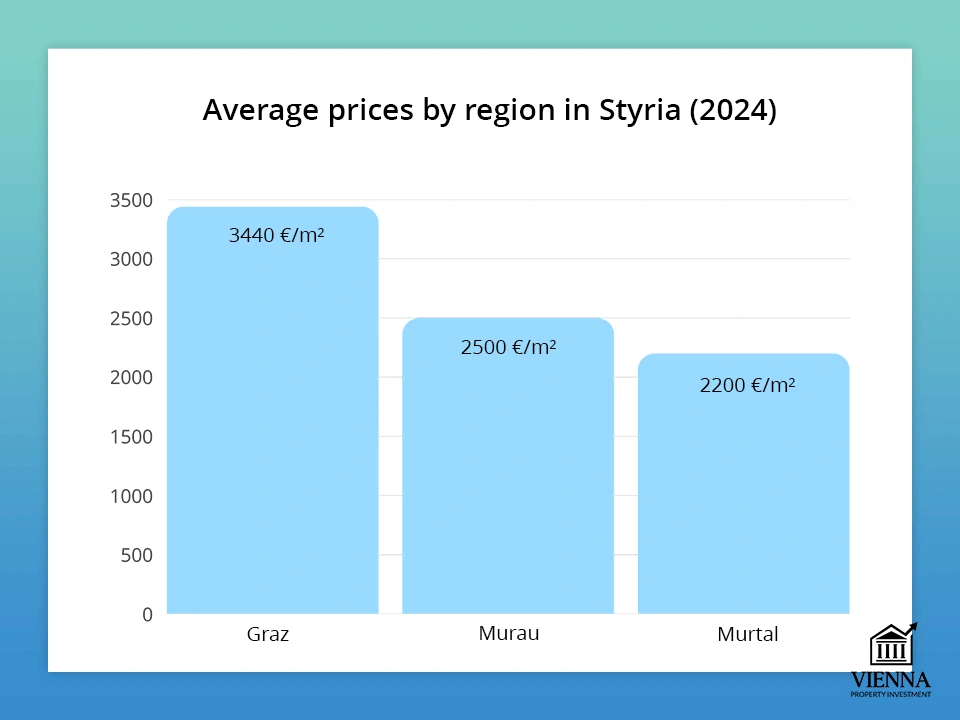
Graz. Here, in the heart of the region, apartment prices range from €3,000 to €4,500 per square meter. A cozy two-bedroom apartment of 80 square meters in the center will cost €250,000 to €350,000. This is a very realistic option for a young family or couple who want to be in the thick of things, with universities, cafes, and festivals nearby.
If you prefer houses, a full family home with a garden and garage in Graz will cost between €400,000 and €600,000, depending on the neighborhood and the property's condition. Why is that? Graz is a dynamic city, where real estate prices are rising thanks to the influx of students and IT professionals.
Murau is a true gem for nature lovers. Everything here is cheaper and more peaceful: apartments cost €1,800–€2,500 per square meter, and a 150-square-meter house can be purchased for €300,000. But don't think this means "squalor"—on the contrary, these properties often boast stunning views of the Alps, fireplaces, and even saunas.
Premium villas with a pool and terrace will cost up to €700,000, but are ideal for those looking for a second holiday home.
Murtal. Here, in a rural area with vineyards and a river, prices are even more attractive: apartments range from 2,000–2,800 euros per square meter, houses from 220,000–350,000 euros. Land here is a different story: from 40–80 euros per square meter, making Styria a paradise for those dreaming of their own plot for a farm or garden.
Trends. 2025 promises moderate growth – experts predict a 2-3% price increase nationwide, thanks to lower mortgage interest rates (from 4% to 3.5%) and a revival in tourism. In the first half of 2025, prices have already risen by 1.8% after a 2.1% decline in 2024, creating a window of opportunity for buyers.

If you're an investor, growth in rural areas can be higher – up to 4% – thanks to ecotourism and new wine routes. Meanwhile, Graz offers stability: land prices near the city range from 150 to 300 euros per square meter, allowing you to build your future literally from scratch.
| Property type | Graz (EUR/m²) | Murau (euro/m²) | Murtal (euro/m²) |
|---|---|---|---|
| Apartments | 3000–4500 | 1800–2500 | 2000–2800 |
| At home | 4000–6000 | 2500–4000 | 2200–3500 |
| Earth | 150–300 | 50–100 | 40–80 |
Overall, prices in Styria are a balance: not so low as to threaten collapse, but also not as exorbitant as in other parts of Europe. The key is to budget for these additional expenses, and you'll be on the winning side.
Areas with the best investment prospects
Every corner of the region offers something unique, from the bustle of the city to a quiet, idyllic retreat. I always advise clients to start by asking, "Do you want to live here year-round, rent it out, or just enjoy the views on the weekends?"
Styria offers the best investment prospects combining price, quality of life and growth potential, and this is especially true in 2025 given the influx of tourists and young professionals.
Graz is undoubtedly Styria's star city for investors. The city is divided into districts, and the choice depends on your goals:
- The center (Innenstadt) is prestigious: historic buildings, pedestrian streets, proximity to the opera house and universities.
- Prices are higher here – up to 4,500 euros/m² – but the price-quality ratio is excellent, especially if you are buying a studio or a small apartment for students.
- The rental yield is 3.5%, with occupancy rates of almost 100% year-round, as Graz is an educational hub with 60,000 students.
- Suburbs like Strassgang or Liebenau are ideal for families: quiet streets, but still a 10-minute tram ride to the city center.
- Prices are more affordable: 2500 euros/m², with excellent infrastructure – metro, parks, schools.
- Investment prospects are high – in 2025, prices in these zones are expected to grow by 5% due to new IT clusters and the development of logistics.

Countryside. If you're drawn to nature, consider Murtal or the surrounding Murau. These areas are ideal for those seeking a great deal: houses with vineyard views for €300,000 are priced lower than in the city, but with higher growth potential—up to 4% per year thanks to ecotourism.
Imagine buying a villa on the Mure River and then renting it out to families on weekends – demand for such properties is growing, especially after the opening of new cycle routes in 2024.
In Murtal, with its warm climate and proximity to Slovenia, real estate is liquid: easy to sell or rent, as it combines rural charm with city accessibility (Graz is an hour's drive away).
Adviсe
- For permanent residence, choose areas along the Mure River – they have fresh air, good schools, and a low crime rate.
- If your goal is rentals, focus on the university districts of Graz or the mountain resorts of Murau: students and tourists will provide a stable income.
- In 2025, the trend toward sustainable areas—those with green spaces and good ecology—will see prices jump by 5–7%.
- Don't forget about transport: properties near the A2 motorway or the railway are always in demand.
-
Case study: One of my clients from Russia, an IT specialist, bought an apartment in Graz for €220,000 in the Strassgang district in early 2025. He chose it for its proximity to the metro and universities, and now rents it out to students for €900 per month—that's €12,000 per year in net income, with a payback of just five years. "I didn't expect Styria to be so profitable, but the area made all the difference," he shared.
Official rules and features of purchasing real estate
Buying real estate in Austria, and Styria in particular, isn't chaos, but a well-oiled process, similar to building a house: every step has its place. However, for foreigners, there are nuances that may seem complicated at first glance.
Styria has slightly more liberal regulations than some other federal states, and in 2025, they became even more accessible thanks to digitalization. Let's explore who can buy real estate in Styria for foreigners, how to navigate all the steps, and avoid any pitfalls.
Who can buy property in Styria?

Styria is open to buyers from all over the world, but with restrictions depending on your citizenship.
EU/EEA citizens. If you're an EU or EEA (European Economic Area) citizen, congratulations – you can buy real estate freely, without any additional permits. This means that a Belgian, German, or Swedish citizen can simply choose a property and go to a notary – no barriers required.
Non-EU citizens. For others, including citizens of Russia, Ukraine, the US, and Asian countries, the situation is slightly more complicated, but not impossible to resolve. You will need permission from the Styrian State Office ( Amt der Steiermärkischen Landesregierung ), and it's best to check the general restrictions on foreigners purchasing real estate in Austria in advance to properly assess the transaction timeline. This isn't a "ban" but rather a test: the authorities want to ensure the purchase won't harm the local market and that your intentions are pure.
What exactly is checked:
- Financial stability (bank statement, proof of income)
- Purpose of purchase (for housing, investment or business)
- No risks to the region's economy
In 2024–2025, the process was simplified: approval takes 3–6 months, and refusals are rare – about 5% of cases if the documents are in order.
Styria differs from other Austrian states. There are no strict "foreigner bans" like in Burgenland or Tyrol, where proof of residency is sometimes required. Styria focuses on balance – foreigners will account for 20% of all transactions in 2025, a 15% increase from the previous year, thanks to tourism and business.
Special categories:
- If you already have a residence permit in Austria (for example, a Red-White-Red Card for qualified specialists), then you do not need a permit – you are considered a resident.
- For families with children or investors planning a business, the process is expedited: show a plan (for example, how you will rent out the property), and your chances of approval will increase.
- If you buy land larger than 500 square meters, you'll be required to check for agricultural use – but in Styria, this is rarely a problem; the region favors farmers and winemakers.
I remember one client from Ukraine worrying, "What if they don't let me in?" We prepared the documents—proof of income, a description of the investment—and the permit arrived within two months. At Vienna Property Investment, we always help with everything from document translation to application submission. The key is to start early, and Styria will become your home.
Steps to buying real estate in Styria

In Styria, purchasing a property takes 2–4 months, and in 2025, everything became faster thanks to online services. Take your time—every step is important to avoid mistakes.
Search for a property. Start with websites like Immowelt , which has thousands of Styrian real estate listings. But honestly, it's better to work with a local agency: at Vienna Property find options that suit your budget and preferences and arrange viewings (even virtual ones for foreigners).
Inspection. This is key: check the condition, neighbors, and infrastructure. If necessary, order an independent appraisal (Gutachten) – this costs 500–1,000 euros, but will save you from surprises like hidden repairs.
Preliminary contract. First, you sign a preliminary contract (Reservierungsvertrag), where you fix the price and pay a deposit—usually 10% of the purchase price. This is a "reservation" to ensure the property remains in your possession.
The main contract. The main purchase and sale agreement (Kaufvertrag) is signed before a notary. For foreigners, it's important that everything be in two languages (German and your native language), and the notary will certify its authenticity. This is where you pay taxes and fees—more on that below.
Land Registry Permit. If you're not from the EU, you must simultaneously apply for a permit at the Land Registry: online through the portal, with documents (passport, financial confirmation, contract). In 2025, this will be digitalized – you'll receive a response by email.
Registration of ownership in the Land Register (Grundbuch) after approval. This takes 1–2 months: the notary submits the documents, and you become the official owner.
Make the final payment (bank transfer), and the keys are yours! Plus, if you're taking out a mortgage, the bank will verify everything at the contract stage.
Here are the steps in a simple list for your convenience:
- Search and inspection (1–2 weeks). View 5–10 properties, choosing 1–2 favorites.
- Preliminary agreement and deposit (1 week). Secure the deal by paying 10%.
- Permit for foreigners (1–3 months). Submission and waiting period, along with notary services.
- Signing the Kaufvertrag and registration (2–4 weeks). Payment, Grundbuch, keys.
-
Case study: A client from Kazakhstan decided to buy a house in Styria, Austria, in 2024 for €400,000. We organized every step of the process, from searching in Murtal to applying for a building permit. Ultimately, the deal closed within three months – he now enjoys mountain life and even rents out part of the house to tourists.
Important nuances and legal aspects
Yes, bureaucracy isn't the most fun, but in Styria it's transparent and protects you. Let's talk about the risks and how to avoid them – I've seen how ignoring small details led to delays, but with the right approach, everything goes smoothly.
Main risks
- Encumbrances on the property, such as the seller's mortgage or disputes with neighbors (Hypothek in Grundbuch)
- Hidden defects – mold, roof problems.
How to minimize
Due diligence is essential: hire a lawyer or inspector (1,000–2,000 euros) to conduct an inspection. In Styria, this is standard—they'll inspect the property and documents within a week.
Documents that are needed
- Your passport
- Proof of funds (bank statements)
- Agreement
- For foreigners – translations into German
- Check the deal's integrity in Grundbuch online : free of charge, and you'll see all encumbrances.
Additional expenses
- Taxes and fees – 5–7% of the cost
- Main – Grunderwerbsteuer (purchase tax) 3.5% of the price
- Notary – 1–2%
- Agency – 3% (if you are the buyer, you pay your side)
- Registration in Grundbuch – 1.1%
- In Styria, there is no additional "speculative" tax if you hold a property for more than two years – this is a plus for investors
- For mortgages for non-EU citizens, banks require a 30-40% down payment, but rates are low – 3.5% in 2025.
The expense table will help you calculate:
| Type of consumption | Percentage/amount | Example for €300,000 |
|---|---|---|
| Acquisition tax | 3,5% | 10 500 € |
| Notary | 1–2% | 3000–6000 € |
| Agency | 3% | 9000 € |
| Registration | 1,1% | 3300 € |
| Total | 5–7% | 15 000–21 000 € |
Peculiarities of purchasing different types of real estate
Styria offers properties to suit every taste, from compact apartments for young couples to spacious villas for families. Each type has its own advantages, disadvantages, and tricks.
In this section, I'll explain how to approach buying an apartment, house, or land to make an informed choice. In 2025, the market is diverse, and the right type will brighten your life—or make your investment more profitable.
Buying an apartment: what to look for

Apartments are a top seller in Styria, especially in Graz: they account for 60% of the market because they're convenient for city living. Imagine walking into a bright two-room apartment with a balcony overlooking the old town—and that's for €200,000–€400,000 for 70–100 square meters.
The types vary: new buildings are modern, with Class A energy efficiency (solar panels, smart home), with prices starting at €3,000+/m². Old buildings – historic buildings in the center of Graz, with charm but potential for renovation – are cheaper, at €2,500/m².
What to look for? Infrastructure is key: choose apartments near the Graz Hauptbahnhof metro station, schools, or parks to avoid spending hours commuting. By 2025, demand for "smart apartments" with Wi-Fi and fitness facilities will increase by 10%, especially among younger people.
Legal aspects. Apartments are often in cooperatives (Wohnungseigentum), which have house rules (Hausordnung) regarding noise and repairs. The contract includes a share of the land and parking. Foreigners are required to rent a standard apartment, but condos are simpler than houses.
-
Tip: If you're new to the area, start by looking at 3-5 options: check the insulation (Styria is humid), the elevator, and the view. This isn't just a place to live—it's your slice of European comfort.
House or villa: which is better for you?
Buying a house in Styria, Austria, means finding freedom: your own garden, barbecues in the evenings, and air filled with the scent of pine trees.
The average price is €250,000–€500,000 for 150–200 m², depending on location. A traditional house (Bauernhaus) in Murtal is cozy, with exposed wooden beams, and costs €300,000. A villa, more luxurious, with a pool, terrace, and mountain views, starts from €500,000 in Murau.
Pros of the house: Privacy, possibility of expansion, low utility bills (if energy efficient).
Cons: Maintenance – taxes 0.5% per year (1500 euros for 300k), repairs 5-10,000 euros annually, plus snow removal in winter.
A villa adds status: Ideal for families or rentals, but higher costs include insurance and a gardener. Maintenance costs are 1–2% of the price per year, but are offset by rental income – €20,000/year for a villa.
What's best? For permanent residence, a house in the suburbs of Graz: close to the city, yet quiet. For vacation, a villa in the mountains: easily rented out to tourists. In 2025, the trend is toward "green" houses with panels—they're cheaper to operate.
-
Case study: A young couple bought a villa in Styria for €600,000 in 2024. They converted it into a family home, but rent it out in the summer – yielding 4%, making it their favorite place. "Home isn't just walls, it's emotions," they said.
Land plots: how and where to buy land
Land in Styria is an investment in a dream: your own plot for a house, a farm, or simply peace of mind. Buying land in Styria means investing in the future, with prices ranging from 20–200 euros per square meter.
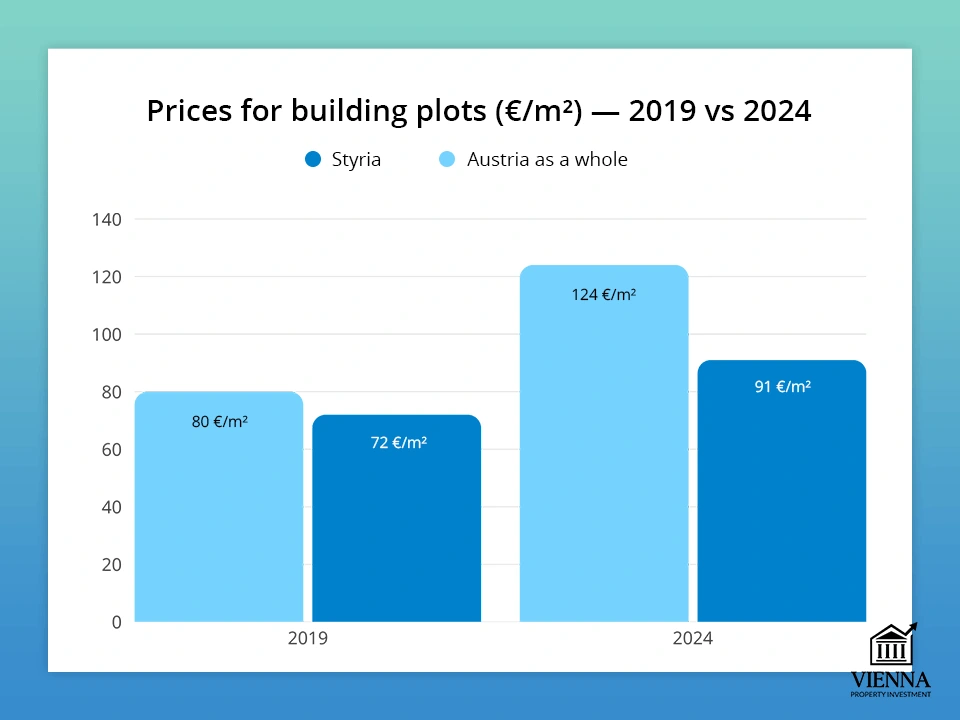
Categories: Agricultural land (Ackerland) – 20–50 euros/m², suitable for farms or orchards. Construction land (Bauland) – 100–200 euros/m², near cities. In Murtal – affordable, 40 euros/m², with potential for vineyards.
Development opportunities. Check the development plan (Bebauungsplan) at your local Bauamt (Regional Development Authority) to determine building permits, heights, and environmental considerations. Permits: For non-EU landowners, from the land office, 1–2 months, plus an environmental assessment for larger plots (>1,000 m²). Outlook: 5% growth in valleys in 2025 due to tourism – land is liquid and easy to resell.
Where to buy? Near Graz – for construction, in the mountains – for ecology. Start with checking the soil and access (road, electricity).
New rules and changes to real estate legislation in Styria
The year 2025 has brought a fresh wind of change to Styria – laws are evolving to ensure the market is transparent and sustainable. As a consultant, I'm closely monitoring this, because the new regulations directly impact you: do they make life easier or add steps?
Real Estate Transfer Tax. Effective July 1, 2025, the RETT was updated: now, it applies at 3.5% to indirect transactions, such as purchases through company shares, if more than 50% of the assets are land.
Nothing has changed for direct purchases, but verification of the source of funds has become stricter, especially for large sums from foreigners. This means more documentation on the origin of the money, but the goal is to combat money laundering, not to create a barrier for honest buyers.
Rent freeze. This freeze was lifted in April 2025, now at +4.2%, raising yields to 3.8%.
- This is a plus for buyers: if you are an investor, the rent will pay off faster.
- There's good news for loans: the minimum down payment is 20% for everyone, interest rates are 3.5%, and non-EU citizens can now more easily get a mortgage with proof of income.
In Styria, there are no new restrictions on foreign purchases – permits are issued, but for land >1000 m², an environmental assessment (Umweltverträglichkeitsprüfung) has been added to maintain the region's "green" status.
-
A practical case: A foreigner waited four months for a land permit in 2024 due to the old rules; in 2025, under the new system, it was six weeks. "The changes have sped everything up," he noted.
Consequences. Prices rose by 2%, transactions by 10% in the first half of 2025 – the market has revived:
- For buyers, accessibility has increased: EU – unchanged, non-EU – slightly more paperwork, but faster approval.
- Investors benefit: stability and rising rents make Styria attractive.
- The downside is delays for speculators, but for long-term investors it’s a complete profit.
-
Tips for the new reality:
- Apply for permits online in advance; focus on residential properties (less inspections).
- Work with lawyers who are up-to-date with the latest updates – at Vienna Property, we update contracts for RETT.
- Price impact: +2–3% in Graz, +4% in rural areas – affordability remains, but choose wisely.
Investments and rentals: how to make money on real estate in Styria
Investing in Styria isn't about quick cash, but about smart, stable growth. In 2025, returns of 3-4% are expected – above the Austrian average, thanks to tourism and the economy. Let's explore how to turn a purchase into a source of income: from rentals to strategies. This isn't just theory – many of my clients are already making money and enjoying the process.
Rental income potential
Rentals in Styria are a gold mine, especially with rates set to rise by 4.2% in 2025. Imagine: your apartment in Graz brings in €800–€1,000 per month for a studio apartment, with 95% occupancy—students and expats are always looking. In the Murau Mountains, it's seasonal. €1,500 in the summer for a villa, but year-round for families on weekends.
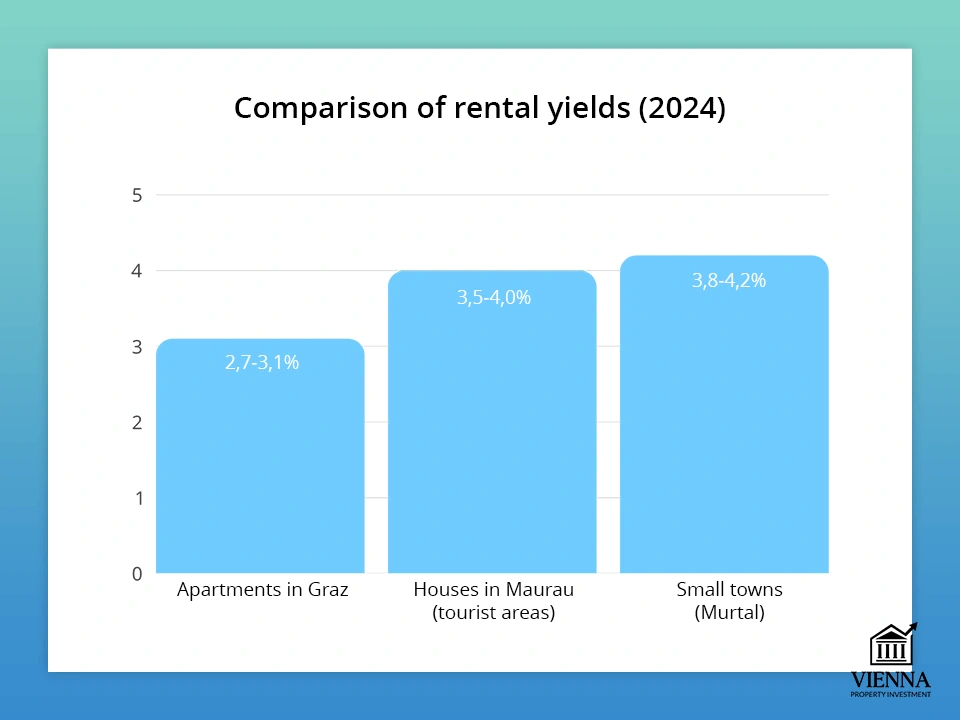
- Expected return: 3.2% in Graz (stable), 4% in rural areas – after inflation net 2.5–3.5%
- Risks: seasonality in tourism (in winter, vacancies are 10%), but in cities – minimal
- Demand +8% in 2025 due to migrants and tourists
- Typical renters: Students (60% in Graz – reliable, long-term), families (30% – in the suburbs, pay on time), tourists (10% – through Airbnb, but with taxes)
- Murtala – winemakers and ecotourists
- To maximize your savings: Furnish your property and use platforms like Immowelt to search. You'll lose 10-15% on taxes and maintenance, but the net profit is achievable.
| District | Rent (€/m²/month) | Profitability (%) | Occupancy rate (%) |
|---|---|---|---|
| Graz | 12–15 | 3,5 | 95 |
| Murau | 10–12 | 4,0 | 85 (seasonal) |
| Murtal | 9–11 | 3,8 | 90 |
Real Estate Investment Strategies
Strategies are like cards in a game: choose the one that suits you.
Short-term (flip). Buy, renovate, and sell – 10–15% profit in Graz in 6–12 months. Ideal for liquid properties near public transport.
Long-term. Lease, payback period 7–10 years, with price growth of 2–3% per year.
For resale. Focus on new builds: low entry, quick exit.
Passive income. Airbnb villas: +20% profit, but manage through an agency (5% commission).
Relevance. Diversify in 2025: €250,000 for an apartment + land for growth.
-
Tips: Analyze the market, aim for €10,000/year with €300,000 invested. Avoid overvalued areas.
Conclusion
To sum it up, Styria in 2025 is more than just a region on the map, but an opportunity for vibrant living and smart investments. We've covered everything from exploring the hills and Graz to the nuances of buying apartments, houses, and land, as well as new laws and rental strategies.
Prices are affordable (from 2,000 euros/m²), the rules are transparent for foreigners, and the yield is stable – all this makes the region ideal for families, retirees, or investors.
Latest tips:
- Set a budget of €200,000–€500,000, including 5–7% for fees
- Start with a consultation – at Vienna Property we will select a property and help with the paperwork
- Expect growth: +2–3% in prices, 3–4% in rent
- If the goal is a residence permit, combine it with business for simplicity
Ready to step into a new chapter? Contact us – Styria is waiting to become your home. This isn't a purchase, but an investment in happiness!