Salzburg is one of the most beautiful and prestigious regions of Austria, renowned not only as the birthplace of Mozart but also as a cultural center of Europe with its unique architecture, alpine landscapes, and high quality of life. Real estate in Salzburg is considered one of the most sought-after assets among Austrians and foreign buyers.
If you've been thinking about buying an apartment in Austria, you've likely considered this region—especially if you've already compared apartments in Vienna and understand the difference between capital city and resort-style properties. On the one hand, there's a strong tourism industry, good transportation accessibility, and well-developed infrastructure. On the other hand, limited land and intense competition make the market quite expensive and exclusive.
Why Salzburg is popular with shoppers
Salzburg is the second most visited city in Austria after Vienna. Millions of tourists visit the city each year, creating a constant demand for rental accommodation.

The main reasons for the region's popularity:
- Cultural heritage and prestige. Salzburg's Old Town is a UNESCO World Heritage Site. Owning an apartment here is not only a residence but also a status symbol.
- Tourism and rentals. Thanks to festivals, museums, and concerts, demand for short-term rentals remains consistently high.
- Nature and sports. The proximity to the Alps makes the region attractive in both winter and summer. Skiing, hiking, cycling, and lakes all contribute to property value.
- Education and healthcare. The region boasts over 400 educational institutions, including universities, as well as a modern healthcare system.
- Limited supply. In the center of Salzburg, it's nearly impossible to find land for new construction, so prices for existing properties are rising faster than in other regions.
Thus, Salzburg is of interest both to those who want to buy property in Austria for permanent residence and to investors who plan to rent out their property.
Market areas and features
Salzburg is divided into several key zones, each with its own characteristics, distinct buyer and renter audiences, and unique pros and cons. Understanding the differences between the districts helps prospective property owners make a more informed decision.
Central districts
Altstadt is the heart of Salzburg and one of the most expensive neighborhoods in Austria. Narrow streets, centuries-old buildings, palaces, and Baroque facades make it unique. Apartments here are often located in historic buildings with high ceilings, original interior details, and views of the Hohensalzburg Fortress.
- Pros: prestige, historical value, high rental demand from tourists, proximity to theaters and museums.
- Cons: high price (€6,000–10,000 per m² and above), limited supply, possible restoration restrictions for owners.
- Audience: Wealthy foreigners, property collectors, investors working in the Airbnb and luxury rental segments.
Andräviertel is located near the historic center, but boasts more modern architecture. Here you can find apartments in mid-20th-century buildings and modern apartments in new buildings. The area is lively, with many cafes, shops, and student residences.
- Pros: more affordable than Altstadt, yet close to the city center; well-developed infrastructure; popular with students.
- Cons: noisier, less greenery, apartments often require renovation.
- Audience: young professionals, students, medium-term tenants.

Maxglan is a vibrant residential area with everything from supermarkets to sports facilities. It features both older buildings and new residential complexes. Prices are slightly lower than in Altstadt, but higher than in the suburbs.
- Pros: well-developed infrastructure, good transport links, variety of housing formats.
- Cons: Not as prestigious as Altstadt, but not the most affordable either.
- Audience: middle-income families, renters looking for a balance between price and comfort.
Aigen is a green and prestigious neighborhood favored by affluent families. It boasts numerous villas with gardens, spacious apartments with terraces, and houses with panoramic mountain views.
- Pros: quiet, greenery, prestige; proximity to the center, but without the bustle of the city.
- Cons: high cost; limited supply.
- Audience: wealthy foreigners, businessmen, families with children.
Suburbs and surrounding areas
Flachgau (Salzburg-Umgebung) includes suburban towns and villages, such as Wals-Siezenheim and Seekirchen am Wallersee. Prices here are significantly lower than in the city center, but the quality of life is unaffected: there are plenty of green spaces, spacious homes, good schools, and excellent public transportation links.
- Pros: spacious houses with plots, affordable prices, nature nearby.
- Cons: Getting to the center can take time; rental demand is lower than in the city.
- Audience: Families who want to live in a house with a garden and work in the city.
Lehen is considered a "balanced" district. It's closer to the center than Flachgau but less expensive than Altstadt. It has many apartment buildings, well-developed infrastructure, and the price per square meter is lower than in central districts.
- Pros: more affordable, convenient location, developed social infrastructure.
- Cons: The architecture is predominantly utilitarian; the area is not considered prestigious.
- Audience: young families, renters, student-focused investors.
Zell am See and Pinzgau are resort destinations popular among foreigners. Modern chalets, apartments with panoramic windows, and vacation rentals are being built here. Prices are high, but demand is steady: skiing in winter, lakes and hiking in summer.
If the key criteria are the maximum concentration of Alpine resorts and stable demand during the winter season, it is also logical to compare this with the possibility of buying real estate in Tyrol .
- Pros: year-round tourist flow, high rental yield, prestige.
- Cons: High property costs; rental management requires effort.
- Audience: Resort property investors, families looking for a second home for their holidays.
The Salzburg real estate market is highly diverse. The center is home to the elite and tourists, the suburbs to families and more affordable homes, and the resort areas to international investors. To make an informed choice, it's important to clearly understand the purpose of the purchase: to live, rent, or invest. If the primary goal is to live comfortably and get more square footage for the same price, many buyers also compare Salzburg with other regions where it's easier to find a property—for example, real estate in Styria .
Real estate prices
In 2025, the Salzburg real estate market exhibits a clear division by district. In prestigious neighborhoods such as Altstadt or Aigen, prices per square meter exceed €8,500, and rental rates reach €20–23. These locations remain in the elite segment, where limited supply drives continued price growth.
The mid-range is formed by neighborhoods like Parsch and Morzg, where apartments cost between €7,500 and €8,500 per square meter, with rents hovering around €17–19. The more affordable neighborhoods of Lehen and Gnigl offer apartments for €5,500–6,500 per square meter , with rents hovering around €14–16, making them attractive to investors.
On the outskirts, in the neighborhoods of Liefering and Taxham, prices drop below €5,500 per square meter, with rents hovering around €13–14, making it possible to find relatively affordable options for both living and renting out.
| Location / District | Purchase price, €/m² | Average rent, €/m²/month |
|---|---|---|
| Altstadt, Riedenburg, Aigen (prestigious districts) | 8 500–9 500 | 20–23 |
| Parsch, Morzg (intermediate level) | 7 500–8 500 | 17–19 |
| Lehen, Gnigl (accessible areas) | 5 500–6 500 | 14–16 |
| Liefering, Taxham, Kasern (outskirts) | < 5 500 | 13–14 |
Average Rent: Salzburg vs. Austria
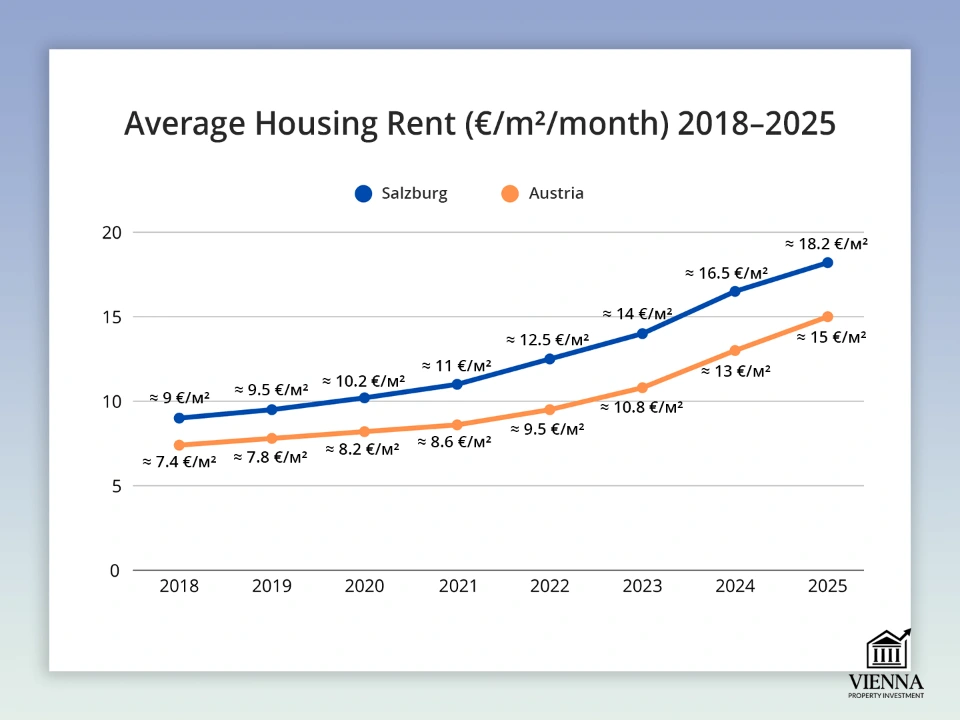
Since 2018, rents in Salzburg have risen steadily, reaching approximately €18.3 per square meter per month in 2025, compared to the Austrian average of approximately €15 per square meter. The gap, which was only approximately €1.50 in 2018, has widened to almost €3 by 2025.
This dynamic is explained by the limited supply of new apartments in Salzburg: the city center has virtually no development space, and demand is growing due to tourists, students, and remote workers. While other Austrian federal states have seen more moderate growth rates, Salzburg has demonstrated a steady trend of accelerated price appreciation.
For investors, this graph means one thing: investing in real estate in Salzburg offers higher rental yields than the national average. However, the barrier to entry is also higher here: purchase prices per square meter consistently exceed the Austrian average.
What are buyers and renters looking for?
The Salzburg market resembles a dessert display at a coffee shop: everything from miniature studios to luxurious penthouses is available, and everyone can find something to suit their tastes and budget.
Families are drawn to medium- and large-sized apartments. Imagine a spacious three-bedroom apartment with a balcony, where mornings begin with a cup of coffee to the sound of bells ringing in the Old Town. Apartments of 85–90 square meters are the gold standard: enough space for children and guests, but not too much extra space that becomes an expense.
Renters are enamored with compact yet stylish options. A two-bedroom apartment with a Scandinavian-style kitchen and a small terrace quickly disappears from the market. Young couples and students are looking for precisely these types of properties, and rents remain consistently high.
What do residents value most?
- a balcony or terrace (the view of the Alps is worth more than any furniture),
- a modern kitchen where you can gather friends,
- walking distance to transport and schools.
But an elevator or a garage aren't always a priority. Salzburg is a city where people would rather pay for a mountain view than an extra parking space.
-
Tip: If you're buying an apartment to rent out, look for properties up to 80 square meters in areas near universities or the city center. These apartments are easier to rent out and offer a quicker return on investment.
How does a real estate purchase work?

Buying a home in Salzburg is a unique experience, more like a dramatic film with unexpected twists and turns than a straightforward legal procedure.
First, a dream is born. Some see themselves in a chalet by the lake: a light mist drapes over the water, a hot coffee in hand, and the dawn in the Alps outside the window. Another dreams of an apartment in the Altstadt, with a view of the Hohensalzburg Fortress and the sound of a street violinist playing in the square in the evenings. Investors, however, are pragmatic: they are drawn to apartments near universities, where tenants will always be available.
Then comes the property search. Realtors show dozens of apartments, and each one is a separate scene:
- antique apartments with arched ceilings and heavy oak doors,
- A new building with panoramic windows that offer a view of the entire city.
It's easy to get carried away in moments like these, but it's crucial to look beyond the surface: liquidity, rental potential, and price growth are what truly matter.
Once the property has been selected, the most serious part begins: legal due diligence. In Austria, there are no "gray areas": every property right is recorded in the Grundbuch (legal title deed). It's at this stage that most buyers realize that understanding the details consultant or lawyer
Then comes the culmination—the signing of the Kaufvertrag . A lawyer or notary reads out all the terms: the price, the parties' obligations, and the terms. A few signatures, and you become the full owner.

And finally, a "surprise" that comes as a shock to many: additional expenses. An additional 8-10% is added to the apartment's price for taxes, registration, notary fees, and agent commission. So, a €400,000 apartment turns into €440,000.
It's important to remember: the Salzburg market is not about "cheap hits," but about prestige, transparency, and long-term value.
Investment potential
Real estate in Salzburg runs like a Swiss watch: rental demand is stable, and purchase prices are rising even when the market is cooling in other regions. For homeowners, this means not only capital preservation but also growth.
Rental yields average 4-5% per annum. In resort areas like Zell am See or Bad Hofgastein, rates are higher, but those who prefer management and working with tourists rather than permanent residents tend to flock there. The risk is higher here, but the returns are also higher.
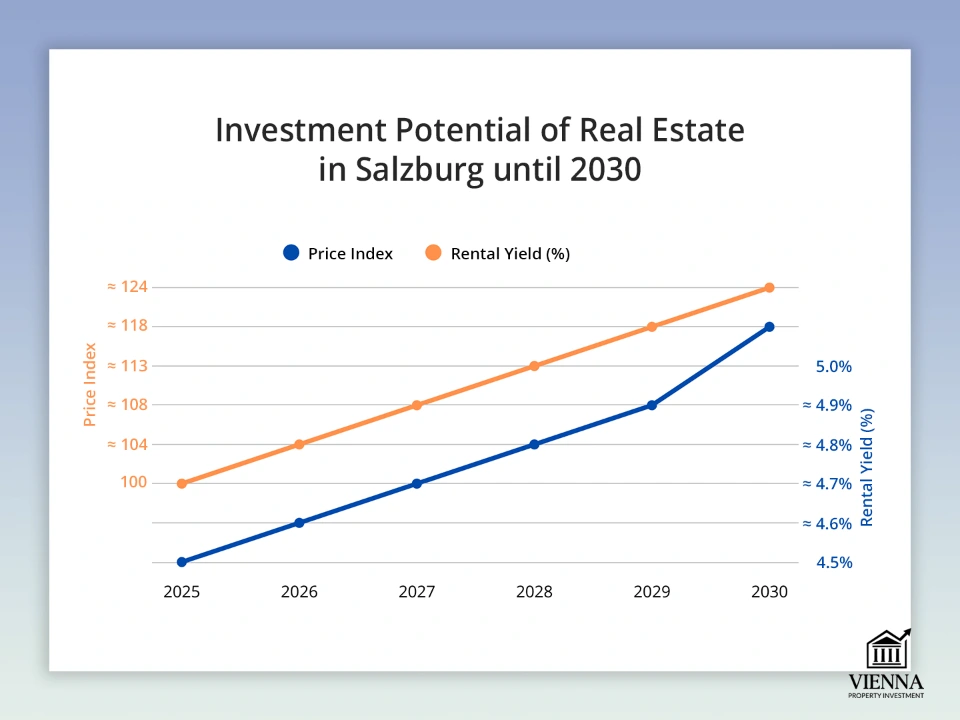
Looking at the dynamics of recent years, the number of transactions is increasing, and the price per square meter is rising especially rapidly in the city center and prestigious areas. Where new projects are limited, each existing property becomes a rare commodity.
Interestingly, investors in Salzburg always have several strategies. They can buy a compact apartment and rent it out to students or young professionals. They can invest in larger apartments and target families who rent for years. Or they can go for the premium segment—villas or penthouses, which appreciate in value the fastest.
New Rule: Share Deals No Longer the Easy Way
Imagine this: you see a great opportunity—real estate is owned by a company, and you want to buy a share in that company, not the house or apartment itself. Previously, this could have been a clever and profitable solution—you could avoid some taxes if the share transfer was done carefully, through corporate structures.
But starting in July 2025, this game has become more complicated. Now, if you buy shares in a way that ultimately results in control of 75% of the company (or comparable control through ownership chains), the transaction may be considered a direct transfer of real estate—and will be subject to RETT, as if you had purchased the property directly.
This means that the schemes previously used to avoid the RETT are becoming less secure. Those who thought, "I'll buy a share of the company, and everything will be as if it were unofficial," will now have to rethink their strategy.
Pros and cons of buying
Every real estate market has two sides, and the Salzburg market is no exception. It's not just a question of price or square footage—it's a city with a unique atmosphere, limited supply, and high demand.
Here, historic buildings in the city center, prestigious villas at the foot of the Alps, and more affordable apartments in the suburbs coexist. To see the full picture, it's important to consider the market through the prism of its pros and cons, as these define Salzburg's character and help determine who should invest here and who should look for alternatives.
Pros
Prestige and status. Real estate in Salzburg is not just about square footage but also a symbol of a certain standard of living. Owning an apartment in the Altstadt or a villa by the lake is a kind of "calling card" that immediately speaks to the owner's wealth and taste.
Many foreigners buy property here not for the profitability, but to emphasize their status. The region's prestige is comparable to Vienna, but with the added benefit of a historic city atmosphere and proximity to the Alps.
Stable rental demand. Salzburg is a tourist mecca, attracting millions of visitors every year. But rental demand here isn't limited to summer or winter. Universities, festivals, and business events make the rental market year-round. Even small apartments near universities are always available—they're immediately snapped up by students and young professionals. This means owners receive a steady income stream, regardless of the season.
Rising housing prices. The price per square meter in Salzburg has been steadily rising over the past decades. Even periods of economic downturn have not led to significant price declines. In prestigious areas, growth can reach 5-7% per year, and even higher in the luxury segment. For investors, this means that investing in housing in Salzburg acts as a long-term asset, protecting against inflation.
An apartment "works" for its owner. Unlike many other regions, where property can sit empty, here an apartment becomes an asset that generates profit even with minimal management. Renting out a property in Salzburg is easier than in less popular regions because demand significantly exceeds supply. This is especially true for small apartments and apartments in central areas.
World-class infrastructure. Salzburg is not only a historic center but also a city with a well-developed infrastructure. It boasts schools, universities, hospitals, museums, theaters, and shopping centers. All this makes life comfortable for residents of all ages, from students to retirees. Buying a home in Salzburg means access to a European quality of life.

Nature and a unique location. Salzburg is known as the city "between lakes and mountains." Residents can ski in the morning and dine in the Old Town in the evening. This combination of nature and urbanity makes real estate particularly attractive. Apartment and house owners often cite the view and proximity to the Alps as the deciding factors in their purchase.
Security and transparency of transactions. The Austrian real estate system is considered one of the most transparent in Europe. All transactions are recorded in the land register ( Grundbuch) , which eliminates fraud. This is a huge advantage for foreign investors: the risk of losing money due to unscrupulous sellers is minimal.
International community. Salzburg has long been home not only to Austrians but also to expatriates from Germany, Switzerland, Italy, and even the Gulf States. This creates a multicultural atmosphere and increases demand for housing. Property owners note that renting apartments to foreign tenants is often easier, as they are willing to pay higher rents for the convenience.
Cons
High prices. Salzburg's main drawback is its price. A square meter in Altstadt or Aigen easily exceeds €9,000. For many buyers, this becomes an insurmountable barrier. Even in less prestigious areas, prices remain above the Austrian average. Therefore, it's difficult to find affordable housing in Salzburg.
Limited supply. There's virtually no space for new construction in central areas. Many buildings here are historic and protected by the state. As a result, properties rarely come to market, yet demand is high. Apartments are often passed down from generation to generation rather than sold. For new buyers, this creates a "hunt for rarities" situation, where they have to wait years for the right offer.
Bureaucracy for foreign buyers. For EU citizens, the purchase process is relatively straightforward, but for foreigners from third countries, it can be lengthy. Land survey approval is required, especially when purchasing land or a house in a tourist area. This process can take several months and requires careful preparation.
Expensive additional costs. Few people consider that an additional 8-10% will have to be added to the apartment's price. Transfer tax, registration, notary fees, and agency fees—all together, this turns a €500,000 apartment into a property worth closer to €550,000. For some buyers, this comes as an unpleasant surprise.
Competition among buyers. Due to limited supply, competition in Salzburg is fierce. If an apartment in a good area comes onto the market, it's immediately snapped up. Transactions often close even before the property goes on sale. This creates tension: buyers have to act quickly to secure a spot.
Risks of reselling in rural areas. Although the city center is showing strong price growth, real estate in rural areas of Salzburg is less liquid. Reselling a house or apartment there can be more difficult, and prices appreciate more slowly. For investors, this means it's better to consider such properties for personal enjoyment rather than as a means of quick profit.
High tenant pressure. Since rent in Salzburg is higher than the Austrian average, many tenants are looking for compromises and choosing more affordable areas. For landlords, this means expensive, premium apartments take longer to rent than compact apartments in the city center. Investors should take this into account to avoid downtime.
Salzburg's pros and cons are closely intertwined. On the one hand, there's prestige, capital growth, a stable income, and a high standard of living. On the other , there's the high cost, limited market, and challenging conditions for foreigners.
But it is precisely this combination that makes the region unique. Salzburg is not a market for quick deals. It is a place for those looking to invest in long-term stability, quality of life, and prestige. For investors, Salzburg is more of a "safe haven," where real estate operates as a reliable asset rather than a playground for speculative play.
Results
Salzburg is hardly a cheap market. Finding a bargain here is practically impossible, but that's precisely what makes it special. Every purchase in this city is built for the future. Real estate is becoming more than just square footage—it's becoming part of the cultural and economic fabric of the region, where every house holds a history, and every apartment becomes a valuable asset.
For some buyers, this is an opportunity to preserve capital in a stable European jurisdiction, where the market is protected by laws and regulated by clear rules. For others, it's a step toward a new life among the Alps: morning strolls through the narrow streets of the Old Town, coffee with a view of the Hohensalzburg Fortress, and the feeling of living in a place where tradition and modernity coexist in harmony.
Investors are taking a pragmatic view of Salzburg: high rental demand, a year-round flow of tourists, students, and international specialists—all of this creates conditions in which an apartment or house rarely remains empty.
Here, real estate can generate a stable income, and its value increases regardless of economic fluctuations in other regions of Austria or Europe.
Real estate in Salzburg is more than just walls and a roof. It's a way of life, where every morning begins with a view of the mountains and the bells of the Old Town, and every euro invested pays off in the long term.