Carinthia (German: Kärnten) is a southern federal state of Austria, often called the "land of lakes and sun." People come here for the crystal-clear lakes of Wörthersee and Millstättersee, cozy alpine villages, ski resorts, and a mild climate that distinguishes the region from the harsher northern regions.
If you've ever wondered how to buy real estate in Carinthia, you probably know that you can find a wide variety of options here—from cozy country houses at affordable prices to luxury lakeside villas that are among the top ten most expensive properties in Austria.
Unlike Vienna and Tyrol, where the market has long been overheated and new properties are practically nonexistent, and those planning to buy an apartment in Vienna usually have to budget higher and wait longer for a suitable option, Carinthia remains a relatively affordable region.
Many buyers dream of buying an affordable home in Austria, as real estate prices in villages and small towns are lower than in the capital. Meanwhile, the market continues to grow thanks to domestic demand and international buyers from Germany, Italy, and Switzerland.
Why Carinthia is popular among buyers

Carinthia occupies a unique position in the Austrian real estate market. On the one hand, it's not the capital or a major financial center where banks and international corporations are concentrated. On the other hand, this region offers what many buyers consider the most important criterion for quality of life: harmony between nature and infrastructure.
Here, you don't have to choose between comfort and peace, as modern schools, universities, shopping centers, and medical facilities are within walking distance of Alpine lakes and mountain resorts. Carinthia is ideal for those who want to combine a leisurely pace of life with access to essential urban amenities.
The region's climate also makes it particularly attractive: mild winters, warm and sunny summers, and a large number of clear days per year make Carinthia a comfortable place to live.
Unlike the northern parts of Austria, traditional Alpine houses and villas with large terraces offering panoramic views of lakes or vineyards are more common here. Advantages of buying a house or apartment in Carinthia:
Natural surroundings. Lakes, mountains, forests, and pastures create a resort-like atmosphere year-round. Carinthia is considered the "land of lakes," with over 200 large bodies of water. It's the ideal destination for those who dream of buying a mountain home in Austria and still enjoying the summer sun on a pristine lake.
Affordable prices. Compared to Vienna, Tyrol, or Salzburg (where those planning to buy property in Salzburg often need a larger budget due to high competition in sought-after areas), housing in Carinthia remains affordable. Even near popular lakes, you can find options two to three times cheaper than in similar locations in Switzerland or Italy. For many foreigners, this is an opportunity to buy a home in Austria at an affordable price while maintaining quality and prestige.
A variety of formats. Carinthia offers a unique blend of styles: from modern apartments in Klagenfurt to Austrian laminated timber houses that blend perfectly into the rural landscape. Investors can choose from small rental apartments to luxury villas with private piers on Lake Wörthersee.
Investment potential. Despite its affordability, prices in Carinthia are rising steadily—an average of 4–6% per year. This is especially true in tourist areas, where demand for housing is high in both summer and winter. For those considering buying property in Carinthia for investment, the region offers excellent prospects: rising prices are coupled with the opportunity to rent out properties to tourists and local residents.
Convenient location. The region borders Italy and Slovenia, making it particularly attractive to international buyers. The Adriatic coast, Venice, and Ljubljana are easily accessible—just a few hours by car. Carinthia is effectively at the crossroads of cultures and economic ties, enhancing its status as an investment destination.
Furthermore, the region actively supports tourism and infrastructure development: new roads are being built, ski resorts are being renovated, and modern wellness centers are opening. All of this increases the value of real estate, whether it's a small, affordable house in an Austrian village or a luxurious lakeside villa.
Property prices in Carinthia
| Location / Accommodation Type | Price per m² (average) | Comment |
|---|---|---|
| Klagenfurt (regional capital) | €2 200–2 500 | Modern apartments, high demand, stable rent |
| Villach | €2 000–2 400 | Tourist center, good rental prospects |
| Villach / Spittal | €2 000–2 300 | Affordable apartments and private houses |
| Countryside | €1 200–1 500 | The best option if you want to buy a house in an Austrian village at a low price |
| Wörthersee, Millstatter See | €5 000–12 000 | Luxury villas near lakes, premium segment |
| Land plots | €50–160 per m² | An excellent option for building your own home |
Interestingly, buying a house in the Austrian mountains, for example in Hermagor or the Villach-Land region, is often cheaper than a similar property in Tyrol or Salzburg. Moreover, houses here can be brand new, built using environmentally friendly technologies.
Austrian houses made from glued laminated timber are becoming increasingly common —they boast high energy efficiency, are resistant to temperature fluctuations, and blend beautifully into the Alpine landscape. This type of housing is prized by families committed to an eco-friendly lifestyle, as well as by foreigners seeking to combine comfort with traditional architecture.
Don't forget about land. In Carinthia, land prices remain relatively affordable: in rural areas, building plots can be purchased for as little as €50–70 per square meter, while in the areas around Klagenfurt or Villach, they range from €100–160 per square meter. This opens up a wealth of opportunities for those looking to build their own home from scratch—whether a modern cottage or a traditional Alpine home.
Who is Carinthia suitable for?
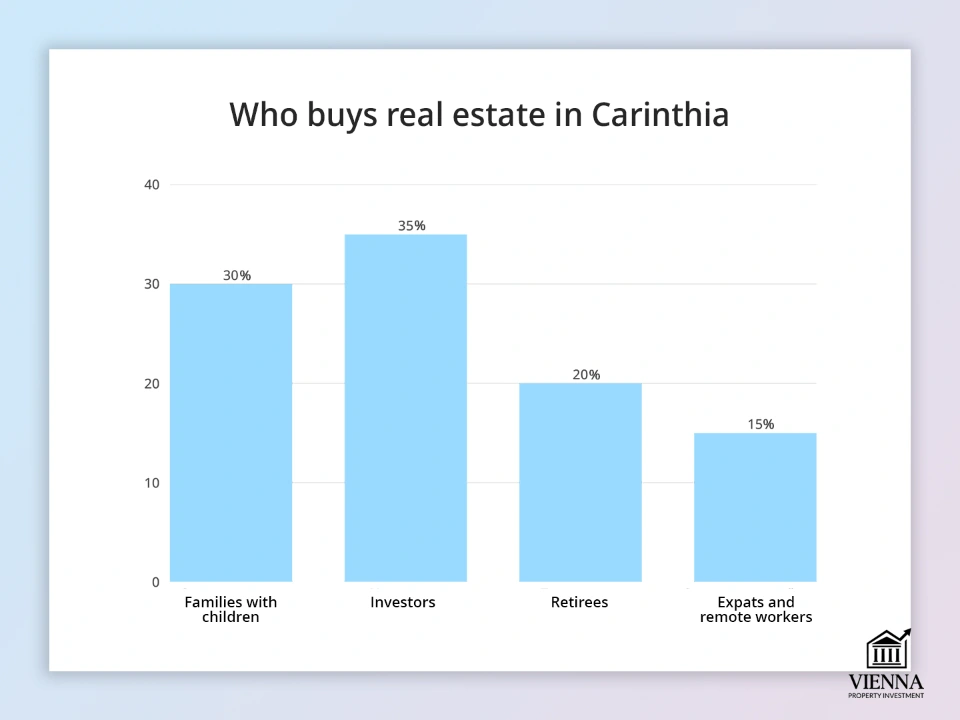
Understanding your goals for buying real estate in Carinthia helps you better navigate the market. This region attracts a variety of buyers, each with their own priorities.
Families with children most often choose Carinthia for its quiet lifestyle and environmentally friendly environment. Klagenfurt and its surrounding areas remain the most popular, boasting schools, a university, sports centers, and cultural centers. For these families, having a garden, proximity to a lake or forest, and the ability to raise children in a safe environment are important.
Investors view Carinthia as a profitable alternative to more expensive regions of Austria. Unlike Vienna and Tyrol, you can buy a house by the lake or in the mountains at a more affordable price and rent it out to tourists year-round. Average rental yields are around 4-6% per annum, and luxury villas near Lake Wörthersee can yield even more.
Retirees from Germany, Switzerland, and other European countries choose Carinthia for its mild climate, clean air, and advanced healthcare. They prefer small apartments or cozy houses in villages where they can enjoy a relaxed lifestyle and picturesque nature.
Expats and remote workers are a new category of buyers. Thanks to the growth of the internet and the popularity of remote work, Carinthia has become an attractive destination for IT professionals and freelancers. Here, you can buy an affordable house in the countryside, work online, and still be just a few hours' drive from Vienna, Ljubljana, or Venice.
The process of buying real estate in Carinthia

When considering buying a house in Austria or an apartment in Carinthia, it's important to understand the legal and organizational aspects of the process. The Austrian market is known for its transparency and security, but there are certain nuances for foreigners. These steps are generally similar for those considering buying property in Tyrol , but in tourist areas, additional requirements regarding the use of the property are more common.
1. Selecting an object
The first step is to determine your goal. If you're looking to buy a house in an Austrian village at a low price, it's worth looking at offers in rural areas, where prices are lower. For investment, it's better to choose properties near lakes Wörthersee, Millstattersee, or in resort towns, where rental demand is higher.
2. Checking documents
Before purchasing a property, a legal due diligence is mandatory. This includes checking for ownership rights, debts, and restrictions. In Austria, transactions are protected by the land registry (Grundbuch), which records all owner information. This guarantees security: if a property is registered, ownership is protected by law.
3. Conclusion of the Kaufvertrag
The main document for the transaction is the purchase and sale agreement (Kaufvertrag). It is prepared by a lawyer or notary. It specifies the price, payment terms, and the rights and obligations of the parties. Once signed, the agreement is submitted to the land registry.
4. Transaction costs
Many buyers forget that there are additional costs beyond the property price itself. These comprise 8-10% of the property's value:
- property transfer tax - 3.5%,
- registration in Grundbuch - 1.1%,
- legal/notary services - 1.5–2%,
- agency commission - up to 3.6%.
For example, if you want to buy a villa in Austria for €500,000, you will need to set aside an additional €40,000–50,000 for the paperwork.
5. For foreigners
Foreigners purchasing real estate in Austria are more strictly regulated than EU citizens. In Carinthia, permits are issued by the local state commission. This means non-residents must justify the purchase: for permanent residence, work, or business purposes. However, if the purchase is made through an EU-registered company, the process is simplified.
Prices in different locations

Carinthia today offers a highly diverse market, from affordable apartments in small towns to premium lakeside villas. According to Engel & Völkers, housing prices near Lake Wörthersee reached €5,000 per square meter in 2020, 44% higher than in 2015.
This figure clearly demonstrates the growing demand for real estate in tourist areas. In Klagenfurt, the regional capital, the average price is around €2,800 per square meter, and this market is showing steady growth thanks to the university, businesses, and developed urban infrastructure.
Compared to other Austrian federal states, Carinthia remains more affordable. The average home price nationwide is approximately €4,375 per square meter, while apartments in prestigious areas of Vienna average €5,900 per square meter. This makes Carinthia approximately 20–30% cheaper, making it attractive to buyers looking to buy a home in Austria in the mountains or by a lake while still maintaining affordability.
Private homes deserve special attention. According to international investment funds, a typical 150 m² house in Carinthia is valued at €454,592, significantly lower than prices in Tyrol or Salzburg, where a similar property can cost 25–40% more. At the same time, the quality of construction here is in no way inferior—many houses are built using modern, environmentally friendly materials, such as Austrian laminated timber, renowned for its durability and energy-saving properties.
| Location / Accommodation Type | Price per m² (average) | Market Features |
|---|---|---|
| Klagenfurt (capital) | €2 200 – €2 800 | Modern apartments, high demand among students and families |
| Villach | €2 000 – €2 400 | Tourist center, favorable rent |
| Villach / Spittal | €2 000 – €2 300 | Affordable apartments and houses for living |
| Countryside | €1 200 – €1 500 | The best option if you want to buy a house in an Austrian village at a low price |
| Wörthersee/Millstatter See | €5 000 – €12 000 | Luxury lakeside villas, premium segment, limited supply |
The Pros and Cons of Buying Property in Carinthia
Buying property in Carinthia attracts many foreigners, but it is important to weigh not only the benefits but also the potential challenges.
Pros
Affordable prices.
Carinthia remains one of the most affordable regions in Austria in terms of housing costs. While luxury apartments in Vienna reach €6,000 per square meter and above, modern apartments in Klagenfurt or Villach can be found for €2,200–2,800 per square meter.
Even near popular resorts, Carinthia remains cheaper than Tyrol or Salzburg, making the region ideal for those looking to buy a home in Austria affordably while maintaining quality of life.

Nature and climate.
The region is known as the "land of lakes"—there are over 200 bodies of water, and the mild alpine climate makes life comfortable year-round. In summer, residents swim in pristine lakes, and in winter, they ski in Hermagor or Bad Kleinkirchheim. This balance makes Carinthia attractive not only for permanent residence but also for those seeking a mountain home in Austria as a second vacation home.
Steady price growth near the lakes.
In the areas around Wörthersee, Millstattersee, and Ossiacher See, housing prices are steadily rising by 4–6% per year. Luxury villas with private piers or panoramic terraces can appreciate even faster—up to 10% annually. This is due to the extremely limited supply and high demand from Austrians, Germans, and Swiss.
Rental Investments.
Carinthia is a region with year-round tourism. In summer, people flock to the lakes and in winter, to the ski resorts. This allows for rental properties with no downtime and yields of 4–6% per annum. Small apartments in Klagenfurt or Villach are particularly profitable: they are popular with students, tourists, and business travelers.
Cons
Bureaucracy for foreigners.
Although Austria is open to buyers from the EU, the purchasing process can be more complicated for third-country nationals. In some cases, permission from the Land Office (Grundverkehrsbehörde) is required, which can take several months. Particularly strict regulations apply to land and houses located in tourist areas.
Low liquidity in rural areas.
If you decide to buy a house in the Austrian countryside at a low price, it's important to understand that reselling it may be difficult. Unlike Vienna or resorts, demand in remote areas is limited, and prices may appreciate more slowly. It's better to consider such properties as personal residences rather than investments.
Limited supply near the lakes.
The most expensive and prestigious properties are villas on the lakefront. However, supply is extremely limited here: land for development is strictly protected, and many homes are inherited and rarely come to market. This increases costs and complicates the purchasing process, especially for foreign investors.
Thus, Carinthia combines unique advantages—affordable prices, stunning natural beauty, and growing investment potential—but also requires a balanced approach. The region is ideal for long-term living and rental investments, but for quick resale or speculation, other markets are better.
Market outlook
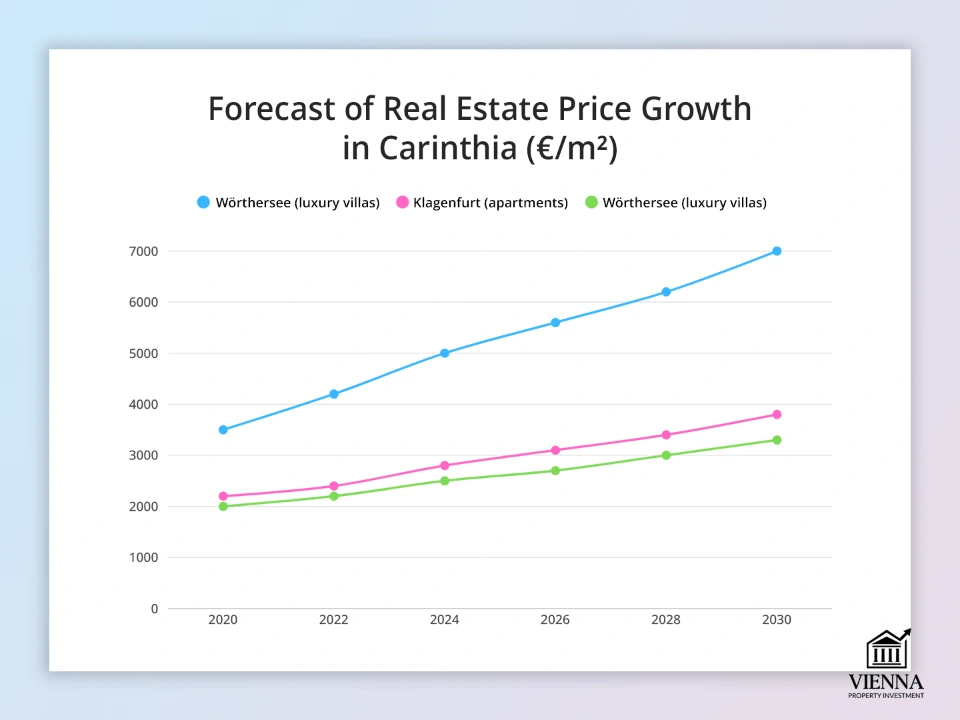
While Carinthia was once viewed as a "quiet" alternative to Salzburg or Tyrol, it is now emerging as one of Austria's most promising regions. Experts note that prices here will rise steadily and without sudden fluctuations over the next five to ten years, which is especially important for investors who value predictability.
The main factor driving this growth is limited supply. Lakeside and mountainside properties are strictly controlled by the state: new construction permits are issued extremely rarely, and protected natural areas prohibit residential expansion. This means that every existing property becomes a rare commodity, only increasing in value over time.
International interest is no less important. More and more buyers are coming from Germany, Switzerland, and Italy, as well as from the Persian Gulf countries. For them, Carinthia combines the advantages of Austrian stability and seclusion with the accessibility of resorts and proximity to the Adriatic coast.
In recent years, the "second homes" segment—second homes for seasonal living—has also been rapidly growing. This trend is particularly popular among families who want to combine lakeside vacations in the summer with skiing in the winter.
The development of tourism infrastructure is adding another impetus to growth. The ski resorts of Bad Kleinkirchheim and Gerlitzen are modernizing their lifts, building new wellness centers, and opening boutique hotels. All of this is creating additional demand for rental properties, and therefore for the purchase of real estate for both rental and residential purposes.
The popularity of remote work and digital professions also plays a role. Carinthia is increasingly becoming a choice for those seeking a balance between a quiet life in an eco-friendly environment and the opportunity to work online. These buyers are drawn to both small houses in villages and modern apartments in Klagenfurt or Villach.
What types of real estate are in demand in Carinthia?

Carinthia is unique in that virtually every type of housing can be found here—from compact studios in Klagenfurt to luxurious villas on Lake Wörthersee. It's important for buyers to understand that the market is divided into several segments, each with its own unique characteristics.
City apartments.
In Klagenfurt and Villach, the main demand is for apartments of 60–100 m². These are chosen by young families, students, and investors planning to rent out their properties. Prices start at €2,200 per m², and in new buildings in the city center, they reach €3,000–3,200.
Country houses.
Many foreigners dream of buying a house in the Austrian countryside at an affordable price. In Carinthia, this is a reality: in the countryside, you can find houses for €150,000–200,000. These are often traditional buildings with a plot of land that can be renovated and transformed into a cozy home.
Luxury lakeside villas.
The most prestigious segment is lakeside homes. These properties cost from €5,000 per square meter and up, while villas can reach €10–15 million. They are in demand among foreigners seeking a second home or summer residence. Building new homes here is virtually impossible: the land is strictly protected, causing prices to rise faster than in other regions.
Glued laminated timber houses.
Austrian glued laminated timber houses are becoming popular among buyers seeking a combination of eco-friendliness and modern comfort. These houses blend well with the Alpine landscape, are quick to build, and boast high energy efficiency. In Carinthia, they can be found in the mountains and villages, where land is relatively inexpensive.
Real estate investments
Investing in Carinthia real estate today looks particularly promising because the region combines several key advantages: a low entry barrier compared to Vienna and Salzburg, stable price growth, and high tourism potential.
For many foreigners, the question of how to buy real estate in Carinthia is directly related to the opportunity to diversify their capital: buying a house in the Austrian mountains, renting it out to tourists in the winter, and earning rental income near lakes in the summer.
Experts note that rental yields in Carinthia range from 4 to 6% per annum. Apartments and villas near Wörthersee and Millstättersee are particularly popular, as the rental season lasts almost year-round. Tourists come not only for the beaches but also for the ski resorts, wellness centers, and festivals.

This is why investors often consider buying an affordable home in Austria in less popular areas and then renting it out through platforms like Airbnb or Booking.
Carinthia is also attractive for long-term investors due to its projected price growth. Analysts are already recording annual housing price increases of 4-6%, and up to 8% in prime lakeside locations. This means that if you buy an Austrian laminated timber house in the countryside for €300,000 today, in 10 years it could cost €420,000 or more.
It's also important to consider the purchase format: some prefer apartments in Klagenfurt as a ready-made option with high liquidity, while others invest in land (€50–160 per square meter) to build a custom-designed villa. This approach not only allows for quality control but also optimizes costs.
Ultimately, Carinthia offers investors three scenarios:
- Short-term income through rental to tourists.
- Medium-term increase in value when selling an object in 5-10 years.
- Long-term ownership as part of family capital or inheritance.
Conclusion: Is it worth buying real estate in Carinthia?
Carinthia is more than just another region of Austria; it's a place where nature and investment meet. Here, you can stroll along Alpine trails in the morning and dine by a warm lake in the evening, watching the sunset. Every euro invested in a house or apartment works not only for comfort but also for the future. Prices are rising steadily, rental income is year-round, and owning property in Austria opens the door to new opportunities.
Yes, bureaucracy for foreigners and limited supply near the lakes may seem like a barrier. But that's precisely what makes the market so valuable: unique properties don't pop up on every corner, meaning every transaction is special. Carinthia is suitable for those who want more: not just "buying a house in Austria at a low price," but investing in a lifestyle, a sense of stability, and the future of their family.
Ultimately, real estate here is more than just walls and a roof. It's a piece of Austrian history, prestige, and a safe haven for capital.