The rental market in Austria occupies a key position in the country's housing system: over 40% of the population prefers to rent, and in large cities, especially Vienna, the share of renters is even higher. However, rent formation remains one of the most challenging issues for both tenants and landlords.
The reason is that rental prices in Austria depend not only on market factors—location, apartment condition, year of construction, and infrastructure—but also on legal regulations. One of the most important elements here is the Mietrechtsgesetz (MRG)—the Rental Act—which applies differently to different properties: in some cases, fully, in others, partially, and sometimes not at all. This determines whether a free market price can be set or whether the landlord is obligated to adhere to regulatory rates and restrictions.
In this article, as an Austrian real estate expert, I'll take a detailed look at what makes up rent, what factors influence it, and how to correctly determine a fair rental price for housing in Austria.
What does rent in Austria consist of?
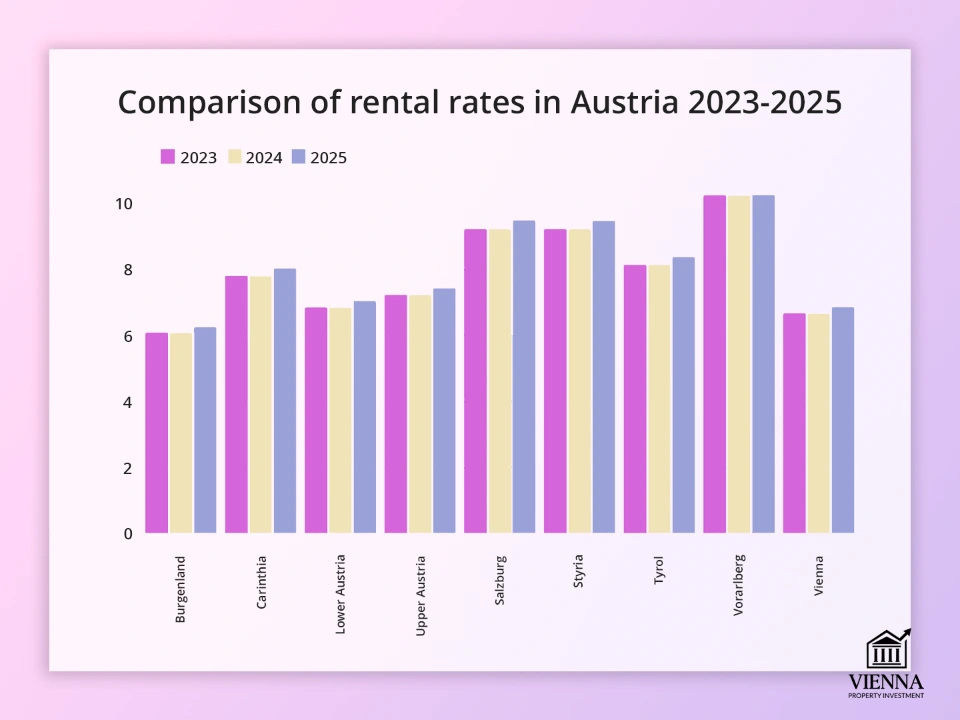
Rent comparison in Austria 2023-2025
Rent in Austria isn't limited to the "net" price of the apartment. In most cases, the rent paid by the tenant consists of several components. This cost structure is important if you're looking to buy an apartment in Vienna for rent and can calculate the monthly payments in advance.
Basic rent (Hauptmietzins). This is the basic amount a tenant pays for the use of the property. In the first quarter of 2025, the average Hauptmietzins was €502 per month or €7.50/m², 2.7% higher than in the same period in 2024 (Statistik Austria, 2025). The amount of this rent depends on the type of apartment (new building, older building, etc.), its condition, and whether it is subject to the Mietrechtsgesetz (MRG).
Operating costs (Betriebskosten). These include utilities and building maintenance, such as garbage collection, water supply, sewerage, common area lighting, hallway cleaning, elevator maintenance, and building insurance. In the first quarter of 2025, the average Betriebskosten was €165.20/month or €2.50/m², representing approximately 30% of the total rent.
Special expenses (besondere Aufwendungen). These are additional costs that may include elevator fees, laundry, repairs, and other specific services. These costs are usually specified separately in the lease agreement.
Furniture Fee (Entgelt für Einrichtungsgegenstände). If furniture is provided in a rental apartment, the landlord may charge an additional fee for its use. The amount of this fee is determined based on the value of the furniture and its lifespan. For example, if the furniture costs €7,000 and has an estimated lifespan of 20 years, the monthly furniture fee could be approximately €29.60, plus a 12% landlord surcharge, for a total of €33.10 per month.
VAT (Umsatzsteuer). Value-added tax in Austria is 10% for rental properties. However, the standard VAT rate of 20% applies to furniture, parking, and heating.
Thus, renting an apartment in Austria involves several components, each with its own specifics and governed by relevant laws and regulations. Understanding these components is important for both tenants and landlords to ensure transparency and fairness in rental relationships.
The role of the Mietrechtsgesetz (MRG) and its scope of application

The Residential Tenancy Act (Mietrechtsgesetz, MRG) was passed on November 12, 1981, and regulates the relationship between landlords and tenants in Austria, ensuring a balance between the rights of both parties. However, it does not apply to all types of real estate. Depending on the age of the building, its purpose, and other factors, the MRG may apply in full, in part, or not at all.
Full application of MRG
MRG applies in full to the following types of real estate:
- Houses built before 1945, including buildings built before 1953 with government subsidies.
- Housing with state support, regardless of the year of construction.
In such cases, the rent is limited taking into account:
- Housing categories: defines the type of property (e.g. social housing, government-supported housing).
- Richtwertmietzins: a guideline rental rate set for certain categories of housing.
- Angemessener Mietzins: reasonable rent that takes into account market conditions and the specific features of the specific property.
These measures are aimed at protecting tenants from inflated rents and unjustified evictions. For example, an 80-square-meter apartment in Graz in an old building (Altbau) with modern renovations, fully covered by the MRG, is rented for approximately €600 per month, which is 25-30% lower than the market price for similar housing not covered by the MRG.
Partial application of MRG
MRG applies in part to the following types of property:
- New condominium units built after 1953 if the building consists of multiple units and did not receive government assistance.
- Attics and extensions added to existing buildings after 1953.
In such cases, the rent is defined as “reasonable” (angemessen), meaning that the landlord and tenant can freely agree on the rent amount, taking into account market conditions.
Example : A modern 55 m² apartment in a condominium in Linz, built in the 1960s, subject to partial application of the MRG, can be rented for €650/month, while comparable housing without MRG on the private market costs around €750/month.
Objects outside the scope of MRG
MRG does not apply to the following types of property:
- Private houses and duplexes , regardless of the year of construction.
- New buildings after 2006 that did not receive state support.
- Tourist apartments and short-term rentals.
In these cases, the landlord and tenant have complete freedom to set the terms of the lease, including the amount of rent.
Example 1: A 100 m² private house on the outskirts of Vienna, built in 2010, can be rented out for €1,200/month, entirely by agreement between the parties.
Example 2: A 70 m² apartment in a new building in Innsbruck from 2020 for long-term rent could have a rental rate of €1,050/month, set without MRG restrictions, depending on demand.
These differences are especially important for those planning to rent an apartment in Vienna long-term or interested in renting a property in Austria in general.
| MRG category | Real estate example | Average rental rate (€/m²) | Valuation relative to market price |
|---|---|---|---|
| Full application of MRG | 65 m² apartment in the historic Altbau, central Vienna | €6.80 | ≈30% below market price |
| Partial application of MRG | Attic 55 m² in a 1960s condominium, Graz | €9.60 | ≈15% below market |
| Without the use of MRG | New building 75 m², Innsbruck, 2020. | €12.50 | ≈at the market level |
Rent calculation systems in Austria

In Austria, rent is determined by several systems, each of which takes into account various factors, such as the condition of the property, its location, and the year it was built. Let's look at the main ones:
Category rentals (Kategorienmietzins)
The rental category system classifies apartments into four categories (A–D) depending on their condition and equipment at the time of the lease agreement:
- Category A: modern standard, apartment with modern finishing and equipment.
- Category B: good standard, apartment with quality finishing, but without the latest improvements.
- Category C: average standard, apartment with basic finishing, perhaps in need of some improvements.
- Category D: low standard, apartment without toilet inside, possibly with outdated finishing.
These categories influence the rent amount, with higher standard apartments having higher rents.
Richtwertmietzins (Estimated rent)
Richtwertmietzins are reference rental rates established for each federal state of Austria. They are reviewed every two years.
A new system of annual adjustments to Richtwertmietzins and category rates in Austria came into effect on April 1, 2025. These changes were introduced as part of the 4th Mietrechtlichen Inflationslinderungsgesetz (4. MILG) to mitigate the impact of high inflation on tenants.
| Parameter | The old system | New system (from April 1, 2025) |
|---|---|---|
| Adjustment frequency | Every 2 years | Every year, April 1st |
| Calculation method | Based on the change in the consumer price index (VPI) over two years | Based on the change in VPI over the previous year, with a 5% increase cap |
| Application | To Richtwertmietzins and Kategoriemietzins | To Richtwertmietzins and Kategoriemietzins, including Gemeindewohnungen and Genossenschaftswohnungen |
| Limiting the increase | Absent | Maximum 5% in 2025 and 2026; starting in 2027, average inflation over the past 3 years, capped at 5% |
Example of calculation of the Richtwertmietzins adjustment:
| Federal state | Richtwertmietzins (€/m²) | VPI Change for 2024 | 2025 adjustment |
|---|---|---|---|
| Vienna | 6,67 | 2,9% | +0.19 €/m² |
| Styria | 9,21 | 2,9% | +0.27 €/m² |
| Tyrol | 8,14 | 2,9% | +0.24 €/m² |
Important points for tenants:
- Rate freeze: For rental agreements concluded before 1 April 2025, rates will remain at the 2023 level. This means that rents will not increase in 2025.
- Rate increase cap: In 2026, rate increases will be capped at 5% of the previous rate. In 2027, the average inflation rate for the past three years will apply, capped at 5%.
- Exceptions: These restrictions do not apply to vacant Mietverträge, such as new buildings or private homes.
Angemessener Mietzins (Reasonable Rent)
Angemessener Mietzins is a rent calculation system based on market conditions and applies to certain types of real estate:
- Large apartments: usually over 130 m², such as a spacious apartment in Vienna's old building (Altbau) in the 1st district.
- Properties in listed buildings: historic buildings included in the register of cultural heritage, where the rent must take into account the cost of maintenance and reconstruction.
- New buildings: apartments in newly constructed buildings where MRG use is limited or absent.
For example, a 140 m² apartment in a gated community in Vienna: the guide price is €6.70/m², but given the condition, location and market demand, the Angemessener Mietzins can be €9.50/m², which is higher than the Richtwertmietzins.
Important: Angemessener Mietzins gives landlords the opportunity to receive market rent for large and unique properties, but at the same time, tenants are protected from inflated rents—the rent must be justified by the market situation.
Erhöhter Mietzins (Increased Rent)
Erhöhter Mietzins is used when a landlord makes major repairs or improvements to an apartment. This may include:
- Complete kitchen or bathroom renovation
- Thermal modernization of the building (energy saving)
- Elevator installation, common area improvements, facade modernization
How to install:
- The amount of increased rent is determined by the arbitration commission or the court.
- The increase is limited to a certain period, most often 10 years for standard housing and up to 20 years for social housing.
- These measures protect tenants from unjustified increases, while the landlord recoups his investment.
Practical advice: If you're looking to rent an apartment in Austria long-term, it's worth checking whether the Erhöhter Mietzins tax has been applied to the property to understand the actual rental price. For example, an apartment in a historic building in Vienna after thermal modernization: base rate €6.80/m² → increase to €8.20/m², approved by the arbitration committee.
Legal aspects and recent changes

The legal framework for rental housing in Austria is strictly regulated, and it is important for tenants and landlords to understand the current laws and any recent changes. The Mietrechtsgesetz (MRG) and Wohnungsgemeinnützigkeitsgesetz (WGG) define the limits of acceptable rents, tenant protections, and the possibility of legal rent increases.
Key changes were introduced in 2024–25 to curb rent surges, increase transparency and protect tenants, particularly in large cities such as Vienna.
Rent indexation (Wertsicherungsklausel)
Rent indexation in Vienna deserves special attention —it's often linked to the CPI (VPI) and has a greater impact on the final price than you might think.
A rent adjustment clause is a provision in a lease agreement that allows the landlord to adjust rent based on changes in the consumer price index (CPI). Until 2024, such adjustments could result in rent increases of 10% or more.
Starting in 2024, a cap on annual rent increases based on indexation was introduced: the maximum increase is 5% per year. This change is aimed at protecting tenants from excessive rent increases in the face of high inflation.
Possibilities of increasing rent
There are certain situations when a landlord can legally increase the rent:
- Repairs and modernization: If the landlord makes major repairs or improvements to the apartment, they may increase the rent. The amount of the increase is determined by an arbitration committee or court for a limited period.
- Transfer of the contract to relatives: When transferring the lease to relatives, the landlord can set a new rent in line with market conditions.
- Very low starting rent: If the starting rent is significantly below the market rate, the landlord may demand an increase to a reasonable level in accordance with §45 Mietrechtsgesetz (MRG).
Subsidized and cooperative housing
The Wohnungsgemeinnützigkeitsgesetz (WGG) regulates rent in non-profit housing, such as housing provided by housing cooperatives. There are rent caps, and long-term increases can be applied for up to 20 years, for example, to cover the costs of repairs and modernization. These measures balance the interests of tenants and landlords.
Many housing cooperatives and municipal programs allow Ukrainians and refugees to apply for subsidized housing. If you're looking to rent an apartment in Vienna for refugees, it's important to consider registration and proof of residence status. This makes access to cooperative housing a more realistic and secure option for temporary or permanent residence.
Factors Affecting Rental Prices

Renting a home in Austria depends on many factors that can significantly impact the cost. Let's look at the main ones:
1. Location
Vienna is traditionally the most expensive city to rent in Austria. Within the city, price differences are also significant:
- City centre (Innere Stadt, Wieden, Währing, Döbling): high rental prices due to prestige and developed infrastructure.
- Outskirts (Favoriten, Donaustadt, Floridsdorf): more affordable prices, but with less transport accessibility and infrastructure.
According to CBRE, rents in central Vienna could reach €16.5/m² in 2025, while on the outskirts they will be around €12.2/m².
2. Area and layout
Small apartments (less than 40 square meters) are in high demand among students and young professionals. They often cost more per square meter than larger options. For example, studio apartments in Vienna can rent for between €630 and €890 per month.
3. Condition and repair
Apartments in new buildings or with modern renovations (for example, in the Altbau style) are more expensive. In 2025, the average rent for new apartments is approximately €14.87/m², while for older apartments it is approximately €10.00/m².
4. Energy efficiency of the building
Apartments with a high energy efficiency rating (e.g., Class A) have lower utility costs, making them more attractive to tenants. This can increase rental prices by 5-10% compared to similar apartments with a lower energy efficiency rating.
5. Furniture and infrastructure
Furniture, an elevator, a balcony, a garage, or parking can significantly increase the rent. Fully furnished apartments with additional amenities can cost 10–20% more.
6. Demand and seasonality
Demand for rental housing in Austria traditionally rises in the fall, when students and expats return to the city. This leads to higher rental prices during this period. In 2024, rents in Vienna increased by an average of 6.2–7.7%.
| Region / City | City Centre / Prime Locations (€/m²) | Outskirts / Middle District (€ / m²) | Notes |
|---|---|---|---|
| Vienna | 16,5 | 12,2 | Prices are higher due to high population density and infrastructure |
| Graz | 13,2 | 10,1 | A university town, demand for student apartments is high |
| Salzburg | 15,0 | 11,5 | Popular tourist destination, limited accommodation |
| Linz | 12,8 | 9,8 | Industrial center, moderate prices |
| Innsbruck | 14,5 | 11,0 | A student town, demand is high in autumn |
| Klagenfurt | 11,5 | 8,7 | More affordable options, fewer upscale areas |
| Burgenland | 9,0 | 7,5 | The most accessible region, low population density |
| Tyrol (outside Innsbruck) | 12,0 | 9,5 | Mountainous regions, seasonality affects demand |
| Styria | 14,0 | 9,2 | The city of Graz is more expensive, the countryside is cheaper |
| Upper Austria | 13,0 | 10,0 | Includes Linz and surrounding area |
Inflated rent: where to go and what to do

If you believe you're paying too much rent in Austria, you have the option to challenge it. In buildings subject to the full Mietrechtsgesetz (MRG), tenants can appeal to an arbitration board or court to verify the rent. If the rent exceeds the permissible level, it can be reduced to the legal limit, and any overpayments can be refunded.
It's important to adhere to the following deadlines:
- for open-ended contracts, an application can be submitted within 3 years from the date of conclusion of the contract;
- for fixed-term contracts - no later than 6 months after their expiration or conversion to open-ended contracts.
After these deadlines have expired, it is no longer possible to challenge the rent, but it remains possible to object to an unjustified increase in the rent by indexation (Wertsicherung).
In new buildings and properties outside the MRG's jurisdiction, the situation is more complex: there, the price is determined freely, and court rulings rarely side with the tenant.
In my practice, I've encountered cases where tenants complained about excessively high rent. For example, a refugee family who decided to rent an apartment in Vienna long-term was paying almost 20% more than the legally established rent for older apartments. We filed a complaint with the arbitration commission, and the rent was reduced and the overpayments were refunded.
Conclusion: How to navigate Austrian rentals

In my opinion, rental prices in Austria aren't just a figure on a contract, but the result of a complex combination of market conditions, legal regulations, and the specific property's condition. It's especially important for tenants to understand whether the apartment is subject to the Mietrechtsgesetz (MRG) and what additional terms are included in the contract—from indexation to possible rent increases due to renovations.
An interesting trend is observed in 2025: rents in new buildings continue to rise, especially in Vienna's prestigious districts, while legislation strengthens tenant protections in older buildings and regulated buildings. This creates a balance between the interests of landlords and tenants. This is especially relevant for those seeking to rent an apartment in Vienna for refugees: regulated rents can be significantly lower than market rates, making such options more affordable.
When choosing an apartment, consider not only the price but also the housing category, energy efficiency, infrastructure, and contract terms. Sometimes it's wiser to pay a little extra for modern renovations and a convenient location than to face ongoing repair costs or high utility bills.
For those looking to rent an apartment in Austria long-term, it's important to carefully review the contract and understand your rights—this can help save money and avoid unpleasant surprises. Carefully review the rental agreement in Vienna , including the indexation (Wertsicherung), the payment details, and the terms of any potential increases after renovations.