Vienna is one of the few European cities where historic buildings have been preserved on such a grand scale and in such splendor. For centuries, it was the center of the Austro-Hungarian Empire, which had a profound influence on its architecture. Every street here bears the imprint of different eras: from opulent Baroque palaces to Gründerzeit apartment buildings and the austere Functionalist buildings of the 1920s.
Historic Vienna properties are more than just homes; they're also part of its cultural heritage. These apartments, known as Altbau, are distinguished not only by their architectural value but also by their unique atmosphere: high ceilings, elegant moldings, massive doors, and antique parquet floors create a distinctive style that's impossible to replicate in modern new buildings. That's why interior design in Vienna for Altbau apartments is often based on preserving original details rather than replacing them.
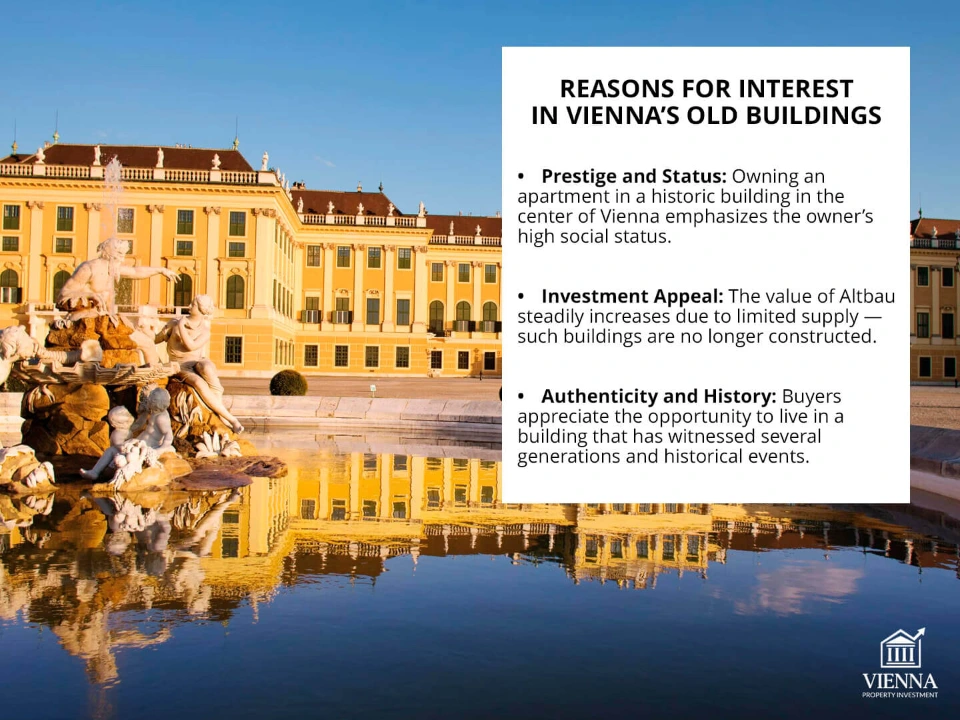
Every year, interest in such properties is growing not only among local residents but also among foreign buyers. This is due to several factors:
- Prestige and status. Owning an apartment in a historic building in central Vienna underscores the owner's high social status.
- Investment appeal. Altbau prices are steadily rising due to limited supply—homes like these are no longer being built.
- Authenticity and history. Buyers value the opportunity to live in a building that has witnessed several generations of residents and events.
The purpose of this article is to help potential buyers understand:
- What features distinguish historical real estate from an ordinary old apartment?
- What legal and technical nuances are important to consider?
- How to approach a purchase wisely and preserve the value of an object in the long term
A historic apartment in Vienna is not only a beautiful home, but also a serious responsibility associated with preserving the unique architecture and adhering to certain regulations.
What is considered historic property in Vienna?

In everyday speech, the terms "old apartment" and "Altbau" are often confused, but in the Austrian real estate market they have fundamentally different meanings.
| Concept | Characteristic | Example |
|---|---|---|
| Old apartment (umgangssprachlich) | Any apartment built more than 20-30 years ago. It may be in poor condition, but it is not legally considered a historic building. | A 1970s house with an outdated layout. |
| Altbau | A building constructed before 1953 that falls under the Mietrechtsgesetz (MRG) law. These are most often buildings from the Gründerzeit period or interwar functionalist architecture. | 1890 house with stucco and wooden windows. |
Historical stages of construction:
| Period | Architecture and features | Examples |
|---|---|---|
| Before 1918 – Gründerzeit | Luxurious buildings with stucco, high ceilings, and decorative facades. Inner courtyards (Hof) are common. | Districts Josefstadt, Innere Stadt. |
| 1918-1938 – Functionalism and the social projects of the "Rotes Wien" | Straight lines, minimalism, the first mass-produced housing complexes. Social housing was built for working-class families. | Karl-Marx-Hof in the Döblingdistrict. |
| 1939-1953 – post-war recovery | Simple and functional houses, without decorative elements. | Parts of the districts Hernals and Ottakring. |
Why is Altbau so highly valued?

Historic Vienna real estate has always been in high demand. Altbau (Old Townhouses) are not just old buildings, but unique structures that cannot be replicated in modern times. Their value is determined by several key factors.
1. Limited offer
Viennese Altbau are an irreplaceable resource. New buildings in Vienna are constructed strictly to modern standards and lack the rich decorative flourishes that characterized the late 19th and early 20th centuries.
The reasons why there aren't more such houses:
- Strict building codes. In Vienna's central districts, new projects are strictly limited in height and design to preserve the city's historic character.
- Limited land availability. Almost all areas within the Gürtel (the main transport ring) are already built up, making demolishing a historic building and constructing a new one virtually impossible.
- High restoration costs. Even if a building can be reconstructed, preserving the original façade and details is often much more difficult and expensive than building a modern home.
Thus, each apartment in Altbau becomes an exclusive product, and demand consistently exceeds supply.
2. Cultural value

The Altbau are part of Vienna's cultural heritage. Many of the buildings are listed buildings, making them not only residential buildings but also elements of the city's history.
Features of cultural value:
- Many buildings from the Gründerzeit period reflect the spirit of the Austro-Hungarian Empire, when Vienna was the cultural and political centre of Europe.
- Houses with original stucco, stained glass, and decorative facades have become the city's calling card; they can often be seen on postcards and in tourist guides.
- Owning an apartment in such a building is perceived as participating in the preservation of history, and not just buying square meters.
For foreign buyers, this becomes an important argument: they are acquiring not only a home, but also a symbol of Vienna, which enhances the owner’s status.
3. Investment potential

Historic real estate has high investment appeal, especially in prestigious areas.
Reasons for price increases:
- Constant demand from both local residents and foreign investors.
- Limited supply – no new Altbau are being built, and existing buildings are aging and becoming even more valuable.
- High rental rates: apartments in historic buildings with high-quality renovations can generate a stable income from renting to tourists or long-term tenants.
| District | Average price per m² (2025) | 5-year growth trend |
|---|---|---|
| Innere Stadt | 12 000-18 000 € | +25% |
| Josefstadt | 8 000-11 000 € | +20% |
| Hernals | 5 000-7 500 € | +15% |
Conclusion: purchasing Altbau is not only an aesthetic pleasure, but also a reliable investment, especially with proper management of the property.
4. Emotional factor
For many buyers, not only rational calculations are important, but also the emotional component:
- The atmosphere of the old house evokes a feeling of connection with the history of the city.
- High ceilings, stucco moldings and massive doors create a feeling of coziness and grandeur at the same time.
- Living in such a house is associated with Viennese tradition and culture, which is especially important for art and history lovers.
Often, it is the emotional factor that becomes decisive when choosing an apartment: buyers are willing to pay more for a sense of uniqueness and authenticity.
The role of Denkmalschutz (architectural heritage protection)
Vienna has a strict Denkmalschutz system, which regulates the protection of historic buildings.
If a house is included in the register of architectural monuments, its owner is obliged to comply with a number of rules.
Owner's responsibilities:
- Preserving the original appearance of the building:
- It is prohibited to change the facade without approval;
- You cannot install modern plastic windows instead of wooden ones;
- All decorative elements (stucco, balconies, doors) must be preserved or recreated.
2. Coordination of any repair work.
Even internal redevelopment often requires permission from city authorities.
3. Participation in restoration projects.
In the case of major renovations to a building, owners pay part of the costs, but the state may provide subsidies or tax breaks.
Impact on the real estate market:
- The cost of such objects is higher because they are unique and have the status of cultural value.
- Owners receive prestige and state support, including financial assistance for restoration.
- However, for the buyer this also means greater responsibility and restrictions when it comes to repairing and using the apartment.
| Pros | Cons |
|---|---|
| The growth in prices for such properties is above average. | Restrictions on any changes to the facade and interior. |
| Possibility of receiving government subsidies for repairs. | The need for regular coordination with monument protection authorities. |
| Prestige and uniqueness of the property. | Higher maintenance costs. |
Architectural features and style
Vienna's Altbau are true architectural gems that shape the city's unique character. These buildings were built in an era when architecture was considered an art form, and the quality of materials and attention to detail were at the highest level.
Key architectural features:

High ceilings (3-4 meters).
- They create a feeling of space and light.
- Allows for the implementation of bold design solutions, including multi-level lighting or mezzanines.
- Ceiling roses for chandeliers are often found in vintage living rooms

Decorative moldings and ceiling roses.
- A symbol of the luxury of the Gründerzeit period.
- Original stucco is often the main decoration of an apartment and can increase its market value.

Classic parquet.
- Handcrafted from oak or beech.
- Even after decades, many floors remain in good condition and can be restored with sanding.
- Parquet flooring gives warmth and nobility to the apartment.

Stained glass and wooden windows.
- Often have decorative bindings or colored glass.
- Modern technologies make it possible to restore them, preserving their appearance and improving thermal insulation.

Wide stairwells and massive doors.
- They gave the building respectability and emphasized the status of the residents.
- Some buildings still have antique elevators with wrought iron elements.

Inner courtyards – Hof.
- They performed the functions of ventilation and natural lighting.
- Today they are being transformed into green oases with gardens or recreation areas for residents.
- In a historical context, the Hof was a place for neighbors to socialize and a part of the city's culture.
The importance of architecture for the modern consumer. Such details create an atmosphere of unique authenticity, appreciated by both Viennese and foreigners.
Contemporary designers often combine original Altbau elements with contemporary interiors to create unique premium apartments.
Example: An apartment in the Josefstadt , where the original stained glass windows and parquet floors have been preserved, after a high-quality restoration can cost twice as much as a similar space in a modern building.
Legal aspects of owning historic real estate
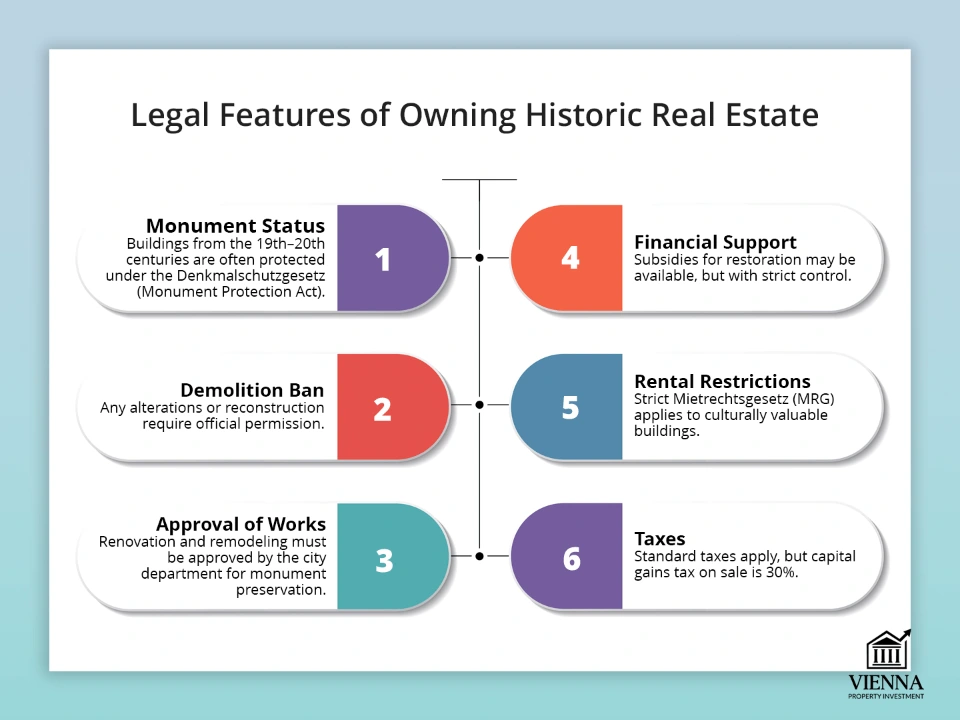
Purchasing an apartment in Altbau requires careful legal review. Vienna's older housing stock often comes with unique legal nuances that can impact both the feasibility of redevelopment and the cost of maintenance.
Checking the legal status of an apartment
The main source of information on the legal status of real estate in Austria is the Grundbuch – the state land register.
Before planning to buy an apartment in Altbau in Vienna , it is important to order a Grundbuchauszug (extract from the register), which indicates:
- current owner of the object;
- encumbrances (mortgages, lawsuits, easements);
- restrictions on sale or redevelopment.
Types of apartments by legal status:
| Type | Description | What is important for a buyer to know? |
|---|---|---|
| Eigentumswohnung (apartment ownership) | The buyer receives full ownership of the property. | The safest option: you can dispose of the apartment (sell, bequeath, rent it out). |
| Mietwohnung (rental apartment) | The apartment is owned by another owner, and the current tenants live there under a long-term lease. | When purchasing such a property, the buyer is obliged to respect the rights of the tenants; it is practically impossible to evict them. |
Tip: If an apartment is being sold with existing tenants, it's important to review the terms of their lease in advance. Sometimes such properties sell for less, but they can't be used for personal residence.
Restrictions on reconstruction
In historic buildings, there is strict control over repair and construction work.
Key points:
- If a building is under Denkmalschutz protection, any changes to the façade, windows, doors, and even interior decoration must be approved by city authorities.
- Remodeling an apartment (for example, moving a kitchen or bathroom) also requires permission from the municipality.
- Violating the rules may result in large fines or legal action.
| Type of work | Need approval? | Comment |
|---|---|---|
| Cosmetic repairs (painting walls, replacing floors) | No | If historical elements are not affected. |
| Replacement of windows and doors | Yes | Only with approval from Denkmalschutz. |
| Redevelopment (demolition of walls, relocation of utilities) | Yes | The project is submitted for approval. |
| Change of facade, roof | Yes, it is absolutely necessary | It is often necessary to hire a licensed architect. |
Influence of the Mietrechtsgesetz (MRG)

The Mietrechtsgesetz (MRG) regulates the relationship between landlord and tenant. Special rules apply to buildings constructed before 1953:
- Rent cap.
Owners are not free to set high rents; they are calculated using a formula that takes into account the building's age and condition. - Difficulties in evicting tenants.
If tenants with long-term contracts live in an apartment, terminating them is virtually impossible, except in rare cases (such as nonpayment of rent).
Important: Purchasing an apartment with existing tenants may be an investment opportunity, but is not suitable for personal residence.
Obligations of the owner of a house under Denkmalschutz protection
If a building is officially recognized as an architectural monument, the owner is subject to additional obligations:
- Preservation of the original appearance:
it is not allowed to replace antique elements (stucco, doors, windows) with modern analogues. - Regular restoration work:
Owners are required to maintain the building in good condition, often participating in joint projects with the city. - Financial responsibility:
part of the restoration costs is reimbursed by the state in the form of subsidies or tax breaks.
| Responsibilities | Possible benefits |
|---|---|
| Maintaining the facade and roof in their original appearance. | Financing up to 50% of restoration work. |
| Coordination of each repair with the authorities. | Tax deductions for the amount of expenses. |
| Participation in the city's cultural programs. | Increase in the market value of the apartment. |
Technical nuances and hidden costs

Historic properties can be not only beautiful but also technically challenging to maintain. When purchasing an Altbau, it's important to consider the condition of the utility systems and the potential costs of upgrading them.
The main problems of old buildings
Electrical and plumbing
- In many older homes, the wiring and pipes have not been changed for decades.
- Replacing the system can cost tens of thousands of euros.
- Old cables are not designed for modern household loads (for example, air conditioners, powerful kitchen appliances).
Gas boilers and Austria's gas cessation
- In Austria, a program to phase out gas heating is gradually being implemented.
- Owners of older apartments may need to expensively replace their heating system with electric or heat pumps.
Soundproofing and ventilation
- In buildings from the late 19th century, the walls are thick, but the floors are wooden, which creates problems with sound insulation.
- Ventilation systems are often absent, which increases humidity in apartments.
Energy efficiency and utility costs
Historic homes rarely meet modern energy efficiency standards.
- High ceilings and old windows increase heating costs.
- After installing modern windows and insulation, you can reduce your bills by 15–30%, but this work requires approval from Denkmalschutz.
| Indicator | Altbau (without modernization) | Modern house |
|---|---|---|
| Average heating bill (winter) | 150-250 € / month | 80-120 € / month |
| Energy efficiency class | EF | BA |
Contributions to the reserve fund and Betriebskosten
In Austrian apartment buildings, owners pay monthly:
- Betriebskosten – current utility costs (cleaning, garbage removal, house insurance).
- Rücklage – reserve fund for major repairs.
Example: for an 80 m² apartment, the Betriebskosten may be €250–300 per month, and the Rücklage contributions another €100–150.
Unobvious expenses of the owner
Facade or roof renovation: If the municipality initiates restoration, the costs are shared among all apartment owners.
Home insurance: mandatory insurance against fire, flooding or damage to architectural monuments.
Legal fees: Potential legal costs in disputes with tenants or neighbors.
Financial side and investments

Vienna's historic real estate is not only a residential option but also a powerful investment tool. Prices in the Altbau area are steadily rising, and prestigious neighborhoods are sought after by wealthy buyers from around the world.
Why Altbau is in demand
- Prestige: an apartment in a 19th-century building is a symbol of high social status.
- Limited supply: new buildings cannot reproduce the ancient architecture.
- Price increase: Over the past 10 years, the average price of Altbau has increased by 40-50%.
Average prices for Altbau by district (2025)
| District | Average price per m² | Peculiarities |
|---|---|---|
| Innere Stadt | 12 000-18 000 € | Historic center, prestigious houses, high tourist demand. |
| Josefstadt | 8 000-11 000 € | Intellectual area, close to universities. |
| Alsergrund | 7 000-10 000 € | Good transport links, ancient buildings. |
| Hernals | 5 000-7 500 € | More affordable prices, green areas near Wienerwald. |
Renting: Pros and Cons
Pros: stable income due to tourist flow and demand for long-term rentals;
Prestigious apartments can be rented at prices above market value.
Restrictions:
- In buildings built before 1953, the Mietrechtsgesetz is in force, which limits rental rates;
- Short-term rentals (Airbnb) may be prohibited in some areas of the city.
How to increase the value of an apartment

- High-quality repairs:
restoration of original elements - stucco, parquet, doors; - the use of modern materials that harmonize with the historical style.
Modernization of engineering systems:
- replacement of heating and electrical systems;
- increasing energy efficiency without compromising appearance.
Tip: Apartments that have undergone professional renovations can increase in price by 20–30% compared to similar apartments without renovations.
Investments for foreigners
Foreign citizens can purchase real estate in Austria, but with restrictions:
- The purchase requires permission from the Land Commission (Grundverkehrsbehörde);
- taxes upon purchase:
- property transfer tax – 3.5%;
- registration fee – 1.1%;
- notary and lawyer services – 2-3% of the transaction amount.
Premium properties as a "second residence"
Wealthy foreign buyers often purchase apartments in central Vienna as a second residence or as a means of preserving capital.
- These apartments are rarely rented out; their main value is prestige and growth in value.
- In some cases, such properties are used as accommodation during business trips or cultural events (for example, the Vienna Ball).
- The cost of premium apartments in the city centre can exceed €20,000 per m², especially if the building has the status of an architectural monument.
Vienna's districts with the most interesting historical buildings
Vienna's historic real estate is unevenly distributed. In some neighborhoods, entire blocks of buildings from the Gründerzeit period (late 19th and early 20th centuries) have been preserved, while in others, historic buildings blend with modern developments. Neighborhood influences not only architectural style but also price, affordability, and investment potential.
Innere Stadt (1st district)

Innere Stadt is the heart of Vienna and its historical center.
The most prestigious buildings, palaces, and famous streets such as Kärntner Straße and Graben are located here. Many buildings are protected by the Denkmalschutz, making them particularly valuable to collectors and investors.
Advantages:
- Maximum prestige and high liquidity.
- Proximity to the opera, museums and cultural sites.
- High tourist demand makes apartments attractive for rent.
Flaws:
- Very high price – one of the most expensive areas in Europe.
- Restrictions on redevelopment due to strict Denkmalschutz controls.
Josefstadt (8th district)

A small, intimate neighborhood known for its intellectual and cultural character. It boasts preserved historic residential buildings with cozy "hof" (courtyards).
Advantages:
- Proximity to universities and theatres.
- The atmosphere of "old Vienna" with less congestion than in the city center.
- There is high demand for long-term rentals among students and teachers.
Flaws:
- Limited choice of apartments – the area is small.
- Some houses need restoration.
Alsergrund (9th district)

A district with a mix of historic buildings and modern complexes. It is home to hospitals, universities, and the embankments of the Danube Canal.
Advantages:
- Balanced price for its location.
- Good transport accessibility.
- Many properties suitable for rental investment.
Flaws:
- Less historical atmosphere compared to Josefstadt.
Hernals (17th district) and Ottakring (16th district)

These neighborhoods are located on the western outskirts of the city, at the foot of the Wienforest. Their buildings combine historic buildings with more modern structures.
Advantages:
- Affordable prices in Altbau compared to central areas.
- Environmental friendliness and proximity to green areas.
- The authentic atmosphere of old Vienna without the tourist bustle.
Flaws:
- Fewer offers in the premium segment.
- Slower price growth compared to the center.
Comparison of districts by key parameters
| District | Price per m² (€) | Atmosphere | The main interest of buyers |
|---|---|---|---|
| Innere Stadt | 12 000 – 18 000 | Elite, tourist | Prestige, collectibles |
| Josefstadt | 8 000 – 11 000 | Quiet, cultured | Personal residence, rent |
| Alsergrund | 7 000 – 10 000 | Mixed | Investments, long-term lease |
| Hernals / Ottakring | 5 000 – 7 500 | Authentic, calm | Buying for life, budget investments |
How to choose and inspect an object before purchasing
Purchasing an Altbau requires careful preparation. Unlike modern homes, historic properties may have hidden issues that impact the cost of ownership and renovation options.
What to look for during inspection
Communications:
- Check the condition of electrical wiring, plumbing and heating.
- Find out if any updates have been made in the last 10-15 years.
Condition of the roof and facade:
- Roof repairs are one of the most expensive items of expenditure for owners.
- If the façade requires restoration, the municipality may require the owners to contribute to the cost.
Stairs and Hof:
- Wide stairwells are Altbau's signature feature, but their condition also requires regular maintenance.
- Courtyards can be green oases or, conversely, a source of increased humidity.
Hausordnung (house rules):
- A document that regulates the behavior of residents, including issues of repairs, keeping pets, and noise.
Documents that need to be verified
| Document | Document | Importance |
|---|---|---|
| Grundbuch | Confirms ownership and the existence of encumbrances. | Key document, verified by a notary. |
| Bauakt | Archive of permits for construction work and redevelopment. | Allows you to identify illegal changes. |
| Nutzwertgutachten | Determines the share of ownership in the house and influences the distribution of expenses. | Important for calculating monthly payments. |
| Minutes of owners' meetings | Information about future repairs and planned expenses. | Helps to understand what major expenses await the owner. |
Why is it important to work with experts?
- A construction expert will identify hidden defects (for example, problems with the foundation or heating system).
- A lawyer will review all legal aspects, including the lease agreement if the apartment is being sold with tenants.
- A financial consultant will help you calculate your tax burden and monthly expenses.
The Future of Vienna's Historic Real Estate
The Altbau market is growing rapidly but faces a number of challenges. In the coming years, historic buildings will increasingly adapt to modern environmental and energy efficiency standards.
Development trends
Transition to green technologies:
- Austria plans to completely phase out gas heating by 2040.
- Altbau owners will actively convert their homes to modern systems—heat pumps, solar panels, and electric heating.
Renovation programs for old buildings:
- The state provides subsidies for the modernization of historic buildings.
- The main goal is to preserve cultural heritage and improve energy efficiency.
Growing interest from foreign investors:
- Vienna consistently ranks among the top cities for quality of life.
- Premium apartments in the city centre are increasingly being purchased as an investment asset or a second residence.
Market problems
Affordable Housing Shortage: Repairs and restoration require significant investment, driving up the price of historic properties and making them unaffordable for the middle class.
Conflict between preservation and modernization: Strict Denkmalschutz regulations often restrict the installation of modern windows, facade insulation, and redevelopment.
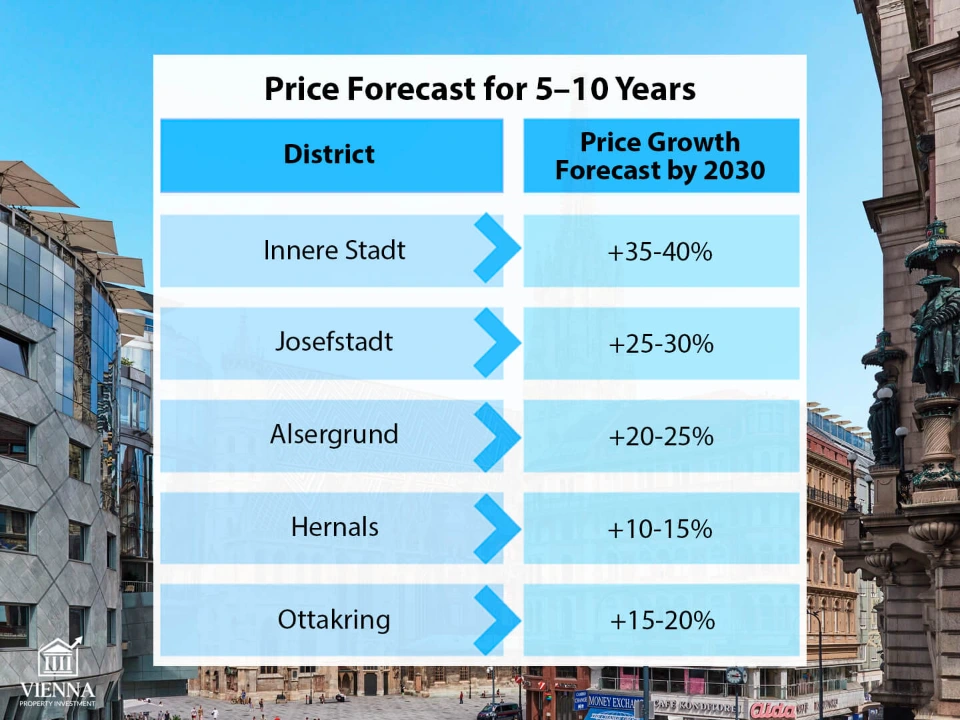
Price forecast for 5-10 years
| District | Price growth forecast by 2030 |
|---|---|
| Innere Stadt | +35-40% |
| Josefstadt | +25-30% |
| Alsergrund | +20-25% |
| Hernals / Ottakring | +15-20% |
Conclusion: The premium segment will continue to grow due to limited supply, while more affordable areas will gain popularity among young families and mid-level investors.
Conclusion
Historic properties in Vienna are more than just a place to live; they are a contribution to the city's cultural heritage.
Altbau combines unique architecture, prestige and long-term investment potential
Key findings:
- It is important to carefully study the legal, technical and financial aspects before purchasing.
- Working with experts and lawyers helps avoid unexpected problems.
- Vienna remains one of the most stable and attractive real estate markets in Europe.
Advice: View your Altbau purchase as a project, respecting the building's history and paying attention to detail. This approach will not only preserve the property's value but also make it a comfortable place to live and a profitable investment.