When it comes to prestigious and sought-after districts of Vienna, the central 1st district with its palaces or the dynamic and fashionable 7th district . However, those with a deeper understanding of the city also consider the 9th district – Alsergrund.
Many investors and people considering the city as a permanent residence are interested in Vienna's Alsergrund district, as it represents a unique combination of "smart" infrastructure and sustainable demand for housing.
The constant flow of tenants and buyers here is formed by students, young professionals, teachers, and doctors, making the market as stable as possible.
Vienna's 9th district is just a few minutes' walk from the historic center, literally outside the Ring. It's known primarily as the "university and hospital district," as it's home to the country's largest scientific and medical institutions: the University of Vienna, the Medical University, and the renowned Vienna General Hospital (AKH). However, the Alsergrund's role goes far beyond that.
Here, there's no need to resort to a "center for everyone" to feel at the heart of the city. The scientific atmosphere, cultural institutions, theaters, museums, and a strong medical base create a steady stream of people looking for housing to rent or buy for years to come.
It's important to emphasize that areas with concentrated universities and clinics have an extremely low risk of experiencing a so-called "demand vacuum." As long as academic and medical infrastructure exists, there will always be residents, renters, and service consumers.

However, Alsergrund is not only science and medicine. It also boasts well-maintained parks, green squares, and ancient buildings with elegant facades reminiscent of the intelligentsia of the 19th and 20th centuries.
The area of the district is relatively small—only 2.99 square kilometers—but it boasts numerous thoroughfares with cafes, shops, and trams. It also boasts secluded courtyards where roses bloom in the summer.
Alsergrund is interesting in several respects:
- as an intellectual and educational center,
- as a green area in close proximity to the city center,
- as a stable real estate market characterized by high demand and limited supply.
My goal is to offer the reader of this article not a superficial overview, but a detailed and practical analysis. We will examine which streets and housing types are most attractive for living and investment, how the transportation network and green spaces are structured, which educational and medical institutions are driving demand, and which projects are already impacting or will impact the market in this district of Vienna in the coming years.
Special attention will also be paid to the "human" level: resident reviews, specific rental and purchase cases, as well as recommendations for different categories of buyers – families with children, investor-landlords, and specialists working in the medical or scientific fields.
History: From Suburb to Intellectual Center
Alsergrund grew up on the site of former rural and suburban settlements, which gradually absorbed the urban rhythm of rapidly developing Vienna in the 19th century.
From the suburbs to the urban area

Initially, these were separate estates and settlements, formed along roads and springs. After administrative reforms and urban growth in the 19th century, these territories organically became part of the city.
Medical cluster

The district's special function became apparent as early as the 18th century. In 1784, the Allgemeines Krankenhaus (Allgemeines Krankenhaus) was founded here—the future AKH Clinic—and around it, medical facilities, research institutes, and residential areas for doctors and teachers began to develop.
The medical cluster is a key driver of the region's economic and social life, as it provides an influx of specialists, students, and related services.
Architectural heritage

When it comes to the architecture of Vienna's 9th district, during the period of intensive urbanization in the late 19th and early 20th centuries, Gründerzeit buildings were actively erected here – massive apartment buildings with ornate facades, spacious apartments, and hof courtyards.
To this day, they form the basis of Alsergrund's residential stock, creating an atmosphere of "majestic antiquity" that is quite in demand in the premium segment of the market.
Secession and Art Nouveau on the streets of the district

The turn of the century saw the emergence of the Secession artistic movement in Vienna, and although its main icon – the Secession Building – is located outside the district, Art Nouveau ideas and new aesthetic principles reached here as well.
Alsergrund displays transitional forms: from the ornate buildings of the Gründerzeit to the more functional and austere modern façades. Individual architects also played a significant role, designing hospital buildings, schools, and residential buildings that took into account new requirements for hygiene, lighting, and spatial organization.
Through the prism of social upheaval

The history of Alsergrund is closely linked to the turbulent events of the 20th century (wars, revolutions, and changes in political regimes), which left noticeable traces on the district's appearance. In the first decades of the last century, prominent doctors and scientists lived and worked here. The Jewish community occupied a significant part of the cultural and intellectual life of the Alsergrund district, particularly in the surrounding medical institutes and cultural centers.
The Nazi occupation and World War II brought severe losses. The district lost much of its architecture, as many buildings were destroyed or damaged. However, the most tragic fate was that of the residents, as many were forced to flee their homes or were deported.
After the war, Alsergrund entered a phase of reconstruction. New residential areas were rapidly constructed, including municipal housing, which helped address the city's acute housing shortage.
Unique urban structure
Alsergrund can be described as a combination of characteristic "hofs" (courtyards), narrow streets, and unexpected green parks and squares.
Most of the buildings are protected by the state. Restoration work is being carried out with great care to preserve the historical authenticity of the exterior and adapt the interior spaces to modern standards (thermal insulation, ventilation, etc.).
This creates certain advantages for investors, as houses with traditional hofs are prized for their atmosphere and charm. However, such properties require significant investment in renovation.
Intelligent brand

The hallmark of Vienna's 9th district is its cultural identity, which has evolved over centuries. Music, literature, universities, and medical science have created a lasting image of the Alsergrund as a place of intellectuals and knowledge.
Franz Schubert and Sigmund Freud also lived here. Freud's house at Berggasse 19 today serves as a museum and attracts tourists from all over the world.
For investors, this cultural "brand" has practical value. It helps generate stable demand from tenants with high solvency and reduces the area's dependence on short-term rental income.
Geography, zoning and structure of the area
Despite its compact size—approximately 2.99 km²—Alsergrund has a high population density. According to the latest municipal and statistical estimates, approximately 40,000–42,000 people currently live here, corresponding to tens of thousands of inhabitants per square kilometer.
These figures clearly show that the area is small, but rich in functions – from residential areas to large medical complexes and educational institutions.
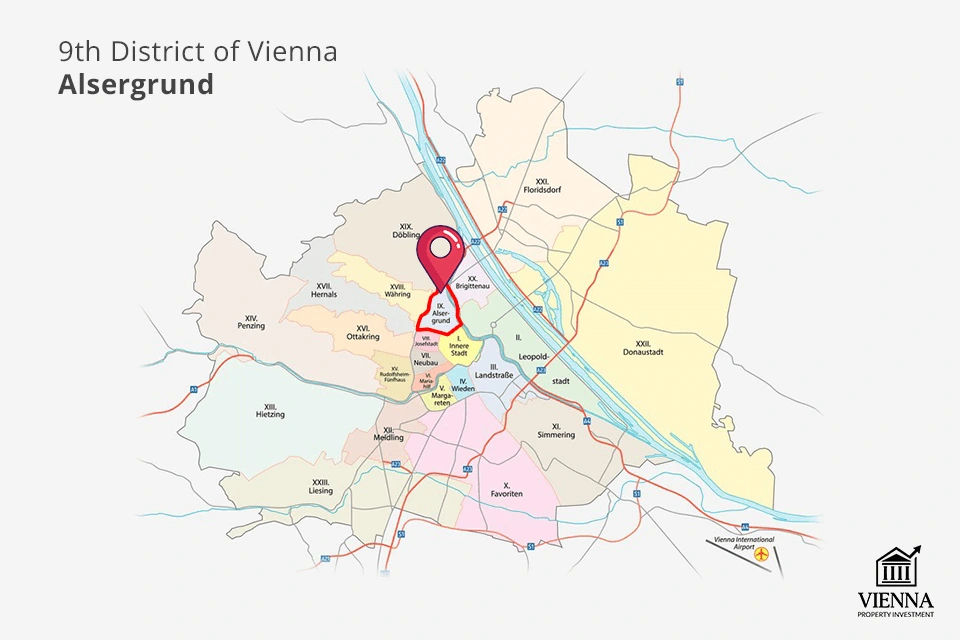
Geographic location and boundaries. The Alsergrund enjoys a favorable location, bordering both Vienna's central districts and the green areas to the north. This serves as a "connecting" area. Residents enjoy walking distance to key cultural attractions in the city center, while also enjoying proximity to parks and quiet residential areas.
In terms of transportation, important city axes run through the area, with tram and bus lines operating, and metro stations in the surrounding areas providing quick access to both the city center and business districts.
This is especially valuable for students and young professionals who do not have a car or do not want to use one every day to get around the city.

Main neighborhoods and functional zones. Within the district, several "microzones" can be distinguished based on their functions:
- The university and medical zone is located around campuses, research institutes, and clinics. There is consistently high demand for short- and medium-term rentals. The zone is complemented by dental clinics, pharmacies, and specialty stores.
- The historic residential center —the Gründerzeit quarters with their historic buildings and protected facades—is a classic example of Viennese residential architecture, with apartments distinguished by high ceilings and spacious layouts, particularly appealing to families and those who appreciate authenticity.
- The commercial and small business zone is lined with streets lined with cafes, pastry shops, small restaurants, and stores. This part of the district forms its "living fabric," making the space comfortable for both residents and visitors.
- Green spaces —squares, alleys, and mini-parks—occupy approximately 10% of the city's territory, according to city data, but play a critical role in shaping quality of life.

This district of Vienna is quite contrasting: for example, the bustling and lively streets of Alserstrasse and Wöhringerstrasse sit alongside quiet residential alleys tucked away in cozy courtyards. It's this combination that creates a comfortable balance for living.
Zoning: Mixed Functions and Urban Development Regulations. The district's urban structure is not monofunctional: residential areas, university buildings, hospital complexes, and cultural facilities intertwine.
At the same time, local zoning regulations (Bauordnung) and monument protection standards strictly limit redevelopment and high-rise construction in historic areas. For local residents and city residents, this is an undeniable advantage: the area retains its architectural uniqueness and special status. This can also be a plus for investors, as if new construction is limited, price increases are driven by a shortage of quality supply.
-
It's important for investors to consider that renovation and restoration projects require significant investment and numerous approvals, which is important to consider in advance.
Population and social structure
Alsergrund is one of those Vienna neighborhoods where you can sense a special atmosphere from the very first moment you enter. It lacks the museum-like "settings" for tourists found in the central districts, and lacks the noisy, multilingual bustle typical of some outskirts.
Today, Vienna's 9th district is home to approximately 43,000 people, and its demographic structure clearly reflects its academic and professional role in the city's life.
Students

The main group of residents are students and young professionals. The University of Vienna and the Medical University of Vienna attract thousands of students from all over the world every year. Many of them stay in Alsergrund after graduation, finding jobs in clinics, universities, or high-tech fields.
This creates a population with a broad age range, with a noticeable "peak" among the young and working-age population. This factor directly impacts the housing market, as it features a particularly high proportion of small apartments—one- and two-bedroom—as well as a strong demand for short- and medium-term rentals.
Families

At the same time, the area is also attractive to families with children. This is facilitated by green spaces, a peaceful environment, safety, and well-developed infrastructure. Income levels in Alsergrund are considered above the city average. And, as you might have guessed, the most common professions among residents are related to education, medicine, IT, and culture.
Foreigners
The district's ethnic composition is also noteworthy. Approximately 20–25% of the district's residents are foreigners . These are primarily students from Germany, Italy, and Eastern Europe, as well as researchers from the United States and Asia. This makes Alsergrund feel like a miniature "international campus," as dozens of languages are spoken here daily.
This diversity creates demand for specific services: international shops, language courses, cafes serving ethnic cuisine, and cultural events for various diasporas.
One day, I was drinking coffee in a small café near the AKH clinic and witnessed a fascinating scene: at the next table, doctors from India, students from Poland, and professors from Germany were all discussing a joint project. It's moments like these that make you realize: the Alsergrund isn't just a neighborhood, but a true intersection of cultures and knowledge.
Income
The district's socioeconomic profile can be described as "highly educated and professionally oriented." A significant proportion of residents work in education, medicine, scientific research, culture, and the service sector. These include professors, doctors, researchers, representatives of international organizations, and creative professionals.
The average income in the district is traditionally higher than the Vienna average, but the neighborhood is diverse. On one street, you might find old Hof buildings housing municipal apartments, while nearby, you'll find modern premium apartments and office buildings.
For investors, this means the opportunity to operate across several market segments at once: from the stable middle class to expensive housing with a high level of solvency.
The role of migration
Migration flows and the influx of international students in Vienna's 9th district create two stable "pools" of demand. The first is short-term: exchange students, interns, clinical patients, and their accompanying families. The second is long-term: young professionals and academic families.
This structure stimulates the development of daily and seasonal rentals, as well as services for expats: specialized agencies, multilingual consultations, and professional services for renting furnished housing.
For investors willing to actively manage such properties, this means high occupancy rates, although it does require greater attention to marketing and service.
The influence of culture

Theatres, museums, galleries, coffee shops and small shops form a vibrant local economy that provides employment and creates a vibrant neighbourhood atmosphere.
A separate factor in stability is the medical industry. Clinics and specialized centers provide a constant influx of employees and patients, which creates a steady demand for housing and enhances the multiplier effect on the district's economy.
A practical takeaway for those choosing housing: families and those seeking a quiet, long-term home are better off focusing on the northern and western parts of the district, as they have more residential areas and green spaces. If you're looking to buy a rental property, I'd recommend looking at properties near university campuses and transportation hubs, as rental demand from students and young professionals is consistently high here.
Housing: a mix of historical and modern
Alsergrund is considered one of Vienna's most interesting residential areas. Here, two worlds coexist: classic 19th-century houses with stucco and spacious rooms, and modern apartments in new residential complexes created through extensive renovations.
The historic Gründerzeit apartment buildings and their cozy courtyards, or hofs, remain the district's main architectural symbols. These apartments are prized for their high ceilings, spacious rooms, and urban charm.
However, it should be taken into account that they often require significant investments, such as insulation and installation of elevators, to meet modern standards.
Social (municipal) housing

Municipal housing (Wiener Wohnen), which has historically been particularly strong in Vienna, also plays an important role. In the Alsergrund, one can find housing complexes from the early 20th century and projects from the post-war period.
Some of these buildings are designated architectural monuments. This limits external changes while ensuring stable occupancy and the preservation of the historic environment.
For investors, this means that competition with municipal housing in the affordable rental segment is quite intense. However, thanks to the district's social policies, demand remains predictable, without sudden surges.
Elite projects and renovations
In recent years, there has been a surge in renovations. Old apartment buildings are being transformed into modern complexes with panoramic windows, underground parking, and energy-efficient technologies.
The closer a property is to the Ring or major parks, the higher its price. The premium segment consists of renovated apartments in historic buildings and small modern residential complexes on sites where new construction is permitted.
According to Immopreice, property prices in Alsergrund are significantly higher than the city average: in prime locations, they reach €7,000–9,000 per square meter.
For example, housing near Wörtingpark or the university district can be purchased for around €5,500–6,000 per square meter. This is comparable to Vienna's more prestigious neighborhoods, and demand remains consistently high due to limited supply.
To make it clearer, I will provide some approximate data on housing:
| Property type | Average purchase price | Average rent |
|---|---|---|
| Standard apartments (old stock) | 4,500–5,000 €/m² | 14–16 €/m² |
| Luxury apartments (closer to the Ring/parks) | 5,500–6,000 €/m² | 16–18 €/m² |
| New buildings/renovations | 6,000–7,000 €/m² | 17–19 €/m² |
Rental market
The rental market in Vienna's 9th district is based on two streams: long-term rentals for families and professionals, and short-term rentals for students, interns, and medical patients.
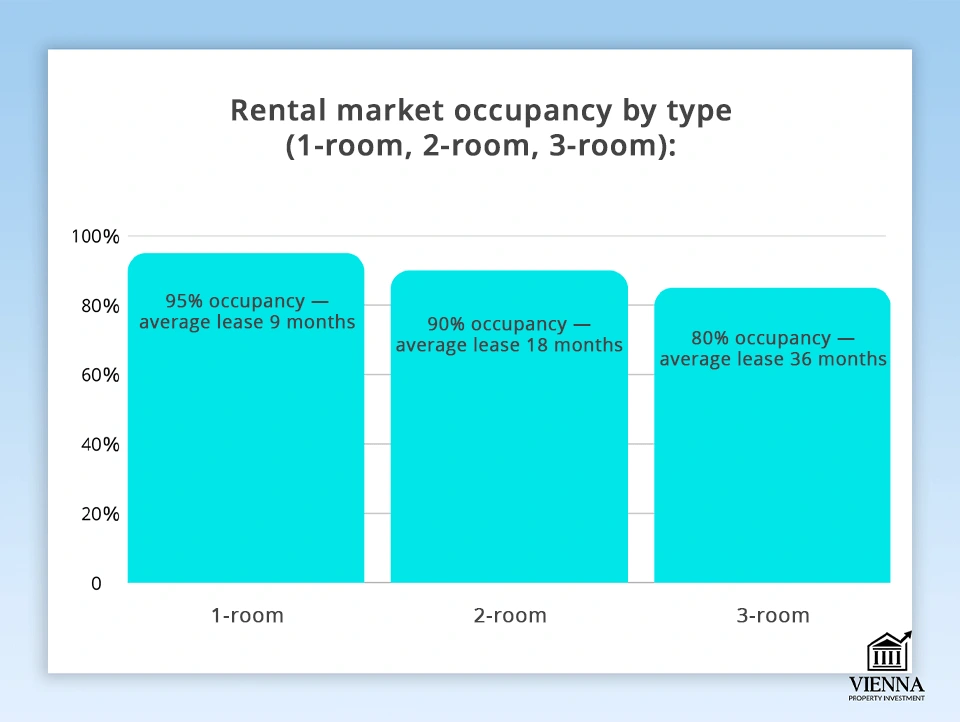
Rent per square meter varies between older buildings and modern complexes. Therefore, it's important to consider the target audience when choosing a strategy.
For example, a compact one- or two-room apartment near campus will always be in demand among students, while a spacious three- or four-room apartment in a quiet part of the area is more likely to attract a family willing to rent long-term, but with less tenant turnover.
Using streets as an example:

The area around the AKH and the university campus on Alserstrasse. Rental demand is high here due to the proximity of clinics and academic buildings. Small apartments are ideal. The development is mixed, offering both affordable apartments and new developments.

Gründerzeit districts. They attract buyers seeking historical charm and status. Prices per square meter are higher here, but renovation quality standards are particularly stringent.
Streets near parks and squares. Popular with families, these areas offer stable prices and demand, but the selection of properties is limited.

Wöhringerstrasse is a busy shopping street where you can find affordable older apartments.

Berngasse. Prestigious address near the Freud Museum; above-average prices.
Risks and recommendations
The main risks for investors are related to the need for capital investments in older buildings: insulation, electrical wiring, and utility upgrades. An additional limitation may be the buildings' conservation status, which prohibits redevelopment and façade modifications. Competition from municipal apartments in the affordable rental segment should also be considered.
My recommendations for investors: plan ahead for renovation reserves; collaborate with local architects and familiarize yourself with façade protection regulations; use a mixed strategy: small apartments for a steady flow of units, and one or two spacious apartments for long-term capitalization.
Education

If you ask Viennese what they associate with the 9th arrondissement, most will answer: "universities." Indeed, it is here that the city's educational heart beats.
University institutions

The Alsergrund is home to the University of Vienna, one of the oldest and largest in Europe, as well as the Medical University, renowned for training world-class specialists.

A significant portion of the district is occupied by the AKH medical complex, Europe's largest center combining clinical practice, research, and education. This attracts students, faculty, and researchers to the Alsergrund.
Additionally, the Academy of Fine Arts operates here, lending the area a creative atmosphere. Numerous language schools, private high schools, and continuing education courses also play a role.
All this creates a fully-fledged educational ecosystem that is attractive to both students and expats, as well as families for whom their children's education is an important consideration when choosing housing.
Schools and gymnasiums
This district of Vienna offers a wide range of educational institutions, from state-run Neue Mittelschulen (NMS) and gymnasiums to private schools and international programs. Larger international institutions are located in neighboring districts, but thanks to convenient transportation, they are easily accessible to residents of the district.
When choosing a place to live, parents consider not only the quality of education but also the convenience of transportation. Often, the ability to walk to school within 10-20 minutes is the deciding factor when purchasing an apartment.
Language courses are equally popular. Many families enroll their children there to speed up their adaptation and integration into the Viennese environment.
Scientific centers
Alsergrund is also known as a hub of science and research. Dozens of laboratories, research institutes, and international centers operate here. Many students stay in the area after their studies, finding work, and scientists come here on contract. This gives the area a special vibrancy.
The Medical University of Vienna (MedUni) and its neighboring institutes are actively developing joint projects with international partners. This format of collaboration enhances the Alsergrund's status as a scientific cluster and attracts not only researchers but also legal entities interested in access to the laboratories and clinical facilities.

A landmark project is the new campus on Mariannengasse, which increases the area's "academic density." For the real estate market, this means increased demand for specialized housing and related services.
Many families deliberately choose Alsergrund for their education. One of my clients from Italy told me, "We decided to buy an apartment here because we want our children to study in Vienna. While they're young, the property can be rented out to students—it's an ideal investment."
Infrastructure and transport
Alsergrund stands out for its transport connections. Despite its compact size (approximately 3 km²), key routes pass through the district, connecting it with both the historic center and other parts of the city.
Metro. The main line U6 crosses the northern Alsergrund. Alser Straße and Michelbeuern provide quick access to university buildings, hospitals, and other areas of the city.
Proximity to the metro makes life more convenient, reduces dependence on cars, and increases the attractiveness of housing near the station.
To be honest, for me this line is one of the most convenient: you can quickly get to the other end of the city on it, saving a lot of time.

Trams. A true symbol of the 9th district, lines 2, 43, and 44 run through the busy streets, taking passengers to the city center—to the Town Hall or the Ring—in just a few stops. In the evening, the trams are filled with students returning from classes, and the atmosphere truly resembles a campus bus.
For residents, this means dozens of destinations within 10–20 minutes without transfers, and for investors, it guarantees high liquidity for apartments near bus stops.

Bicycle and pedestrian infrastructure. Bike paths run along the main streets, and electric scooter rental stations are also available.
Many residents choose this method of transportation. I've personally used a scooter several times to travel from the AKH clinic to the Ringstrasse—the journey takes about 10 minutes, and there are no traffic jams.
STEP 2025. The city's transportation development program is also being actively implemented in Vienna's 9th district. New pedestrian areas are being created, cycling infrastructure is being expanded, and tram stops are being improved.
Recently, safer crossings were made on Wöhringerstrasse and modern stops with dynamic signs were installed.
For clarity, I will provide a table of the transport capabilities of the area:
| Mode of transport | Main lines/stations | Time to the center |
|---|---|---|
| Metro | U6 (Alser Straße, Michelbeuern) | 10–12 min |
| Tram | 2, 43, 44 | 8–10 min |
| Bike | Along Ringstraße | 10–15 minutes |
| On foot | University is the center | ~20 min |
Transportation should be a key factor for investors. An apartment near a metro or tram line rents out faster and at a higher price. Alsergrund has many such "attractions," making it more attractive than the suburbs.
Parking and parking policy

Parking in the 9th arrondissement is a complex issue. The streets are narrow and the buildings dense, so the city is actively implementing a well-thought-out regulation system.
Parkpickerl. The main tool is the Parkpickerl, a resident permit issued by the municipality. It allows residents with permanent registration to park in their own zone. The permit can be obtained through the Magistrate or Bezirksamt .
Parking includes an administrative fee and an annual fee. There is also a limit on the number of permits per address. For residents, an annual permit costs approximately €10 per month—inexpensive by Viennese standards. Visitors can only use short-term parking, at a rate of approximately €2.20 per hour.
For renters with a car, this issue is of paramount importance. That's why it's crucial for investors to include all the details in the apartment description: whether there's a private garage, whether a Parking Picker is available, and what restrictions apply to guests. Clear parking information directly impacts the property's appeal.
Comparative data on parking:
| Parking type | Conditions | Price |
|---|---|---|
| Residential (Parkpickerl) | For area residents only | ~10 €/month. |
| For guests | Short term (max. 2 hours) | ~2.20 €/hour |
| Underground parking | In new buildings/business centers | 150–200 €/month. |
| Charging stations | Growing number of points | Included in the electricity grid tariff |
I've noticed more than once that families with children often choose apartments in buildings with underground parking. Even if such properties are more expensive, they still command higher market prices.
Innovation. In recent years, Vienna has increasingly adopted digital parking solutions. For example, dynamic signs have appeared in the district that show the number of available spaces in nearby parking lots. The parking system is also integrated into mobile apps. This saves drivers time and reduces the burden on street parking.
Transforming the space. In recent years, some parking areas have been converted into small squares with benches and greenery. This decision initially sparked controversy among residents, but many now note that these courtyards have become quieter, more comfortable, and more pleasant for strolling.
This has direct implications for real estate buyers: streets with limited parking and green spaces often become more attractive to families and pedestrians. Homes near such spaces command higher prices.
It's important for investors to maintain a balance: while an apartment with parking remains the most reliable investment option, housing without parking, located within walking distance of transportation and urban infrastructure, also shows steady price growth.

Electric cars. The city is strengthening its network of public charging stations . There are currently hundreds of them throughout Vienna, including the Alsergrund.
Owners of properties with underground parking should consider installing a private charging point or signing a contract with an operator. This is already becoming a competitive advantage and will certainly be a significant factor in the future.
Operators offer ready-made solutions for residential complexes: dynamic load management, automated payment, and convenient services. This simplifies the implementation of charging stations and makes such apartments particularly attractive.
Religion and religious institutions
Despite its strong academic and scientific character, the Alsergrund also retains a rich spiritual component. The district's religious life reflects the diversity of historical Vienna: Catholic churches, Orthodox and Protestant parishes, vestiges of the Jewish community, and Islamic centers are represented here.
For families moving here, religious infrastructure plays a vital role. It encompasses not only places of prayer but also cultural, educational, and social centers that facilitate integration and the creation of new connections.
Catholic churches

The most famous Catholic church in the 9th district is the Servite Church on Servitenplatz. It's a masterpiece of Baroque architecture and also a hub for the local community, hosting organ concerts, cultural gatherings, and charity events. The square's atmosphere, with its cozy cafes and fountain, is one of the most "European" spots in the district.
Another architectural masterpiece is the Votivkirche, a neo-Gothic cathedral on Ringstraße. It serves not only as a place of worship but also as a cultural symbol of the city, hosting concerts, exhibitions, and tours.
In addition to large churches, the area also has smaller parish churches that serve important social functions. They organize clubs, schools, and provide assistance to those in need, strengthening the local community and creating an additional network of services for families.
Orthodox parishes

Alsergrund and the surrounding districts are home to several Orthodox communities—Russian, Greek, Serbian, and Romanian. These parishes unite not only believers but also entire migrant families, serving as centers of community and support.
There are also Protestant groups operating here, which are also actively involved in the cultural and social life of the area.
Synagogue and Islamic prayer houses

Until 1938, there was a significant Jewish community in Alsergrund, occupying entire blocks.
The tragic events of the Nazi regime destroyed this part of the city's life, but its memory endures. Today, this is evident in memorials, museums, and a vibrant religious life in Vienna's central districts. The main synagogues, including the Stadttempel, are located nearby and accessible on foot.
The area has also become home to Muslim communities. Cultural associations and small mosques operate here, primarily targeting migrants and students. They conduct educational programs and dialogues between religions.
Multi-confessional projects
One of the strengths of this district of Vienna is its tolerance and ability to integrate different religious traditions. Interfaith meetings, exhibitions, and concerts are regularly held here. These events help residents better understand each other and foster a sense of community.
For new residents, this means a wide range of multi-faith services: from participation in rituals and holidays to integration through clubs and social initiatives.
As I often tell my clients, the presence of churches, cultural centers, and religious events makes a neighborhood more welcoming for a wide range of populations. This means that real estate there becomes more attractive for both renters and buyers.
Culture, Leisure and Events
While some districts of Vienna could be described as "quiet, family-friendly," Alsergrund is a neighborhood of ideas, experimentation, and cultural exploration. The energy of the universities is palpable here, and it sets the tone for the entire cultural scene.

Theaters and concert halls. The district boasts several small theaters and venues, where experimental formats predominate. Theater im Zentrum and Rabenhof Theater are known for their productions with minimalist direction and bold interpretations.
The atmosphere of such performances draws the audience into intellectual dialogue. For example, I once attended a production of a contemporary novel at the Rabenhof: the stage was almost empty, the scenery minimal, but the actors' performances held the entire auditorium captivated until the end.
Besides these, in the area you can find:
- Theater am Alsergrund – cabaret theatre;
- Schauspielhaus Wien – drama theatre;
- The Volksoper, Burgtheater and Musikverein are all within walking distance or easy transport access.

Museums and galleries. The pride of the district is the Alsergrund Museum , which tells the story of the district over the past two centuries: from rural outskirts to a student center. Of particular interest is the exhibition on 19th-century physicians and the famous Vienna Medical School.
It's also worth remembering that the city's largest museums, the Museum of Art History and the Natural History Museum, are just minutes away. Residents of the area joke, "We live between the university and the museum ," and there's some truth to that.

Film screenings and festivals. In the summer, the courtyards and squares of the Alsergrund are transformed into open-air cinema venues. A screen is set up in front of the Servite Church; admission is free, and students, families with children, and tourists flock there. The atmosphere is reminiscent of southern European evenings, when the entire neighborhood takes to the streets.
The main event of the year is the Servitenfest. It transforms Servitenplatz into a fair of music, crafts, and street food. I personally consider this event one of the best ways to experience the spirit of the 9th district.
Lectures and scientific events. The proximity of the University of Vienna and the medical campus makes the Alsergrund a space where culture and science are closely intertwined. The district libraries and university halls host lectures, exhibitions, and public discussions – from biomedicine to philosophy and contemporary literature.

Flea markets and markets. On weekends, flea markets open in small spaces. Here you can find vintage books, jewelry, or furniture. These spaces always attract a creative community, which positively impacts property values in the area.

Don't forget about the Altes AKH Christmas Market, a Christmas market loved by locals and students.
When I tell clients that cultural richness directly impacts investment appeal, not everyone immediately believes it. But experience confirms: apartments near cultural centers are easier to rent, especially to foreigners and students. Alsergrund is a prime example of this.
Parks and green spaces
Vienna is renowned for the fact that approximately 50% of its territory is covered by green space. Alsergrund fits seamlessly into this system: despite its dense development, parks and squares account for approximately 10% of the area, a respectable figure for a central district.

Altes AKH. The former hospital complex has now been transformed into a university campus and a leafy courtyard. It hosts promenades, student gatherings, and seasonal markets, including the aforementioned Christmas market. These are the true "lungs of the neighborhood."
Votivpark. The small park near the Votivkirche is popular with students and office workers for short breaks and lunch breaks. It naturally complements the academic area surrounding the university.

Prater. Although the Prater Park is administratively located in the neighboring district, its green spaces begin just nearby. Residents of the Alsergrund often walk or bike here—the paths are connected to the city network and lead directly to the Danube.
Wörting Park. Locals call it "the quiet heart of the neighborhood." The atmosphere is reminiscent of old Viennese gardens: neat paths, shaded by large trees, and peaceful strolls by families and elderly residents.
Hedwigsgarten and small parks. The area is literally dotted with miniature green spaces. They create a cozy atmosphere and offer a respite from the bustle of the city within walking distance.

New urban projects. As part of the STEP 2025 program and the Smart City , new green spaces are being actively developed in the district. Some parking spaces have been converted into "green islands" with trees and benches. Playgrounds are being improved, rainwater collection systems are being installed, and courtyards are being developed.
Social aspects. Modern projects also consider social aspects: safe evening commutes, good lighting, inclusive playgrounds for children, and public spaces adapted for people with limited mobility. All of this contributes to the perception of Alsergrund as a comfortable neighborhood.
Personally, I consider this an important point: modern families are increasingly choosing apartments not only based on square footage and price, but also on proximity to parks and convenient green areas.
Economy, offices and international relations
Vienna's 9th district is not only a cultural and university district, but also a vibrant business community. Here, small businesses, innovative startups, and leading research institutes coexist in a surprising way.
Small and medium-sized businesses. The district's streets are filled with family-run cafes, bookstores, antique shops, and bakeries. They create the very atmosphere of "home-style Vienna." For example, on Lichtentalstrasse, there are still establishments where recipes are passed down from generation to generation.
Such businesses thrive thanks to a constant flow of students, clinic patients, and cultural event attendees. For investors, this means steady demand for small retail spaces and offices for local companies.
Support through the Vienna Business Agency and city programs makes it easier to register a business, find financing, and find office space.

Startups. The university environment creates a fertile ground for the development of IT and biomedical projects. Many startups get their start here, renting coworking spaces and small offices and taking advantage of consulting support from city authorities.
Offices and research institutes. The Medical University of Vienna's campus and research centers collaborating with international organizations are located here. Their presence creates a constant demand for housing—both short-term and long-term—for students, researchers, and staff.
International presence. Vienna is one of the world's centers of diplomacy. It is home to UNO City, offices of dozens of international organizations, embassies, and consulates. Some of this infrastructure is located near the Alsergrund.

For example, the US Embassy is located here, a fact that underscores the area's status. The presence of international specialists and diplomatic personnel invariably increases demand for high-quality apartments and international-level services.
Commercial real estate in Vienna . Demand for commercial space is stable. Small offices, coworking spaces, and retail outlets on central streets are enjoying continued interest. A trend in recent years has been hybrid formats: partly in-office and partly remote work. This increases the value of compact and flexible solutions.
For investors planning a startup, an important consideration is locations with high pedestrian traffic: close to university buildings, campuses, and transportation hubs. An additional advantage is proximity to support programs for young businesses, such as the Vienna Business Agency, which stimulate growth.
The real estate market is directly dependent on the local economy. Alsergrund boasts three key tenant groups: students, researchers, and international specialists. For investors, this is a rare combination of stability and growth.
Modern projects and investments
Although Alsergrund is a historical district, it is actively being renewed to meet the needs of the 21st century. Contemporary urban developments here directly impact the real estate market and its attractiveness to investors.
Aspern

One of the largest projects of recent years is Seestadt Aspern in the 22nd district. Despite its remoteness from the city center, it sets standards for all of Vienna: sustainable technologies, energy efficiency, and mixed-use. Its influence is also felt in the Alsergrund, where smart and environmentally friendly initiatives are increasingly being implemented.
Campuses

The development of university infrastructure is of particular importance for the district. The largest project in this district of Vienna is the Campus Mariannengasse of the Medical University of Vienna. This centralized clinical and educational facility will cost hundreds of millions of euros. Construction is scheduled for the first half of the 2020s.
Such projects attract new specialists, create additional demand for rental housing, and stimulate the development of services in the immediate vicinity.
New residential complexes
In recent years, the area has seen the emergence of more new eco-friendly residential buildings, incorporating solar panels and green roofs. Their value lies in the fact that they remain in the historic center while fully complying with modern standards.
Green transport
As part of the STEP 2025 program, the district will receive new bike paths, pedestrian routes, and electric vehicle charging stations. These factors are becoming critical for renters, as more and more people choose housing based on environmental friendliness and the ease of getting around without a car.
Investment attractiveness of the area
Alsergrund remains one of Vienna's most attractive districts for investors thanks to a unique combination of three factors: stable rental demand, a limited supply of quality housing, and a well-developed urban infrastructure.
The main advantages of investing here are a strong educational and medical infrastructure, the historic appearance of the buildings, and the presence of green spaces literally within walking distance of the center.
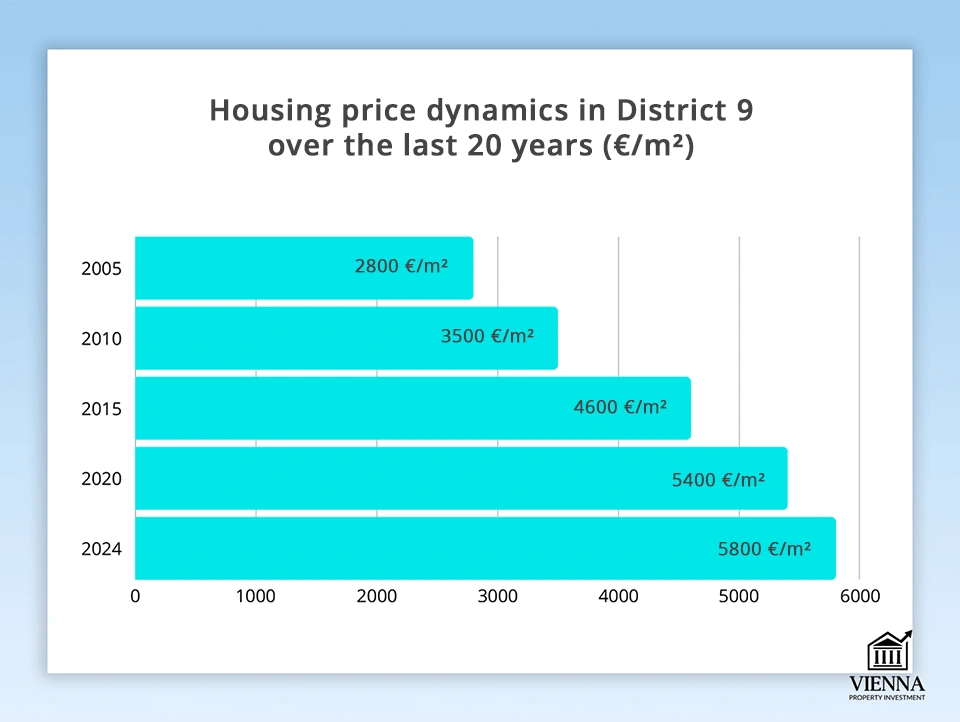
Housing prices. According to city reports, the price per square meter in Alsergrund ranges from €5,500 to €6,000. Rent for a one-bedroom apartment averages €800 to €1,000 per month, while a two-bedroom apartment costs €1,200 to €1,500 per month.
These figures confirm the district's status as one of Vienna's more expensive and stable micromarkets. The average price here is significantly higher than citywide, indicating high capitalization and certain entry barriers for new investors.
Why it's good for investing:
- Stable demand. Universities and medical centers provide a constant flow of tenants, from students and professors to doctors and clinic patients. This reduces the risk of downtime, unlike areas where demand depends on tourism or office activity.
- Limited supply of new housing. Historic buildings are protected by strict regulations, and the dense structure of neighborhoods precludes large-scale construction. With steady demand, this supports prices for existing apartments.
- Income diversification. This area of Vienna successfully combines long-term rentals for families with short- or medium-term rentals for students. This approach allows for a balanced portfolio: some properties generate a stable income, while others offer increased returns due to the high influx of students and tourists.
- Urban investment. STEP 2025 programs, campus development, and projects like Aspern are increasing Vienna's overall attractiveness and driving further price growth in the central districts. Any improvement in infrastructure is inevitably reflected in real estate values.

Risks and recommendations for investors. The main barrier is the high entry price. Furthermore, older buildings require renovation investments: insulation, upgrading utility systems, and sometimes even obtaining approval from the Denkmalsschutz.
There are also operational nuances: taxation, rules for renting furnished apartments, and parking policy (Parkpickerl) directly affect the final profitability.
Practical tips:
- conduct due diligence with local architects and engineers;
- allocate a budget in advance for compliance with monument protection standards;
- form a portfolio so that it includes both premium apartments and more high-volume properties;
-
It's always best to have a backup plan: if the renovation of a historic building is delayed, the portfolio should include liquid apartments for short-term rental.
Ultimately, Alzergrund is not a region for quick returns, but a stable micro-market with moderate risks and high asset quality.
Conclusion: Who is Alsergrund suitable for?

Vienna's 9th district exemplifies the harmonious blend of history and modernity. It's ideal for those who appreciate an intellectual atmosphere, the comfort of city life, and proximity to the city center.
For students and young professionals. Living close to the university means minimal commute time and access to academic events. Apartments here sell out quickly.
For families. Parks, schools, quiet streets, and a safe neighborhood make it convenient for families with children. Vienna's city center is just ten minutes away.
For creative and international communities. Festivals, cultural events, and startup hubs create an environment where it's easy to find like-minded people.
For investors. Stable demand, rising prices, and long-term tenants create a solid foundation. This isn't the cheapest area, but it's one of the most predictable in terms of returns.
A practical checklist for investors:
- Define your target audience: students, families or premium customers.
- Check the building's status: protected property, energy efficiency, technical condition.
- Consult Parkpickerl taxes and rules.
- Set aside a budget for renovation and marketing (especially if you're targeting short-term rentals).
In short, Alsergrund is one of Vienna's best neighborhoods for both living and investing in real estate . Everything is close by: universities, parks, museums, cafes, and schools. But most importantly, it offers a unique atmosphere and lifestyle appreciated by educated and active people.
When I think of Alsergrund, I see a rare balance: it's central enough to remain prestigious, yet cozy enough to be livable. For an investor, it's a perfect match for comfort and financial gain.