Vienna's sixth district, Mariahilf, is a vibrant and exciting neighborhood. It's located right next to the city center (the First District). The main street, Mariahilferstrasse, is a shopping paradise. The district combines a historic atmosphere with a modern, creative spirit.
Mariahilf is a district of Vienna that was formerly a suburb and became part of the city in the mid-19th century. Since then, it has gradually transformed from a residential area into an important commercial and cultural center. Mariahilf er Straße has become a pedestrian zone and is known as Vienna's largest shopping street , remaining a symbol of this transformation.
Vienna's sixth district is a place where old meets new. Here you'll find centuries-old Viennese coffeehouses and beautiful Art Nouveau staircases. Contemporary art galleries and trendy cafes are located nearby. The district is incredibly diverse: the main street, Mariahilfer Straße, is always bustling with life, while a detour reveals quiet, cozy courtyards and hidden passages, such as Raimundhof or Fillgraderstiege.
In this article, I aim to demonstrate that the Mariahilf district of Vienna has preserved its multilayered history. It blends the architecture of the Gründerzeit era, renowned cultural venues (such as the Theater an der Wien , Haus des Meeres, and the Naschmarkt), the bustling shopping street Mariahilf er Straße, and tranquil inner city neighborhoods. All of this makes the district livable and attractive for long-term investment. For those just beginning to consider what kind of housing to choose in Vienna, Mariahilf serves as a prime example of a vibrant, central neighborhood.
History of the Mariahilf district
Vienna's 6th district (Marijhilf) is considered one of the city's oldest and most vibrant. Its history dates back to Ancient Roman times and saw particular development during the transition from the Middle Ages to the Modern Age.
The first villages in the area today—Laimgrube, Gumpendorf, Magdalenengrund, and Windmühle—appeared in the 12th and 13th centuries. Documents from that time confirm their existence. The area received its name "Mariahilf" (which translates as "Mary's Help") from the Barnabitenkapelle chapel, which stood near the cemetery. This chapel housed a copy of Lucas Cranach the Elder's famous painting of the Virgin Mary.
Formation and incorporation into Vienna

On March 3, 1850, five suburbs—Magdalenengrund, Windmühle, Laingrube (or Laimgrube), Gumpendorf, and Mollard—officially became part of Vienna and merged into a single new district. Initially, it was called the 5th district (Mariahilf). But just 10-12 years later, in 1861-1862, the administrative boundaries were revised. Part of its territory was transferred to the new 7th district of Neubau. From then on, the Mariahilf district was permanently assigned its current number—the 6th.
19th century: booming trade and the emergence Mariahilfer Straße
In the 19th century, the district began to develop rapidly. After the demolition of the city wall and the construction of Ringstraße, it received a new impetus for growth. The opening of the Westbahnhof (1857–1859) played a key role, turning Mariahilfer Straße into a major commercial hub. Shops, residential buildings, coffee shops, and department stores began to be built here, defining the appearance of the district during its period of economic boom.
Gründerzeit architecture is typical of Viennese apartment buildings with ornate facades, large windows, and high ceilings. In Mariahilf, such buildings create a unique appearance characteristic of the late 19th century. Retail buildings also played an important role: large department stores like Gerngross and Herzmansky appeared on Mariahilfer Straße.
The 20th Century: Social Change, Communal Housing, and Post-War Reconstruction
At the beginning of the 20th century, Mariahilf became an important center of the labor and socialist movement, largely thanks to the work of leaders such as Viktor Adler. During the interwar period, as part of the "Red Vienna" policy, construction of municipal housing complexes (Gemeindebauten) began here. One example was the Leuthnerhof (1931–1932), built on the site of the former defensive ramparts of the Linienwals, which had been demolished in the late 19th century.
During World War II, the Mariahilf district suffered greatly. Mariahilfer Straße was heavily damaged by bombing, particularly in February 1945, when many buildings were damaged or destroyed. In April of that year, looting occurred, including the ransacking of the Herzmansky department store. After the war, active reconstruction began, and the district gradually regained its status as a shopping center and restored its architectural appeal.
The modern stage: a balance between the historical and the modernist
Since the late 20th century, the Mariahilf district has become a shining example of Vienna's renewed vibrancy. Here, historic architecture seamlessly blends with modern life: historic buildings now house trendy cafes, boutiques, and galleries. The district is renowned for its vibrant Naschmarkt market, which has become a true cultural and gastronomic hub, attracting both locals and tourists.
In recent years, Mariahilfer Straße has been completely transformed. Pedestrian areas, shared spaces, and bike paths have been added. These changes have made the street an example of a modern and sustainable approach to urban planning. Now there are fewer cars, and residents and visitors alike can enjoy a more comfortable and vibrant atmosphere.
Today, Mariahilf is a neighborhood that blends the entire history of Vienna. It grew from medieval suburbs with their churches, experienced the bourgeois heyday of the 19th century, socialist housing complexes in the 20th century, and modern transformations today. Here, you can see a blend of different eras—from archaeological finds to architectural styles. But most importantly, it is a vibrant, popular neighborhood that remains one of the best places to live, do business, and invest in Vienna .
| Date / period | Event |
|---|---|
| 12th–13th centuries | The first mentions of settlements refer to the villages of Laimgrube, Gumpendorf, Windmühle, Magdalenengrund. |
| 17th century | Here a chapel, "Mariahilf", was built with an image of the Virgin Mary, which gave its name to the future district. |
| 1850 | Annexation of suburban villages to Vienna and formation of the 5th district – Mariahilf. |
| 1861–1862 | The creation of the 7th district Neubau with the transfer of part of the land to it; Mariahilf is finally established as the 6th district of Vienna. |
| 1857–1859 | The construction of the Westbahnhof transformed Mariahilfer Straße into one of the capital's main shopping streets. |
| The end of the 19th century | During the Gründerzeit era, the district experienced rapid growth: apartment buildings, large department stores (Gerngross, Herzmansky) and theatres were erected. |
| 1919–1934 | During the period of “Red Vienna”, the first social housing complexes appeared, among them Leuthnerhof (1931–1932). |
| 1945 | During World War II the area suffered from bombing, and destruction also affected Mariahilfer Straße. |
| 1950s | In the post-war years, the restoration and return of trade activity began. |
| 2000s | The Naschmarkt has increased its importance as a cultural and gastronomic space, and the area has gradually become a hub for creative industries. |
| 2010–2015 | The recent renovation Mariahilfer Straße has brought new pedestrian areas, cycle routes and the concept of "shared spaces". |
| Today | Mariahilf in Vienna is a dynamic Viennese district where historical traditions seamlessly intertwine with commerce, culture and modern urban solutions. |
Compact geography and multi-layered structure
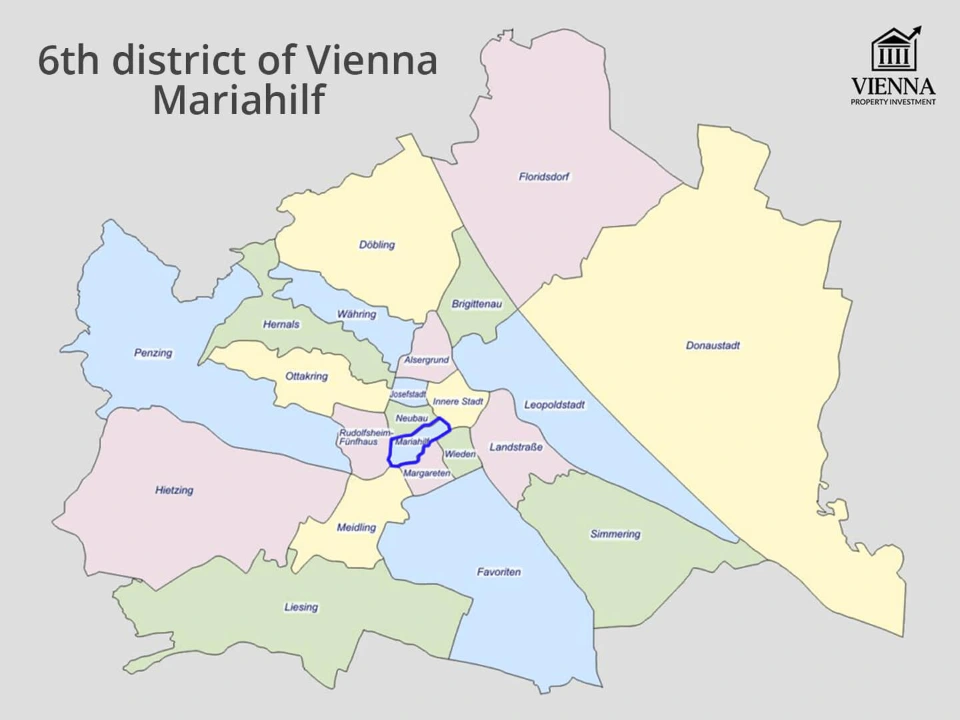
Mariahilf is a small but incredibly dense district of Vienna. With an area of just 1.48 km², it is home to approximately 30,000 people, creating one of the highest population densities in the city. This concentration is typical of central districts of the capital and makes Mariahilf particularly attractive to investors: demand for housing here is consistently high, and new supply is limited by the district's natural boundaries.
Spatial structure of the area
Mariahilf is a neighborhood traversed by the famous Mariahilfer Straße. It's one of Austria's main shopping streets, home to boutiques, department stores, and international shops, as well as numerous cafes, restaurants, and cultural venues. In the 2010s, the street was pedestrianized, making it a convenient place to stroll, shop, and meet. This has increased its popularity and made nearby real estate even more valuable.
As an expert, I can confirm that apartments in Mariahilf er Straße remain highly valued. The area is popular with both locals and expats working in the city center, so demand and prices are consistently high.
However, step away from the main shopping street, and the district reveals a completely different side. Even on parallel streets, for example around Gumpendorfer Straße , quiet residential neighborhoods with an intimate atmosphere begin. Here, classic Gründerzeit-style buildings with cozy courtyards (Grätzl) have been preserved, creating that unique "Viennese intimacy."
Contrasts and microzones
The neighborhood thrives on contrasts: a bustling shopping street with a never-ending stream of shoppers and tourists is literally a stone's throw from quiet alleys where time flows more slowly. It's this combination that locals especially appreciate—you can enjoy the tranquility of a cozy courtyard, and five minutes later find yourself in the very center of city life.
The Naschmarkt , Vienna's largest market (covering an area of approximately 2.3 hectares), located on the edge of the 6th district, deserves special attention
Geography and connections with neighboring areas
On the map of Vienna, the 6th district ( Mariahilf ) is located immediately south of Innere Stadt and borders the districts of Neubau (7th) and Margareten (5th) . Its location creates an ideal bridge between the historic center and the modern creative quarters. On the western side, the district is bordered by railway lines and the Gürtel highway, while on the eastern side, it is directly adjacent to the MuseumsQuartier, a major cultural complex, significantly enhancing its cultural appeal and value.
Its unique location makes Mariahilf one of Vienna's most affluent districts: it harmoniously combines tourist attractions, retail activity, and cultural clusters. For investors, it's important that such districts consistently rank among the most reliable investment destinations in the Austrian capital.
Population and social structure of Mariahilf

Vienna's sixth district is a harmonious blend of historic architecture and contemporary urban life. Its social environment combines traditional Viennese charm with the capital's multicultural diversity. Approximately 30,000 people live here within a compact area of 1.48 square kilometers, and this high population density creates the district's distinctive, dynamic atmosphere.
Multiculturalism and the proportion of foreigners
According to city statistics, approximately 30% of residents in the Mariahilf district are foreigners—higher than the Viennese average of 25%. Immigrants from Turkey and former Yugoslavia also live here, as well as significant communities from Germany and Eastern Europe. In recent years, the number of expats in creative and IT professions has been growing, attracted by the proximity to the city center and the MuseumsQuartier cultural cluster.
The district's multicultural character enhances its appeal as a rental investment. Housing in Vienna's 6th district is consistently in demand among students, international professionals, and young families.
Age structure
Mariahilf is considered a "young and active" district. It has a higher population aged 20-40 than the Vienna average. This is due to several factors:
- proximity to universities and art academies;
- developed environment for students: Naschmarkt, cafes, bars and co-working spaces;
- an abundance of compact apartments (30–50 m²), ideal for young professionals.
However, it's not as if Mariahilf has lost its family-friendly character. Deep in the neighborhoods, spacious apartments in the Gründerzeit style remain, traditionally home to Viennese families—sometimes for several generations.
For investors, this creates two clear target audiences: young people (fast turnover and high liquidity) and families (stable long-term rental contracts).
| Age group | Population share (%) |
|---|---|
| Up to 15 years old | 12,4 |
| 15–19 years old | 6,0 |
| 20–39 years old | 34,4 |
| 40–59 years old | 28,0 |
| 60 years and older | 19,2 |
Residential profile of Mariahilf

Vienna's 6th district is unique for its combination of old buildings and modern residential spaces. Unlike neighboring Margareten, there is less municipal housing here, increasing the district's appeal to investors and private buyers.
Historical Foundation and Gründerzeit
The majority of the residential stock in the 6th district is made up of historic buildings from the Gründerzeit era—apartment buildings from the late 19th and early 20th centuries. Many of these buildings have been meticulously restored, preserving distinctive architectural features such as high ceilings, wooden floors, and spacious rooms. The courtyards have been transformed into comfortable recreation areas, making them particularly attractive to families and creative professionals.
One of my clients purchased an 85 m² apartment in the historic Gründerzeit building in the Gumpendorfer Straße district. After restoration, preserving the original architectural details, the property was rented out for €2,500 per month, demonstrating high profitability and a rapid return on investment.
Premium segment
The Mariahilf district of Vienna is particularly popular among luxury real estate buyers. Its appeal stems from three key factors: unique historical buildings, a central location, and well-developed infrastructure. Key attractions for the premium segment include:
- The area around MuseumsQuartier offers apartments with modern designs, convenient layouts, and new utilities. These buildings are particularly attractive to creative professionals, employees of international companies, and investors seeking short-term rentals.
- Mariahilfer Straße has apartments overlooking the main shopping street. It's noisy, but everything you need is nearby—shops, cafes, and cultural venues.
- On Gumpendorfer Straße and in the surrounding areas, you can find expensive apartments in restored buildings from the Gründerzeit era, with high ceilings and beautiful historical details.
Average prices for luxury housing in Mariahilf range from €6,500 to €7,200 per square meter, and rental rates here traditionally exceed the average for the 6th district. Prices may be higher depending on the floor, layout, and view. Apartments with terraces or large panoramic windows are particularly popular.
A case in point: a client purchased a 95 m² top-floor apartment in a building near MuseumsQuartier for €7,100 per square meter. After a high-quality renovation, the property sold in just three months—a clear demonstration of how quickly quality homes in this segment can sell.
New projects and renovations
Mariahilf is witnessing an interesting trend: the neighborhood is gradually being rejuvenated through targeted construction and the transformation of courtyards. Small projects nestled deep within the neighborhoods create a perfect synthesis—modern interiors blend with historic facades, which is particularly appealing to buyers seeking authenticity with modern comfort.
- The cost of new apartments in such projects ranges from €6,500 to €7,200 per square meter, depending on the floor, square footage, presence of a terrace, and views.
- Renovated premises in courtyard outbuildings are offered at a more affordable price (approximately €6,200–€6,500/m²), but at the same time they receive modern engineering systems, improved thermal insulation, and luxury finishing.
These properties are particularly popular with buyers looking for long-term rentals or luxury housing.
One of my clients bought a 70 m² apartment in a renovated courtyard near Naschmarkt for €6,400 per square meter. After the renovation, it was rented out for €2,200 per month, yielding an annual yield of approximately 4%. Another client invested in a new building on Gumpendorfer Straße—he purchased a 95 m² apartment for €7,100 per square meter and successfully sold it just three months after completion.
| Type of housing | Examples | Purchase price | Rental price | Peculiarities |
|---|---|---|---|---|
| Old Foundation Gründerzeit | Apartments with high ceilings and parquet floors | 6 200–6 500 | 1 800–2 500 | Houses with historical architecture and quiet courtyards, renovation possible |
| Renovation of courtyard buildings | Small courtyard projects with new engineering | 6 200–6 500 | 1 900–2 400 | Cozy, renovated apartments, landscaped courtyards, and playgrounds |
| New projects (spot development) | Energy-efficient modern apartments | 6 500–7 200 | 2 000–2 700 | Modern layouts, terraces and large panoramic windows |
| Premium segment | Locations near MuseumsQuartier and Mariahilfer Straße | 6 500–7 200+ | 2 200–3 000+ | Apartments with views, designer interiors and high demand |
Educational infrastructure in Vienna's 6th district

Vienna's 6th district is attractive not only for its beautiful historic buildings and excellent infrastructure, but also for its diverse educational opportunities. It boasts both public and private schools, and its convenient location allows residents to easily reach universities and academies in neighboring districts.
Preschool education and kindergartens
Both public and private daycare centers are available in the Mariahilf district. Private institutions, which focus on early language development and creative programs, offer services for €350-€450 per month.
By enrolling their child in a public kindergarten, parents save significant money: the monthly cost is only 150-250 euros. Moreover, many developmental activities and extracurricular activities are already paid for. This format is an ideal solution for families, especially those who have recently moved to the country, and helps their child adapt to a new language and cultural environment.
Primary education
At Volksschule Mittelgasse, students gain fundamental knowledge in languages and mathematics within the framework of the state curriculum. The educational process is built on collaborative project work, which develops critical thinking. Music, art, and sports clubs are available to ensure a balanced development.
Astrid Lindgren Elementary School is known for its modern teaching methods. It emphasizes project-based learning, creative exploration of scientific subjects, and an individualized approach to each student's development. Particular attention is paid to language preparation, with the program incorporating the early acquisition of English and other foreign languages. Tuition ranges from €4,000 to €5,500 per year and includes additional clubs and activities, making the school one of the most prestigious in the area.
Grammar schools and secondary schools
Gymnasium Mariahilf specializes in advanced training in foreign languages, natural sciences, history, and cultural studies. The curriculum is based on real-world practice: students complete interdisciplinary projects, conduct laboratory research, and participate in international academic exchanges. Partnerships with museums, cultural centers, and universities enable the organization of field trips, master classes, and research expeditions, promoting students' comprehensive development and integration into the academic environment.
Private New Middle School St. Marien offers the IB International Curriculum and advanced English language instruction. Education is based on an individualized approach, project-based activities, and preparation for international exams. Tuition ranges from €6,000 to €7,500 per year, including additional courses, clubs, and language modules. Students actively participate in cultural and research initiatives in the area, helping them develop leadership and communication skills.
Creative studios and music education
May Art Studio offers courses in painting, sculpture, and other artistic fields for children and teenagers, helping them develop their creativity, sense of beauty, and ability to express themselves through art. Tuition starts at €250 per month and includes practical lessons, master classes, and exhibitions of student work. This allows young artists to gradually build a portfolio and hone their skills.
The Franz Schubert Conservatory is one of the area's top music schools, training musicians, teachers, and performers. It offers instruction in both classical and contemporary music, offering individual and group lessons, master classes, and organizing performances at Vienna's concert venues. Tuition ranges from €3,000 to €4,500 per year, including participation in competitions and concerts.
Professional and higher education institutions
Mariahilf is ideal for students and aspiring professionals in IT, design, or applied sciences. This is because the Vienna University of Technology . Its students can use the latest equipment and classrooms for their studies and research. These amenities attract many young people looking for an apartment close to their studies and work.
Moreover, thanks to its convenient location and excellent public transportation, Mariahilf offers easy access to major universities in the city center, such as the University of Vienna, the Academy of Fine Arts Vienna, and the University of Applied Arts . This makes the area popular among art and humanities students.
In terms of housing, Mariahilf is an excellent choice for families, students, and teachers. Living close to educational institutions is always in demand, guaranteeing a stable rental income. For example, an apartment near the Gymnasium Mariahilf was fully rented out within just a few weeks of purchase. Such properties generate approximately 4.5-5% annual returns.
Infrastructure and transport

Mariahilf (Vienna's 6th district) boasts the best public transportation in the city. It's convenient for both residents and real estate investors. The district connects the old city center with modern residential and business districts. Getting around here is easy on foot, by bike, or by public transportation —everything is within easy reach.
Good transport accessibility directly increases housing demand. Apartments near metro stations or tram stops are in high demand and rent out very quickly. For example, one of my clients bought a two-room apartment near the NeubauGasse station and rented it out in just a week.
Metro, trams and buses
Getting anywhere in the city from this district is easy thanks to the convenient metro system. Stations on the U3 (Neubau, Zieglergasse) and U4 (Kettenbrückengasse) lines provide quick connections to Vienna's city center and other districts. This is a great advantage for students, working professionals, and families who value a quick commute to work or school.
The area is very well connected to the metro, offering easy access to Vienna's city center and other parts of the city. This is convenient for those commuting to work or school—students, young professionals, and families especially appreciate this accessibility.
In addition to the metro, Mariahilf has well-developed tram and bus routes. They connect residential areas with important city landmarks. Trams run along Mariahilfer Straße and Gumpendorfer Straße, making it easy to reach shops, cultural venues, and educational institutions. For example, my clients who live in apartments on Mariahilfer Straße report being able to reach universities or offices in the city center in just 10-15 minutes.
Bike paths and green transport
Recently, cycling in the area has become much more convenient, with the active construction of bike paths. Authorities are also reducing car traffic in the center, expanding pedestrian areas, and restricting parking. Residents and visitors can easily rent bicycles and electric scooters, making eco-friendly travel around the city even more accessible.
Pedestrianization and STEP 2025
According to the STEP 2025 urban development plan, the district's main shopping street, Mariahilfer Straße, will be made more pedestrian-friendly. Sidewalks will be widened, bike paths will be improved, and more space will be created for people. These changes will make the district more welcoming and safe for families with children and young people, and will also attract more cafes, shops, and creative spaces.
Proximity to key transport hubs
Mariahilf enjoys an exceptionally convenient location in Vienna. The major Westbahnhof railway hub is just a 10-minute walk away, offering excellent transportation options. From here, it's easy to reach any part of the city, including the international airport and neighboring cities. This excellent transport accessibility makes the neighborhood consistently popular in both the rental and real estate markets.
Infrastructure and quality of life
In Mariahilf, everything you need is right at your fingertips: shops, pharmacies, banks, clinics, and supermarkets are all within walking distance. There are numerous cafes, restaurants, sports centers, and cultural and educational facilities, making the area comfortable for people of all ages.
This district of Vienna combines a convenient location with prestige, making real estate here liquid and in demand. Properties near metro stations, tram stops, or the pedestrian area Mariahilfer Straße are particularly valuable—they rent quickly and generate a stable income.
Balance between parking and urban environment

Parking in Mariahilf (Vienna's 6th district) is particularly strictly regulated—it's known as a "blue zone." On-street parking is generally restricted to local residents with a special Parkpickerl permit. According to city administration data (2025), the district has only approximately 4,500 parking spaces for residents—12% fewer than in the neighboring 5th district. This system helps reduce the number of cars on the streets, alleviates congestion, and makes life more comfortable, especially around the pedestrian area Mariahilfer Straße.
Lack of space and multi-level garages
Parking in Mariahilf is challenging due to dense development and narrow streets. Multi-level and underground parking garages near residential buildings and shopping centers partially solve the problem. According to research, 60% of renters consider parking availability when choosing an apartment. Such parking complexes are not only convenient for drivers but also make the area more comfortable for pedestrians and cyclists, freeing up the streets from cars.
Pedestrianization and "green streets"
Vienna's authorities are consciously reducing the number of cars in the city center to make it more comfortable and environmentally friendly. This is particularly noticeable in Mariahilf, where more and more pedestrian streets, green spaces, and well-maintained courtyards are appearing where cars used to be. For example, some streets around Mariahilfer Straße are now entirely pedestrian-only, with car access severely restricted. In 2024, the renovation of NeubauGasse and Seitenstraßen streets was completed, with new sidewalks, bike racks, and modern streetlights installed. These changes have made the area much more pleasant for both residents and tourists.
Digital technologies in parking management
A digital approach to parking management is becoming increasingly important. Electronic signs informing about available spaces in city parking lots have been installed in the district, and advance parking reservations are now available through mobile services. According to Wiener Linien, these measures have reduced the time it takes to find a parking spot by approximately a quarter, and by almost a third during peak hours. Drivers spend less time and experience less stress.
From an investment perspective, the shortage of street parking spaces and the high demand for underground garages significantly increase the value of properties with access to parking. In my clients' experience, homes with private parking or located near a garage complex are easier to rent out and command higher prices. Typically, such properties are priced 5-10% higher than similar apartments without parking solutions.
The Spiritual Life of Mariahilf
Vienna's 6th district boasts a wide range of religious buildings, highlighting its cultural diversity and vibrant social scene. This district is attractive to both native Viennese and visitors, offering a unique blend of classic Viennese traditions and diverse international influences.
According to Statistik Austria data for 2023, the district is predominantly Catholic, accounting for approximately 55-60%. Protestants account for approximately 4-5%, Muslims for 5-7%, and Orthodox Christians for 2-3%. Buddhists, Jews, and followers of other religions collectively account for less than 2%. This diversity of faiths fosters an atmosphere of mutual respect and openness, making the district particularly welcoming for families, expats, and young professionals.
The district's main Catholic landmark is Mariahilfer Kirche, a 19th-century neo-Gothic church. It is located in the heart of Mariahilf, next to bustling Mariahilfer Straße. The church serves not only as a place of worship but also as an important cultural space: it regularly hosts organ concerts, art exhibitions, and social events, making it a magnet for locals and tourists alike.

The Evangelical Church Mariahilf is located in the central part of the district, on Mariahilf er Straße. The Protestant church organizes educational courses, social projects, and cultural events, focusing on working with families and youth, and actively engages residents in parish life.
Evangelical Christian Community Neubau - Mariahilf on Neustiftgasse. The neighborhood's Protestant community offers a variety of activities for children, teenagers, and families, including clubs, volunteer projects, and training courses.
The Islamisches Zentrum Mariahilf is a small prayer and study center located near Gumpendorfer Straße and Mariahilf er Gürtel. It offers religious and cultural lessons, as well as educational sessions for local residents, helping people from different communities better understand each other and live in peace.
The Thai Buddhist Center Vienna is located in the northern part of Mariahilf, at Mariahilf er Straße 202. This center offers meditation, cultural workshops, and classes for children and adults. Here you can develop spiritual practices and gain a deeper understanding of Buddhist culture.
In Mariahilf, various religious communities (Christians, Muslims, and Buddhists) actively collaborate. They jointly organize charity events, educational activities, and cultural festivals. This collaboration helps displaced people adapt to their new lives, strengthens ties between residents, and creates a unique multicultural atmosphere in the area, where diversity and mutual respect are valued.
Culture and creativity in Mariahilf
Mariahilf (Vienna's 6th district) is a successful blend of old and new. Here you'll find both historic buildings and new creative spaces, as well as a vibrant social scene. The district is considered one of the most prestigious places to live and invest in Vienna. Local theaters, museums, cinemas, and regular festivals attract both locals and tourists, creating a unique, vibrant atmosphere.

Theaters:
- Theater an der Wien is one of Vienna's oldest and most famous stages, located near Mariahilf er Straße. Great composers such as Beethoven and Mozart once performed on this stage. Today, opera, chamber music, and drama performances are available here, with tickets ranging from 25 to 120 euros. The proximity to such an iconic venue enhances the area's appeal to renters, especially students and young professionals who value cultural life.
- The Raimund Theater is located between Gumpendorfer Straße and Mariahilf er Straße and is known for its musicals and musical performances. Tickets range from 30 to 100 euros. The theater also hosts educational programs for young people and interactive performances, making it popular with both tourists and locals.
Museums and galleries:
- The MuseumsQuartier complex , located near the 7th arrondissement, is easily accessible to residents of Mariahilf. It houses contemporary art museums, exhibition spaces, and creative workshops. Admission to exhibitions costs €10-€15, while workshops range from €15 to €50. This area attracts students, creative professionals, and families with children—there's something for everyone.
- Gumpendorfer Straße is home to small galleries, exhibition spaces for contemporary artists, and photography studios. Admission to exhibitions ranges from €5-12, while creative workshops start at €20. These spaces form a vibrant creative cluster, enhancing the area's appeal to renters, particularly those seeking to live near art and design centers.
Cinema and festivals:
- Haydn Cinema , located on a quiet street near Mariahilf er Straße, specializes in arthouse and festival films. Regular screenings cost €8-12, while festival screenings cost €10-18. This venue brings together locals, students, and young professionals, creating a community of film and culture enthusiasts.
- During the summer, Mariahilfer Straße in Mariahilf regularly hosts festivals featuring live concerts, creative workshops, and street performances. Local flea markets offer unique items priced from €1 to €50, while food fairs offer street food and local produce for €5 to €15. These events support local businesses, bring residents together, and create a vibrant atmosphere in the neighborhood.
Creative spaces and studios:
- Creative spaces are rapidly opening in the area: design studios, artist studios, and coworking spaces. Coworking spaces cost €150-€300 per month, while art studios cost €200-€500 per month. These spaces attract young professionals and creative companies, fostering an innovative and creative environment in the area.
Mariahilf's vibrant cultural scene, including theaters, museums, film screenings, and festivals, cements its status as one of Vienna's most popular neighborhoods among renters and investors. According to Wiener Zeitung (2024), locations with a well-developed cultural and creative infrastructure offer 15-20% higher rental liquidity than less saturated areas.
Clients who have invested in properties near the MuseumsQuartier or Theater an der Wienhighlight the consistent tenant interest and rapid return on investment. Good infrastructure, convenient transportation, and a wide range of entertainment options make this area particularly attractive to families, students, international residents, and creative professionals.
Parks and green spaces: recreation and environmental development
Mariahilf (Vienna's 6th district) is a densely built-up historic quarter with a vibrant atmosphere. Although green space only accounts for about 3% of the area, the district continues to develop sustainable public spaces and offers residents a variety of outdoor recreation options.
The main parks of the area

Esterházypark is the district's main and largest park. Its history dates back to the aristocratic Esterházy family, and today it is a popular recreation spot for locals. At the park's center stands the Flakturm, a former military tower from World War II that has been converted into an observation deck with panoramic views of Vienna.
The Haus des Meeres is located here—a renowned aquarium and zoological exhibition, especially popular with families and tourists. The park offers everything for a comfortable stay: playgrounds, running and cycling paths, benches, and picnic areas. According to city data (2024), the park attracts up to 2,500-3,000 visitors per day in the summer. This popularity makes the areas around the park even more attractive for living and investment.
Gumpendorferpark is a cozy green space between Gumpendorfer Straße and the surrounding side streets. It's the perfect spot for leisurely strolls, meeting friends, exercising, or practicing yoga outdoors. During the summer, local events often take place here, including painting workshops, free workouts, and other activities that create a vibrant atmosphere. This is why the park is so popular with those looking for housing in the area. In recent years, the park has been renovated, with new benches, modern lighting, and an expanded playground.
Rahlgasse Grünanlage and Neustiftgasse Small Park —small courtyards and squares created on the site of previously vacant lots—have become verdant green oases. These cozy corners are especially popular among tenants who appreciate the opportunity to relax in a quiet spot right next to their home. Community events are regularly held here: neighbors collaborate to plant trees, create flowerbeds, and create new seating areas, strengthening their sense of community and promoting environmental stewardship.
Schwarzenbergpark is a small green area with benches along Nebenstraßen. It's an ideal spot for a quiet break. Small parks with bike racks and playgrounds also provide additional amenities, allowing residents to enjoy the fresh air without having to venture far from home.
Modern projects to expand green spaces
In line with the STEP 2025 strategy, Mariahilf is implementing a concept of "green streets" and pedestrian spaces. Key areas include:
- Increase in the area of pedestrian zones on Mariahilfer Straße and adjacent streets;
- Landscaping of sidewalks with plants, installation of comfortable benches and small architectural forms;
- Transforming courtyards and empty spaces into cozy mini-parks and recreation areas.
The Grätzl Green Initiative project shows how abandoned courtyards and plots are transformed into welcoming green spaces with lawns, flower beds, and children's playgrounds.
Mariahilf is attractive to investors not only for its prestigious location and developed infrastructure, but also for its well-designed landscaping, which positively impacts housing prices. Even small squares and cozy courtyards enhance living comfort, which is especially important for families with children, students, and creative professionals. The creation of pedestrian zones and landscaped streets makes the area even more attractive—both from an environmental perspective and in terms of quality of life.
Mariahilf's Business Potential

Vienna's 6th district combines economic activity with cultural and tourist opportunities. Its convenient location in the city center and well-developed infrastructure make it attractive for both real estate investment and starting and running a business.
Mariahilf is conveniently located near diplomatic and international organizations, as well as close to the Westbahnhof train station, providing excellent public transportation connections. The district is attractive to foreign investors as a location for offices and representative offices, particularly for companies in the creative industries and the hospitality (HoReCa) sector.
Trade and HoReCa
Mariahilfer Straße is considered the shopping hub of this prestigious Vienna neighborhood, home to popular brands, designer stores, and numerous cafes and restaurants. Mariahilf is renowned for its vibrant culinary scene, offering classic Viennese coffee houses and establishments serving international cuisine. Local authorities are actively developing the food and hospitality industries, making this sector particularly attractive to businesses and investors.
The district's main advantage is its constant presence among tourists and residents of the surrounding neighborhoods, making commercial space highly sought after. Shops on Mariahilfer Straße rent on average between €40 and €60 per square meter per month. This is higher than the average for Vienna's 6th district, but the prime location and high customer traffic justify the price.
Small offices and creative industries
Mariahilf is becoming popular with creative companies, IT startups, and design firms. Small offices can be found in both historic buildings from the Gründerzeit era and modern, renovated buildings.
Examples include the offices of Manz Crossmedia and Schiebel GmbH, confirming the interest in the area from innovative and creative businesses. Coworking spaces and studios are primarily concentrated near the MuseumsQuartier, allowing them to interact closely with cultural institutions.
Tourism and hotel business
The area is popular with tourists due to its convenient location near Vienna's city center, the Naschmarkt, and the MuseumsQuartier. Both large hotels and apartment hotels for longer stays are available here. On average, a hotel room costs €120-€250 per night, while apartments with a kitchen cost approximately €90-€180 per night.

Popular places to live include:
- Hotel Beethoven Wien is a sophisticated boutique hotel near Naschmarkt, known for its tranquil atmosphere, uniquely decorated rooms, and hearty breakfasts. Average rates are around €170–€200 per night.
- Motel One Wien- Staatsoper is a stylish hotel with a minimalist design, located just steps from the Opera House. Rates start at approximately €140 per night.
- Flemings Selection Hotel Wien-City is a convenient option for both business trips and family vacations, close to metro stations and museums. Rooms cost approximately €150-€190 per night.
- Boutiquehotel Das Tyrol is a design hotel on Mariahilfer Straße with art decor and a spa area. Rooms range from €180 to €230 per night.
- Apollo Hotel Vienna and NH Collection Wien Zentrum are examples of hotels focused on extended stays, often chosen by business travelers and international professionals.
- For budget travelers, apartments are available through Airbnb and local rental services, where prices per night typically range from €90-€120.
The construction of new hotels is bringing life to the area. More tourists are coming, strolling the streets, visiting the cafes and restaurants on Gumpendorfer Straße and around Naschmarkt, and shopping in local shops. This is a great help to small businesses, as they gain more customers.
The Mariahilf district is one of Vienna's most popular tourist destinations. Statistics show that there are an incredible number of hotel overnight stays per square kilometer. This means that investing here is a great idea, not only in regular housing but also in tourist apartments.
Renewal and development of the area

Mariahilf is constantly evolving. Here, ancient and modern are wonderfully intertwined, and urban development policies prioritize ecology. The area is visibly improving: new housing is appearing, public spaces are being improved, and transportation is expanding. This comprehensive approach makes it a promising destination not only for those looking for a home but also for those seeking a profitable investment.
Renovation of Mariahilfer Straße
The renovation of Mariahilfer Straße was one of the city's most ambitious projects: work began in 2014 and was completed in 2015. The program included the creation of pedestrian spaces and bike paths, updated facades, and the addition of more greenery. These changes significantly transformed Vienna's 6th district, Mariahilf, making it more convenient and attractive for both local residents and visitors.
In 2014, neighborhood residents supported the project in a referendum, after which work was carried out in stages from July 2014 to May 2015. The result was a reduction in noise and air pollution, the creation of new green spaces, and expanded pedestrian areas. Mariahilfer Straße has been transformed into a vibrant hub with shops, cafes, and restaurants, providing a powerful boost to the local economy.
This resulted in increased real estate prices for housing and retail space, while new cycling opportunities and improved public transportation made Mariahilf even more attractive and comfortable to live in. The project demonstrated how to successfully integrate historic architecture with modern urban development principles.
Spot residential development and courtyard renovations

In addition to major transformations, smaller residential projects with cozy courtyards and green interior spaces are appearing in the area. For example, buildings from the Gründerzeit era are being renovated, preserving their historical appearance but adding modern features such as green roofs, children's play areas, and sports fields.
New buildings in the district cost up to €7,500 per square meter. Apartments with landscaped courtyards and improved infrastructure are particularly sought after, enjoying steady demand from both Austrian and international buyers. Thanks to such properties, Vienna's sixth district is cementing its status as one of the most comfortable and prestigious residential locations.
Environmental and transport investments
The STEP 2025 strategy aims to make the urban environment more comfortable and environmentally friendly through investments in clean transportation, pedestrian spaces, and greenery. The plan focuses on:
- Renovation of pedestrian and cyclist areas;
- Transforming streets into “green oases” with trees, comfortable benches and rest areas;
- Improving the efficiency and accessibility of public transport, in particular through the development of the metro and tram network.
Projects like these improve living conditions in the area, making it more comfortable and environmentally friendly for people, and also increase the value and attractiveness of real estate for investors.
Investment attractiveness of Mariahilf
If you're looking for a secure rental investment in Vienna, consider Mariahilf. This neighborhood enjoys consistently high demand thanks to three factors: its historic character, premium infrastructure, and, most importantly, its impeccable location. Walking distance to the city center and key tourist attractions makes it a magnet for the most reliable tenants: students, expats, and young professionals. This ensures low vacancy rates and high liquidity for your investment.
From my experience, students and creative professionals prefer to live near Mariahilfer Straße and MuseumsQuartier, where they can conveniently combine study, work, and leisure. For example, one client purchased a two-room, 70 m² apartment for €480,000 after a complete renovation in the style of Gründerzeit. Within a week, the apartment was rented out to international students for €2,500 per month, and it immediately began generating a stable income with no downtime.

Rental and sales prices show that this neighborhood is in high demand: one-bedroom apartments rent for €950-2,900 per month, two-bedroom apartments for €2,200-3,900, and three-bedroom apartments can cost up to €5,070. Premium apartments on Mariahilfer Straße and near the MuseumsQuartier sell for an average of €6,200-6,800 per square meter. This is more expensive than in neighboring neighborhoods, but the investment is justified by the fact that the properties here are almost always occupied and generate a stable income.
| Apartment type | Area (m²) | Purchase price (€) | Rent (€ per month) | Peculiarities |
|---|---|---|---|---|
| One-room apartment | 45 | 280 000 | 1 200 | Renovation, district center, U-Bahn nearby |
| Two-room apartment | 70 | 480 000 | 2 500 | View of Mariahilfer Straße, modernized Gründerzeit |
| Three-room apartment | 95 | 680 000 | 4 200 | Nearby MuseumsQuartier, balcony, modern utilities |
| Premium apartments | 120 | 820 000 | 5 000 | Modernly restored, with original design and spacious ceilings |
Mariahilf boasts a combination of status and safety, making it a distinct advantage compared to Vienna's less desirable outskirts. A map shows the 6th district surrounded by prestigious neighborhoods, while high-crime areas are located much further away. This makes real estate investments here particularly secure and valuable.
Conclusion: Who is Mariahilf suitable for?

Mariahilf, Vienna's 6th district, is considered one of the most convenient and sought-after areas for living, working, and investing in real estate. It's particularly suitable for young professionals and creatives seeking proximity to the city center, well-developed services, and cultural venues. Residential properties here are located near museums, theaters, and galleries, while the abundance of cafes, restaurants, and coworking spaces creates the atmosphere of a modern and vibrant urban district.
Mariahilf is a great neighborhood for families . You won't have to drive your child far: a selection of schools, high schools, and kindergartens are all nearby. Parks and sports fields are also available for walks and recreation. Families looking for a home here are delighted with the cozy and well-designed environment, where everything is within easy reach.
For investors , Mariahilf offers a unique combination of stability and growth. Key advantages include high rental demand (apartments are always vacant) and the constant appreciation of prices per square meter, promising both short- and long-term benefits. Investment options are wide: invest in renovated classics in historic buildings or in modern new developments. Either option promises a reliable and predictable return.
Expert assessment: Mariahilf's main advantage is the perfect balance between a historic atmosphere and modern amenities. The district is fully equipped with all necessary infrastructure, boasts excellent public transportation links, and offers a vibrant lifestyle. Unlike Vienna's newer districts, which will require time to develop, Mariahilf already offers the highest level of comfort, making it a stable and attractive place to live.
In summary, Mariahilf is synonymous with prestigious living in the Austrian capital. The district brilliantly fulfills two roles: it is both a wonderful place to live and a profitable asset. Its formula for success lies in its combination of practicality, vibrant dynamism, and stability. Here, harmony reigns, where the past meets the present, creating an environment that is attractive in every respect.