Margareten is Vienna's 5th district, located just two kilometers from the city's historic center. Despite its proximity to the Inner City, Vienna's fifth district retains its own unique atmosphere, distinguishing it from the central neighborhoods.
There's no pretentiousness here, but that's precisely its charm: Margareten is a district with character , where history meets modernity, and the working-class past has been transformed into a dynamic, multi-layered living space.
Margareten was traditionally known as a densely populated area for working-class families. In the 19th and 20th centuries, apartment buildings and more affordable housing were built here for those working in Vienna's factories and artisan workshops. These architectural influences are still visible in the city's architecture: dense neighborhoods, narrow streets, and old Biedermeier buildings create a distinctive character.
Over time, the district has undergone social and cultural changes, and today it has become a symbol of multicultural Vienna. Here you'll find gourmet shops, ethnic cafes, and authentic markets, creating a vibrant and diverse urban environment.
Margareten attracts not only with its accessibility but also with its diversity. In recent decades, the district has been undergoing active renovation: older housing stock is being renovated, modern complexes are emerging, and with them, new residents, primarily young professionals, students, and creative entrepreneurs . It is this blend of past and present that shapes the district's distinctive identity: it remains affordable, but is already beginning to take on the characteristics of a "fashionable" address.
Vienna's 5th district is attractive to investors due to its location and growth potential. Its proximity to the city center, well-developed transportation network, cultural diversity, and steadily improving housing quality make Margareten increasingly attractive. The combination of affordable prices and capitalization prospects creates a favorable investment environment, while rental demand from students and young professionals maintains stable yields. Investors should compare local indicators with current apartment prices in Vienna as a whole.
This article aims to examine in detail the characteristics of Vienna's fifth district: its infrastructure, real estate market, cultural offerings, and investment potential. Margareten is more than just a residential area, but a dynamically developing part of the city that maintains its distinctive character while opening up new opportunities for residents and investors.
The Story of Margareten

Vienna's fifth district, known as Margareten, was formed from a collection of independent suburbs gradually absorbed into the capital. Until the mid-19th century, the following independent settlements existed: Hundsturm, Hungelbrunn, Laurenzergrund, Margareten, Matzleinsdorf, Nikolsdorf, and Reinprechtsdorf. All of them were incorporated into Vienna on March 6, 1850, and became part of the fourth district (Wieden).
Social and economic differences between the central area and the more remote, working-class zone led to its division. In 1861, a territorial reform was implemented: the eastern part remained in the 4th district, while the western, more industrial area became Vienna's new 5th district—Margarethen, with a population of approximately 32,000.
Further territorial adjustments: in 1874, Margareten lost land south of the Gürtel, including the Matzleinsdorf cemeteries, to the new 10th district, Favoriten . In 1907, the western part of the former Hundsturm (Neu margareten ), including Hundsturmer Friedhof, was transferred to the 12th district, Meidling —and since then, the boundaries of the Vienna district of Margareten have remained unchanged on the map.
From suburbs to industrial area
Margareten's origins date back to the Middle Ages. The first mention of Margareten dates back to 1373: the Margaretner Gutshof stood in the center of the future city limits, around which a settlement developed. Between 1388 and 1395, a chapel dedicated to St. Margaret of Antioch was built—her name became the basis for the district's name. The estate's owner, Archbishop Nikolaus Olaho, expanded the estate, founded a garden, and founded the new village of Nikolsdorf.
During the Second Ottoman Siege of Vienna (1529) and the subsequent attack in 1683, the estate and surrounding grounds were repeatedly destroyed and rebuilt. By the 18th century, Margaretenhad developed into a central square. In 1835–1836, the MargaretenBrunnen fountain was added, and nearby, Margaretenwas built—a residential complex and palace that became a symbol of the urban development of the time.
Industrial development and social change
As the city expanded, Margareten Vienna became a working-class suburb: dense development of apartment buildings and factories met the needs of the rapidly growing workforce. These neighborhoods retained the dense structure characteristic of the industrial 19th century. This architectural density is one of the district's distinctive features.
During the "Red Vienna" period (1920s–1930s), the city actively developed social housing (Gemeindebau). Vienna's 5th district provided significant tracts of state land for the construction of large-scale, affordable housing complexes. Large apartment complexes, similar to the Karl-Marx-Hof, were built in Margareten, but concentrated there. They served not simply as housing, but as an embodiment of social democratic ideals—improving the quality of life for working people.
Post-war reconstruction and the architecture of the Hofs
Between the world wars and especially after World War II, Margareten suffered severe damage—bombings, disrupted communications, and destroyed transportation. After the district was liberated by Soviet troops on April 10, 1945, the city began rebuilding: streets were cleared, buildings were restored, electricity and gas supplies were restored, and transportation was gradually restored.
The architecture of "hofs"—residential complexes with courtyards—became an important part of post-war renewal. These complexes created not only affordable housing but also protected, socially oriented spaces. The hofs helped strengthen community by forming distinct neighborhoods within Vienna's fifth district.
Today, Vienna's Margareten district is seen as a part of the city that has preserved traces of its industrial and social history while confidently moving forward. In the context of real estate market dynamics, it is often mentioned alongside the term "Vienna's most prosperous districts," as neighborhoods like Margareten balance historical authenticity with contemporary renewal. And in discussions about the capital's development near Vienna's new districts, Margareten's name inevitably comes up, as an example of the organic blend of past and future.
| Period / Date | Event | Significance for the area |
|---|---|---|
| 1373 | First mention Margareten | Formation of a settlement around the Margaretner Gutshof estate |
| 1388–1395 | Construction of the Chapel of St. Margaret | Gave the name to the future district |
| 1529, 1683 | Ottoman sieges of Vienna | Destruction of settlements and subsequent restoration |
| 18th century | Development of Margaretenplatz | The square becomes the center of public life |
| 1835–1836 | Construction of Margaretenbrunnen and Margaretenhof | The first iconic architectural ensembles |
| 1850 | Inclusion of suburbs (Hundsturm, Nikolsdorf, etc.) into Vienna | The area becomes part of the city, initially as part of the 4th district |
| 1861 | Formation of the 5th district of Vienna - Margareten | Separation from Wieden, creation of an independent district |
| 1874 | Transfer of part of the land to the 10th district of Favoriten | Loss of southern territory and cemeteries |
| 1907 | Transfer of the western part of the Hundsturm to the 12th district of Meidling | Modern boundaries of the district |
| 19th century | Industrialization and construction of apartment buildings | The transformation of Margareten into a working-class district |
| 1920s–1930s | "Red Vienna", construction of communal farms | Shaping the image of the district, social support for residents |
| 1945 | Liberation of the area and the beginning of reconstruction | Rebuilding infrastructure after the war |
| The second half of the 20th century | Mass construction of new residential complexes | Modernization of housing stock |
| 21st century | Renovations, a multicultural environment, and growing investor interest | Transforming the area into a dynamic and attractive part of the city |
Geography, zoning and structure of Margareten
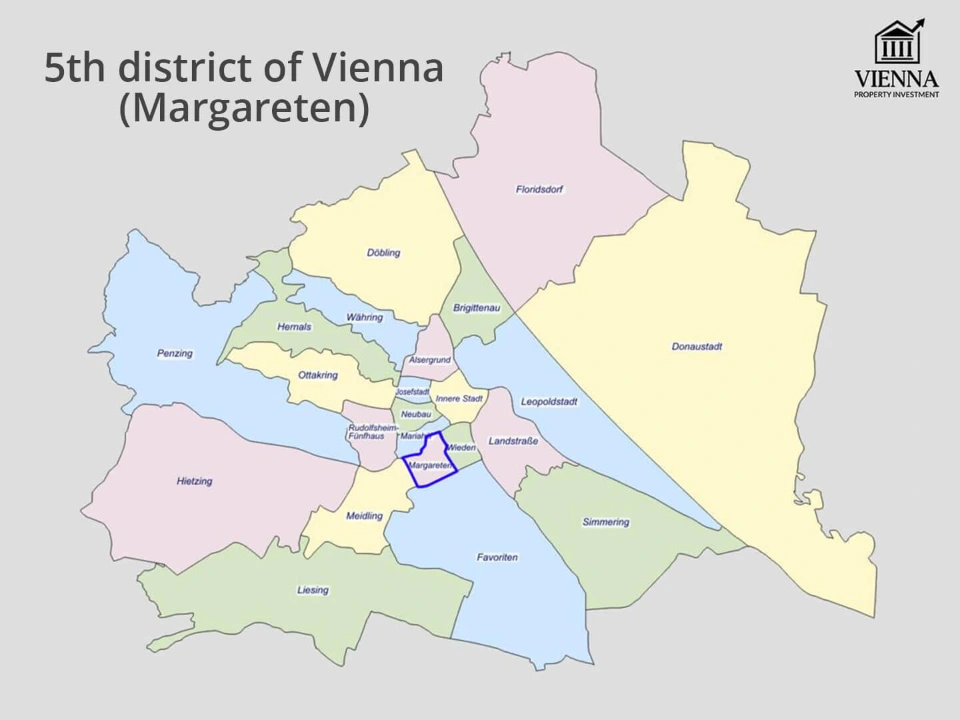
Vienna's 5th district, Margareten, covers an area of approximately 2.03 km², making it one of the most compact districts in the city. According to 2025 estimates, approximately 54,000–55,000 people live here, with a density exceeding 25,000 residents per square kilometer. This concentration is explained by the nature of the development: a predominance of 19th- and 20th-century apartment buildings and limited available space for new projects.
By comparison, the average density in Vienna as a whole is significantly lower, highlighting Margareten's unique structure. Its compact size and high density create the feeling of an "urban hub"—a neighborhood where every block is rich in amenities, and all key amenities are within walking distance. This quality makes Vienna's fifth district attractive to those who value compactness and dynamism.
Boundaries and location
Margareten is located just two kilometers from the capital's center. It borders Wieden (4th) to the east, Mariahilf (6th) to the north, Favoriten (10th) to the south, and Meidling (12th) to the west. Thanks to this location, the district enjoys excellent public transportation links: metro, tram, and bus lines connect it to the city center and other neighborhoods.
The geographical terrain of the area is flat, with minimal elevation changes, which has a beneficial effect on dense and rational development.
Zoning by quarters
Despite its compact size, Margareten's structure is diverse. Three types of urban zones can be roughly distinguished:
- The historic center is the neighborhoods around Margareten , where old houses and palace complexes from the 19th century have been preserved. This is also where the district's cultural life is concentrated.
- The area along the Gürtel is a busy thoroughfare separating Margareten from Meidling and Favoriten. The area along both sides of the Gürtel is home to the largest concentration of commercial properties, shops, and modern residential complexes.
- Shopping streets such as Margareten Straße and Reinprechtsdorfer Straße form the "economic heart" of the district, combining shops, restaurants, small offices, and housing.
This division shows that Vienna's Margareten district simultaneously functions as both a residential and a business space.
The urban core and quiet courtyards
Margareten's distinctive feature is the combination of dense urban fabric and quiet courtyards. Outside, the streets are often busy, with traffic and retail space, but once you pass through the archway of a building, a courtyard opens up, offering tranquility, green spaces, recreation areas, and spaces for children.
These courtyards largely compensate for the lack of public parks: green spaces occupy only about 4.5% of the district's area. By comparison, in Vienna, this figure exceeds 40%. Therefore, "hofs" play an important social and environmental role, creating an atmosphere of comfort and privacy in a metropolitan environment.
The Importance of Structure for Life and Investments
Today, Margareten is considered one of Vienna's best neighborhoods for livability among those who value a balance between historical charm and modern convenience. Its high density, well-developed public transportation network, shopping streets, and quiet courtyards make it a versatile neighborhood.
Margareten stands out on the Vienna neighborhood map due to its compact size, and is attractive to both investors and renters in the real estate market. Some neighborhoods in the district are seeing rising housing prices, thanks to their favorable location and the gradual renovation of the housing stock.
Who inhabits Margareten?

Despite its relatively compact size, Margareten boasts a high degree of social diversity: from the long-established indigenous population to first- and second-generation migrants, from teachers and healthcare workers to service professionals. An above-average education level and an international component create favorable conditions for a comfortable life and the mutual enrichment of different cultures.
Demographic portrait: age and education
Margareten, or Vienna's fifth district, is a compact, vibrant, and multi-layered community. As of January 1, 2025, it had a population of 54,581, of which over 39,000 were between the ages of 18 and 64; approximately 7,300 were children and adolescents under 17; and just over 8,200 were pensioners. This makes the average age profile younger than in many other parts of Vienna.
Regarding education, among residents over 15 years of age: 12.6% have a higher education (university or equivalent), 16.4% have a full matriculation (Matura), 34.2% have vocational education, and 36.9% have only basic/compulsory education. All these figures are comparable to or slightly higher than the Viennese average.
Multiculturalism in Faces: The Proportion of Foreigners
Margareten is a true multicultural hub of Vienna. As of early 2025, of the 54,581 residents, 30,817 hold Austrian citizenship, approximately 10,608 are from EU, EFTA, or UK countries, and 13,156 are of other nationalities. Thus, the proportion of foreigners here exceeds 30%, reflecting the multiculturalism characteristic of many of Vienna's best neighborhoods. By comparison, the proportion of foreigners across the city is approximately 35%.
Income and social level
According to Stadt Wien, the average annual gross income of full-time employees (Vollzeit) in Margareten in 2023 was €61,007, while the average for Vienna as a whole was €61,861. After taxes, the net average annual income in the 5th district was approximately €41,268, while the average for Vienna was €41,910.
This income level confirms that Margareten is a middle-class neighborhood: not the most expensive, but not the cheapest either – balancing affordability with a high-quality social structure.
This makes the area attractive both to young professionals and families seeking the comfort and infrastructure of the city, as well as to investors seeking stability and demand for housing.
New Urban Pulse: Young Professionals and Migrants
Over time, Margareten has become a magnet for young professionals and families, particularly those with a migrant background. The combination of affordable housing, proximity to the city center, compactness, and cultural diversity creates a creative atmosphere. According to the Vienna Mosaic study, areas of the city with a migrant population and economic accessibility foster social integration and mixed urban communities.
Margareten is at the center of this trend – a district that attracts young workers, creative professionals, and people of various nationalities, who together create a dynamic and connected urban fabric.
Housing: from social housing to modern apartments

In Margareten, it's not uncommon to find buildings with a social housing apartment on one floor and a modern loft two floors above, renting for €2,000/month. In 2025, I had a client, a young IT specialist from Austria, who rented a renovated two-bedroom apartment for €1,750/month right in a building where the lower floors are occupied by municipal apartments. This social mix makes the neighborhood vibrant and multilayered.
Social Housing: The Historical Legacy of Reumannhof and Metzleinstaler Hof
Margareten became one of the symbols of the so-called "Red Vienna" (Rotes Wien)—the period of the 1920s and 1930s, when the Social Democratic authorities actively built municipal housing (Gemeindebauten). Metzleinstaler Hof (1919–1920) was one of the city's first, and Reumannhof (1924–1926) was a model for large-scale and prestigious projects: the complex included courtyards, arches, decorative facades, and social functions (laundries, clubs).
Today, about 17% of housing in Margareten is in the social housing segment, and almost a quarter citywide. These buildings, although built a century ago, remain in demand, as the municipality regularly carries out renovations (window replacement, insulation, and energy-efficient systems).
Interestingly, social housing in Margareten is distributed throughout the entire district, rather than concentrated in isolated "ghettos." This helps the neighborhood avoid the stigma that plagues Vienna's crime-ridden outskirts.
Luxury apartments: renovations near Margaretenand Naschmarkt
Margareten is gradually becoming a "fashionable district" (gentrification).
- In and around MargaretenPlatz, Gründerzeit buildings from the late 19th century are being actively renovated. Boutique apartments with designer interiors, high ceilings, and panoramic windows are being created here.
- The proximity to Naschmarkt and the city center makes these apartments particularly popular with expats, young professionals and creative families.
- The new complexes use "green" standards: solar panels, energy-efficient heating, and underground parking.
Thus, Vienna's fifth district combines historical spirit with modern standards, making it attractive to all segments of the population.
Prices: from affordable to premium
The real estate market in Margareten (Vienna's 5th district) is unique in that it offers affordable apartments for young families and students, as well as renovated boutique apartments for wealthy clients.
Home Purchase (2024–2025):
- The average price is around €4,827/m² (above the Vienna average, but lower than in the 1st or 3rd districts).
- In the old housing stock near Gürtel, prices start at €3,800/m², but for renovated apartments near Margaretenplatz and Naschmarkt, the price can reach €6,000–6,500/m².
- In premium new buildings (loft projects, penthouse) the cost exceeds €7,000/m².
In 2025, I supported a German family with a small child who purchased an apartment on Pilgramgasse (56 m²) for €5,150 per m², bringing the total transaction price to €289,000.
In 2024, I worked with a French client who invested in a renovated 82 m² apartment near Margareten Platz. The transaction price was €6,200 per m² (approximately €508,000). The apartment, featuring designer renovations and a view of the square, is currently renting for €2,200 per month, providing a stable income.
Housing rental (2025):
- Small studio (30–35 m²) — €900–€1,100/month.
- Two-room apartment (50–60 m²) — €1,300–1,700/month.
- Spacious apartments (85–100 m²) — €2,000–2,500/month.
For example, a young couple from Ukraine rented a 38 m² one-bedroom apartment from Gürtel in 2024 for €980/month. The apartment was in a Gründerzeit building without an elevator, but had a renovated kitchen.
| Type of housing | Examples | Purchase price | Rental price | Peculiarities |
|---|---|---|---|---|
| Social (Gemeindebau) | Reumannhof, Metzleinstaler Hof | – | 400–700 €/month (discounted rates) | Historical complexes, regular renovations |
| Old Fund | Gründerzeit-Houses at Gürtel | 3,800–4,500 €/m² | 900–1,400 €/month. | Affordable segment, student and youth housing |
| Renovations at Margaretenplatz | Boutique apartments | 5,500–6,500 €/m² | 1,500–2,200 €/month. | Luxury apartments, high demand |
| Premium new buildings | Loft, penthouse | >7,000 €/m² | 2,000–2,500 €/month. | Modern standards, energy efficiency |
Education in Margareten: from grammar schools to research centres

The presence of a well-developed educational infrastructure directly influences Margareten's perception as one of Vienna's prestigious neighborhoods. Despite its working-class past, it now competes vigorously with the more expensive neighborhoods of the Innere Stadt and Mariahilf, offering a high level of educational opportunities at comparatively moderate housing prices. This is why families choosing Vienna's neighborhoods to live in are increasingly choosing Margareten.
Rainergymnasium – Tradition and Modernity
The Rainergymnasium, the oldest gymnasium in Margareten, founded in the 19th century, is considered the district's central educational institution. Today, it enrolls over 1,200 students, and is renowned for its strong focus on the humanities, languages, and natural sciences. Teaching is top-notch, and graduates attend prestigious universities in Austria and Germany. Rainergymnasium is rightfully considered one of the hallmarks of education in Vienna's fifth district.
HTL Spengergasse is Austria's largest technical college
An equally important educational center is HTL Spengergasse, Austria's largest technical university, with approximately 2,600 students. The institution has a long history (founded in 1873) and is renowned for its training in IT, engineering, and media technology. Many graduates find employment with Viennese startups and international companies.
Interestingly, HTL Spengergasse has been actively developing cooperation with IT companies from Central Europe in recent years and is also participating in projects to digitally transform urban services.
Primary education
Primary schools (Volksschule) in Margareten (Vienna's 5th district) provide a solid foundation for children's continued education and development. The district is home to several Volksschule, including Volksschule Reinprechtsdorfer Straße and Volksschule Margareten, which provide education for children aged 6 to 10. They utilize modern teaching methods, including the integration of digital technologies, foreign language instruction, and additional subjects (music, sports, and art).
VHS Polycollege and IT College – opportunities for adults and young professionals
VHS Polycollege is one of Vienna's largest centers for continuing education, located in Margareten (Vienna's 5th district). It offers hundreds of courses for adults, from language and cultural programs to professional training in business, design, IT, and engineering. Polycollege also offers career guidance and retraining programs, which are especially important for migrants and young professionals. Courses offer certifications recognized by Austrian employers and the opportunity to participate in internships and placements with Viennese companies.
The IT College, also located in Margareten, focuses on training specialists in information technology and digital technologies. Here, students master programming, web development, cybersecurity, and IT project management. The college actively collaborates with Viennese universities and major IT companies, providing graduates with opportunities for internships and employment while still studying.
Science and international cooperation
The Institute for High Energy Physics (HEPHY) occupies a special place in the educational and scientific environment of Vienna's 5th district. It collaborates with CERN on major global particle research projects. Thus, even in a relatively small district, a world-class scientific center operates, raising Margareten's prestige.
Transport accessibility and infrastructure
Margareten is one of Vienna's most convenient and dynamically developing districts in terms of transportation infrastructure. Thanks to a well-developed public transportation network, bicycle routes, and urban policies focused on sustainable mobility, the district attracts both local residents and investors.
Metro and trams

- U-Bahn line U4: Margaretengürtel and Pilgramgasse stations provide convenient access to the city center and other districts. Line U4 connects the districts of Hütteldorf and Heiligenstadt, passing through key points such as Karlsplatz and Schönbrunn.
- Tram lines: The area is served by tram lines 6, 18, 62 and others, providing convenient connections to various parts of the city.
Bicycle infrastructure
- Bike path development: Around 24 kilometers of new bike paths are planned for Vienna by 2025, including projects to improve infrastructure in the Margareten district.
- Reducing Parking Spaces: The city's policy is to reduce the number of on-street parking spaces, which will help create a safer and more comfortable environment for pedestrians and cyclists.
Urban Policy and STEP 2025
- STEP 2025: The city's STEP 2025 program aims to develop a sustainable urban environment, including improving transport infrastructure, expanding cycling and pedestrian routes, and reducing dependence on private vehicles.
- Investments in bridges and road reconstruction: The city is actively investing in improving bridges and road reconstruction, which helps improve transport accessibility and reduce air pollution.
Parking and parking policy in Margareten

Margareten is not only a historical and cultural district but also an example of modern urban parking and sustainable development policy. Parking management and greening projects make the district more convenient for residents and attractive to investors, confirming its status among Vienna's best neighborhoods.
Parkpickerl – parking permits for residents
Vienna's fifth district operates the Parkpickerl system, which grants residents the right to long-term parking in their district:
- Cost and terms: from €10 per month, with the possibility of extension for 4–24 months.
- Benefits: With Parkpickerl, residents can park without time restrictions, which is especially important for high-density areas.
- Local features of Margareten: Parkpickerl zones cover the entire district, including the central streets and the blocks around Margaretengürtel, which helps reduce traffic congestion and the number of cars on the roads.
Paid parking zones and dynamic navigation
The district is actively introducing paid parking zones for short-term parking:
- Cost: from €1.10 for 30 minutes to €4.40 for 2 hours.
- Operating hours: from 9:00 to 22:00 on weekdays.
- Dynamic displays and apps: The system displays the number of available spaces in nearby garages and parking lots, and mobile apps allow you to plan your parking in advance.
This technology helps reduce the number of cars "wandering" on the streets and reduces traffic, which has a positive impact on the ecology of the area.
Converting parking lots into green spaces
Margareten is involved in projects to create green public spaces instead of asphalt parking lots:
- Example: Naschmarkt: part of an old parking lot has been converted into a recreation area with lawns, trees and seating.
- Benefits: Improved air quality, reduced noise, and safer and more convenient pedestrian routes.
- Future plans: City authorities continue to gradually reduce the amount of street parking while expanding bike paths and pedestrian areas.
Religion and religious institutions in Margareten

Margareten is not only one of Vienna's most dynamic districts but also an example of multi-faith harmony and social integration. It is home to a diverse community, encompassing representatives of various religions and cultures, reflected in a rich array of religious institutions and initiatives.
Margareten is distinguished by its religious diversity. According to 2001 data:
- Catholics make up 42.2%. There are three Catholic parishes in the district (for example, St. Joseph's Church and the Church of the Heart of Jesus), which belong to the Archdiocese of Vienna.
- Muslims make up 11.9%. Mosques and Islamic cultural centers operate in the area.
- Orthodox – 9.6% (Serbian, Romanian, Greek communities).
- Evangelicals – 4.3%.
- Without confession - 24.6%.
The area also has a Buddhist center and small Protestant communities. Religious institutions play not only a spiritual but also a social role, facilitating the integration of migrants and organizing cultural initiatives.
Catholic churches
Pfarrkirche St. Joseph . Located on the corner of Schönbrunner Straße and Ramperstorffergasse, this church was founded in 1771 and is one of the oldest in the area. Its architecture combines elements of late Baroque, and the interior retains a historical ambiance. The parish is actively involved in the social life of the area, offering various programs for parishioners and local residents.
Herz-Jesu-Kirche . Built in 1879, this Neo-Renaissance church was originally part of the convent of the Sisters of the Good Shepherds. Today, it serves as a place of worship and cultural events. Its unique architecture and historical significance make it an important landmark in the area.
Mosques and Islamic centers
Masjid Ar-Rahma . Located on Stöbergasse, this mosque serves as a hub for the neighborhood's Muslim community. It hosts Friday prayers, educational programs, and cultural events promoting integration and mutual understanding.
Muradiye Camii . Part of the Union of Islamic Cultural Centers, this mosque at Pelzgasse 9 is an important religious and cultural center for Muslims in Margareten. It hosts prayers, educational classes, and cultural events aimed at strengthening the community.
Almohajerin Moschee . Located at Leitgebgasse 7, this mosque serves as a hub for the Afghan community in Vienna. It hosts prayers, cultural events, and programs aimed at maintaining traditions and integrating into Austrian society.
Buddhist and other Eastern religious centers
Shaolin Tempel Austria . Located at Bacherplatz 10/3, this center is the first official Buddhist temple in Austria. It hosts Buddhist ceremonies, meditations, and Shaolin kung fu classes, promoting spiritual development and cultural exchange.
Wat Yarnsangvorn Vienna . This Thai Buddhist temple at Kohlgasse 41/6 serves as a spiritual center for the Thai community and anyone interested in Buddhism. It hosts prayers, meditations, and cultural events that promote understanding and respect for Thai culture and religion.
Margareten actively supports a multi-faith environment through various social and cultural initiatives. Religious institutions often collaborate with local organizations to organize events aimed at fostering mutual understanding and integration among diverse communities. This includes joint celebrations, educational programs, and cultural exchanges that promote harmonious coexistence among various religious and cultural groups.
Culture, leisure and events in Margareten

Vienna's 5th district is not only a historic and densely populated area but also a true cultural hub where modernity harmoniously blends with tradition. The district is known for its theaters, museums, art spaces, and street festivals. Here, every resident and visitor can find entertainment to suit their tastes, from experimental theater and art cinema to music festivals and flea markets.
Culture in Margareten is built not only on institutional events but also on the vibrant local community. Theaters, museums, cinemas, and festivals foster a creative and social atmosphere, making Margareten one of Vienna's most attractive neighborhoods to live in. Many events are available at discounted rates for students, seniors, and Kulturpass holders.
Theaters
- Volx/ Margareten (Volx/Margareten) . Located on Schönbrunner Straße, in the heart of the district. This independent theater is known for its experimental productions and close ties to the local community. It regularly hosts performances addressing current social and cultural issues. Tickets: €10–20.
- Theater Scala (Theater Scala) . Located on Wiedner Hauptstraße, near the intersection with major pedestrian streets. Offers productions from classical to contemporary. Tickets: from €15, depending on the performance.
- Spektakel (Spectacle) . Located on Schönbrunner Straße, near Volx/ Margareten . This cultural center features comedy shows, concerts, and events. Tickets start at €20.
These theatres actively collaborate with local schools and universities, conducting master classes and creative programs for young people.
Film and art screening
- Filmcasino (Filmcasino) is a historic art cinema at Margareten Straße 78. It is known for its independent film screenings, themed festivals, and post-film discussions. Tickets: €9.50, with discounts for club members.
- Open-air cinema and summer screenings . During the summer months, Margareten and neighboring districts host open-air screenings on Margareten's district square (Bezirksplatz) or in the district's open-air parks. Cult films and new releases are often screened, and themed festivals are also held. Admission is generally free; fees may apply for special screenings.
Museums and galleries
- Bezirksmuseum Margareten (Margareten District Museum). Located on Schönbrunner Straße, in the center of the district. Exhibitions cover the district's history, architecture, photography, and archival materials. Admission is free.
- The Economic Museum is located on Vogelsanggasse, near transport hubs. The museum explores the development of Austria's economy and industry. Admission: 6 euros; discounts are available for students and seniors.
- Local galleries and art spaces. Located throughout the district—on Margareten Straße, Schönbrunner Straße, and Ramperstorffergasse—they host contemporary art exhibitions, installations, and workshops.
Festivals and street events
- The Naschmarkt flea market. The Naschmarkt is located primarily in the 6th district (Mariehilf), but borders the 5th district (Margarethen). Residents of Margarethen have easy access to this market, which sells antiques, vintage items, and unique items every Saturday.
- Art fairs and street festivals take place in Margareten's district squares and pedestrian streets, such as Margareten Gürtel and Bezirksplatz. Throughout the year, food, craft, music, and art festivals take place here.
- Open-air concerts and festivals. Venues are located on Bezirksplatz and in the district's courtyards. Admission is free or a nominal fee of 5 to 10 euros.
Parks and green spaces in Margareten

In the early 2000s, green spaces in Margareten occupied only about 4–5% of the district's territory. The district was traditionally densely built-up and had a limited number of squares and parks. In recent years, city initiatives to redevelop courtyards, transform streets, and create new green spaces have significantly increased the area of green areas.
Projects to reconstruct small courtyard spaces, transform wastelands into public gardens, and create modern micro-parks with recreation areas, children's areas, and sports zones are being implemented particularly actively.
Thanks to these efforts, Margareten is now experiencing significant growth in green space and is becoming one of Vienna's most vibrant urban ecology districts, improving the quality of life for local residents and the district's attractiveness for new investment and housing.
Barbara Prammer Park. In July 2025, a new 1,500 m² urban park named after Barbara Prammer, an Austrian political activist, opened in Margareten. The park is located on the Rechte Wien zeile, next to the Kettenbrückengasse U-Bahn station. The project included the planting of 14 new trees, the creation of flower and herb beds, benches, and water features. Particular attention was paid to improving the neighborhood's microclimate, reducing summer temperatures, and improving air quality.
Einsiedlerpark and Bruno-Kreisky-Park. In the 2000s, a project on gender-sensitive design of public parks was implemented in Vienna, aiming to create safe and inclusive spaces for all residents, including women and children. As part of this project, Einsiedlerpark and Bruno-Kreisky-Park in Margareten were redesigned. The parks were improved with improved lighting and visibility, added play and rest areas, and accessibility for people with disabilities. These changes contributed to increased park visitation and improved the public perception of these spaces.
Bacherpark is a city park covering approximately 6,000 square meters, located in the center of Margareten. The park is named after Leopold Bacher, a local 19th-century public figure. The park features playgrounds and sports areas, including a "knight's castle" and rope bridges. There is also a designated dog walking area, equipped with lava rocks and decorative stones.
In addition to the main parks, Margareten also boasts other green spaces, such as Herweghpark, Klieberpark, Scheupark, Margaretner Stadtwildnis, and Stefan-Weber-Park. These spaces offer additional opportunities for relaxation and socializing in the fresh air.
The City of Vienna is actively investing in the development of green spaces in Margareten. In recent years, projects have been implemented to green streets, courtyards, and rooftops, as well as to create new parks and squares. These initiatives are aimed at improving the quality of life for residents, enhancing biodiversity, and reducing the negative impact of urbanization on the environment.
Economy, offices and international relations

Vienna's 5th district is traditionally considered a residential and creative quarter, where historic buildings, small businesses, and modern office buildings coexist. The district's economic landscape differs significantly from the city center (Innere Stadt) or more business-oriented districts such as the 1st and 2nd districts.
Small business and local economy
Small businesses, family-run cafes, shops, and artisan workshops form the backbone of Margareten's economy. This district of Vienna is known for its multicultural atmosphere, and this is reflected in its businesses: here you can find traditional Viennese coffee shops as well as bakeries run by migrants from Turkey, the Balkans, and the Middle East.
In recent years, the district has become a magnet for creative industries, including designers, architects, and digital media specialists. Thanks to affordable rent (compared to central districts), many studios and agencies are opening offices here. Coworking spaces and studios are particularly booming, making Vienna's fifth district attractive to young entrepreneurs.
Corporate presence and offices
Although Margareten in Vienna is primarily associated with residential areas, it is also home to the offices of several prominent companies. Among them:
- Manz Crossmedia is an Austrian media group with a history dating back to the 19th century, today active in the field of legal information and digital solutions.
- Schiebel is a technology company known worldwide for its unmanned aerial systems (including the CAMCOPTER S-100 drone).
In addition to private companies, the district is home to city public utility departments, which ensure the infrastructural development of the district and Vienna as a whole. This further creates sustainable employment for residents.
International dimension
Although Margareten itself is not a diplomatic quarter, its location plays a key role. Thanks to the U4 metro line, residents and workers have quick access to the Vienna International Centre (UNO City), home to the offices of the UN and other international organizations. Diplomatic missions located in the central districts are also easily accessible.
Thus, even without a concentration of embassies, the Margareten district of Vienna has good connections to Vienna's international centers, which is advantageous for tenants working in international business or consulting.
My observations: As an Austrian real estate expert, I note that Vienna's 5th district is gradually becoming a magnet for commercial leasing investors. The combination of local small businesses and the presence of high-tech companies creates a balanced market. It's important for investors to understand that despite its reputation as a "people's" district, Margareten is developing as a hybrid zone—with affordable housing, vibrant street retail, and a growing office segment.
In the coming years, we can expect increased interest in commercial properties here, as the area benefits from its central location and international connectivity. For real estate buyers and renters, this means greater investment stability compared to more vulnerable areas of the city.
Modern projects and investments
In recent years, Vienna's Margareten has become not only a residential and cultural quarter, but also a platform for significant urban development projects combining housing, commercial spaces, and new public areas.
Residential complex on MargaretenStraße

One of the largest projects in the heart of Vienna's fifth district is the complex currently under construction on MargaretenStraße, being developed by PORR Group. The project includes 235 apartments of various formats—from compact studios to spacious family apartments—reflecting the neighborhood's social diversity. The lower floors will house commercial space, including crèches, medical practices, and convenience stores.
An important part of the concept is underground parking for 255 cars, which reduces the pressure on street space. The project also includes recreation areas, green spaces, and playgrounds, in line with the "short-distance city" strategy Vienna is actively pursuing. Thus, Vienna's fifth district will receive a facility that integrates housing, social functions, and infrastructure.
The PORR website doesn't list a specific completion date; however, the property is already being actively promoted in marketing materials as occupancy-ready—most likely, completion is expected by the end of 2025 or early 2026.
According to the First Vienna Residential Market Report 2025, the average price of first-time occupancy apartments in Margareten ranges from €1,800 to €4,800 per square meter. Therefore, a 60 square meter apartment could cost between €288,000 and €320,000.
In my experience, projects like MargaretenStraße are profitable not only for end users but also for buy-to-let investors. Their value is enhanced by well-designed infrastructure: the presence of commercial and social facilities—from crèches to medical offices—makes the complex particularly attractive to families and, therefore, sustainable for investors.
STEP 2025 Urban Strategies
The development of Vienna's Margareten district is inextricably linked to citywide strategies. Within the framework of STEP 2025 (Stadtentwicklungsplan Wien 2025), the key areas are:
- expansion of public transport (in particular, the modernization of the U2 metro line and improved connections with the U4, passing through Margareten),
- the creation of additional green spaces and "cooling islands" to combat the effects of urban overheating,
- integration of the innovative environment—from new forms of coworking spaces to support for startups in the creative industries.
Particular attention is being paid to ensuring neighborhoods like Margareten remain accessible and maintain their social diversity. To this end, new developments include a proportion of affordable housing and social infrastructure.
Investment attractiveness of the area
Margareten (Vienna's 5th district) is currently considered one of the most promising areas for residential investment . This is due to a combination of its prime location, stable demand, and relatively affordable prices.
Stable demand and prices

According to Vigo Immobilien, the average price per square meter in Vienna's Margareten district is approximately €4,800 per square meter, significantly lower than prices in central districts such as the 1st or 4th districts, yet housing remains in high demand. The high population density, as well as proximity to the city center and key transportation hubs, guarantee stable rental demand—both long-term and short-term.
In practice, I see that apartments in Margareten quickly find tenants: students and young professionals are eager to rent studios and 1-2-room apartments near the U4 line and shopping streets, while families choose more spacious apartments close to schools and green areas.
For example, one of my clients purchased a two-bedroom, 70-square-meter apartment on Rechte Wien, which was rented out to an expat from an international company just two weeks after the deal was completed. Another client, a young family with two children, chose an apartment in a recently renovated building near Margareten, where the proximity to schools and kindergartens made the property highly sought after on the rental market.
Thanks to this dynamic, Vienna's fifth district consistently attracts investors. Housing in this district not only provides a reliable flow of rental income but is also gradually increasing in value thanks to infrastructure developments: new residential complexes, modern office space, greenery, and improved transport accessibility.
| Type of housing | Area, m² | Price per m² (€) | Total cost (€) | Comment |
|---|---|---|---|---|
| Studio apartment | 35 | 4 800 | 168 000 | Compact studios, popular with students and expats |
| 1-room apartment | 50 | 4 850 | 242 500 | Ideal for rent or young family |
| 2-room apartment | 70 | 4 900 | 343 000 | Rental demand is high, close to the U4 and Naschmarkt |
| 3-room apartment | 90 | 5 000 | 450 000 | Often bought for families, a complex with green areas |
| Penthouse / luxury apartment | 120 | 5 817 | 698 040 | Renovations near MargaretenPlatz, premium segment |
Convenient location and infrastructure
Vienna's fifth district borders Naschmarkt and the first district, providing residents with access to the city's cultural and business life within a few minutes' walk or via the U4 line. Infrastructure is rapidly developing: new residential complexes are being built (such as the MargaretenStraße project), parks are being modernized, and transport accessibility is being improved. All of this has a positive impact on the capitalization of properties.
Multinational environment and cultural segment
Margareten Vienna is renowned for its multinational population. Expats, students, and young professionals from creative industries actively live and rent apartments here. The area is perceived as dynamic and modern, creating a strong demand for compact apartments and rentals.
Security issues
The media sometimes mentions that dangerous areas of Vienna include certain streets in Margareten, but in reality, this image is largely exaggerated. While the neighborhood, like any densely populated area, may have its share of problematic areas, it is generally considered safe and is actively being improved. Compared to Vienna's truly crime-ridden neighborhoods, Margareten remains an attractive place to live and invest.
Based on my experience with Austrian real estate, Vienna's 5th district is particularly attractive to investors today. Relatively low entry costs, high liquidity, and a multinational tenant base make projects here some of the most balanced in terms of risk/return. I expect prices in Margareten to gradually increase over the coming years, driven by infrastructure upgrades and growing interest from international tenants.
Conclusion: Who is Margareten suitable for?
Margareten (Vienna's 5th district) combines the convenience of a central location, well-developed infrastructure, and a vibrant community. Based on my experience in real estate, this neighborhood is ideal for a variety of people and investors.
- Families appreciate Vienna's fifth district for its schools, kindergartens, parks, and underground parking, as well as its convenient public transportation links. My clients often chose apartments near the Rainergymnasium and HTL Spengergasse, so their children could easily walk or bike to school. The presence of green spaces, such as Barbara Prammer Park, Einsiedler Park, and Bruno-Kreisky-Park, makes the district especially attractive for families with children.
- For investors, Margareten offers an opportunity to earn a stable rental income, thanks to the high population density and demand for apartments on the market. For example, one of my clients purchased an apartment in a complex under construction on Margareten Straße and, within a few months, signed a lease agreement with an expat from an international company. The combination of affordable prices (≈ €4,800/m²) and growing capitalization makes the area a promising investment.
- The multinational population and creative atmosphere of Margareten in Vienna attract expats, young professionals, and representatives of creative industries . One of my clients, a designer from Germany, was able to rent a stylish apartment in a renovated building near Margareten , making it convenient for work and social contacts.
Vienna's Margareten district combines vibrant infrastructure, the transformation of older neighborhoods, and easy access to the city center. Margareten remains a safe and comfortable place to live and invest. A balanced mix of residential, commercial, green spaces, and transportation makes it attractive to a wide range of audiences: families, investors, and international professionals.