Wieden Wieden Vienna's 4th district, compactly located south of the city's historic center, just 1.5 km from Ringstraße. It is one of the city's oldest and most prestigious districts, harmoniously blending historical heritage with the modern rhythms of the metropolis. Wieden is considered a cultural and educational center, and its streets are filled with architectural monuments, atmospheric cafes, designer shops, and green parks.
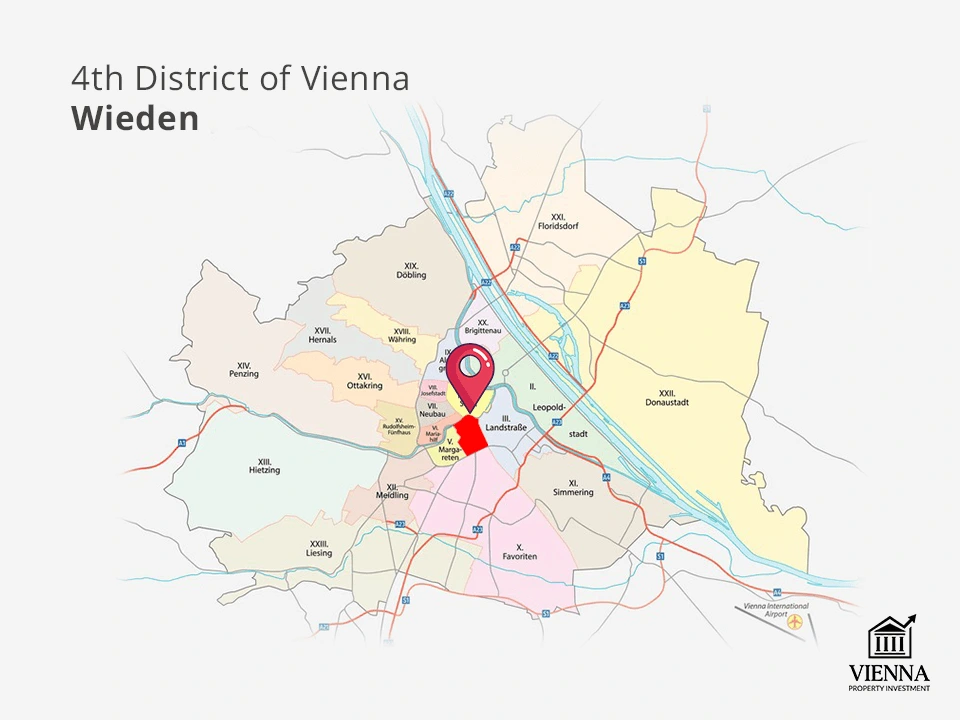
Wieden is known for its 19th-century aristocratic palaces, built during the rapid development of the Austrian Empire. The district developed as a residential area for the nobility and wealthy bourgeoisie, which is reflected in its architectural appearance: majestic building façades, decorative elements, and spacious apartments with high ceilings.
However, in the 21st century, Wieden has become not only a symbol of old Vienna, but also a district with a dynamically developing infrastructure, in demand by young professionals, students, and representatives of the creative industries.
The district's main symbol is the Karlskirche (St. Charles' Church), a remarkable Baroque monument commissioned by Emperor Charles VI. This church is not only an architectural marvel but also an important cultural venue, hosting classical music concerts and international festivals ( Karlskirche ).
Modern Wieden is a unique mix of prestigious neighborhoods and affordable areas, a student community and tourist infrastructure. The district is attractive for both residential and investment thanks to its convenient location: it is close to Hauptbahnhof Wien (the main train station) and Karlsplatz, the city's most important transportation hub, and is adjacent to Vienna's cultural center, the 1st district (Innere Stadt).
This article aims to take a detailed look at Wieden's history, its current development, infrastructure, transportation, residential features, and investment potential. We will also compare it to other central Vienna districts and analyze its prospects for families, students, investors, and tourists.
History of the area

Wieden has a rich and varied history, reflecting all stages of Vienna's development – from medieval settlements to the capital of a modern European state.
Middle Ages and Early Modern Period (12th–17th Centuries). The first mention of the territory of Wieden dates back to the 12th century, when the area was an agricultural suburb of Vienna. It was home to farms and small villages that supplied the capital with produce.
In the 16th and 17th centuries, the area began to gradually change: monasteries and aristocratic country residences appeared, making Wieden a popular vacation spot for the nobility. Its development accelerated thanks to the construction of roads connecting it with the central districts.
Baroque era (18th century). The 18th century was a time of prosperity for the district. In 1713, Emperor Charles VI commissioned the construction of the Karlskirche, a church that became a symbol of the victory over the plague. Architect Joseph Emanuel Fischer von Erlach created an outstanding Baroque architectural monument that defined Wieden's cultural significance for centuries.
The 19th century – industrialization and rapid growth. In the 19th century, Wieden became part of the industrial and commercial development of the Austrian Empire. Factories, workshops, and the first apartment buildings appeared in the area.
A key event was Wieden's incorporation into Vienna in 1850, opening the way for large-scale urban development. During this period, FavoritenStraße became the district's main commercial and social center, and prestigious residential neighborhoods began to develop around it.
Wieden was also associated with scientific and educational developments at this time, thanks to the opening of the first technical schools, which later became the basis of the Technische Universität Wien (TU Wien).
World War II and the Post-War Period. During World War II, the district suffered severe damage, particularly in the area around the Südbahnhof. After the war, intensive reconstruction began, with particular attention paid to the restoration of historical monuments and the preservation of cultural heritage.
Modern stage (21st century). Today, Vidén is a district that combines tradition and innovation. Historic buildings are being actively renovated, streets are being modernized, and cultural clusters and student campuses are being created. The district is actively developing as a center for tourism, science, and business.
Geography, zoning and structure
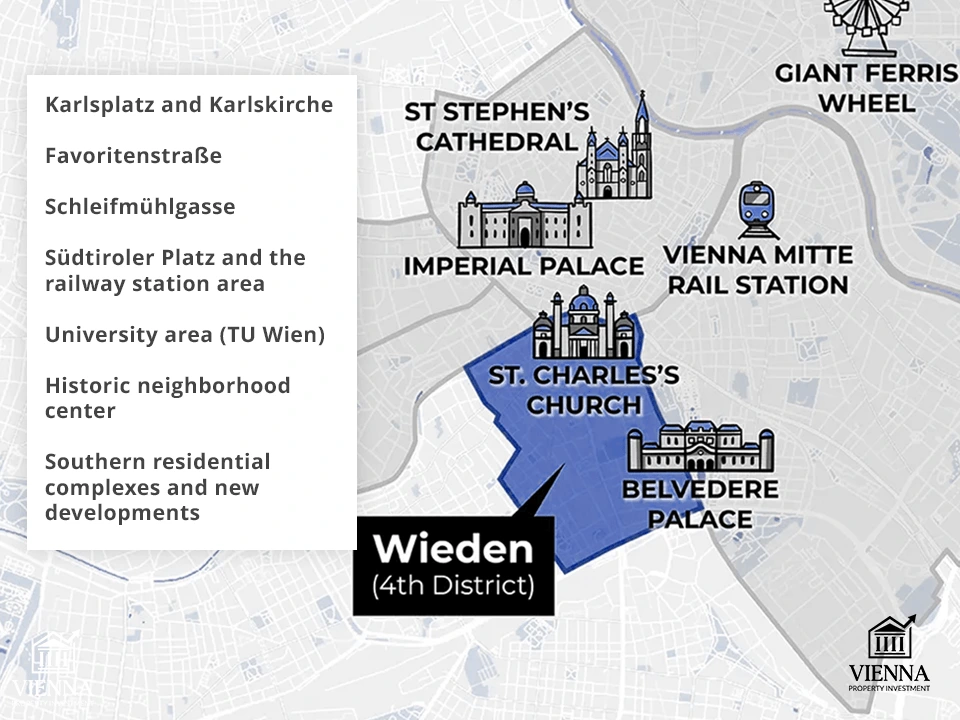
Wieden is Vienna's fourth district and one of the most compact, giving it an intimate and cozy atmosphere. It covers only about 1.8 square kilometers , but this small area is home to a vibrant city life.
According to the official Wien , the district's population as of 2025 is approximately 34,000, a population density exceeding 18,000 residents per square kilometer, typical for Vienna's central districts. It is one of the city's most densely built-up areas, where the limited space enhances the value of every square meter of land.
| Viden Zone | Functional purpose | Key objects and features | Impact on the area |
|---|---|---|---|
| Karlsplatz and Karlskirche | Cultural and tourist center | Karlskirche, Museum of Vienna, exhibition halls, concert venues, Karlsplatz square | Impact on the area |
| Favoritenstraße | Trade and business street | Shops, restaurants, cafes, banks, office buildings, access to Südtiroler Platz | Economic activity, business development, high rental costs |
| Schleifmühlgasse | Creative Quarter and Gastronomic Center | Art galleries, design studios, bars, restaurants, small exhibition spaces | Attracting young people and representatives of creative professions |
| Südtiroler Platz and the station area | Transport hub, logistics center | Südtiroler Platz, Hauptbahnhof Wien, U-Bahn and suburban train lines | High transport accessibility, growing demand for housing and hotels |
| University Zone (TU Wien) | Academic and scientific zone | TU Wienbuildings, research labs, startup centers | Formation of a multicultural environment, development of the housing rental market |
| Historic center of the quarters | A residential and cultural center with historical heritage | 19th-century houses, renovated mansions, prestigious residential complexes, museums, private galleries | Rising housing prices, preserving the area's cultural identity |
| Southern residential complexes and new projects | Modern residential areas are emerging on the border with Favoriten | New buildings with underground parking, green courtyards, kindergartens, and sports areas | Attracting families, increasing the number of young professionals |
Strategic location
Wieden is located just one and a half kilometers from Ringstraße and the historic city center. This location makes it incredibly convenient for both residents and tourists. To the north, it borders the Innere Stadt ( 1st district) , providing proximity to the Vienna Opera, museums, and the capital's most important cultural sites.
In the east, Wieden adjoins Landstraße ( 3rd district) , famous for its diplomatic missions and the Belvedere palace complex.
From the south, the district connects with Favoriten , the 10th district and the largest in terms of population, making the southern part of Wieden a link between the city centre and the outskirts.
To the west, it borders Margareten district (5th district) , which is distinguished by more democratic development and relatively affordable housing.
The North is the cultural center of the region

The northern part of Wieden, adjacent to Karlsplatz, is the district's cultural and tourist core. It is home to the Karlskirche, one of Vienna's main architectural symbols, as well as museums, exhibition spaces, and concert venues.
Karlsplatz connects several important areas of city life—tourism, culture, and education, as the buildings of the Technical University of Vienna (TU Wien) are located nearby. This area is always filled with tourists, students, and locals, creating an atmosphere of vibrant urban space.
Favoritenstraße – the commercial and business heart

Just to the south is FavoritenStraße, Wieden's main shopping artery. It's home to shops, cafes, restaurants, office buildings, and banks. This street connects the district's center with the Südtiroler Platz transportation hub and is strategically important for business and logistics.
FavoritenStraße not only functions as a shopping centre, but also creates a vibrant urban environment where life is vibrant both day and night.
The West is a creative and gastronomic cluster

In the western part of the district, closer to the border with Margareten, lies Schleifmühlgasse, known for its art galleries, design studios and atmospheric bars.
This quarter is considered Wieden's creative hub, attracting young people, students, and representatives of the creative industries. Small exhibitions, performances, and cultural events are held here, making Schleifmühlgasse an important part of the district's cultural landscape.
Southern Territories – Transport and Mobility

The southern part of the district has a distinct transportation function. It is home to Südtiroler Platz, a major hub providing connections to Hauptbahnhof Wien, Vienna's main railway station.
This makes Wieden an important transit area, convenient for both residents and tourists arriving from other regions of Austria and Europe. The transport infrastructure boosts business activity in the southern districts and facilitates the development of residential complexes near the train station.
University zone

The TU Wiencampus plays a key role in Wieden's overall structure. The university attracts students from around the world, fostering a multicultural environment and actively influencing the district's economy. The large student population stimulates the rental market, as well as the emergence of startups and research centers focused on technology and innovation.
Contrast between buildings and atmosphere
Viden boasts a diverse architecture. In the district's center, 19th-century buildings built for the aristocracy and wealthy citizens have been preserved. Today, they are being renovated and converted into prestigious apartments or cultural institutions.
At the same time, closer to the southern and eastern borders, modern residential complexes with underground parking, green courtyards, and well-developed infrastructure are being actively built. This combination of historical authenticity and modern solutions makes Vidén a district where the past harmoniously coexists with the future.
Compactness and ease of movement
The neighborhood's compact size makes it ideal for walking and cycling. Within a few blocks, you can easily navigate landmarks, shops, universities, and quiet residential courtyards. Despite the dense development, the area boasts small parks and squares, creating a balance between urban vibrancy and opportunities for recreation.
Viden can be described as a district of contrasts, where cultural, educational and transport centres are concentrated in a limited area, making it unique and attractive for both living and doing business.
Population and social structure

Wieden, Vienna's fourth district, is known for its social and cultural diversity. It is one of the most dynamic districts of the Austrian capital, where representatives of a wide variety of social groups coexist harmoniously.
Around 30% of the district's population is foreign-born, making Wieden one of the most multicultural districts in central Vienna. This high figure is due both to the district's location near key universities and cultural centers, as well as its thriving business environment.
The main population groups are students, researchers, expats, and international families. The area is home to a large number of students and faculty members of the Technical University of Vienna (TU Wien), whose campus is located on Karlsplatz. Another significant group are expats working in diplomacy, IT, and international business.
The prestigious residential complexes near Karlsplatz and Weißgerberviertel are particularly popular among embassy employees, international companies, and startups. Furthermore, the area has a large international population, creating a high demand for kindergartens and schools with bilingual programs.
The age structure of the population of Viden shows that the area remains young and active.
- 18% of the residents are pensioners, mostly living in old 19th-century buildings, especially in the historic quarters around Schleifmühlgasse.
- More than 25% of the population are young people under 30, including students, young professionals and representatives of the creative industries.
This balance of age groups ensures a constant renewal of the social composition and makes the area attractive for business and cultural projects.
The level of education here is significantly higher than the Vienna average: approximately 45% of residents hold university degrees. This figure is explained by the concentration of higher education institutions, research institutes, and creative spaces that attract the intellectual elite.
Social stratification and income
Wieden is a district of contrasts. Its central area, around Karlsplatz and Karlskirche, is home to premium neighborhoods where housing prices and the standard of living are significantly above average. These areas are distinguished by well-maintained architecture, green courtyards, and proximity to cultural attractions. Meanwhile, on the southern edge of the district, closer to Favoriten, are more affordable residential buildings, including municipal housing and older buildings that have not been renovated.
The average income in Wieden is higher than the Vienna average, but it is unevenly distributed. The district's residents include many highly paid professionals in technology, medicine, and diplomacy, but there is also a significant group of low-income people—students and migrants.
| Indicator | Meaning |
|---|---|
| The share of foreigners | ~30% |
| Pensioners | 18% of the population |
| Young people under 30 | 25% of the population |
| Higher education | 45% of residents |
| Average income | 3,200 € / month (gross) |
Cultural diversity is also reflected in the urban environment: the district's streets are lined with shops and restaurants serving cuisines from various countries, as well as cultural centers connected to international communities. This makes Wieden not only a place to live but also a space for cultural exchange and integration.
Housing: from historic mansions to modern apartments
Viden is renowned for its architecture and diverse residential stock. Here you'll find both renovated 19th-century mansions and modern residential complexes that meet high environmental standards. The area is especially prized by those seeking a combination of historical heritage and modern amenities.

Historic buildings are concentrated in the Karlsplatz and Schleifmühlgasse districts, where spacious apartments with high ceilings, stucco moldings, and wooden parquet floors can be found. These buildings, built during the Historicist and Art Nouveau periods, have become symbols of prestigious Viennese real estate. Many have been completely restored and adapted for modern living, while preserving their original architectural elements.

In the south of the district, closer to Südbahnhof and Favoriten Straße, modern residential complexes are being actively built. They are designed for young families and professionals working in Vienna's central districts. These projects emphasize energy efficiency, spacious common areas, and convenient transportation access.
Social housing accounts for approximately 10% of the district's total housing stock, making it less prevalent than in neighboring districts such as Favoriten. The main municipal buildings are located closer to the district's southern border, where property prices are traditionally lower.
Real estate prices in Vidén (2025)
| Location | Average purchase price (€/m²) | Rent (€/m²) |
|---|---|---|
| Karlsplatz / Karlskirche | 9 500 – 12 000 | 23 – 27 |
| Schleifmühlgasse | 8 000 – 9 500 | 20 – 24 |
| Favoritenstraße | 6 500 – 8 000 | 17 – 20 |
High demand for short-term rentals is a key feature of the Wieden real estate market. Thanks to its proximity to universities, museums, and tourist attractions, apartments in the area are popular among students, researchers, and tourists.
Platforms like Airbnb are actively used by property owners to rent out their homes on a daily basis, providing a stable income stream but also creating challenges for city authorities in regulating short-term rentals.

Prestigious buildings near Karlsplatz and Weißgerberviertel remain the most sought-after properties among diplomats, top executives, and wealthy families. These neighborhoods are distinguished not only by their beautiful architecture but also by their proximity to cultural centers—the Opera House, museums, and prestigious schools.
Thus, the housing market in Viden offers a wide range of options, from affordable apartments for students and young professionals to luxury residences. This makes the area attractive for both permanent residences and investment projects.
Education

Wieden Wieden one of Vienna's key educational centers, home to leading universities, high schools, and cultural institutions. The district boasts a high level of academic activity and is attractive to students from both Austria and abroad. To understand the context, it's helpful to consider how Vienna's universities are distributed among districts: Wieden benefits from its proximity to several key campuses. A unique intellectual atmosphere is fostered here, influencing not only the district's image but also its economic development.
At the heart of Wieden's educational system is the Technical University of Vienna (Technische Universität Wien, TU Wien), one of Europe's largest technical universities and the country's leading research centre.
The university was founded in 1815 and today educates more than 26,000 students in faculties covering engineering, architecture, computer science and applied mathematics.
The university's campus is located directly on Karlsplatz, making it not only an educational institution but also an architectural landmark of the district. TU Wien actively collaborates with international research organizations, including CERN and the European Space Agency, and its graduates are in demand on the global job market.

Musical and artistic culture also play a significant role in Wieden's educational life. Near the district, there's the Musikverein, a renowned concert hall that, in addition to its core concert offerings, offers courses and masterclasses for young musicians and adult music lovers. These programs are especially popular among international families and students studying music in Vienna.

Wieden offers a wide network of public and private schools for children and teenagers, including Volksschulen (primary schools) and gymnasiums with international programs. Bilingual schools offering instruction in German and English are popular, particularly sought after by expat families and diplomats living in the district's upscale neighborhoods. One example is the BG/BRG Wiedner Gymnasium, known for its emphasis on foreign languages and natural sciences.
The system of continuing education courses deserves special attention . Educational centers offering programs in IT, engineering, and management are actively developing in the area. These courses are often organized in partnership with TU Wien and international companies, ensuring a high level of training and a practical focus.
The proximity of the Inner Stadt to universities creates a convenient environment for students and faculty: many universities, including the University of Vienna (Universität Wien) and the Academy of Fine Arts, are within walking distance. This creates a vibrant academic environment where education, science, and culture are closely intertwined.
Thus, Viden's educational infrastructure makes the district a magnet for young talent and professionals, and also contributes to the development of creative and high-tech sectors of the economy.
Infrastructure and transport

Wieden boasts one of the best transportation systems in Vienna thanks to its central location and proximity to key transportation hubs. The district connects the historic city center with the southern and eastern districts, as well as international destinations via Hauptbahnhof Wien , Austria's main train station, located just a few minutes' walk from the district's southern border.
The U-Bahn (metro) is the main element of transport accessibility. Three metro lines pass through Wieden:
- U1 – connects Karlsplatz with the northern and southern districts of the city, including the central shopping areas.
- U2 – provides quick access to museums, universities and exhibition centres.
- U4 – connects the area with the western part of Vienna and tourist attractions.
Key stations are Karlsplatz, Taubstummengasse and Südtiroler Platz, which serve thousands of passengers daily.
The tram network consists of routes No. 1 and No. 62, as well as the Badner Bahn line, which connects the center of Vienna with the southern suburbs and operates as a city train.
Bus routes provide connections to the neighbouring districts of Landstraße and Favoriten , as well as to the city's key cultural centres.
Cycling is also actively developing. Modern bike paths have been installed along Karlsplatz and Favoriten Straße, integrated into the citywide system of bicycle routes. City authorities encourage the use of environmentally friendly modes of transport by offering dedicated bicycle parking and Citybike Wien .
Main transport hubs of Viden
| Mode of transport | Key stations/routes |
|---|---|
| Metro (U-Bahn) | Karlsplatz (U1, U2, U4), Taubstummengasse (U1), Südtiroler Platz (U1) |
| Trams | No. 1, No. 62, Badner Bahn |
| Railway | Hauptbahnhof Wien is the country's main train station |
| Bicycle paths | Karlsplatz, Favoritenstraße, routes to Innerer Stadt |
As part of the city's strategic plan, STEP 2025, Wieden is actively involved in programs to modernize the transport network. Key projects include:
- The expansion of the U2 line will improve the area's connections with the northern parts of the city.
- Reconstruction of transport hubs, including Karlsplatz and Südtiroler Platz stations.
- Implementation of smart traffic lights and digital traffic management systems to reduce congestion and improve safety.
These initiatives not only improve transport accessibility, but also contribute to the quality of life of the area's residents and the sustainable development of Vienna.
Parking and parking policy
As in many central districts of Vienna, parking in Wieden is strictly regulated. The entire district is part of the Parkpickerl system—paid parking zones that operate on weekdays and limit the parking time for non-residents. Apartment and house owners can obtain a residence permit at preferential rates, allowing them to park their cars close to their residence.
In recent years, the number of underground parking garages has been growing, particularly in areas near new residential developments near FavoritenStraße and Südbahnhof. These facilities are designed with modern environmental standards in mind and are often equipped with charging stations for electric vehicles.
| Parking type | Average cost (€/hour) |
|---|---|
| Ground toll zone | 2,50 – 3,00 |
| Underground parking | 3,50 – 4,00 |
| Resident Pass (Monthly) | 10 – 12 |
The city is actively implementing projects to transform surface parking lots into green public spaces. Under the Green Vienna program, many areas previously used for parking are being converted into parks, playgrounds, and pedestrian areas. This helps reduce air pollution and improve the environmental situation in the area.
An innovative solution was the implementation of digital parking monitoring systems. Residents and visitors to the area can use mobile apps to monitor available spaces in real time, reducing traffic congestion and shortening the time spent searching for parking. This system is particularly effective near transport hubs and shopping areas, such as Karlsplatz and Favoriten Straße.
Thus, Wieden's parking policy combines strict control, innovation and environmental initiatives, making the district an example of sustainable urban infrastructure management.
Safety and quality of life
Wieden is considered one of the relatively safest areas of Vienna, particularly in the historic quarters around Karlsplatz and Resselpark. The area is heavily patrolled by police, particularly near tourist attractions.
The Vienna authorities are paying particular attention to the safety of pedestrian areas and transport hubs such as Südtiroler Platz and Hauptbahnhof Wien, where surveillance cameras have been installed and modern lighting systems have been introduced.
| Indicator | Viden (2025) | Vienna average |
|---|---|---|
| Street crime rate | Short | Average |
| Access to emergency services | High (≤5 minutes) | High |
The district actively participates in the city's Safe Vienna program, which aims to improve quality of life, including the development of green spaces, street art, and projects to reduce noise and air pollution.
Healthcare and medical infrastructure

Wieden has a well-developed healthcare system, including both public and private clinics. The district's proximity to Vienna's main hospitals, such as the Krankenhaus der Barmherzigen Brüder Wien, ensures quick access to high-quality medical services.
The district boasts modern clinics, dental centers, and specialized medical offices. Particular attention is paid to preventative programs for senior citizens and children.
Many private clinics provide services in multiple languages, which is important for expats and tourists.
| Institution | Type | Peculiarities |
|---|---|---|
| St. Elisabeth Krankenhaus | Hospital | Multilingual staff, cardiology center |
| Ordination am Karlsplatz | Private clinic | Services for expats and tourists |
| Zahnzentrum Wieden | Dentistry | Modern technologies and equipment |
Religion and religious institutions
Wieden (Vienna's 4th district) boasts a diverse religious life, reflecting both its historical development and the modern multicultural structure of its population. The district's primary religion is Catholicism, but Orthodox, Protestant, and Islamic communities are also active. This broad spectrum of religious practices makes the district an important center for spiritual interaction and interfaith dialogue.

The main symbol of the district's Catholic tradition is the Karlskirche (Church of St. Charles Borromeo) . This outstanding Baroque architectural monument was built in the 18th century according to the designs of the architect Johann Bernhard Fischer von Erlach. The Karlskirche not only serves as a parish church but also serves as one of Vienna's main cultural venues, regularly hosting classical music concerts, organ recitals, and international music festivals.
Tourists and local residents often visit it not only for the services, but also for architectural tours – the interior of the church and its dome are considered a model of Baroque luxury.

The second significant Catholic center in the district is the Pfarrkirche St. Elisabeth. Built in the 19th century, this parish church is a spiritual center for residents of the neighborhoods around Favoriten Straße. It hosts active youth groups, social programs for the poor, and religious education courses for children.
Due to Wieden's multiculturalism, the district is also home to mosques and Islamic cultural centers serving the Turkish, Syrian, and Balkan communities. These centers play an important role not only in religious life but also in the social integration of new immigrants, offering German language courses, legal consultations, and cultural events.
Orthodox parishes in Viden are primarily associated with the Serbian and Russian diasporas. Protestant churches are represented by small congregations, many of which actively participate in interfaith projects.
An important area of the district's work is interreligious dialogue, supported by non-profit organizations and city structures. These platforms help reduce social tensions and strengthen mutual understanding between different groups.
Culture, Leisure and Events
Wieden is not only an educational and business center, but also a district with a vibrant cultural life renowned far beyond Austria's borders. Its cultural heritage blends classical Viennese tradition with contemporary art, creating a unique atmosphere that attracts tourists, artists, and students.
One of the main cultural centers is the Karlskirche, which, in addition to its religious role, serves as a venue for classical music concerts and opera productions. World-renowned ensembles and performers perform here, and Christmas concerts at the Karlskirche are considered one of the highlights of the winter season in Vienna.

Near the Karlskirche is the Vienna Museum ( Wien Museum Karlsplatz), which tells the history of the city and its districts. The museum is known for its temporary exhibitions, which cover both classical and contemporary art.

Schleifmühlgasse street is known as the center of the contemporary art scene. It is home to small galleries, art studios, and creative spaces that host exhibitions by young artists and international art projects. This part of Wieden is actively developing and attracting representatives of the creative industries.

A special place in the district's cultural life is occupied by the Wien er Kammeroper, which specializes in chamber opera productions and collaborates with young performers from around the world. The theater's repertoire encompasses both classical works and contemporary experimental productions.
Key annual events in Viden
| Event | Time of the event | Place |
|---|---|---|
| Christmas markets | December | Karlskirche and Resselpark |
| Street Art Festival | May-June | Schleifmühlgasse |
| Summer concerts | July-August | Resselpark and Karlskirche |
| Open-air cinema | August | Parks of the district |

Vidén is also known for its open-air cinemas, neighborhood festivals, and flea markets. Summer outdoor events attract both residents and tourists, creating a festive atmosphere and bringing the city to life. Thus, the district's cultural life is dynamic and diverse, offering events to suit every taste.
Gastronomy and nightlife

Wieden is renowned for its culinary culture, which combines traditional Viennese cuisine with contemporary global trends. Dozens of restaurants, wine bars, and cafés are located on Schleifmühlgasse and around Karlsplatz. Here you'll find everything from classic Viennese establishments serving schnitzels and strudels to fine dining restaurants offering signature dishes.
The area is also renowned for its nightlife. Along FavoritenStraße and near Naschmarkt, there are bars, clubs, and art spaces hosting music evenings, exhibitions, and parties. This makes Wieden popular among young people and tourists seeking an active lifestyle.
| Category | Examples of establishments |
|---|---|
| Traditional restaurants | Gasthaus Pöschl, Zum Alten Fassl |
| Modern cafes | Café Kafka, Vollpension |
| Wine bars | Wein & Co, Unger und Klein |
| Night clubs | Club U, Sass Music Club |
Parks and green spaces
Despite its compact size, Wieden boasts a high concentration of green spaces, making it one of the most environmentally conscious districts in central Vienna. The city places particular emphasis on developing green spaces through the Green Vienna program, which aims to increase the area of parks and public gardens by 2030.

The district's main park is Resselpark, located near the Karlskirche Church. It's not only a recreational area but also a venue for cultural events, including concerts, fairs, and festivals. The park features modern play areas for children, as well as picnic areas and sports facilities.

Alois-Drasche-Park is a cozy, family-friendly spot. It features playgrounds, manicured lawns, and areas for walking pets. The park is popular with residents of the surrounding neighborhoods and is an important part of the local community.

The third most important green space is Anton-Benya-Park, a quiet spot for secluded walks and exercise. This park is especially popular among the area's elderly residents and students, who come here for outdoor recreation.
| Park | Main purpose | Peculiarities |
|---|---|---|
| Resselpark | Cultural events, walks | Proximity to Karlskirche, open-air concerts |
| Alois-Drasche-Park | Family vacation | Modern playgrounds, safe zones |
| Anton-Benya-Park | Relaxing holiday | Quiet alleys, sports areas |
City projects include actively greening roofs and building facades, as well as replacing outdated parking areas with small parks and public spaces. These measures contribute to an improved microclimate and a higher quality of life in Viden.
Thus, despite the dense development and limited space, the area remains green and comfortable to live in, offering its residents and visitors a unique balance between urban dynamism and natural harmony.
Key places in the Viden district
| Category | Object / Place | Brief description | Address / Location | Features / Notes |
|---|---|---|---|---|
| Religion | Karlskirche (Church of St. Charles Borromeo) | Baroque masterpiece of the 18th century, symbol of the area | Karlsplatz | Classical music concerts, observation deck in the dome |
| Pfarrkirche St. Elisabeth | 19th-century parish church | Elisabeth-Platz | Social and youth programs | |
| Islamic Cultural Center | Meeting place for the Muslim community | Favoritenstraße, southern part of Wieden | Integration and German language courses | |
| Culture | Wien Museum Karlsplatz | Historical Museum of Vienna | Karlsplatz 8 | Permanent and temporary exhibitions, a rare collection of paintings |
| Wiener Kammeroper | Chamber Opera Theatre | Fleischmarkt 24 | Experimental productions, young performers | |
| Schleifmühlgasse | The center of the contemporary art scene | Schleifmühlgasse Street | Galleries, art spaces, exhibitions | |
| Parks and green spaces | Resselpark | Central Park near Karlskirche | Karlsplatz | Events, summer concerts, children's areas |
| Alois-Drasche-Park | Family park | Alois-Drasche-Park, next to Favoritenstraße | Modern playgrounds, green areas | |
| Anton-Benya-Park | A cozy park for relaxation | Anton-Benya-Straße | Quiet walks, sports areas | |
| Transport | Hauptbahnhof Wien | Vienna's main railway station | Südtiroler Platz | International and domestic routes |
| Karlsplatz (subway station) | One of the largest transport hubs | Karlsplatz | Transfer between lines U1, U2, U4 | |
| Favoritenstraße (U-Bahn) | Station on line U1 | Favoritenstraße | Access to the southern part of the area | |
| Cultural events | Christmas Market at Karlskirche | An annual winter event | Karlsplatz | Traditional treats, handicrafts |
| Street Art Festival | Spring cultural event | Schleifmühlgasse | Contemporary art installations, open-air concerts | |
| Summer concerts | Open-air concerts | Resselpark, Karlskirche | Free admission, live sound |
Economy and business

The Wieden district plays a key role in Vienna's economic life thanks to its location near the historic center and major transportation hubs, including Hauptbahnhof Wien . It is an area where traditional small businesses, tourism, creative industries, and tech startups harmoniously blend.
Wieden is renowned for its diverse business scene. Dozens of art galleries, design studios, craft shops, and cozy cafes line Schleifmühlgasse and FavoritenStraße, becoming not only a magnet for locals but also a cultural hotspot for tourists.
Small businesses are actively supported by Vienna's city programs focused on sustainable development and the preservation of historic buildings. Many galleries, restaurants, and shops are located in renovated 19th-century buildings, creating a unique atmosphere in the district.
A key factor in the region's economic growth is its proximity to the Technische Universität Wien (TU Wien ) , one of Europe's leading technical universities.
The university is building an ecosystem of research centers and technology parks, attracting students, young professionals, and international companies to the fields of technology and engineering. Startups in the fields of IT and sustainable development are supported through the city's Innovation Vienna and Vienna Business Agency .
Tourism also plays a significant role in Wieden's economy. The district is visited by thousands of tourists daily, who flock to the Karlskirche, museums, and cultural venues such as Wien Museum Karlsplatz. This stimulates the development of the hotel industry, restaurants, and short-term rentals, particularly near Karlsplatz and Resselpark.
| Economic sphere | Examples | Impact on the area |
|---|---|---|
| Small business | Galleries, cafes, craft shops | Job creation, preservation of cultural heritage |
| Creative industries | Design studios, art centers | Attracting tourists and creating a unique image of the area |
| Technology and Science | Startups and research centers at TU Wien | Innovation and development of technology parks |
| Tourism | Hotels, tour companies, restaurants | Strong tourist flow and income for the area |
Modern projects and investments
Viden is actively developing within the framework of the city's STEP 2025 program, aimed at improving quality of life and sustainable development.
One of the most significant projects is Neu Wieden , a new district for the innovative economy. It is planned to house modern offices, laboratories, and coworking spaces targeting IT companies, engineering startups, and scientific organizations. This project is intended to become a key hub for business and science, strengthening the district's position as a technology hub.
Another important development area is the reconstruction Favoriten Straße. This street, previously congested with traffic, is gradually being transformed into a pedestrian zone with wide promenades, shops, cafes, and green spaces. These changes make the area more comfortable to live in and enhance its tourist appeal.
Particular attention is being paid to housing. near Südtiroler Platz, next to Hauptbahnhof Wien . These buildings are equipped with energy-efficient technologies, green roofs, and courtyards, meeting modern environmental standards.
| Project | Description | Effect on the area |
|---|---|---|
| New Wieden | Center for Innovative Economy: offices, laboratories, coworking spaces | Attracting investments and startups |
| Reconstruction of FavoritenStraße | Transforming the street into a pedestrian zone with shops and cafes | Increased tourist flow, improved quality of life |
| Residential complexes near Südtiroler Platz | Modern homes with green technologies and developed infrastructure | Rising housing prices, improving the urban environment |
The main goal of all these projects is to make Wieden a region where science, culture and tourism are harmoniously combined, and to ensure sustainable development for decades to come.
Investment attractiveness of the area
The Wieden district remains one of the most attractive for investors in the Vienna real estate . Its main advantages are its proximity to the city center, excellent public transportation access via Hauptbahnhof Wien , and a rich cultural scene. The presence of universities, museums, and business centers generates stable rental demand from students, tourists, and expats alike.
Investors particularly value historic buildings in the prime areas around Karlsplatz and Karlskirche, where demand for housing is consistently high. These neighborhoods are traditionally sought after by diplomats, international professionals, and wealthy families. Meanwhile, in the southern part of the district, around FavoritenStraße, more affordable options for long-term investment are available.
| Parameter | Meaning (2025) |
|---|---|
| Average housing yield | 3.8-4.5% per annum |
| Price growth forecast | 5-6% annually in premium zones |
| Average price per square meter | 6,800 – 10,000 € depending on location |
High demand is supported by an influx of TU Wien students and tourists. Short-term rentals through services like Airbnb remain promising, especially near Karlskirche and FavoritenStraße.
With a stable economy and well-thought-out urban policies, Wieden is a safe option for long-term investment.
Conclusion: Who is Viden suitable for?
The Wieden district is a unique blend of history, cultural heritage, and a modern urban vibe. Families enjoy a wide selection of schools, kindergartens, and green spaces, including the Resselpark and Alois-Drasche-Park, making the area comfortable and safe to live in.
Students and young professionals choose Wieden for its proximity to TU Wien , its well-developed transportation network, and its vibrant cultural scene. Living in this area allows you to be in the heart of the action without sacrificing convenience or access to educational and career opportunities.
For investors, Wieden is a neighborhood with stable and growing rental demand, particularly in the prime areas around Karlsplatz. Projected property price growth and high yields make it a reliable asset for an investment portfolio.
Bottom line: Wieden is a district equally attractive for living, studying, and doing business. It harmoniously combines the coziness of historic quarters with the dynamism of a modern metropolis, remaining one of Vienna's most promising areas for long-term development and investment.