Landstrasse is Vienna's third district, located in the southeast of the city, just 1 kilometer from the historic center, bordered by the famous Ringstrasse. Its proximity to the old town makes it not only a convenient place to live but also an important link in the cultural and business life of the Austrian capital.
The area is known for its contrasting character: luxurious neighborhoods with historic palaces and diplomatic missions, quiet streets with cozy old houses, and modern residential complexes in redeveloped areas coexist here.
The main attraction is the Belvedere Palace and Park complex, a listed cultural heritage site. It is a symbol of the district and attracts hundreds of thousands of tourists annually. Landstrasse is also known for its large number of embassies and consulates, earning it the unofficial title of "Vienna's diplomatic heart."
This article takes a detailed look at key aspects of the area: its history, cultural and social structure, infrastructure, transport, real estate market and investment prospects, as well as the role of Landstrasse in the economy and life of Vienna.
History of the area
The history of Landstrasse spans over 800 years and reflects the development of Vienna as the capital of Austria. The first mentions of the area date back to the 13th century, when it was a small settlement outside the city walls. The name of the area itself comes from the German word Landstraße, which translates as "country road" or "third road," symbolizing its location relative to the old city center.
In the 18th century, the district became home to aristocratic residences. It was during this period that Prince Eugene of Savoy built the famous Belvedere Palace complex here, which remains an architectural gem of Vienna to this day.
The 19th century was a time of industrialization and rapid development of transportation infrastructure. In the 1830s, construction of the Wien Mitte railway station began, transforming Landstraße into Vienna's key transportation hub. Landstraße and Hauptstraße emerged as a major commercial artery, around which residential and commercial developments flourished.
During the monarchy, the district consolidated its role as a residential area for the aristocracy and bourgeoisie. However, during World War II, Landstrasse suffered significant damage due to its strategically important infrastructure, including train stations and industrial areas.
After the war, a large-scale restoration program began. In the late 20th and early 21st centuries, the district underwent extensive modernization, with the emergence of modern residential complexes, office buildings, and pedestrian areas. Today, Landstrasse is not only a center of diplomacy but also a district with a rich cultural and social life, where tradition seamlessly blends with modern technology.
| Stage | Period | Key events |
|---|---|---|
| Formation of settlements | 13th–17th centuries. | 13th–17th centuries. |
| Aristocratic heyday | 18th century | Construction of the Belvedere, development of residences of the nobility. |
| Industrialization and transport | 19th century | Wien Mitte station, growth of trade and population. |
| World War II | 1939-1945. | Destruction, loss of historic buildings. |
| Restoration and redevelopment | 1945-2000. | Reconstruction of residential areas and public spaces. |
| The modern stage | 2000s – present. | Economic and cultural development, new investments. |
Geography, zoning and structure of the Landstrasse district
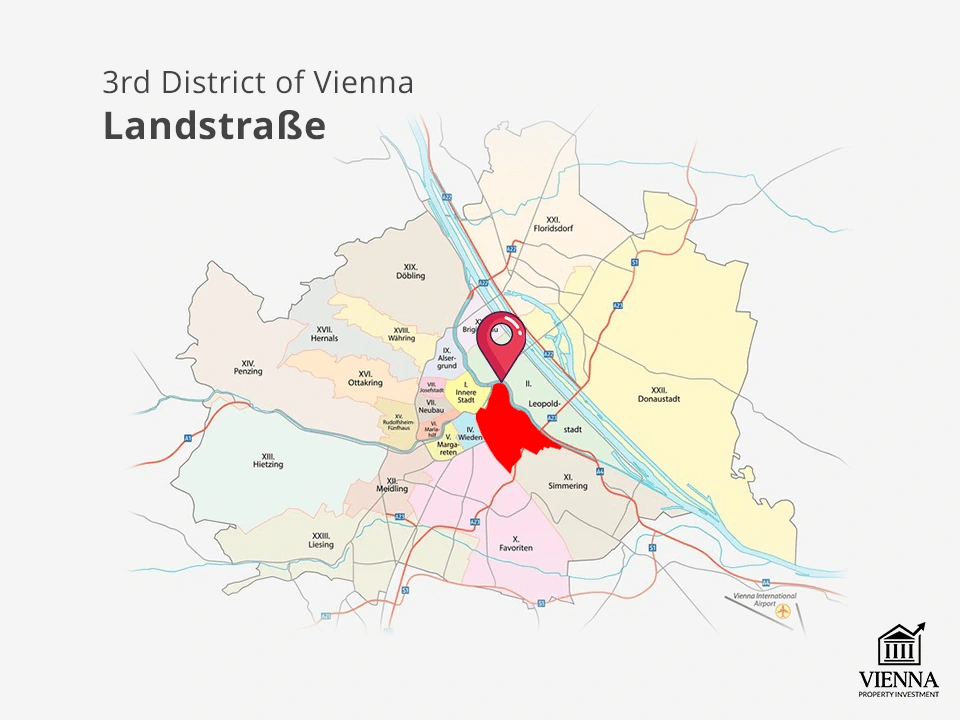
Landstraße is a medium-sized district with an area of 7.42 km², making it one of Vienna's compact yet highly functional and infrastructure-rich districts.
Despite its relatively modest size, it is home to approximately 92,000 people (as of 2025), with an average population density of approximately 12,400 residents per square kilometer. This high density is due to its proximity to the city center, high demand for real estate, and active residential development.
Landstrasse is a district where historical heritage, business activity and modern urban development projects are closely intertwined, making it one of the most dynamic and interesting in terms of urban development.
Location and boundaries of the district
Landstrasse is located in the southeast of Vienna and occupies a strategic location. Its northern border runs along the famous Ringstrasse, separating the district from Innere Stadt —the city's historic center—providing easy access to the capital's key cultural and administrative sites.
To the west, the border is the Danube Canal (Donaukanal) , an important waterway that historically played a role in trade and industry and today forms a picturesque waterfront with parks and pedestrian areas.

To the south, Landstrasse adjoins Hauptbahnhof Wien , the main railway station of the city and Austria as a whole, making the district an important transportation hub not only within Vienna but also for international routes. Its eastern borders run along the Favoriten and Simmering , creating a distinctive transition from the upscale central neighborhoods to more industrial and residential areas.
This location makes Landstrasse more than just a residential area, but a key link between Vienna's city center, industrial zones and suburbs, as well as international transport routes. Thanks to this, both residential and business infrastructure, as well as the tourism sector, are actively developing here.
Structure and key quarters
The internal division of Landstrasse clearly reflects the district's multifunctionality. Each quarter has its own historical origins and modern specialization.

Belvedere is the heart of the district, the symbol of Landstrasse, and one of Vienna's main attractions. It is home to the famous Belvedere Palace and Park complex, a designated Austrian cultural heritage site. This quarter is distinguished not only by its historic buildings but also by its vibrant tourism industry and high real estate prices.

Erdberg is an important transportation hub for the district. It is home to the Vienna International Bus Terminal, the city's main bus station, which provides international bus routes throughout Europe. Erdberg is also known for its business centers and highway access, making it attractive for logistics and business.
St. Marx is an example of the successful redevelopment of former industrial sites. Formerly a district of factories and warehouses, it is now undergoing rapid redevelopment: modern residential complexes, office buildings, and cultural spaces are emerging in the place of the old industrial buildings.

Weißgerberviertel is a prestigious residential neighborhood along the Danube Canal. It boasts historic 19th-century buildings, modern apartments, and designer residential projects. This neighborhood is particularly popular among affluent families and expats thanks to its green embankments, well-developed infrastructure, and proximity to the city center.

Landstraße and Hauptstraße are the district's main commercial artery. Shops, restaurants, cafes, and cultural attractions are concentrated here. Historically, this street was a hub for commerce, and today it remains an important place for business and leisure.
| Quarter | Modern features |
|---|---|
| Belvedere | Tourist center, palace complex, prestigious housing, luxury hotels. |
| Erdberg | Bus station, transport hub, business centers, convenient exit outside the city. |
| St. Marx | Redevelopment of industrial zones, office parks, modern residential complexes. |
| Weißgerberviertel | A prestigious residential area with green embankments, old houses and designer projects. |
| Landstraßer Hauptstraße | The main shopping street with restaurants, shops, cultural and public facilities. |
Zoning and development
Landstrasse can be roughly divided into several functional zones.
The northern part, closest to the historic center, is considered an elite residential and cultural zone. It is home to palaces, diplomatic missions, museums, and historic buildings. This area is characterized by higher housing costs and strict requirements for architectural modifications to preserve the area's historic character.
The southern part of Landstrasse is actively developing as a business and transportation hub. It boasts bus stations, major transportation hubs, and modern office buildings. This area is particularly attractive for investment due to its proximity to the Hauptbahnhof train station and highways.
The eastern Landstrasse neighborhoods are known for their green spaces, including Belvedere Park, Arenbergpark, and small, cozy squares. This part of the district has a more tranquil atmosphere and is actively used by residents for strolls and recreation.
Transport connectivity and infrastructure

One of Landstrasse's key advantages is its excellent transport accessibility. The area is served by two metro lines, the U3 and U4, which connect it to the historic center, the airport, and other key parts of the city. The proximity of railway hubs, including Wien Mitte and Hauptbahnhof, makes the area convenient not only for residents but also for tourists arriving in Vienna by train from other European countries.
Erdberg is home to an international bus terminal serving dozens of routes connecting Vienna with Germany, the Czech Republic, Hungary, Slovakia, and other countries.
In addition to public transport, Landstraße is actively developing bicycle routes and pedestrian areas, which is in line with the city's strategy to reduce car traffic and improve the environmental situation.
Landstrasse thus represents a district with a harmonious combination of historical heritage and modern development, a clearly defined functional structure and important transport significance for the whole of Vienna.
The main street of the district
Landstraße r Hauptstraße is not just the district's central street, but its historical and modern heart, shaping the character of Landstraße. Stretching from Ringstraße to the edge of Erdberg, it connects the district's most important cultural, commercial, and business hubs, serving as the main transportation artery.
Here you can find boutiques of famous Austrian and international brands, cozy designer clothing stores, supermarkets, and local artisan shops. This street traditionally attracts tourists, as it is home to restaurants, cafes, and wine bars offering Austrian, Italian, Japanese, and Middle Eastern cuisine.
Landstraßeand Hauptstraße also play a special role in the district's cultural life. It is home to small theaters, art galleries, and cultural centers that regularly host exhibitions, concerts, and workshops.

One of the street's advantages is its excellent transport integration. It is served by metro lines U3 and U4, as well as several tram and bus routes. Wien Mitte railway hub is within walking distance, serving the CAT (City Airport Train), which connects Vienna's city center with the international airport.
This transport accessibility makes the street convenient not only for residents of the area, but also for tourists and employees of international organizations.
Population and social structure of the area

The Landstrasse district is distinguished by a distinctly multicultural social structure, largely due to its proximity to diplomatic missions and international organizations. According to the latest data, approximately 28% of the district's population is foreign-born. These are primarily expats, employees of international corporations, and diplomats working in embassies and the UNO-City international complex, located just a few metro stops away.
Landstrasse's age structure is balanced, but two prominent groups can be identified. The first are the elderly residents of the older neighborhoods, who make up approximately 20% of the population. The second are young professionals and families who are actively moving to the area due to its convenient location, developed infrastructure, and prestigious schools.
Income levels in Landstraße are above the Vienna average. The highest incomes are found in the Belvedere and Weißgerberviertel neighborhoods, home to a large number of affluent families and employees of international organizations.
At the same time, the district maintains its social diversity. While the northern neighborhoods boast prestigious real estate and a well-developed cultural infrastructure, the southern part of the district, particularly near Erdberg, remains more affordable in terms of housing and rent, making it attractive to students and young professionals.
| Social indicator | Meaning (2025) |
|---|---|
| The share of foreigners | 28% |
| The proportion of pensioners | 20% |
| The predominant group of foreigners | Expats, diplomats, employees of international organizations |
| Income level | Above the Vienna average |
| The most prestigious neighborhoods | Weißgerberviertel, Belvedere |
Safety and quality of life

Landstrasse is considered one of Vienna's safest central districts. Crime rates here are below the city average thanks to well-developed social policies and active police work. The district is among the top five districts in Vienna for urban quality, according to the Mercer Quality of Living 2024 .
The neighborhoods around Belvedere and Weißgerberviertel, which have low levels of street crime, are particularly popular. Livelier areas, such as Erdberg and St. Marx, are characterized by active nighttime traffic but are constantly monitored by municipal police.
| Indicator | Landstrasse (3rd district) | Average level in Vienna |
|---|---|---|
| Street crime rate (on a 10-point scale, with 10 being the highest) | 2,8 | 3,6 |
| The presence of CCTV cameras on the streets | 85% of streets | 75% |
| Number of police stations per 10,000 residents | 1,4 | 1,2 |
| Quality of Life Index (Mercer) | 9,1 / 10 | 8,7 / 10 |
Factors that improve area safety:
- High concentration of diplomatic missions - diplomatic quarters are always under heavy guard.
- Good lighting of streets and park areas.
- Municipal programs for the social integration of migrants.
- Modern digital control systems in Wien Mitte and Gasometer City.
Housing: from historic palaces to modern complexes
Landstrasse is renowned for its diverse residential stock, reflecting the area's rich history and vibrant modern development. Here you'll find both historic 19th-century buildings and cutting-edge residential complexes featuring eco-friendly technologies.

The northern part of the district, near Belvedere and Rennweg, is dominated by historic 19th-century apartment buildings, many of which have been renovated. These buildings attract connoisseurs of classical Viennese architecture and are sought after by diplomats and wealthy families.
The southern neighborhoods, especially St. Marks, are experiencing rapid growth thanks to redevelopment projects in former industrial areas. New residential complexes, integrated with offices, parks, and educational institutions, are emerging in place of old factories and warehouses.

The Erdberg district offers social housing, which accounts for approximately 14% of the total housing stock in Landstraße. These buildings are targeted at local residents with middle incomes, as well as young professionals
According to Vigo Immobilien , property prices in Landstraße vary depending on location and property type – and are a good indication of how the real estate market in Vienna .
- The average price of purchasing an apartment is €6,200-7,800 per m² , but in the luxury projects near Belvedere and on the first line of the Danube Canal, prices reach €12,000 per m².
- Apartment rents range from €16 per m² in standard buildings to €25 per m² in the premium segment.
| Property type | Average purchase price (€ per m²) | Rent (€ per m²) |
|---|---|---|
| Social housing (Erdberg) | 4 800 – 5 500 | 12 – 15 |
| Historic Houses (Weißgerberviertel) | 7 000 – 9 500 | 20 – 25 |
| Modern complexes (St. Marx) | 6 200 – 7 800 | 16 – 22 |
| Elite projects at Belvedere | 10 000 – 12 000 | 23 – 25+ |
Short-term rentals, especially through platforms like Airbnb, are in high demand among tourists. The highest concentration of such offers is found near Wien Mitte, where travelers seeking to be right in the center of the action stay.
Education and schools
Landstrasse's educational infrastructure is considered one of the most developed in Vienna. This is due not only to the high standard of living of local residents but also to the large number of expats who choose to live in the area.

Landstraße houses both public schools and private institutions catering to the children of foreigners and diplomats. One of the most prestigious educational institutions is the Akademisches Gymnasium, Vienna's oldest liberal arts school with an in-depth focus on languages and culture.
-
If you're choosing a school not only in the 3rd district but also comparing options across the city, read more in this article: The Best Schools in Vienna .
The area is also home to several primary schools, including Volksschule Landstraße , and private schools offering English and French instruction are available for expat families.
In addition, Landstraße has a strong presence of music and art schools, reflecting the area's cultural status.

Stadt Wien claims to be placing special emphasis on developing education in technology and innovation. A campus for applied technologies and IT is being established in the St. Marx district, attracting students from across Europe.
The proximity to the city center makes the area particularly convenient for students: the University of Vienna or the Technical University are reachable in no more than 15 minutes by public transport.
| Level of education | Examples of institutions | Language of instruction | Notes |
|---|---|---|---|
| Primary schools | Volksschule Landstraße | German | Focus on bilingual education |
| Secondary schools | Gymnasium Boerhaavegasse, BG Landstraße | German, English | Specialization: natural sciences, art |
| International schools | Lycée Français, Vienna Int. School Prep | French, English | High demand from families of diplomats |
| Colleges/campuses | Neu Marx Campus | German, English | Technical and creative specialties |
According to Wien , the district has over 25 educational institutions, including kindergartens, schools, and colleges. This diversity makes Landstrasse ideal for families seeking a quality education in a multicultural environment.
Infrastructure and transport
Landstrasse is one of Vienna's most important transportation hubs thanks to its strategic location near the city center and major railway lines. The area plays a key role in connecting Vienna's central districts with its southeastern outskirts, as well as connecting the city to the international airport.
The district's central transportation hub is Wien Mitte, a major hub that connects several modes of transportation. It is served by the U3 and U4 metro lines, the S-Bahn, and the City Airport Train (CAT), an express train that connects Vienna's city center with Schwechat International Airport in just 16 minutes. This makes Landstrasse particularly attractive to tourists and employees of international organizations.
lines O and 71 operate actively in the area both having a long history and connecting Landstraße with other key areas of the city. Line 71 is known as the route that passes by the Belvedere and leads to the Central Cemetery (Zentralfriedhof), making it an important destination not only for residents but also for tourists.
The area is also served by numerous bus routes, which complement the public transport network , especially in the evenings.
An important element of Landstrasse's transport infrastructure is its extensive network of bike paths, particularly along the Danube Canal (Donaukanal). This popular walking and cycling route is actively used by both locals and tourists.
The district faces major development projects in the future. These include the reconstruction of the Wien Mitte transport hub, aimed at increasing its capacity and passenger comfort, and the expansion of the U2 metro line, which will improve accessibility to the southeastern parts of the district and reduce the burden on existing lines.
| Infrastructure element | Description and meaning |
|---|---|
| Wien Mitte | Central transport hub, connecting the metro, S-Bahn and CAT |
| U-Bahn (lines U3, U4) | The main metro lines providing connections to the city center |
| Tram lines O, 71 | Key routes important for residents and tourists |
| City Airport Train (CAT) | Express to Schwechat Airport, travel time: 16 minutes |
| Bicycle paths | They are actively developing, the main area is along the Danube Canal |
Parking and parking policy

Landstrasse is fully covered by the Parkpickerl system, which operates throughout Vienna. This system of paid parking zones aims to reduce the amount of street parking and encourage the use of public transportation. Residents of the area can purchase a long-term parking pass within a specific block, while visitors pay hourly through parking meters or mobile apps.
In recent years, the city has been actively developing underground parking, particularly near business centers and modern residential complexes in the St. Marx and Erdberg districts. This frees up street space and allows it to be used for green areas and public spaces.
An important aspect of Vienna's transportation policy is the transformation of open parking spaces into parks and pedestrian areas. In Landstraße, this process is particularly noticeable near the Belvedere and in the central part of the district, where new promenades and squares are being created.
Modern digital technologies are being actively implemented into the parking system. Mobile apps are available that allow you to track available spaces, pay for parking online, and receive information on rates.
| Element of the parking system | Description |
|---|---|
| Parkpickerl | Paid parking zone with resident passes and hourly rates |
| Underground parking | The main areas are at St. Marx, Erdberg and Wien Mitte |
| Parking lot transformation | Converting open parking spaces into parks and pedestrian areas |
| Digital services | Mobile applications for payment and monitoring of parking spaces |
Religion and religious centers
Religious life in Landstrasse is characterized by diversity and interfaith dialogue, which is due to the multinational composition of the area's population.
Catholicism remains the dominant religion and several significant churches are located here. The area's main spiritual center is the Rochus Church (Rochuskirche), built in the 17th century. This church is not only an architectural landmark but also an important cultural center, hosting organ concerts and charity events.

Another important Catholic church is St. Nicholas Church, located near Rennweg. It is known for its rich history and active parish life.
Thanks to the multicultural population, Islamic centers and mosques are actively developing in Landstraße, primarily in the Erdberg quarter, home to a significant Muslim community. These centers serve not only a religious but also an educational function, offering classes for children and cultural events for all residents of the area.

The district's Jewish community is represented by a small but active group of believers. The prestigious Weißgerberviertel houses a synagogue, which is an important center of spiritual life for this segment of the population.
Landstraße is home to various non-profit organizations (NPOs) that promote interreligious dialogue and conduct joint events aimed at strengthening social harmony in the area.
| Confession | Main centers | Role in the life of the district |
|---|---|---|
| Catholicism | Rochuskirche, Church of St. Nicholas | The main religion, the center of cultural events |
| Islam | Mosques and Islamic cultural centers in Erdberg | Educational and cultural projects |
| Judaism | Synagogue in Weißgerberviertel | Spiritual life of the Jewish community |
Culture, Leisure and Events
Landstrasse is a district that harmoniously blends rich historical heritage and contemporary cultural life. This area is considered one of Vienna's cultural centers thanks to its unique architectural landmarks, museums, and vibrant events program, attracting both tourists and locals.
main cultural attraction Belvedere Palace and Park complex . Not only is it an architectural masterpiece in the Baroque style, commissioned by Prince Eugene of Savoy, but it is also a world-class museum housing a rich collection of works of art, including Gustav Klimt's famous painting "The Kiss." Over a million tourists visit the Belvedere annually, making it one of the most popular museums in Austria.

Another symbol of the area's cultural transformation is Gasometer City , a unique complex built on the site of former gas holders. Today, it is not only an architectural landmark but also a multifunctional cultural and entertainment center, including concert venues, cinemas, shopping arcades, and restaurants.
The Gasometer is actively used for large-scale music concerts and exhibitions, as well as gastronomic festivals, which attract guests from all over Vienna and the surrounding area.

The district's contemporary theatrical scene is represented by the Akzent Theater, renowned for its diverse repertoire—from classical productions to avant-garde productions. Another important cultural venue is the Art Center Vienna, which hosts exhibitions of contemporary artists, art installations, and workshops.
Throughout the year, Landstrasse becomes the site of numerous events. Belvedere Park hosts music and street art festivals, creating a festive atmosphere and bringing together locals and tourists.

In winter, the district becomes the center of the Christmas festivities, with the Rochusmarkt hosting a Christmas market featuring traditional treats, handicrafts, and a cultural program. In the spring and summer, the gastronomic festivals at Gasometer City are popular, introducing visitors to the cuisines of various countries.
| Cultural site/event | Description | Significance for the area |
|---|---|---|
| Gazebo | A world-class palace and museum, home to the Klimt collection | The main tourist attraction |
| Gasometer City | Concert halls, shops, festivals | A symbol of modern cultural life |
| Akzent Theatre | Theatrical performances and festivals | Performing Arts Center |
| Festivals at Belvedere | Music, street art | Attract tourists and local residents |
| Christmas market at Rochusmarkt | Winter holidays and gastronomy | The key event of the winter season |
Historical heritage and architecture
Landstrasse is a district steeped in history, where ancient palaces and modern buildings harmoniously blend. Its architectural appearance has evolved over several centuries, from the Baroque era to the post-industrial projects of the 21st century.
The district's main architectural symbol is the Belvedere Palace, built in the early 18th century in the Baroque style as the residence of Prince Eugene of Savoy. Besides the Belvedere, the district is famous for its numerous historic Biedermeier and Jugendstil mansions located along Landstraßeand Hauptstraße and in the Weißgerberviertel neighborhoods.
Notable objects:
- Gasometer City is an example of innovative reconstruction of former industrial buildings.
- Rochuskirche is a Baroque church, the historical center of the spiritual life of the area.
- Hundertwasserhaus (on the border with the Löppoldstadt district) is the famous building by Friedensreich Hundertwasser.
- Palais Schwarzenberg is an ancient aristocratic residence.
Parks and green spaces
Landstrasse stands out among Vienna's central districts for its abundance of green spaces and parks, making it particularly attractive for family living and strolling. The district actively participates in the STEP 2025 program, which aims to create a sustainable and environmentally friendly urban environment, which is particularly important for Vienna's central districts.

The heart of the district is Belvedere Park, connecting the Upper and Lower Belvedere. This park is not only a historical monument but also a popular place for recreation, strolls, and cultural events. Its well-maintained paths, fountains, and sculptures create an atmosphere of palatial grandeur and harmony.

Another important green space is Arenbergpark. This modern park combines recreation areas, playgrounds, and art installations. Arenbergpark is known for its open-air cultural projects, regularly hosting exhibitions, installations, and city festivals.
The Gasometer park is undergoing active renovation, based on sustainable design principles. This includes the use of natural materials, the installation of rainwater collection systems, and age-appropriate zoning.
| Park / green area | Peculiarities | Significance for residents |
|---|---|---|
| Belvedere Park | Historical ensemble, cultural events | The main place for walking and tourism |
| Arenbergpark | Art objects, children's areas, cultural projects | Family Leisure Center |
| Park near Gasometer | Contemporary design, ecosystem approach | New recreation and sports area |
These projects are part of the city's overall strategy to increase green space and reduce traffic. The district is actively participating in the initiative to create "green corridors" connecting parks and providing a comfortable environment for pedestrians and cyclists.
Economy and business
Landstrasse is one of Vienna's key economic districts, playing a significant role in both the city and international economies. Its strategic location near the city center, transportation hubs, and cultural attractions makes it attractive to companies, investors, and tourists.
The area is home to offices of international companies and numerous diplomatic missions. This creates high demand for high-quality office space and prestigious residential properties. The St. Marx neighborhood is experiencing rapid growth in the tech and creative sectors, with startups, coworking spaces, and modern business centers opening here.
Small businesses also play a vital role in the district's economy. Cafés, craft workshops, small shops, and design studios create a vibrant and diverse economic environment. These businesses are particularly active along Landstraße and Hauptstraße, which serves as an important commercial and social hub for the district.
Gasometer City, a cultural, commercial, and business center, deserves special attention. It houses shops, restaurants, concert venues, and offices, making it a significant driver of economic activity.
Tourism remains a key economic sector in Landstrasse. The Belvedere and associated cultural events attract hundreds of thousands of tourists annually, generating tens of millions of euros for the local budget. The high tourist flow also supports the development of the hotel and short-term rental sectors.
| Economic sector | Examples and objects | Meaning |
|---|---|---|
| International companies | Offices and diplomatic missions | Attracting specialists and investors |
| Small business | Cafes, workshops, retail outlets | Local economy and jobs |
| Creative industry | Startups and coworking spaces at St. Marx | Innovation and development of the IT sector |
| Tourism | Belvedere, Gasometer City, cultural festivals | Key source of income |
Modern projects and investments
Landstrasse is undergoing an intense transformation: large-scale redevelopment projects, technology clusters, and green residential projects are gradually changing the appearance of the area, transforming it from a transit and tourist zone into a modern, multifunctional urban space.
The central idea of urban investment here is to combine economic activity (offices, start-ups, retail) with a high-quality urban environment (parks, public spaces, eco-friendly buildings).
Neu Marx (Neu Marx Campus)
One of the most prominent and critically acclaimed projects is Neu Marx (Neu Marx Campus), a complex in the St. Marx district conceived as a hub for media, IT, life science, and creative companies. The project began as an initiative of Wien Holding and is gradually being filled with offices, educational, and creative spaces. Neu Marx is being marketed as a miniature "city of the future," where offices coexist with residential areas and event infrastructure.
Today, Neu Marx is home to several dozen companies and institutions, and the area remains key to the development of the IT/creative cluster in the third district.
Wien Mitte

Another important area is the reconstruction and rebranding Wien Mitte. The center Wien Mitte has long been a transportation and commercial hub (retail space, offices, and a cinema). In recent years, projects have been underway to improve the quality of public space, renovate commercial spaces, and enhance transportation integration; ownership changes and transactions at the site confirm the commercial interest of investors.
At the same time, the historical sensitivity of the project (its proximity to the historical core) was repeatedly discussed with UNESCO and city authorities, so the reconstruction is taking into account urban planning restrictions.
Gasometer City
Gasometer City is an example of the successful adaptation of industrial heritage: four brick gas holders from the late 19th century have been reconstructed into a multifunctional urban cluster with housing, retail, offices, and concert venues.
This project has become a model for preserving the historic façade while simultaneously creating a modern, flexible space for living, working, and playing. Gasometer continues to serve as a hub for cultural and commercial events, while additional green and residential initiatives are being implemented nearby.
St. Marx and Erdberg
At the same time, new residential complexes are being built in the St. Marx and Erdberg districts, many of which integrate eco-friendly technologies: green roofs, rainwater recovery systems, energy-efficient solutions, and electric vehicle charging stations.
Such projects are consistent with the city's sustainable development strategy and local subsidies for the transition to climate-neutral technologies. At the same time, the city maintains a balance between affordable housing (social housing) and premium projects to preserve the neighborhood's social fabric.
Key contemporary projects in Landstraße
| Project / zone | The essence of the project | Status / effect |
|---|---|---|
| Neu Marx (St. Marx) | Cluster for IT, media, life sciences; offices + events | Development of a creative cluster, jobs. |
| Wien Mitte (reconstruction) | Upgrading the transport and commercial hub and improving public spaces | Redevelopment, investor deals; attention of UNESCO. |
| Gasometer City | Gasometer redevelopment: housing, shops, concert halls | A successful example of adapting industrial heritage. |
| Residential Complex St. Marx / Erdberg | New housing with green technologies | Increased supply, environmental standards. |
Why this is important for the district: Modernization creates new jobs (IT, creative industries, services), improves public space, and increases real estate marketability. At the same time, the close integration of housing and workplaces keeps local economic flows within the district, reducing the "leakage" of economic activity to other parts of the city.
Investment attractiveness of the Landstrasse district
Landstrasse is one of Vienna's most dynamically developing districts, where historical heritage seamlessly blends with contemporary architectural and economic developments. This unique combination makes the area particularly attractive to private investors, institutional funds, and developers.
There is a strong demand for high-quality residential and commercial space, driven by both the area's geographic location and its socio-economic characteristics.
Landstrasse's proximity to Innere Stadt district (just 1-2 km from Ringstrasse) and key transportation hubs such as Wien Mitte and Hauptbahnhof Wien creates a strategic advantage for investors. The area is an important transit hub for residents, tourists, and employees of international organizations.
This has resulted in consistently high demand for both residential rentals and office and commercial space. According to UBM Development , modern projects near Wien Mitte offer higher yields than properties on the city's outskirts, due to the concentration of business activity and cultural attractions.
Strengths of the area
Landstrasse boasts a number of factors that shape its long-term investment appeal. These advantages ensure stable demand and rising property values, even during market fluctuations.
1. Location and strategic proximity to the city center
The area is literally within walking distance of Vienna's historic center. Its proximity to key tourist and business districts allows residents to enjoy all the benefits of the city center while maintaining a quieter residential atmosphere. Ringstraße is approximately 1–2 km away, and the Vienna International Centre is 15–20 minutes by public transport.
Examples of prestigious areas in Landstraße include Weißgerberviertel, the neighborhoods around Belvedere, and Landstraßeand Hauptstraße. These locations are particularly popular among expats and high-income families.
2. Developed transport system

Transportation is a key driver of real estate liquidity. Landstrasse has one of the best transport links in Vienna:
- Metro (U-Bahn) – lines U3 and U4, connecting the area with the city centre and the airport.
- S-Bahn – a suburban train network running through Wien Mitte.
- City Airport Train (CAT) – direct connection to Schwechat Airport in 16 minutes.
- Trams and buses – dozens of routes, including lines O and 71, which connect the area with other parts of the city.
- The international bus terminal Erdberg is an important hub for tourists and business travellers.
This transport integration makes the area attractive to employees of international companies and tourists, ensuring high rental demand.
3. Stable demand for rentals
According to Statista, approximately 28% of the district's population are foreign nationals, including a significant number of diplomats, employees of international organizations, and business and IT professionals. Tourism also plays a significant role: over a million tourists visit Belvedere Palace annually, generating a steady flow of short-term rentals (Airbnb, Booking, etc.).
As a result, demand for housing remains stable throughout the year, especially in the premium segment.
4. Infrastructure drivers of development
Landstrasse is actively developing thanks to large-scale redevelopment projects:
- Neu Mar is an innovative quarter for IT and creative industries.
- Wien Mitte Reconstruction is a renewal of a key transport and commercial hub.
- Gasometer City is an example of the successful adaptation of historical industrial sites.
- New eco-friendly residential complexes in St. Marx and Erdberg.
These projects not only improve the quality of life, but also increase the value of surrounding properties.
Risks and limitations
Despite the strengths, investors should consider a number of factors that can impact returns.
Market cyclicality. The Austrian real estate market is set to slow in 2023-2024 due to rising interest rates and macroeconomic instability. According to EHL Immobilien reports, the number of investment transactions has declined by 25-30% compared to 2022. This means developers and investors must carefully select projects to minimize risks and maintain profitability.
Regulatory restrictions. Projects near the historic center are subject to strict oversight by the municipality and UNESCO. This applies to both building heights and architectural design, which can increase approval times and impact construction costs.
Profitability and forecasts. Investments in Landstraße are stable, especially in the premium segment and long-term rentals.
| Indicator | Value / Range |
|---|---|
| Gross yield | 4.0-4.2% (2024–Q1 2025) |
| Net yield | 2.5-3.5% after expenses |
| Price growth forecast | 5-7% per year in redeveloped neighborhoods |
| Current level of housing prices | 6,200-7,800 €/m², premium – up to 12,000 €/m² |
Experts predict a gradual market recovery in the next two to three years due to a potential decline in interest rates and increased demand. The areas around Wien Mitte and St. Marx are particularly promising, with prices expected to rise thanks to active infrastructure projects.
Tourism and hotel infrastructure

Landstrasse is one of Vienna's key tourist districts, second in popularity only to the historic center itself (Innere Stadt). Its main attraction is the Belvedere Palace, which attracts over 1.2 million visitors annually, making it the city's second-most visited museum after the Kunsthistorisches Museum.
The area is also popular for its location – its proximity to Wien Mitte train station, the international bus terminal at Erdberg, and the direct City Airport Train (CAT) make it a convenient base for both short-term and business travellers.
Landstrasse's distinctive feature is its diverse range of accommodation options. It boasts both international chain hotels and boutique hotels in historic buildings near the Weißgerberviertel and Belvedere. The area is also actively developing in the aparthotel and short-term rental (Airbnb) segments, driven by high demand from tourists and business travelers.
| Accommodation category | Examples | Average price per night (2025) | Peculiarities |
|---|---|---|---|
| 5★ | InterContinental Vienna (near Stadtpark), Grand Ferdinand | 280-450 € | View of Ringstraße, business services |
| 4★ | Austria Trend Hotel, NH Wien Belvedere | 180-250 € | Balance of comfort and price |
| Boutique hotels | Hotel Spiess & Spiess, Ruby Hotels | 150-220 € | Designer interiors, historical buildings |
| Aparthotels / Airbnb | Near Wien Mitte and Belvedere | 90-160 € | Popular with families and business travelers |
According to Vienna.info, over 2.8 million tourists visited Landstrasse in 2024, with an average hotel occupancy rate of 74%, higher than the city average. The main tourist flows come from Germany, the United States, Italy, and China.
Gastronomy and culinary culture of the region
Landstraße is renowned for its gastronomic scene, which combines classic Viennese cuisine with modern international trends. The district is divided into several culinary zones. Near the Belvedere and Weißgerberviertel are fine dining restaurants, many of which are Michelin-starred, while around Landstraßeand Hauptstraße are casual cafes, bakeries, and wine bars.
Markets and gastronomic festivals occupy a special place. Rochusmarkt regularly hosts farmers' markets, and Gasometer City hosts an annual gastronomic festival featuring renowned chefs and master classes on Austrian and international cuisine.
| Type of establishment | Examples | Average bill per person | Key Features |
|---|---|---|---|
| Fine dining restaurants | Steirereck im Belvedere, Lingenhel | 80-150 € | Viennese and European cuisine, wine lists |
| Cafes and coffee shops | Café Rochus, Joseph Brot | 15-25 € | Viennese desserts, breakfasts |
| Markets and street food | Rochusmarkt, St. Marx Food Hall | 10-20 € | Local farm produce, street food |
| Wine bars and pubs | Vinothek Belvedere, Rochusbar | 20-35 € | Austrian and international wines |
The district's thriving culinary scene makes it attractive not only to tourists but also to local residents, and it also generates a significant share of small businesses. According to Wirtschaftskammer Wien, over 450 small and medium-sized businesses operate in the district's gastronomy sector.
Environmental policy and sustainable development
Landstrasse actively participates in the city's STEP 2025 programs, which aim to promote sustainable development and improve the quality of the urban environment. The district is gradually transforming into one of the most environmentally friendly areas in Vienna, thanks to projects that include modernizing the transportation network, creating new green spaces, and developing eco-friendly residential complexes.
A key project is the Neu Marx Campus, where smart city concepts are being implemented: solar panels, rainwater collection systems, green roofs, and a car-free campus.
The southern part of the district, particularly around St. Marx and Erdberg, is also undergoing significant changes, with old industrial areas being converted into residential and public spaces.
| Project | Target | Contribution to sustainable development |
|---|---|---|
| Neu Marx Campus | Innovation Center for IT and Creative Industries | Minimizing CO₂ emissions and developing environmentally friendly technologies |
| Reconstruction of Wien Mitte | Improving transport integration | Reducing the traffic load in the area |
| Gasometer Park Renewal | Creating a park near Gasometer City | New green areas for residents |
| STEP 2025 | Vienna's Sustainability Strategy | Global improvement in urban quality |
Cycling and active recreation areas are being developed along the Danube Canal. The district aims to increase green space by 15% by 2030, in line with EU "green city" standards.
| Environmental initiative | Implementation status | Influence |
|---|---|---|
| Green roofs on new buildings at St. Marx | 80% new projects | Improving air quality, reducing heat islands |
| Expansion of the bicycle path network | In progress (2025) | Reduction in car use |
| Underground parking and elimination of open parking | 60% of projects completed | Creation of parks and squares on the site of parking lots |
| Waste separation program | Fully implemented | Increasing the recycling rate to 65% |
International status and diplomatic role

Landstrasse is known as a diplomatic district. Dozens of embassies and consulates are located here, including those of Russia, the United States, Switzerland, and France. The presence of diplomatic missions enhances the district's prestige and creates a steady demand for rental housing among international professionals.
Furthermore, the proximity to UNO-City (Vienna International Centre), home to the offices of the UN and other international organizations, makes the area convenient for staff of these organizations. About 18% of the district's residents are affiliated with diplomatic or international organizations.
| Type of institution | Examples | Impact on the area |
|---|---|---|
| Embassies | France, USA, Russia, Switzerland | Increases prestige and demand for housing |
| Consulates | Italy, Spain, China | Development of services and small businesses |
| International NGOs | Amnesty International, Red Cross | Cultural and social integration |
The district also actively participates in international events, including diplomatic receptions and cultural festivals, strengthening its status as one of the key hubs of global Vienna.
Forecast for the development of the region until 2030
According to analytical reports from EHL Immobilien and Statista, Landstraße maintains its status as a district with high growth potential, particularly in the context of urban redevelopment and sustainable development. Significant housing price increases are expected over the next five years, particularly in the St. Marx and Erdberg areas, where new residential complexes and commercial centers are being actively built.
Growth factors include:
- Continuation of redevelopment projects – completion of Neu Marx and reconstruction Wien Mitte.
- Growth in tourist flow – projected increase of 8–10% annually.
- Lower interest rates in the eurozone are stimulating the property market.
- Active development of the transport network, including the expansion of the U2 metro line.
| Indicator | 2025 | 2027 | 2030 (forecast) |
|---|---|---|---|
| Average housing price, €/m² | 7 000 | 7 600 | 8 500-9 200 |
| Tourist flow, million people/year | 2,8 | 3,1 | 3,7 |
| Share of green areas, % | 18 | 20 | 23 |
| Average rental yield, % | 4,0 | 4,3 | 4,5-4,7 |
By 2030, Landstrasse could become one of Vienna's first districts fully compliant with "smart city" principles, with a high degree of digitalization and minimal air pollution. This opens up opportunities not only for developers but also for investors in innovative and ESG-focused projects.
The City of Vienna views Landstrasse as a key area for integrated development over the next 10 years. The strategy's key focus is on integrating new residential spaces, developing transportation hubs, and fostering an innovative economy.
Priority projects:
- Neu Marx 2030 – the creation of an innovative quarter with an IT cluster, studios for startups, and campuses for students.
- Metro expansion – integration of the U2 line and renovation of Wien Mitte and Rennweg stations to increase passenger flow.
- Gasometer City's systemic renovation includes expansion of cultural venues and creation of coworking spaces.
- Digital Landstraße is a program for the implementation of smart technologies: smart traffic lights, parking management via mobile apps.
- Green Landstraße – increasing the share of green areas per capita from 12 m² to 16 m².
| Direction | Key goals for 2035 |
|---|---|
| Transport | New metro lines, 25% reduction in vehicle traffic |
| Housing | 5,000 new energy-efficient apartments |
| Ecology | Increase in green spaces by 33% |
| Economy | Attracting 150+ startups to Neu Marx |
| Tourism | A 20% increase in tourist flow due to new cultural events |
Conclusion for investors
Landstrasse is a district that combines a prestigious location, cultural heritage, and modern urban design. Its investment appeal is based on three key pillars:
- Steady demand from expats and tourists.
- Infrastructure projects that increase the value of the territory.
- Projected price increases in the long term.
The area is suitable for investment in both premium rental apartments and commercial properties in high-traffic areas. However, it's important to consider market cycles and carefully analyze projects before purchasing, especially near the historic center, where additional regulatory restrictions may apply.
Conclusion – who is Landstrasse suitable for?
Landstrasse is a district with a distinct balance of history and modernity. Its strengths include its proximity to the city center, robust transportation infrastructure, and the presence of cultural attractions (such as the Belvedere), as well as active redevelopment projects that improve the quality of the urban environment and stimulate demand for housing and office space.
Who is this area particularly suitable for:
- For families who value proximity to parks (Belvedere), good schools and well-developed infrastructure for everyday life.
- International specialists and diplomats who value transportation accessibility, the prestige of the neighborhood, and the availability of international services.
- Investors focused on long-term returns and capitalization—especially in the high-quality renovation and new energy-efficient complexes segment.
Today, Landstraße is an example of how classic urban fabric can be combined with innovation: from Neue Marx and the reconstruction Wien Mitte to examples of the adaptation of historical buildings such as the Gasometer.
The area remains attractive for both living and business, but a sound investment strategy must take into account current macroeconomic risks (rates, construction costs) and rely on high-quality due diligence on specific projects.