Donaustadt Donaustadt Vienna's 22nd district, located east of the capital across the Danube. It is the city's largest district in terms of area, occupying approximately a quarter of Vienna's total area. On a map, it appears as a world unto itself: on one side is the wide arc of the Danube and its branches, on the other is the border with the federal state of Lower Austria. This location makes the district a kind of "Vienna's gateway to the east ." It is easily accessible by U-Bahn (lines U1 and U2), numerous bus and tram routes, and modern highways that connect the district with the city center and neighboring regions.
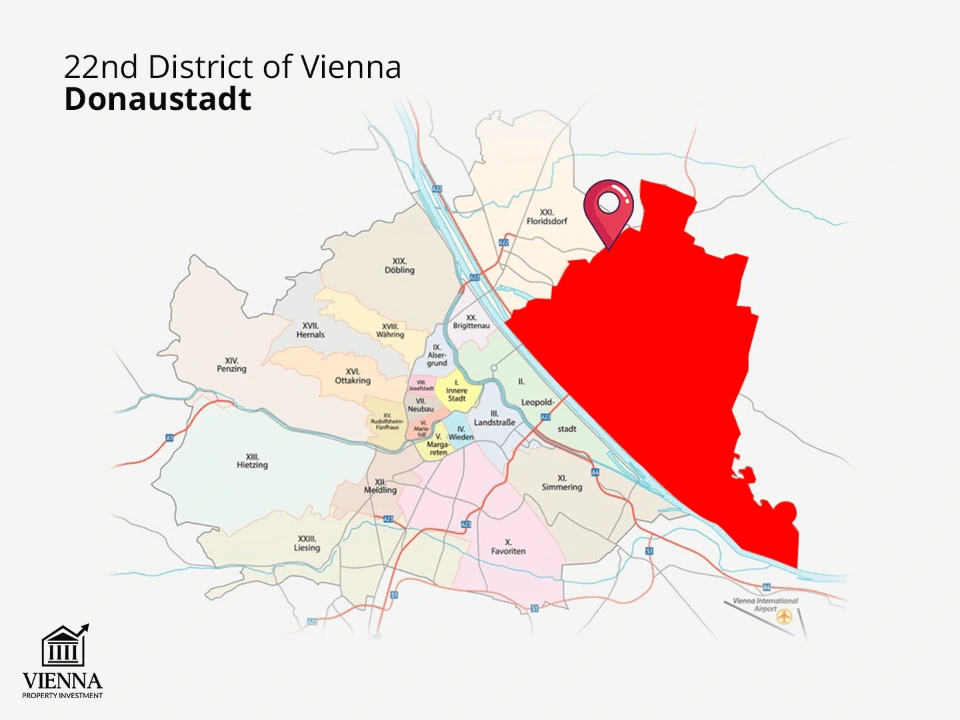
Donaustadt is noticeably different from the city's historic districts. It lacks the dense 19th-century buildings associated with Vienna, but offers spaciousness, modern residential complexes, and entire neighborhoods of private homes. The district has been actively developing since the mid-20th century and has become the site of large-scale urban projects.
A striking example is Donau-City, with its skyscrapers and offices of international corporations, as well as the Vienna International Centre, home to UN agencies. At the same time, the district maintains a balance: alongside modern business districts, it boasts natural areas, the city's largest lake, the New Danube (Neue Donau), beaches, and green parks.

Another distinctive feature of the area is its diversity. Here you'll find both quiet low-rise communities and dynamic urban areas with high-rise buildings. The majority of the population are families and young professionals who value the combination of affordable housing, developed infrastructure, and proximity to nature.
-
Interestingly, Donaustadt occupies almost a quarter of Vienna's total area, yet only accounts for about 10% of the city's population . This imbalance is explained by the district's unique structure: half of its area is occupied by green spaces, bodies of water, and farmland. This is why it is often called a "city of contrasts" – where village houses can be found next to UN skyscrapers, while national parks and the beaches of the New Danube begin just minutes from the business center .
In this article, we'll help you understand the current state of Vienna's 22nd district, its strengths and weaknesses, and who might find it suitable for living or investing. We'll examine the social structure, housing market, education, and transportation, touching on cultural life and natural spaces. We'll also pay special attention to contemporary projects and investment appeal. This overview will allow you to objectively assess Donaustadt: it's not just a residential area, but a dynamic part of Vienna that combines a European capital, international business, and a unique natural environment.
| Area of the district | 102.3 km² | The largest district of Vienna, it occupies almost a quarter of the city's territory |
| Population | ≈ 205,000 people | One of the fastest growing in terms of numbers |
| Proportion of green and water areas | ≈ 45% of the territory | Includes Lobau, Donauinsel and New Danube |
| Average age of residents | 38 years old | Young compared to the central areas |
| The share of foreigners | ≈ 30 % | One of the most multicultural areas of the capital |
| Average rental rate | 14–16 €/m² | Lower than in the center, but with an upward trend |
| Number of metro stations | 11 stations (U1, U2) | Excellent transport integration |
| Average time to the center | 15–20 minutes | The metro connects directly to historic Vienna |
These indicators give a general picture, but when choosing a specific property, it is more important to compare apartments in Vienna by micro-location (metro/schools/parks), building type, and actual maintenance costs.
History of Vienna's 22nd District
The area of today's Donaustadt remained sparsely populated for a long time. This was due to the Danube, which until the 19th century was a full-flowing and unpredictable river with numerous branches, islands, and marshy floodplains. This area was ill-suited for agriculture and permanent settlement. However, archaeological finds confirm that people had settled here as early as prehistoric times.
Early settlements and the medieval period
The first permanent settlements were formed in the early Middle Ages on elevated areas where the soil was less susceptible to flooding.
From the 12th century, small villages began to develop along the Danube, which would later become part of the region. These were primarily agricultural settlements, whose inhabitants engaged in farming, viticulture, and fishing. Natural conditions dictated their way of life: the river frequently flooded in spring and summer, so houses were built on higher ground, and fields had to be cultivated with the potential for flooding in mind.
New times and the first changes
In the 17th and 18th centuries, the area of today's Donaustadt remained a rural outskirts of Vienna. However, its strategic location across the river made it a battleground. During the Turkish Wars, troops passed through the area, and the surrounding area often suffered from destruction and fires. Despite this, villages were rebuilt, and the fertile soil attracted new settlers.
The situation began to change in the 19th century, as Vienna grew rapidly and the Danube became increasingly problematic. The river frequently overflowed its banks, causing catastrophic floods. After the devastating flood of 1830, it became clear that large-scale regulation of the riverbed was necessary.
Danube Regulation and New Prospects

Between 1870 and 1875, a major project was completed: the Danube Regulation Project. This resulted in the creation of a major shipping channel and protective dams, protecting Vienna from devastating floods. These works radically changed the region's fortunes: marshy lands were transformed into suitable land for development and agriculture. It was then that the villages on the eastern bank gained new development prospects.
In the late 19th and early 20th centuries, these territories began to be gradually integrated into the city's overall system. Roads were built, the first industrial enterprises opened, and infrastructure developed.
20th Century: The Path to Vienna's District
In 1904, some of the eastern settlements were officially annexed to Vienna, but the unified 22nd district was formed later. Until the mid-20th century, the area remained predominantly rural, with isolated industrial zones and workers' settlements.
A decisive event was the administrative reform of 1954, when Donaustadt was established as an independent district of Vienna. It included the historic villages of Aspern, Kagran, Essling, Hirschstenetten, Breitensee, and others. This move allowed for more targeted infrastructure development and management of the rapidly growing area.
Second half of the 20th century: urbanization
Active urbanization began in the 1960s and 1970s. The area became a major construction site, with modern residential complexes, new schools, and roads springing up. The "New Danube" (Neue Donau) project, implemented in the 1970s and 1990s, was particularly significant. In addition to flood protection, it created a recreational area with beaches and green embankments, which today is one of the city's main recreational areas.
Another turning point was the construction of the Vienna International Center (UNO-City), opened in 1979. This not only cemented Donaustadt's status as an international district but also marked the beginning of the development of the Donau-City business district, recognizable today by the silhouette of its modern skyscrapers.
21st Century: The Neighborhood of the Future

In recent decades, Donaustadt has become synonymous with modern urbanism. The district is actively involved in major Viennese projects, from sustainable transportation solutions to innovative residential quarters. One example is Seestadt Aspern, one of Europe's largest urban development projects, being built on the site of the former Aspern airfield. Residential and office buildings, educational institutions, cultural centers, and recreational areas around an artificial lake are being constructed here.
Ultimately, the district's history demonstrates a unique transformation: from sparsely populated villages on marshy lands to one of the most dynamically developing districts of a European capital. Today, Donaustadt is perceived as a space for the future, where international organizations, modern residential areas, and natural areas coexist. This balance makes the district a symbol of the new Vienna – open, sustainable, and focused on long-term development.
Geography, zoning and structure of the Donaustadt district
Donaustadt covers an area of over 100 square kilometers, making it Vienna's largest district by area. Situated on the eastern bank of the Danube, the district includes densely populated residential areas as well as extensive green spaces, agricultural land, and bodies of water.
On the north side, Donaustadt borders on the 21st district – Floridsdorf , and together they form the “northeastern belt” of Vienna beyond the Danube – with a similar logic of suburban quarters and good transport connections.
The central natural feature is the Danube River, which divides Vienna into western and eastern parts. It contains both natural floodplains and artificial channels created through river regulation.

The area's predominantly flat topography explains its appeal for large-scale development and urban planning experiments. At the same time, the presence of extensive water and natural areas creates a unique balance between the urban environment and the landscape.
Administrative structure and quarters
Donaustadt consists of several historically developed neighborhoods, which were independent villages until the mid-20th century. Today, they form a unique mosaic structure, preserving rural features alongside modern urban developments.
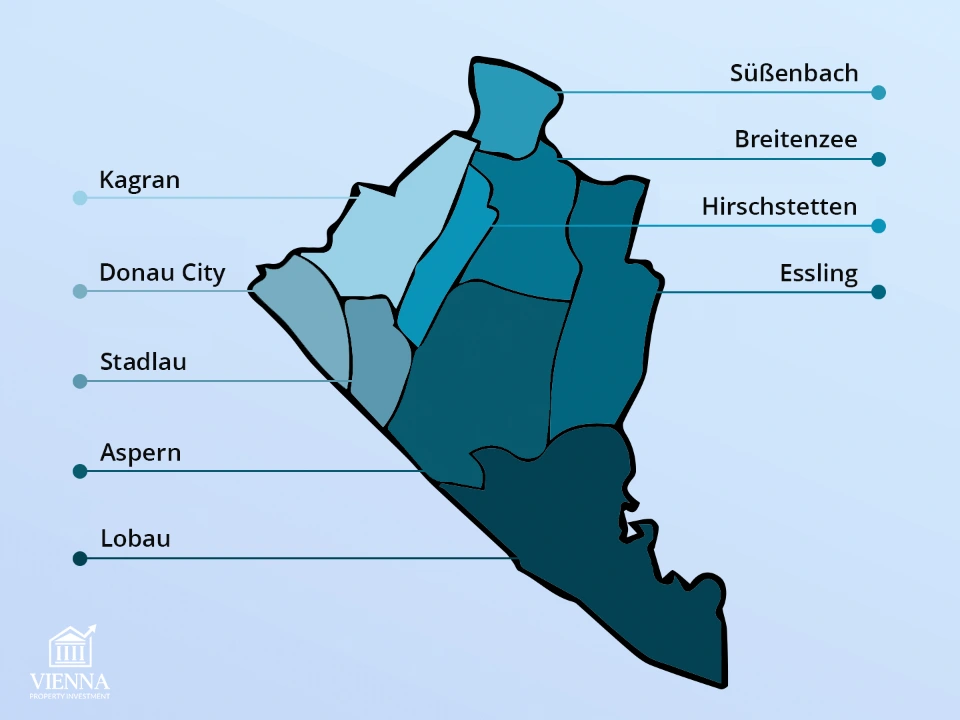
Main neighborhoods:
- Kagran is the center of the district, home to key administrative institutions, U1 metro stations, large shopping centers, and business activity.
- Aspern is the eastern part, known as the site of a former military airfield. Today, the Seestadt Aspern megaproject is being developed here, transforming the area into a "city of the future."
- Essling is a historic village with quiet low-rise buildings that has preserved its rural character and relaxed pace of life.
- Hirschstetten is a neighborhood that combines private homes and low-rise complexes. It is also home to renowned botanical gardens.
- Lobau is a large natural area and part of the Danube-Auen National Park, where development is strictly restricted.
- Donau City is an ultra-modern skyscraper and office district that forms the district's distinctive silhouette.
- Breitensee and Süsenbach are small areas that have retained their village layout and relaxed pace, making them popular with families.
Each neighborhood has its own character: from quiet suburban streets to business centers with international significance.
Functional zoning
The geographical structure of Donaustadt is based on a combination of several types of zones:
Residential areas occupy the majority of the district. Here you'll find both multi-story complexes (Kagran, Siebenhirten) and entire neighborhoods of private homes (Aspern, Essling). The layout emphasizes open spaces and greenery: courtyards, parks, and pedestrian areas.
Business and administrative areas are concentrated in the Donau-City and around the Vienna International Centre (UNO-City). This is the center of international business and diplomacy, home to corporate headquarters and UN offices.
Recreational areas include the New Danube (Neue Donau), the Donauinsel Island, and the Kaiserwasser Lake. These areas are designed for relaxation and sports, and in the summer, the entire city flocks here.
Natural areas include Lobau National Park and the surrounding floodplain forests. This is the largest natural area within the city limits, and it is subject to strict protection.
Industrial and logistics zones are located on the outskirts, close to transportation hubs and the border with Lower Austria. They play an important role in the region's economy without disrupting the residential environment.
Transport structure
The district's zoning is closely linked to its transportation network. Donaustadt is actively integrated into the city system thanks to the U1 and U2 metro lines, which connect it to Vienna's city center. Trams, buses, and regional rail lines complete the picture.
Major highways (A23, A22) cross the district, providing connections to other parts of the city and access to federal highways. Bike paths and pedestrian routes run along the Danube, connecting the neighborhoods with recreational areas.
Spatial balance
Unlike many European districts where dense development crowds out natural surroundings, Donaustadt exhibits a unique balance. Nearly half of the area is occupied by green spaces and waterways. This makes the district not only attractive to live in but also plays an important ecological role for the entire city of Vienna.
This combination explains the unique perception of Donaustadt. On the one hand, it is a dynamic district of skyscrapers and innovative projects. On the other, it is a space where parks, fields, and quiet residential neighborhoods coexist. It is this contrast that makes the district's geography and structure unique and unlike any other district in Vienna.
Population and social structure of the 22nd district
Donaustadt, home to over 200,000 residents, is one of Vienna's largest districts. Its age structure is fairly balanced, with a significant proportion of families with children, young professionals, and retirees. Unlike the central districts, where older residents predominate, Donaustadt has a higher proportion of young people and middle-aged families. This is due to the availability of affordable housing, spacious neighborhoods, and well-developed social infrastructure.

The district's ethnic composition reflects Vienna's overall multinational character. It is home to both native Austrians and significant migrant populations. Among the most prominent diasporas are those from the former Yugoslavia, Turkey, and Poland, as well as an increasingly prominent community of citizens from Eastern European countries.
The share of foreigners and multiculturalism
The proportion of foreign nationals in Donaustadt exceeds 30%, slightly above the city average. This figure makes the district one of the most multicultural in Vienna. Migrants are actively integrating into society, opening shops and cafes, and participating in school and cultural programs.
Multiculturalism isn't perceived as a problem here; on the contrary, it has become an important part of the district's identity. The diversity of national cuisines, holidays, and traditions creates an atmosphere of openness and diversity. This is particularly noticeable in Kagran and Aspern, home to new residential complexes with a high proportion of foreign residents.
Level of education
Donaustadt's educational level is comparable to the city average. A significant proportion of the younger generation has completed secondary education and continues their education at universities and colleges. The district boasts several gymnasiums, specialized schools, and university program branches, facilitating access to education.
It's important to note that the district actively participates in integration programs for migrant children. Schools offer language courses and adaptation programs that help equalize educational opportunities. This allows younger generations to integrate more quickly and build careers on par with local residents.
Income and standard of living
In terms of income, Donaustadt residents are on average comparable to the "middle third" of Vienna's population. The district isn't among the wealthiest, but it's not poor either. It's dominated by families with stable incomes, which allows them to purchase a home with a mortgage, invest in their children's education, and maintain a comfortable standard of living.
Within the district, there is a noticeable contrast: in Donau City and the surrounding area of the international center, incomes are above average due to employment in international organizations and corporations. Meanwhile, in neighborhoods with a higher proportion of migrants, income levels are more modest. Despite this, social infrastructure and city support help to mitigate the differences and ensure equal access to services.
Young professionals and migrants
Donaustadt is characterized by a high influx of young professionals. The reasons are obvious: its proximity to international offices in Donau City, new residential projects in Seestadt Aspern, and housing affordability compared to central areas. Young professionals value good transportation links, the presence of offices and startup centers, and modern infrastructure.
The district has also become attractive to new immigrants. Its low-density buildings, green spaces, and relatively affordable rents make it a convenient place to initially integrate into the urban environment. Many families begin their journey in Vienna here and then settle in thanks to educational and social programs.
Social dynamics
Donaustadt can be described as a district of social growth. Migrant families are gradually improving their standard of living and education, while young professionals are creating a new environment focused on international business and innovative projects. Over time, this is changing the district's overall social structure, making it more dynamic and diverse.
Unlike the older central districts, where the social composition is more stable, Donaustadt remains a dynamic and evolving area. A new generation of Viennese is emerging here, oriented toward internationalism, multilingualism, and flexibility.
Housing: social and luxury segments of Donaustadt
Donaustadt boasts one of the most diverse housing markets in Vienna. Its area offers everything from classic municipal housing (Gemeindebauten) to modern business-class residential complexes, as well as luxury apartments in the Donau City skyscrapers. This wide range of options stems from the district's history: it developed for a long time as a low-density suburban area, but since the late 20th century, it has become the site of large-scale urban development projects.
Today, housing in Donaustadt can be roughly divided into three segments: social, mid-range, and luxury. Each has its own specific features and target audience.
Social housing and affordable options

A significant portion of the housing stock consists of social housing and subsidized apartments. Municipal housing is concentrated in the Kagran, Hirschstenetten, and parts of Aspern neighborhoods. These complexes were built between the 1960s and 1980s and are targeted at families with middle- and lower-middle-income families.
Residents of these buildings enjoy all the advantages of the area: access to schools, kindergartens, shops, and the U1 and U2 metro lines. Although the architecture of some buildings appears typical of their time, many complexes have been renovated, equipped with energy-efficient heating systems and landscaped courtyards.
Affordable rentals make this segment attractive not only to local families but also to migrants starting their lives in Vienna. It is in these neighborhoods that a multicultural environment develops, where neighbors from different countries live side by side and gradually integrate.
Mid-price segment
The majority of Donaustadt's housing stock consists of modern, mid-priced housing. These include apartment buildings built in the last 20–30 years, as well as low-rise townhouse and duplex complexes. The main development zones are Aspern and Essling, where the city is implementing integrated development projects.
This type of housing is aimed at young families and professionals who value a balance between price and quality. Apartments in new buildings feature thoughtful layouts, energy efficiency, and proximity to green spaces and public transportation. Prices here are lower than in central Vienna, while offering comparable quality.
The Seestadt Aspern project plays a special role It exemplifies a modern approach to urban development: residential buildings are located adjacent to offices, schools, and cultural facilities. Apartments of varying levels—from affordable to premium—are being built here, creating a socially mixed environment.
Elite segments and prestigious addresses

Luxury housing in Donaustadt is concentrated in several key areas. The most prominent of these is Donau City, home to modern skyscrapers with apartments offering panoramic views of the Danube and central Vienna. These apartments are targeted at international professionals, UN employees, and wealthy Austrians who value modern comfort.
Another prestigious destination is waterfront housing, along the New Danube and Danube Island. Apartments and houses with water views are in high demand due to the unique combination of urban infrastructure and resort atmosphere.
The area also boasts private villas and business-class homes in Essling and Hirschstenetten. These are quieter areas favored by high-income families who value privacy and space.
Price dynamics
Housing in Donaustadt remains more affordable than areas within the Gürtel, but the gap is gradually narrowing. New developments in Aspern and apartments in Donau-City are driving up average prices, shaping the district's modern image.
At the same time, the market maintains its internal diversity: renting a municipal apartment here is relatively inexpensive, while purchasing an apartment with a view of the Danube costs comparable to luxury properties in the city center. This diversity explains the coexistence of different social groups in the area.
Social Mixing and Prospects
A distinctive feature of Donaustadt is the coexistence of different housing types within the same area. Municipal housing, modern residential complexes, and private villas can be found within the same block. This creates a socially mixed environment, distinguishing the district from more homogeneous parts of Vienna.
Further development of the mid- and premium segments is expected in the future. Integrated development projects make the area attractive for investment, and its proximity to international organizations supports demand for luxury housing. At the same time, the city's social programs ensure the preservation of affordable housing for families and migrants.
Education in Donaustadt

Preschool institutions
Donaustadt boasts a well-developed network of preschools. The district boasts dozens of public and private kindergartens, crèches, and daycare centers. Most are city-funded, making attendance affordable for families of all income levels. Significant attention is paid to the integration of children from migrant families: preschools employ teachers who speak several languages, and special language groups are organized to help them adapt more quickly to their new environment.
School education
The district is home to a large number of primary schools (Volksschulen) and secondary schools. Each of the major zones— Kagran, Aspern, Essling, and Hirschstenetten —has several schools, ensuring access to education for all residents. School buildings are mostly modern or have undergone extensive renovations.
Gymnasiums and specialized schools occupy a special place. Donaustadt boasts gymnasiums with a focus on the humanities and natural sciences, as well as institutions offering advanced foreign language instruction. This is especially important for a region with a high migrant population: children can study in German while simultaneously learning English or other European languages.
Secondary vocational education
In addition to gymnasiums, the region also has vocational schools (Berufsbildende mittlere und höhere Schulen) that train specialists in engineering, economics, and service. For example, Kagran has several institutions training future engineers, programmers, and service workers. These schools are in demand because they allow graduates to quickly enter the job market.
Higher education and research
Although there are no large university campuses in the area, Donaustadt is actively integrated into the city's educational landscape. UNO-City hosts international educational and research programs related to the UN. Seestadt Aspern also houses a number of research centers, implementing projects in urban development, sustainable development, and innovative technologies.
The proximity to the Vienna University of Technology and the Vienna University of Economics, located in the surrounding districts, makes Donaustadt a convenient place to live for students. Excellent public transportation makes it possible to combine studying at the city center's universities with living in the more spacious and affordable neighborhoods on the east bank of the Danube.
Integration and language programs
Working with children from migrant families remains an important focus of the district's educational policy. Schools offer German language support programs, classes with additional hours for adaptation, and courses for parents. This reduces social inequality and helps children integrate more quickly into the educational process.
Development prospects
With population growth and the construction of new residential developments, particularly in Seestadt Aspern, the district is actively investing in expanding its school network. New schools and kindergartens are opening, and sports and cultural facilities are being built alongside educational institutions. This ensures that education remains accessible and high-quality even as the population grows.
Thus, Donaustadt's educational structure combines a basic school network, specialized upper secondary schools, vocational institutions, and integration programs for migrants. This makes the area attractive to families with children and young professionals who see long-term prospects in the area.
Infrastructure and transport (taking into account development)
Over the past decades, Donaustadt has developed into a district with a fully developed infrastructure. All necessary social and everyday amenities are available here: shopping centers, markets, medical facilities, cultural venues, and sports complexes. Kagran is home to one of Vienna's largest shopping centers, the Donau Zentrum, which serves as a central hub for shopping and entertainment. The district is also well-served by healthcare services: city clinics, private practices, and outpatient clinics operate here, while large city hospitals are located in the surrounding areas.
The sports and recreation sector has developed particularly well thanks to the district's geographic location. The New Danube, the Danube Island, and numerous parks provide residents with access to bike paths, jogging trails, and water sports. Gyms, swimming pools, and fitness centers are located in virtually every major neighborhood.
Transport links

Donaustadt's transportation infrastructure is one of the district's strengths. It is integrated into the city's network and enjoys convenient connections to the city center and other parts of Vienna.
- Metro: The district is served by two lines – U1 and U2. Line U1 connects Kagran and other key areas with the city center, providing quick access to historic quarters and business centers. Line U2 connects Aspern and Seestadt with other districts, making new residential developments convenient for residents and workers in the center. In this regard, it's important to understand the geography: Donaustadt is adjacent to the 2nd district, Leopoldstadt , across the Danube, so many routes into the city center pass through it.
- Trams and buses: Dozens of routes complement the metro and provide access to areas far from underground stations.
- Rail connections: Regional trains allow residents to quickly reach the suburbs and Lower Austria, which is important for those who work or study outside the capital.
Automobile infrastructure
Donaustadt enjoys convenient access to the A23 (Southeast Tangent) and A22 (Danube Motorway), which provide connections to the northern and southern regions of Austria. This makes the district a strategic hub for logistics and business activity. A southeastern link connects the district with the 11th district, Simmering : this connection is particularly noticeable for motorists and those frequently traveling to industrial and logistics areas.
Within the district, the road network is designed to accommodate the growing population. Wide avenues, ample parking, and systematic road upgrades help manage traffic flow. At the same time, the city actively curbs excessive use of private vehicles by developing cycling infrastructure and public transportation.
Bicycle paths and eco-transport
The district boasts a well-developed network of bike paths, particularly along the New Danube and the Danube Island. This is not only a recreational area but also a viable alternative to public transportation: many residents use bicycles for their daily commute to work or school. Car-sharing and electric scooter projects have been developing in recent years, in line with Vienna's commitment to eco-friendly transportation.
Development of the transport system
With population growth and active construction in the Seestadt Aspern, the city is placing particular emphasis on developing Donaustadt's transportation system. Key projects include:
- extension of the U2 metro line and improvement of its capacity;
- creation of new tram routes connecting outlying areas with the district center;
- expansion of the network of bicycle routes and bicycle parking;
- modernization of transport hubs such as the Kagran and Aspern metro stations.
These measures are aimed at ensuring sustainable development of the region and preventing overload of the transport network as the population continues to grow.
Spatial equilibrium
A distinctive feature of Donaustadt's transport infrastructure is its balance between urbanization and natural areas. Importantly, road and metro development does not disrupt the ecosystem of Lobau and other protected areas. Projects comply with environmental requirements, making the district a model for integrating modern transportation and natural heritage.
Donaustadt demonstrates an exemplary approach to infrastructure: it combines modern public transportation, a convenient road network, and recreational areas. The district is focused on sustainable development, prioritizing bike paths, public transportation, and green projects over private cars. This model not only ensures a high standard of living for residents but also supports long-term sustainable development.
Parking and parking policy
Donaustadt differs from Vienna's central districts in its more liberal parking situation. Its spacious layout and relatively low building density provide ample parking for both residents and visitors to shopping centers and recreational areas. This is especially noticeable in the low-rise neighborhoods of Essling, Hirschstenetten, and Aspern, where most buildings have their own garages or off-street parking.
Short-term parking zones
Like the rest of Vienna, Donaustadt operates a Kurzparkzone (short-term parking) system. Since 2012, this restriction has been extended to the entire city: parking is permitted only with a parking ticket or using digital parking apps. Residents of the district are entitled to a resident permit (Parkpickerl), which allows unlimited parking within their own neighborhood.
This system has several goals: to reduce street congestion, encourage the use of public transport and reduce transit trips by private cars.
Parking at transport hubs
Park and Ride (P+R) parking lots located near metro stations and train stops play an important role. Donaustadt has several of these, for example, at the U1 Kagran and U2 Aspern stations. They allow suburban residents and drivers entering Vienna to leave their cars and continue their journey by public transport. This approach reduces congestion on the city's central streets.
Private and commercial parking
Commercial parking is rapidly developing in the area, particularly near major shopping centers (Donau Zentrum) and the Donau City business district. These areas boast multi-level indoor parking garages capable of accommodating hundreds of vehicles. Many are equipped with charging stations for electric vehicles, in line with the city's environmental policy.
Development prospects
With population growth and the construction of new residential complexes in Seestadt Aspern, parking remains a pressing issue. City authorities are pursuing a "future mobility" strategy: the design of new neighborhoods emphasizes public transportation, bike paths, and car sharing. Consequently, parking spaces in new buildings are limited, and the emphasis is shifting to alternative modes of transportation.
Ultimately, Donaustadt's parking policy is based on a combination of affordable resident permits, a well-developed network of public transportation hubs, and commercial parking. The district maintains comfortable conditions for drivers while consistently encouraging residents to switch to public and eco-friendly transportation. This approach helps prevent street congestion and supports the district's sustainable development.
Religion and religious institutions in Donaustadt
As in most districts of Vienna, Donaustadt's religious life has traditionally been tied to Catholicism. The historic villages that comprised the district had their own parish churches, around which communities formed. These churches remain today, many of them architectural monuments and centers of cultural life. An example is St. Martin's Church in Kagran, mentioned as early as the Middle Ages.

Catholic parishes
The Catholic Church remains the largest denomination in the district. Donaustadt is home to over a dozen parishes, each serving a separate neighborhood. These churches serve not only a religious but also a social function, hosting cultural events, concerts, and charity fairs. In recent years, the parishes have been actively working with youth and migrants, offering language courses and integration programs.
Protestant and other Christian communities
In addition to Catholics, Protestant (Evangelical) churches are represented in the region. Their parishes are concentrated in Kagran and Aspern, where small but active communities operate. They organize services, meetings, and social initiatives, often in collaboration with Catholic structures.
Additionally, Donaustadt has active Orthodox communities—Serbian and Romanian—due to the presence of migrants from Southeastern Europe. Services are organized for them in their native languages, and churches have become cultural centers for the diasporas.
Muslim and other religious centers
With the growing number of migrants, the number of Muslim communities has also increased. Several mosques and Islamic cultural centers operate in Donaustadt. They play an important social role, providing opportunities for prayer, education, and the preservation of cultural traditions. Many of them are also actively involved in interfaith dialogue, organizing joint events with Christian parishes.
In addition to Islam, the area also has Buddhist and Hindu communities. Although small in number, their cultural centers are open to the public and frequently host educational programs about their traditions.
Multiculturalism and religious coexistence
Donaustadt's religious landscape reflects its multicultural character. Various faiths coexist peacefully here, and local authorities support interreligious cooperation. Schools and cultural institutions host projects aimed at fostering mutual understanding between different communities.
Particular attention is paid to children and youth: religious organizations offer integration programs, language support, and leisure activities. Thus, religion plays an important role not only in the spiritual but also in the social life of the area.
Overall, Donaustadt is a neighborhood where traditional Catholicism coexists with Protestant, Orthodox, Islamic, and other communities. This diversity reflects modern Vienna as a city of dialogue and cultural exchange. Religious institutions serve important functions: they preserve spiritual traditions, help immigrants integrate, and foster an atmosphere of openness.
Culture, leisure and events in Donaustadt
Donaustadt has long been considered a district that emphasized both the residential and natural environment, but in recent decades it has developed its own cultural infrastructure. Kagran and Aspern are home to district cultural centers (Kulturzentren), which host concerts, exhibitions, theater performances, and lectures. These venues play a key role in the life of the local community, bringing together residents of different ages and nationalities.

The Donau Zentrum occupies a special place, serving not only a commercial but also a cultural function: it regularly hosts exhibitions, festive events, and film screenings. Donau City also houses contemporary art galleries aimed at an international audience.
Theaters and music
Although the area lacks major city theaters like the Burgtheater, local theater studios and musical groups are actively developing. Schools and cultural centers often host amateur productions, and in the summer, the open spaces along the New Danube become venues for open-air concerts.
The district's musical life is closely linked to its multicultural environment: here you can hear classical Viennese orchestras as well as ethnic music from Balkan and Turkish ensembles. Such events create a unique cultural diversity that distinguishes Donaustadt from the city's more traditional districts.
Sports and public events
The area is renowned for its sporting and recreational events. Donauinsel is home to Europe's largest free music festival, Donauinselfest, which annually attracts hundreds of thousands of spectators. Besides music, the island hosts marathons, cycling races, and sporting events.
The New Danube is used for rowing, swimming, and triathlon competitions. During the warmer months, the entire riverside area becomes a playground for active recreation, from picnics to street sports. Such events have become an integral part of local residents' lifestyle.
Holidays and Traditions
The historic quarters of Donaustadt have preserved their local traditions. Essling and Aspern host annual markets dedicated to the history of the villages and rural harvest festivals. These events attract not only local residents but also visitors from all over Vienna.
The Christmas and Easter markets in Kagran have gained popularity thanks to their cozy atmosphere and blend of Austrian and international traditions. Here you can encounter artisans, vendors of national dishes, and artists representing the cultures of various countries.
Youth and multicultural scene

Given that Donaustadt is one of Vienna's most multicultural districts, a significant portion of the cultural events are connected to the diaspora. Turkish, Serbian, and Polish organizations host their own festivals, national cuisine days, and concerts. This creates an atmosphere of openness and mutual respect.
Young people actively participate in cultural life through sports clubs, music studios, and street festivals. District authorities support projects for teenagers and young professionals, creating spaces for creative initiatives.
Modern projects and innovations
The district's cultural development is closely linked to new urban development projects. Seestadt Aspern is planned to feature cultural clusters with theaters, concert halls, and artists' studios. The idea is to create not only a residential environment but also a fully-fledged cultural space, attracting residents from all over Vienna.
Donau-City already serves as a venue for international conferences, exhibitions, and business forums. This combination of business and culture underscores the district's international character.
Donaustadt's cultural life is multifaceted: from traditional village festivals and Catholic markets to Europe's largest music festival and innovative art projects in Donau City. The district has managed to combine diverse cultural layers—historical heritage, the multicultural traditions of immigrants, and a contemporary creative scene. Thanks to this, Donaustadt is perceived not only as a "district beyond the Danube" but also as a full-fledged cultural hub, where everyone can find something to do, from family outings to international events.
Parks and green spaces in the 22nd district
Donaustadt is Vienna's greenest district by area. Almost half of its area is covered by parks, forests, agricultural land, and bodies of water. This distribution makes it unique: no other district in the capital combines such dense urban development with such vast natural spaces.
Green spaces serve several functions: they ensure ecological balance, serve as recreational and sporting venues, and become an important element of urban identity. The neighborhood is perceived as a territory where nature and the city coexist rather than compete.
Lobau National Park

The largest natural area in the district is Lobau, part of the Danube-Auen . These floodplain forests and wetlands remain intact after the Danube was regulated. Rare species of birds, amphibians, and plants inhabit the area. Lobau is not only a protected area but also a favorite recreation spot for locals. Hiking trails, bike paths, and excursions make the park accessible, while environmental restrictions prevent excessive human interference.
The city is investing in maintaining Lobau's infrastructure, including information centers, tourist navigation, and nature trails. In recent years, it has focused on educational projects for schoolchildren, who learn about the Danube's natural beauty through guided tours and interactive programs.
Donauinsel and New Danube
Another iconic green space in the district is the Donauinsel Island, created during the construction of the New Danube Canal. Today, it is the city's largest recreation area, stretching 21 kilometers. Thousands of people flock here in the summer: beaches, sports fields, cycling and jogging paths make the island a hub for active recreation.
The city invests annually in the development of the Donauinsel's infrastructure: new sports facilities are installed, children's playgrounds are renovated, and picnic and barbecue areas are created. The island regularly hosts public events, including the famous Donauinselfest.
District parks and gardens
In addition to large natural complexes, Donaustadt boasts numerous district parks. Among them:
- Kagraner Spitz Park is the green heart of the central quarter with playgrounds and recreation areas.
- The Hirschstenetten Botanical Gardens are a unique area with greenhouses and a collection of exotic plants, which are used for educational programs.
- The park at the Kaiserwassersee is a popular place for walks and sports, especially among residents of the Donau City.
These spaces are important to the daily life of the area: they are within walking distance and used for family recreation.
New projects and investments
As Donaustadt's population grows, the city is placing particular emphasis on creating new green spaces. The Seestadt Aspern project includes a lake with a park, pedestrian areas, and bike paths. This project demonstrates a modern approach: green spaces are integrated into residential developments and become part of them.
Investments are also being directed toward improving existing areas: modernizing the New Danube embankments, creating eco-friendly routes, and installing charging stations for electric bicycles. Furthermore, the area is implementing "green courtyard" programs, where older residential complexes are receiving renovated interior spaces with playgrounds and landscaping.
Ecological balance
Donaustadt's green spaces play an important role in climate regulation. The Lobau forests and extensive parks reduce air pollution, regulate summer temperatures, and preserve biodiversity. City officials view the district as a key part of Vienna's sustainable development strategy.
Donaustadt's parks and green spaces create a unique character. Residents have access to nature literally at their doorstep, from the national park to small gardens in their courtyards. The city's investments are aimed not only at preserving its natural resources but also at creating new spaces for future generations. This makes Donaustadt a model of harmonious coexistence between nature and the modern city.
Economy, offices and international relations

Donaustadt is one of Vienna's key economic districts. It combines residential areas with business centers, industrial sites, and international organizations. The district's economic base is diverse, with large shopping malls, logistics centers, light industry enterprises, and modern office buildings located here. Services, trade, and international business are particularly important.
The district boasts a high share of employment in the service sector. Shops, restaurants, sports and cultural centers provide jobs for thousands of residents. Logistics and industrial zones on the eastern outskirts are connected to highways and serve as a gateway for freight transport to Lower Austria and neighboring countries.
Business centers
The Donau-City district has become a symbol of Donaustadt's economic development. This area of modern skyscrapers on the banks of the Danube is home to the offices of international corporations, banks, insurance companies, and IT firms. Its modern architecture, convenient transportation links, and prestigious location make Donau-City attractive to investors.
The Austria Center Vienna largest convention center, hosts international congresses, exhibitions, and forums. This brings significant economic benefits to the area and strengthens its reputation as a global meeting place.
Vienna International Centre (UNO-City)
The district's main international anchor is the Vienna International Center (UNO-City), opened in 1979. It became the third most important headquarters of the UN after New York and Geneva. Thousands of employees from various countries work in the complex, making Donaustadt one of Vienna's most international districts.
The UN's presence attracted diplomatic missions, international agencies, and associated organizations. This enhanced the area's multicultural character and spurred the development of business-class housing, hotels, and services.
International Business Connections
Its proximity to the UN and major corporations has made the district attractive to international professionals. Startups in IT, green technologies, and urban innovation are actively developing here. Research and business clusters are being established in Seestadt Aspern, where international and Austrian companies collaborate on sustainable urban development and energy.
The region's economy is closely linked to global processes. International conferences and collaboration with foreign organizations make Donaustadt part of the global knowledge and innovation network.
The role of trade and services
Beyond international business, the district plays a vital role in Vienna's day-to-day economy. The city's largest shopping mall, Donau Zentrum, attracts shoppers from across the capital and surrounding regions. Small and medium-sized businesses are represented by numerous cafes, shops, and service companies, forming the backbone of the local economy and creating jobs for residents.
Donaustadt's economy is built on three pillars: international organizations (the UN and related entities), business districts (Donau City, Seestadt Aspern), and the retail and service sector. This balance ensures the district's sustainable development and makes it an important economic and diplomatic hub not only for Vienna but for all of Austria.
Modern projects and investments
Donaustadt's largest and most famous project is Seestadt Aspern. One of Europe's largest urban development projects is being built on the site of a former airfield. Its concept is based on principles of sustainable development: residential areas, office buildings, cultural centers, and educational institutions form a self-sufficient "city within a city." The central element is an artificial lagoon with a park area, around which residential complexes are being built.
Seestadt Aspern actively attracts investment in innovation. It is home to startup clusters, energy and smart city research centers, and coworking spaces for young professionals.
Development of Donau City
Donau-City remains a symbol of the district's business potential. In recent years, new skyscrapers have been built, and office space and hotel infrastructure have expanded. Investments come from both international corporations and Austrian developers. The main areas of development are IT, financial services, and international conferences.
Infrastructure projects
City authorities are actively investing in the district's transportation and social infrastructure. Key areas include:
- extension of the U2 metro line for convenient access to new neighborhoods;
- construction of schools and kindergartens in Seestadt Aspern;
- modernization of the New Danube embankments and the recreation area on the Donauinsel.
These projects are aimed at ensuring a high quality of life for the growing population of the area.
Environmental initiatives
Particular attention is paid to green investments. New residential complexes are integrating energy-efficient technologies, solar panels, and rainwater harvesting systems. Improvement projects are focused on preserving natural areas, such as Lobau, and creating eco-friendly routes for cyclists and pedestrians.
Overall, Donaustadt's contemporary projects are shaping the district's image as a laboratory for the future. Seestadt Aspern demonstrates an innovative approach to urban development, Donau City strengthens its status as an international business hub, and infrastructure and environmental initiatives make the district comfortable and sustainable for long-term living.
Investment attractiveness of the area
| Investment direction | Key projects | Volume / effect |
|---|---|---|
| Housing construction | Seestadt Aspern, residential complexes on the New Danube | >20,000 new apartments by 2030 |
| Business and offices | Donau City, UNO-City, Austria Center Vienna | More than 50,000 jobs |
| Transport and infrastructure | Extension of the U2 , modernization of the Kagran and Aspern junctions | Reducing travel time by 15% |
| Ecology and parks | Expansion of the Donauinsel and Lobau zones | +70 hectares of new green spaces |
| Education and Science | Campuses and research clusters in Seestadt Aspern | Investments ≈ €500 million |
| Tourism and events | Donauinselfest, exhibitions and congresses at the Austria Center | Up to 3 million visitors annually |
Housing investments
Donaustadt remains one of Vienna's most promising areas for real estate investment. Unlike the historic neighborhoods within the Gürtel, there is still vacant land available for development. This creates opportunities for developers and investors targeting long-term price growth. New residential complexes in Seestadt Aspern and luxury apartments in Donau City are already enjoying high demand.
Apartments in the mid-price segment are particularly attractive: thanks to their affordability and modern layouts, they are in demand among local families, young professionals, and expats alike.
Commercial real estate
Donau-City is one of the capital's main business clusters, making it attractive for office investment. The presence of the UN and international corporations ensures stable demand for business space and hotel services. Austria Center Vienna further enhances this effect, transforming the district into a hub for international events.
Seestadt Aspern, where innovative clusters for startups and research companies are being created, also offers promising prospects. Investments here are focused on long-term returns and are linked to the development of high-tech areas.
Profitability and prospects
The average rental yield in Donaustadt is comparable to the "middle third" of Vienna, but the growth potential is higher due to large-scale projects and ongoing infrastructure development. The district attracts both long-term investors anticipating rising property prices and those seeking stable rental income.
The multiculturalism and influx of young professionals are driving rental demand, with many expats and students choosing the area for its combination of accessibility, convenient transportation, and quality of life.
Donaustadt's investment appeal is based on a combination of factors: the presence of large-scale projects (Seestadt Aspern, Donau-City), stable demand for middle-class housing, the presence of international organizations, and well-developed infrastructure. The district is perceived as a long-term growth area, where investments in real estate and commercial properties promise sustainable returns.
Conclusion: Who is District 22 suitable for?
| Advantages | Flaws |
|---|---|
| Large area and spacious quarters | Distance from the historical center |
| Modern residential complexes and Seestadt Aspern | Uneven development of different neighborhoods |
| Natural areas: Lobau, Donauinsel, New Danube | Possible traffic congestion during peak hours |
| The UN International Centre and the Donau City business district | Higher prices for housing near the water and in prime areas |
| Good transport accessibility (U1, U2, motorways) | Some old neighborhoods require renovation |
| Multicultural environment and developed infrastructure | Social mixing is not always comfortable for conservative residents |
Donaustadt is a district that successfully combines modern urbanism, an international presence, and a rich natural environment. This makes it suitable for a wide range of residents and investors.
The area is primarily convenient for families with children. Spacious apartments, the presence of social and mid-priced housing complexes, a wide network of schools, kindergartens, and green spaces create a comfortable environment for everyday life. Families appreciate both the quiet neighborhoods of Essling and Hirschstenetten and the modern complexes in Aspern.
to young professionals thanks to its proximity to international offices in Donau City and research clusters in Seestadt Aspern. Here, they find modern housing, excellent transport links, and an innovation-focused environment.
migrants and expats a multicultural atmosphere, affordable housing, and integration programs. The presence of the UN and other international organizations creates an international community where it's easy to integrate.
shouldn't be forgotten either : Donaustadt offers investment opportunities in residential, office, and commercial real estate. The area continues to grow rapidly, guaranteeing rising prices and stable demand.
Thus, Donaustadt is not just a "district beyond the Danube," but a dynamically developing part of Vienna where everyone can find their niche: families – comfort and security, young professionals – career prospects, migrants – space for integration, investors – reliable investment opportunities. The balance of nature, a modern city, and an international presence makes this district one of the most promising in the Austrian capital.