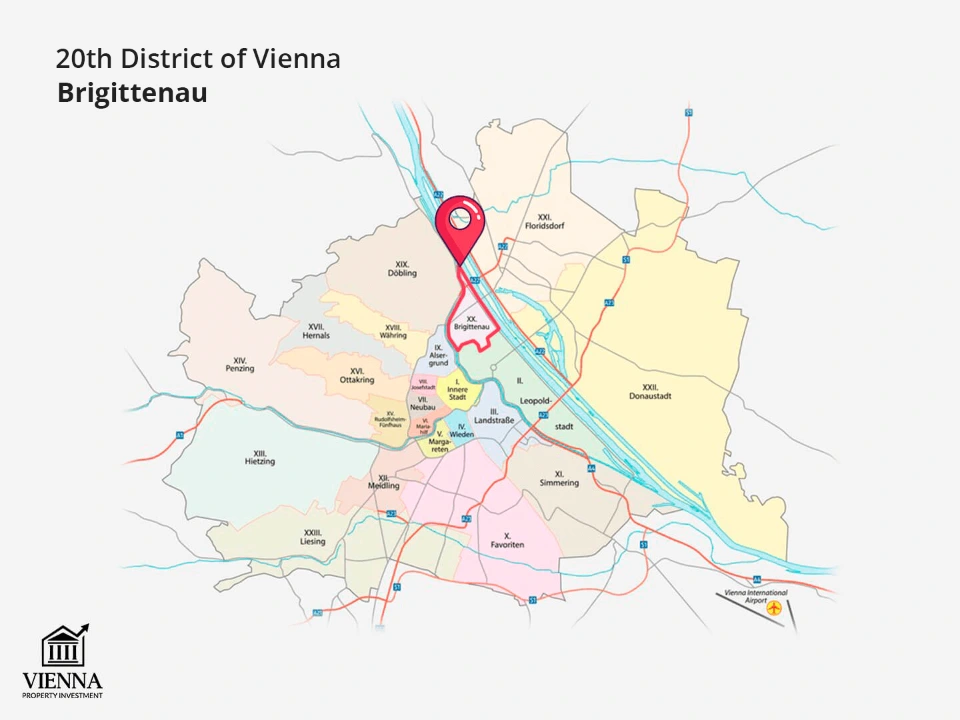
On a map of Vienna, the 20th district—Brigittenau—looks like a veritable island, wedged between the full-flowing Danube and the Danube Canal. Unlike the older districts, which developed in the Middle Ages, Brigittenau has its own history: it was “created” by man through the regulation of the river’s course in the second half of the 19th century.
Today, it is one of the most attractive areas for living and investment – a balance of green areas, modern development, and proximity to the historic center.
I remember my first impression of Brigittenau well: when you ride the U6 subway line and get off at the Handelskai or Jägerstrasse stations, you immediately feel like you're in a special part of the city.
There's no sense of the Inner City's pretentiousness here, but neither does it feel remote. The district seems to bridge two worlds: dynamic business Vienna with its skyscrapers like the Millennium Tower and quiet residential neighborhoods with cozy squares where mothers walk their dogs in the mornings and young people picnic by the water in the evenings.
For those considering moving or buying property, it's important to understand that Brigittenau has long been considered a "working class" area with a less than stellar reputation, but it has changed dramatically over the past 20-30 years.
The area has become multicultural, attracting students, young professionals, and expats. Along with this, housing prices have risen, and numerous cafes, coworking spaces, and cultural initiatives have opened. Today, there are more and more projects here that cater to the modern urban rhythm.

This article aims to highlight the vibrant and attractive Brigittenau district in terms of infrastructure, housing, culture, and investment. We'll take a detailed look at the district's transportation network, schools, residential projects, parks, and businesses, as well as its prospects for investors.
I hope this material will help those planning a move to Vienna or investing in Viennese real estate to get to know Brigittenau better.
The history of Brigittenau: from a "dry island" to a dynamic district
The history of the Viennese district of Brigittenau is a remarkable story of how man literally created the earth in order to build a new home on it.
Just 150 years ago, the Danube lapped at the site of bustling streets, parks, and residential areas, and was once marshy swamps. Today, it's one of Vienna's most dynamically developing districts, having transformed itself from a working-class suburb into a comfortable place to live.
The Birth of a District: How the Danube Was Tamed

The 19th century was a time of great change for Vienna. The city, which had lived under the threat of flooding for centuries, finally decided to undertake a large-scale project to regulate the Danube.
From 1870 to 1875, engineers carried out a colossal amount of work: they drained the old riverbed, created a new one, reinforced the banks with dams, and built defensive structures. It was thanks to this project that Vienna was able to expand toward the Danube for the first time.
A vast area for development emerged in the place of marshes and floodplain islands, including the so-called "Brigitten Island." This new district was originally part of Leopoldstadt, but rapid population growth and infrastructure development had already made it an independent entity by the early 20th century.
Thus, in 1900, during the time of Mayor Karl Lueger, Brigittenau officially separated and received the status of the 20th district of Vienna.
Otto Wagner's contribution and the first steps towards development

Brigittenau has been actively developed since its inception. One of the key architects working in the area was the renowned Otto Wagner. He not only designed residential buildings and infrastructure but also contributed to the construction of key defensive structures.
Among his iconic works is the dam and sluice complex in Nussdorf, built between 1894 and 1898. This structure played a decisive role during the Great Flood of 1899, protecting the city from disaster.
By the late 19th and early 20th centuries, the area began to acquire its unique character. New residential areas and public utilities were built.
In the 1920s and 1930s, construction of high-rise buildings began, including famous communal housing projects designed by architects such as Adolf Loos. An example is the Winarsky-Hof residential complex, built in 1924.
Through wars and modernization

The 20th century brought both ups and downs for Brigittenau. The area suffered greatly during World War II, when fierce fighting took place here, and many buildings were destroyed.
But the post-war period became a time of active restoration and modernization. In the 1950s and 1960s, new social housing was built in the area, which today largely defines its architectural appearance.
During this time, the transport infrastructure connecting Brigittenau with the rest of Vienna was also actively developing. New bridges were built in the 1970s and 1980s, and in 1996, the U6 metro line reached the district, providing direct connections to the city center and other parts of the city.
Modern Brigittenau: Where the Past Meets the Future

Today, Brigittenau is a living example of transformation. From a working-class suburb with a dubious reputation, it has transformed into a modern business and residential center. Here, historic buildings like the neo-Gothic St. Bridget's Church, built in 1874, stand side by side with futuristic office towers.
The most striking symbol of modern Brigittenau is undoubtedly the Millennium Tower, one of the tallest skyscrapers in Austria. Completed in 1999, it has become an iconic architectural landmark and vividly demonstrates how the district has successfully integrated working life, green spaces, and tranquil waterfront recreation.
The history of Brigittenau teaches us that even the most daring projects can transform the landscape and create a new space where people can build their lives. And this once-parched island is now thriving, becoming an integral part of the city.
Geography, zoning and structure
Brigittenau occupies a relatively small area—approximately 5.67 km²—but is home to nearly 85,000 people. The population density is one of the highest in the city, at approximately 15,000 people per square kilometer.
About 21% of the district's area is covered by water: the Danube and the Danube Canal. This gives Brigittenau a unique "island" atmosphere: wherever you go, water is always nearby. This also gives the district unique advantages for leisure: bike paths along the river, waterfront parks, and promenades.

The zoning of the area can be roughly divided into three parts:
- Residential neighborhoods. Mixed development predominates here: old buildings dating back to before 1919, mid-20th-century buildings, and new complexes of recent years.
- Business area. The area is home to major office centers, including Millennium Tower and Rivergate, as well as shopping malls.
- Natural areas. Parks, squares, and long green spaces along the Danube. For families and sports enthusiasts, this is a key advantage.
The district borders the 2nd district (Leopoldstadt) , the 9th (Alsergrund) , and the 21st (Floridsdorf) across the Danube. Thanks to its many bridges (25 in total), residents can easily reach any part of the city.
Population and social structure

Brigittenau is one of Vienna's most vibrant and multifaceted districts. Its history, though relatively short, is rich with transformations that have shaped its contemporary social landscape.
This area is a perfect reflection of how immigration and urbanization can transform an area, creating a unique socio-cultural space.
Today, Brigittenau is home to approximately 85,000 people and is particularly notable for being one of the most multicultural districts in the capital.
Kaleidoscope of Cultures: Ethnicity and Immigration
A key demographic feature of Brigittenau is its ethnic diversity. Statistics, including data provided by the Vienna City Council , confirm that approximately 42% of the district's residents hold foreign citizenship.
This is significantly higher than the city average and makes Brigittenau a true melting pot of cultures.
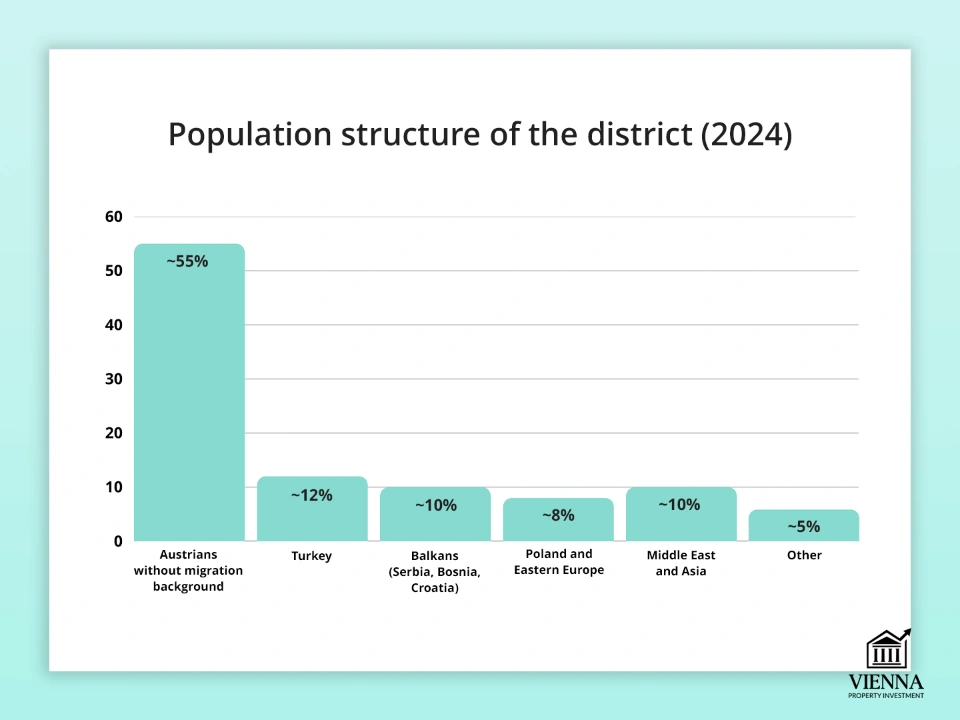
The main groups of immigrants include:
- People from Turkey and the former Yugoslavia, whose presence has its roots in post-war migration.
- New waves of migration from Syria and Afghanistan have further enriched the region's cultural mosaic.
- Students and young professionals from European Union countries such as Germany, Hungary and Slovakia are attracted by the area's convenient location.
This ethnic diversity isn't limited to dry numbers. It permeates everyday life and can be felt in the air.
Just stroll through the famous Hannovermarkt to find yourself in the center of the action: bustling voices in dozens of languages, the aroma of Turkish spices, fresh pastries from a Polish bakery, and Vietnamese bistros located next to traditional Austrian coffee shops.
This atmosphere creates the feeling that the area is not just tolerant of diversity, but literally lives by it.
Youth and Dynamics: Age Structure

Brigittenau's demographic profile is also notable for its age structure. Unlike many other Vienna districts facing the problem of an aging population, Brigittenau is younger than the city average.
The area has a higher proportion of residents under 35. This trend is driven by two main factors: an influx of students and young families who value the area for its relatively affordable housing and excellent transportation links.
However, this doesn't mean Brigittenau has lost its historical connection. The old municipal buildings, built in the mid-20th century, are still home to a large number of long-time residents, native Viennese who have spent their entire lives here.
Their stories and memories create a unique connection between past and present, adding depth and character to the neighborhood. The combination of a young, dynamic population with the wisdom and experience of long-time residents makes Brigittenau's social fabric particularly strong and engaging.
Economic portrait and change of reputation

Brigittenau has long had a reputation as a working-class neighborhood with a lower-middle-class income. This reputation, often accompanied by stereotypes of disadvantage, has been part of its image for decades.
While there have indeed been social problems and higher crime rates here in the past, the last 10 to 15 years have brought significant changes.
Today, the neighborhood is experiencing renewal and gentrification. Here's who and what is driving these changes:
- An influx of new residents. Young professionals, IT specialists, employees of international companies, and creative intellectuals choose Brigittenau for its central location.
- Economic growth. The influx of new residents is driving up real estate prices and the development of new services and stores.
- Changing reputation. From a "distressed" area, it is being transformed into a promising and growing neighborhood. The level of safety, often a concern for potential residents, is now comparable to other central districts of Vienna.
Brigittenau's social fabric is a living, constantly changing organism. It combines the energy of young immigrants and newcomers, the wisdom of its native residents, and a constantly renewing economy. It is this dynamic combination that makes the district more than just a place on the map, but the true beating heart of Vienna.
Housing: from old houses to luxury new buildings

Brigittenau's housing market is a living reflection of the entire district: dynamic, diverse, and constantly changing. Here, historic buildings dating back to before the First World War harmoniously coexist with modern 21st-century residential developments.
This diversity creates unique opportunities for both those seeking affordable housing and investors seeking value appreciation.
Modern market: prices and trends
Brigittenau was long considered one of Vienna's most affordable neighborhoods, but the situation has changed dramatically in recent years. Housing prices, both for purchase and rent, have been steadily rising. According to Findheim , the average apartment size in the district is approximately 61 square meters.
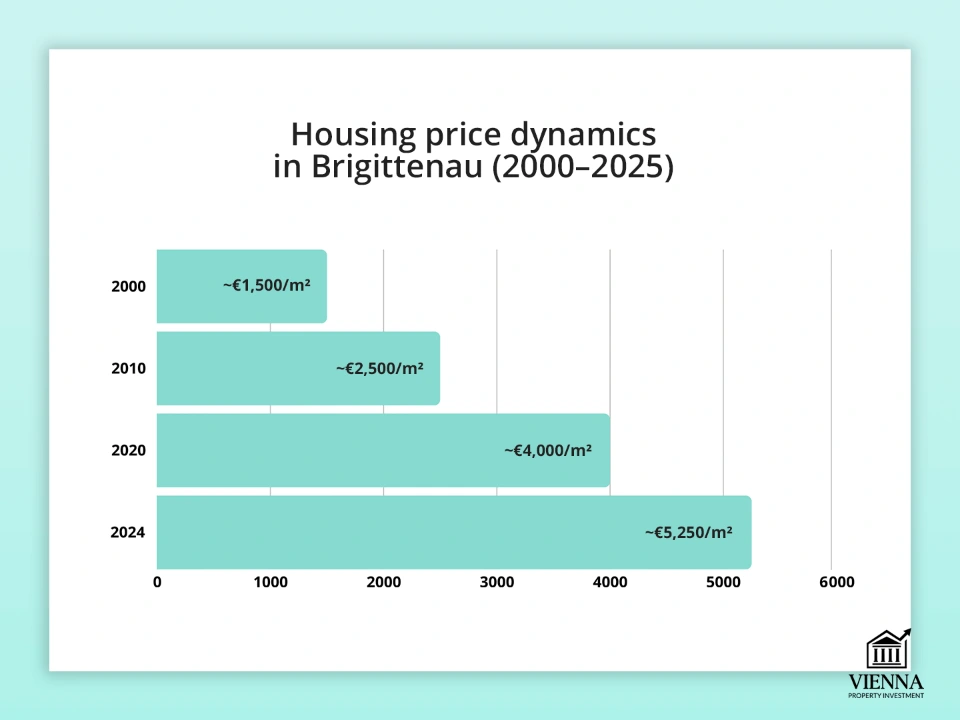
Here's how home purchase prices have changed:
- 2010s – the average price per square meter was between 2,500 and 3,000 euros.
- In 2024, the average price on the primary market reached approximately €5,250/m². On the secondary market, where older homes are represented, prices are slightly lower – around €4,800/m².
Rent has also become more expensive. The average monthly rate is around €18 per square meter. This means that for a 60 square meter apartment, you'll have to pay approximately €1,050–€1,100 per month, not including utilities.

These figures indicate that Brigittenau is no longer a purely "budget" district and is becoming increasingly attractive to people with higher incomes, which is contributing to further gentrification.
A variety of projects: from social to luxury housing
One of the most interesting features of Brigittenau is the coexistence of various housing types. This allows everyone to find something suitable based on their needs and budget.

Municipal Houses. The district is known for its old municipal buildings, built in the mid-20th century. These buildings were part of the post-war workers' housing program and still provide affordable housing for many Viennese.
Major renovations. Many older buildings in the area are undergoing major renovations. This creates attractive opportunities for investors: they can purchase a relatively affordable apartment in an older building, completely renovate it, and rent it out at higher prices.

New buildings. In recent years, Brigittenau has become a hub of active construction. Modern residential complexes are emerging, offering a whole new level of living comfort.
Landmark residential projects
To better understand the specific projects that are shaping the new look of the district, it's worth looking at a few examples:
Brigittenau er Spitz. This modern residential complex is a shining example of business-class housing in Brigittenau. It offers spacious apartments with high-quality finishes, balconies, and terraces.
The complex features underground parking and all necessary amenities on the ground floors. Its location near a major transportation hub makes it attractive to those who value comfort and quick connections to the city center.

Hannes-Landek-Park. This project, by contrast, focuses on creating a family-friendly atmosphere. It features an abundance of green space, a rarity for an urban area.
The complex includes playgrounds, pedestrian paths, and landscaped courtyards, making it ideal for families with children. A focus on eco-friendliness and comfort creates a sense of country comfort without detaching one from city life.
Lorenz-Böhler-Park. This project is aimed at a younger audience: students and young professionals. It offers compact, yet highly functional and modern studio apartments.
The complex is located near important educational and business centers, and its infrastructure meets the needs of young people – from fitness centers to cafes and co-working spaces.
Prospects and investment potential

Despite rising prices, Brigittenau remains more affordable than districts such as the Innere Stadt or Josefstadt. This makes it particularly attractive to investors. For those planning to buy an apartment in Vienna for rental purposes, locations along the U6/U4 and along the embankments are particularly attractive. The potential for property appreciation is very high here, especially in areas of redeveloped former industrial areas and near the Danube.
New developments, such as the " Am Donaukai " residential complex on Handelskai and " Kay " on Engerthstraße, set a new standard for quality of life. They include everything a modern person needs: from energy-efficient systems to landscaped courtyards, ground-floor supermarkets, and kindergartens, which are being built to accommodate population growth.
Education
Brigittenau may not be Vienna's main educational centre, but its infrastructure fully meets the needs of young families.
This vibrant neighborhood offers everything from kindergartens to vocational schools. This makes Brigittenau attractive to those seeking a balance between affordable housing and a quality education for their children.
Full spectrum: from toddlers to schoolchildren
The Brigittenau educational network includes a wide range of institutions for children of all ages.
Kindergartens. For the little ones, the area offers dozens of kindergartens and crèches, both public and private.
As the population grows, especially among young families, city authorities are actively investing in the construction of new, modern gardens, often integrated into new residential complexes, providing space for everyone.

Primary Schools (Volksschule). The district offers a wide selection of primary schools, among which one of the most well-known is the Volksschule Winarskystraße.
This school, one of the oldest in the area, has a long history and a good reputation. It provides a classical primary education and often becomes the first step into school life for many Brigittenau families.

Middle and high schools (Mittelschule and Gymnasium). For teenagers, the area offers several excellent options:
- Bundesgymnasium Karajangasse – this gymnasium is known for its high teaching standards and academic achievements. It prepares students for admission to higher education institutions and is considered one of the best in the region.
- The Technische Hochschule (HTL TGM) on Wexstraße is a renowned technical school that trains future engineers, construction workers, and other technology professionals. Many Viennese travel to Brigittenau specifically to study here.
- Berufsschule Brigittenau is another important vocational school that trains specialists in economics and technology, providing them with in-demand skills for the labour market.
Professional and medical education
In addition to comprehensive schools, Brigittenau also offers specialized educational institutions that train future professionals.

Medical Schools. The renowned Lorenz-Böhler-Krankenhaus Hospital houses medical schools, including nursing and physiotherapy colleges. These schools play a vital role in Vienna's healthcare system, providing the city with qualified personnel.
Other vocational schools. At the junction of the 20th and 21st districts are also other schools, such as the Handelsakademie, which trains specialists in business and commerce.
Proximity to major universities
Although Brigittenau itself has no major universities, its location makes it very attractive to students. The area is in close proximity to Vienna's major university campuses, such as:
- University of Economics and Business (WU Wien)
- Campus of the University of Vienna
Both of these educational institutions are easily accessible by metro or tram, making Brigittenau a great place to rent accommodation for students looking for more affordable options than in the central areas.
Development and prospects
Today, Brigittenau is actively investing in the future of its residents. New development projects, particularly near Brigittenauer Lände, are building modern schools and kindergartens with expanded educational programs.
These facilities offer everything from state-of-the-art equipment to modern gyms and libraries. The city government is allocating funds to expand the space, taking into account the growing needs of young families choosing Brigittenau as their home.
As an investor, I always tell my clients: if real estate is an investment in capital, then a good school is an investment in a family's future. Thanks to its well-developed infrastructure, Brigittenau offers its residents an acceptable compromise between affordable housing and high-quality education.
Infrastructure and transport: connections throughout the city

One of Brigittenau's main attractions is its remarkable accessibility. Despite being surrounded by water and having a somewhat "island" character, the district is perfectly integrated into the city's transportation network.
And this is no coincidence: to span the waterway, a total of 25 bridges were built, connecting Brigittenau with other parts of Vienna. This extensive network allows residents to easily reach both the historic center and the outskirts, making everyday commutes quick and convenient.
Getting Around Vienna: Metro, Trams, and Buses

Public transportation is the district's lifeblood. It's so well developed that owning a car is essentially unnecessary.
Metro. The area is served by two key Vienna metro lines:
- Line U4. It provides direct service to Vienna's city center via Friedensbrücke station (for example, Schwedenplatz is just 5 minutes away) and continues on to Hütteldorf station. This is the ideal route for those working in the city center or wanting to quickly reach cultural attractions.
- Line U6. Its stations—Jägerstrasse, Dresdener Strasse, and Handelskai—connect Brigittenau with the northern part of the city, all the way to the Floridsdorf district, as well as with the southern districts. Handelskai station is also a major transfer hub for S-Bahn commuter trains to the airport and other cities.
Trams. The tram network complements the U-Bahn (subway) perfectly. Routes 2, 5, 31, and 33 pass through Brigittenau, providing connections to the central districts and neighboring areas. Tram 2, for example, runs along the famous Ringstraße.
Buses. Bus routes, including night ones, fill gaps in the transportation network, ensuring accessibility to even the most remote corners of the region and comfortable travel at any time of day.
25 bridges: the heart of the transport artery

The number of bridges connecting Brigittenau with the rest of Vienna is truly impressive. They have become more than just engineering feats, but symbols of overcoming the barriers created by the Danube.
It's thanks to these bridges, such as the Reichsbrücke and Nordbrücke, that the district has ceased to be an isolated "island." It's important to note that the bridges are designed not only for cars, but also for public transportation, pedestrians, and cyclists.
Of course, such road density sometimes leads to congestion, especially during rush hour. But even then, a well-developed public transportation network always offers an excellent alternative.
Green Arteries: Bike Paths and Pedestrian Routes
Brigittenau, which actively invests in eco-friendly transportation, is a true haven for cyclists. According to city officials, the total length of bike paths in the area exceeds 20 km.
The most popular routes run along the Danube and the Danube Canal, where you can enjoy picturesque views without worrying about city traffic.
These routes are more than just roads. They've become a destination for active recreation, where runners, cyclists, and families with children on scooters can be seen during the warmer months. This reflects the district's commitment to creating not only a comfortable but also a healthy living environment.
Investing in the Future: New Projects

The city authorities are constantly investing in the development of Brigittenau's transport infrastructure. These aren't just isolated improvements, but part of a larger strategy. Here are some of the recent projects:
The U6 "Handelsky" station has been modernized. It has become more modern and passenger-friendly, becoming an important multimodal hub.
Development of the Friedensbrücke hub. This project aims to improve transfers between different modes of transport and create a comfortable urban environment around the station.
Greenery and new bike paths. Brigittenau became part of the city's " Raus aus dem Asphalt " ("Out with the Asphalt") program. As part of this project, according to Vienna's official website, the city has allocated over €21 million for greenery and the creation of new public spaces.
Part of these funds was used to create breaks in the dense development of Brigittenau, creating mini-parks, flower gardens, and shady alleys. Such initiatives improve the quality of life and, consequently, the investment appeal of the area.
Parking and Parking Policy: How to Survive as a Driver in Brigittenau

As in most central districts of Vienna, parking in Brigittenau is a pressing issue. The high population density, narrow streets, historical buildings, and the city's active policy of reducing car traffic create a tense situation.
If you're planning a move to the 20th arrondissement and own a car, be prepared for finding a parking space to become a daily quest.
Citywide paid parking system: "Parkpickerl" saves, but not everyone
As of 1 March 2022, Vienna has revolutionised its parking policy by extending the short-term parking zone (“ Kurzparkzone ”) to the entire city.
This decision finally equalized the rights (and responsibilities) of residents of the central and peripheral districts. Brigittenau, like the rest of the districts, became a zone of total parking control. What does this mean in practice?
Paid parking is available on weekdays. Monday through Friday, from 9:00 AM to 10:00 PM, on-street parking is permitted only with a paid parking ticket ("Parkschein") or a resident permit. The maximum parking time for visitors to the area is two hours.
Resident's permit (" Parkpickerl "). For residents of Brigittenau, this is the only way to avoid hourly parking fees and the constant search for a spot. The permit grants unlimited parking in your neighborhood (and in adjacent areas of neighboring districts, which is a major bonus).
The cost of this privilege is 10 euros per month, plus an administrative fee upon registration. You can apply online on the official website of the City of Vienna, which significantly simplifies the process.
But don't get too carried away: having a permit doesn't guarantee a free space at your front door. Evening parking searches, especially after 8:00 PM, can take anywhere from 10 to 30 minutes.".
-
An important detail: there are special shopping streets (Geschäftsstraßen), which have their own, stricter rules. Even with a residence permit, parking on these streets is limited in time (usually up to 1.5 hours) and requires the use of a parking disc.
In Brigittenau, such streets include, for example, sections of Wallensteinstraße and Jägerstraße. An up-to-date list and maps of such streets are always recommended on the official Vienna City Portal.
Underground garages: comfort for a fee
For those unwilling to accept the on-street parking lottery, paid garages remain the only option. Brigittenau has plenty of them, especially near large residential and office complexes, such as:
- Millennium City. One of the largest garages in the area, offering both hourly rates and long-term memberships. It's an ideal option for residents of nearby buildings, but also the most expensive.
- Rivergate. This modern complex on Handelskai also features spacious underground parking.
- Wexstraße Garage. Another popular option in the heart of the neighborhood.
Prices for monthly passes (“Dauerparken”) in such garages vary significantly depending on location, level of comfort (video surveillance, security) and demand.
On average, you should expect to spend between 90 and 160 euros per month. This is a significant expense, comparable to the cost of an annual public transport pass.
Trends: Less asphalt, more life

Vienna is consistently pursuing a strategy of "a city for people," not cars. And Brigittenau is at the forefront of this change. The city administration actively encourages the reduction of on-street parking spaces, converting them into public spaces. This trend manifests itself in several forms:
"Grätzloasen" (Oases in the Neighborhood). Freed-up parking spaces are transformed into mini-parks. Instead of hot asphalt, potted trees, comfortable benches, small play areas for children, or simply lawns appear. This not only improves the microclimate and aesthetics of the street but also creates new spaces for social interaction between neighbors.
Expanding cycling infrastructure. Cycling is the preferred mode of transport in Vienna. Therefore, parking spaces are often sacrificed in favor of creating safe and wide bike paths or installing indoor bike racks.
Reimagining Streets. As part of improvement projects, entire streets are being redesigned. Chaotic double-sided parking gives way to one-way streets, and the freed-up space is used to widen sidewalks, plant trees, and create rest areas.
Having your own underground parking space in a new building isn't a luxury, but a necessity that will save you a lot of time and stress. Almost all new residential complexes in Brigittenau are designed with this reality in mind. They are required to include underground parking.
However, a parking space in such a garage isn't automatically included with the apartment—it must be purchased or rented separately, which increases the overall cost of the property. However, as experience shows, this investment is completely worth it.
The city's policy is clear: owning a car in Vienna, especially in neighborhoods like Brigittenau, will become increasingly less convenient and more expensive. And we need to be prepared for this.
Religion and Community: Points of Attraction in a Multicultural Neighborhood
Brigittenau is more than just an administrative unit on the map of Vienna; it's a living, breathing organism, woven from dozens of cultures and traditions. And perhaps nothing reflects this diversity more vividly than the district's religious landscape.
Here, on a small "island" between the Donaukanal and the Danube, Catholics, whose ancestors built this city, Muslims from Turkey and the Balkans, Orthodox Christians from Serbia and Romania, Protestants and representatives of many other faiths live side by side.
Religious institutions in Brigittenau are more than just places of prayer; they are vital social hubs, centers of integration and mutual support, knitting together the diverse fabric of the local community.
Symbol of the district: St. Brigitta's Church (Pfarrkirche St. Brigitta)

In the heart of the district, on Brigittaplatz, stands its main architectural and spiritual symbol – the parish church of St. Brigitta (Pfarrkirche St. Brigitta).
Built in the neo-Gothic style of red brick between 1867 and 1874, it gave its name to the entire district. Its tall, sky-high spire is visible from many points in Brigittenau and serves as a beacon of sorts.
For the old-timers and the Catholic community, this is not just a church, but a place with which generations of family stories are connected: children were baptized here, weddings took place, and funerals were held here.
Today, in addition to regular masses, the parish maintains an active social life: it organizes fundraisers, pastoral meetings, and serves as an important center for the Catholic community. Even if you're not religious, it's worth a visit to experience the peace and grandeur of this historic site.
I often pass by the Brigittakirche in the evening when the lights are on. It looks especially majestic at that moment.
Interestingly, initially, in the 17th century, only a small chapel, Brigittakapelle, stood on this site, built to commemorate the Swedish siege during the Thirty Years' War. The current church reflects the growth and ambitions of the area in the 19th century, when it transformed from a rural outskirts into a densely populated working-class neighborhood.
The Islamic Community: Invisible but Important Centers

A significant portion of Brigittenau's population is made up of people from Turkey, Bosnia, and Arab countries, so Islam plays a significant role in the life of the district.
However, unlike Catholic churches, mosques and Islamic cultural centers here often lack monumental buildings with minarets. They are located in former shops or on the ground floors of residential buildings, and can be identified by signs in Turkish or Arabic.
These centers are much more than just prayer rooms. They are places where people receive support in their native language, where children learn the Quran and the foundations of their culture, and where adults find help with everyday and legal issues.
For example, the Turkish-Islamic Union in Austria (ATİB) has several cultural centers that serve precisely these purposes. Here, the older generation connects with their roots, while the younger generation gains guidance as they integrate into Austrian society.
The Orthodox World: Preserving Traditions Far From Home

Vienna's proximity to Eastern and Southeastern Europe has historically made it a center of attraction for Serbs, Romanians, Bulgarians, and other Orthodox Christians. Several Orthodox parishes can be found in Brigittenau and the surrounding areas.
For example, the Serbian Orthodox Church of the Resurrection of Christ in the 2nd district, Leopoldstadt, is located very close by and is a spiritual center for the large Serbian diaspora, many of whom live in Brigittenau.
These churches play a vital role in preserving national identity. Sunday services are held in the native language, major religious holidays according to the Julian calendar are celebrated here, and Sunday schools are also held.
For many parishioners, the church is a small island of home, a place where they can not only pray, but also simply speak their native language, discuss the news, and feel part of a large family.
Ultimately, the religious life of Brigittenau is living proof of how different cultures can not only coexist, but also enrich each other.
Church bells, the call of the muezzin, and Orthodox chants merge here into a single symphony of the big city, making the 20th district one of the most dynamic and truly Viennese places.
Culture, Leisure and Events
Brigittenau's cultural scene isn't as obvious as that of Vienna's central districts, but it's surprisingly multilayered. This neighborhood is often underestimated: its working-class past and multinational character conceal a vibrant cultural scene, including grassroots initiatives, local art projects, and festivals.

Theaters and stages. Brigittenau doesn't have an opera house or large theaters like the Burgtheater, but it does have its own cultural centers that create the atmosphere of a "people's district."
- Brigittineum. A small independent theater that presents contemporary plays and dance productions.
- Metropol Theater. This music venue borders the 17th district, but is also frequented by Brigittenau residents. It hosts concerts by Austrian bands, jazz evenings, and comedy shows.
- Stages at Millennium City. The shopping and entertainment complex regularly hosts concerts and film screenings.
Galleries and art spaces. Small galleries in the district actively collaborate with young artists. Street art, local exhibitions, and pop-up projects are featured here. Many creative initiatives are supported by the Vienna City Council through its "Förderung der Kulturarbeit" (Cultural Development) program.

Festivals and events. It's at the district festivals that you can best experience Brigittenau's friendly, bustling, and multicultural atmosphere:
- Brigittenauer Kirtag. A traditional fair where residents of the region of all generations meet. The atmosphere is reminiscent of a mix of a rural festival and a city festival.
- Festivals on the Danube. Summer events on the embankments often take place right here, on this "island.".
- Migrant celebrations. The Turkish, Serbian, and Arab communities host their own cultural evenings, which have long been open to all.

Leisure activities for every day. Beyond the events, Brigittenau offers a wealth of opportunities for everyday relaxation:
- Cinema. Millennium City has a large multiplex.
- Sports. The area is rich in fitness centers,Brigittenau Hallenbad swimming pool, and sports fields along the Danube.
- Restaurants and cafes. Here you can sample cuisine from all over the world—from cheap shawarmas at Hannovermarkt to stylish coffee shops serving Austrian breakfasts.
Parks and Green Spaces: The Breath of the Danube
Despite its reputation as a densely populated urban area, Brigittenau boasts an enviable amount of green space. The secret is simple: its proximity to Vienna's main waterway.
The Danube and the Danube Canal are not just the district's boundaries, but its "green lungs," defining the lifestyle and recreation of local residents. This tradition of creating public spaces by the water has transformed Brigittenau into an oasis within the bustling city:
The embankments of the Danube and the Donaukanal are, without exaggeration, the region's main natural and recreational resource. The endless, well-maintained paths along Brigittenau er Lände are the perfect place for jogging, cycling, or leisurely rollerblading.
In summer, the area is bustling with life: people have picnics on the grass, relax in floating cafes and bars, and enjoy the view of the water.
In winter, the embankments transform into calm, meditative walking routes where you can breathe fresh air away from the hustle and bustle of the city.

Augarten. Although this magnificent Baroque park formally belongs to the neighboring Leopoldstadt (2nd district), for residents of the southern part of Brigittenau, it is within walking distance.
You only need to cross one bridge to find yourself among centuries-old chestnut tree avenues, perfect lawns and the famous anti-aircraft towers from the Second World War.
This is a wonderful place for long walks, sports and family recreation – the Augarten playgrounds are famous throughout Vienna.
Allerheiligenpark. This cozy park, located in the heart of the district, is a true oasis for local residents. It doesn't boast the scale of the Augarten, but that's part of its charm.
This is a classic "neighborhood" park, where mothers with strollers relax in the shade of the trees, children play on modern playgrounds, and seniors sit on benches. There's always a calm and friendly atmosphere here.

Lorenz-Böhler-Park: This park is an example of a modern approach to urban planning.
Situated adjacent to new residential developments, it was designed with the needs of active citizens in mind: excellent bike paths, workout areas, and team sports facilities make it a magnet for young people and sports enthusiasts.
City Investments. The Vienna municipality invests millions of euros in improvements annually. Recently completed projects in Brigittenau include:
- new playgrounds on Winarskystraße;
- expansion of cycle paths along Brigittenauer Lände;
- landscaping of Klosterneuburgerstraße.
Interestingly, some of the former industrial areas are planned to be converted into parks and "green corridors" connecting the inner quarters with the embankment.
Atmosphere. In the evening, the area's parks fill with families, joggers, and teenagers playing basketball. The atmosphere is vibrant, but unlike tourist areas, there aren't crowds of out-of-towners.
Economy, offices and international connections: The business pulse of the district
Brigittenau has long ceased to be just a residential area. Today, it is an important and dynamically developing business hub, where modern business centers coexist with traditional small businesses, creating a unique economic ecosystem.

Millennium Tower. This 202-meter skyscraper on Handelskai is not just an architectural landmark, but a powerful economic driver for the district. Opened at the turn of the century, it symbolizes the transformation of Brigittenau.
Its glass walls house the headquarters and offices of major international companies, particularly in the IT, telecommunications, and consulting sectors. The presence of such an iconic building attracts highly qualified professionals to the area and sets a high standard for the business environment.

Rivergate. Located next door, this two-tower office complex embodies contemporary trends.
Certified to the highest LEED Platinum sustainability standard, Rivergate offers premium office space to companies committed to sustainability. Its construction cements the Brigittenau waterfront as a prestigious business location.
Retail and small business. The Millennium City shopping and entertainment complex is a magnet for the entire northern part of Vienna. With over 100 stores, a huge cinema, a food court, and a fitness center, it creates hundreds of jobs and ensures a steady flow of visitors.
But the district's economy isn't limited to these giants. Small businesses thrive on its streets: from authentic cafes and bakeries on Hannovermarkt to auto repair shops, design studios, and yoga centers. This sector adds vibrancy to the area and provides residents with everything they need within walking distance.

International focus. Brigittenau's strategic location makes it attractive to expats.
The proximity to the Vienna International Centre (UNO City), home to the offices of the UN, IAEA, and other international organizations, is a key factor. The commute to work takes just 10-15 minutes by metro (line U1) or by car.
According to Statistik Austria , employment in the area is growing. The service sector employs over 70% of workers, while industry is gradually disappearing, giving way to office and residential developments.
The industrial past is giving way to a modern knowledge economy, offices and creative industries, promising Brigittenau a promising future.
Modern projects and investments
Over the past two decades, Brigittenau has evolved from a working-class area with affordable housing to the site of large-scale urban developments.
It is here that Vienna is implementing several strategic initiatives that are changing the face of the area and creating new investment opportunities.

Large residential projects. The site of the former Nordwestbahnhof railway station. This is one of Vienna's largest urban development projects, covering an area of approximately 44 hectares.
The plan calls for 6,500 apartments, offices, schools, kindergartens, parks, and sports areas. A key focus is sustainable development: eco-friendly buildings, reduced traffic, and green courtyards.
Construction is planned in several phases, with completion expected in the early 2030s. This represents enormous potential for investors: housing in the new neighborhoods on the site of Nordwestbahnhof will become a magnet for young families and professionals.
Projects near Millennium City and along the Danube. Developers are actively using waterfront areas to create modern residential complexes with river views.
This is the premium segment: spacious apartments, large terraces, and underground parking. Prices here are above the area average, but demand is growing due to expats and Viennese seeking "life by the water.".
Industrial areas are being converted into residential areas. The area is actively transforming former factories and warehouses. Some buildings are being converted into lofts, others into modern residential complexes with parks.
Infrastructure projects:
- Expanding cycle paths along the Danube and creating a "green corridor" to the city center
- Modernization of metro stations U6 and U4, improvement of transfer hubs
- New schools and kindergartens within residential complexes are an important factor for families
City investment initiatives. The municipality actively supports the development of Brigittenau as a "young, green, and international" district. The STEP 2025 strategy identifies the district as a key growth area.
Investment attractiveness of the area
Brigittenau is attractive to investors for several reasons: relatively affordable prices, proximity to the city center, a multicultural atmosphere, and large-scale urban projects. When it comes to investing in Vienna real estate, this district is often viewed as a "middle ground" between the more expensive central districts and the more remote residential areas. Let's examine these key aspects in more detail.
Dynamics of housing prices:
- In the 2000s, housing here was one of the cheapest in Vienna: around €1,500/m²
- In the 2010s, prices rose to €2,500–3,000/m²
- In the 2020s, there has been active growth: in 2024, the average price for new buildings will be around €5,250/m², while the secondary market will be €4,800/m²
By comparison, prices in the 9th district exceed €7,500/m², while in the 2nd district they are around €6,500/m².
Conclusion: Brigittenau remains an "undervalued" district with high growth potential.
Rental market:
- Average rent in 2024 is about €18/m²
- A 60 m² apartment brings in around €1,100 per month
The yield is higher than in prestigious areas (where purchase prices are higher and rents grow more slowly).
Liquidity. Thanks to its multiculturalism and proximity to the city center, housing here is in demand among:
- students (due to accessibility and transport links to universities)
- young professionals and expats
- middle-class families who value the combination of price and infrastructure
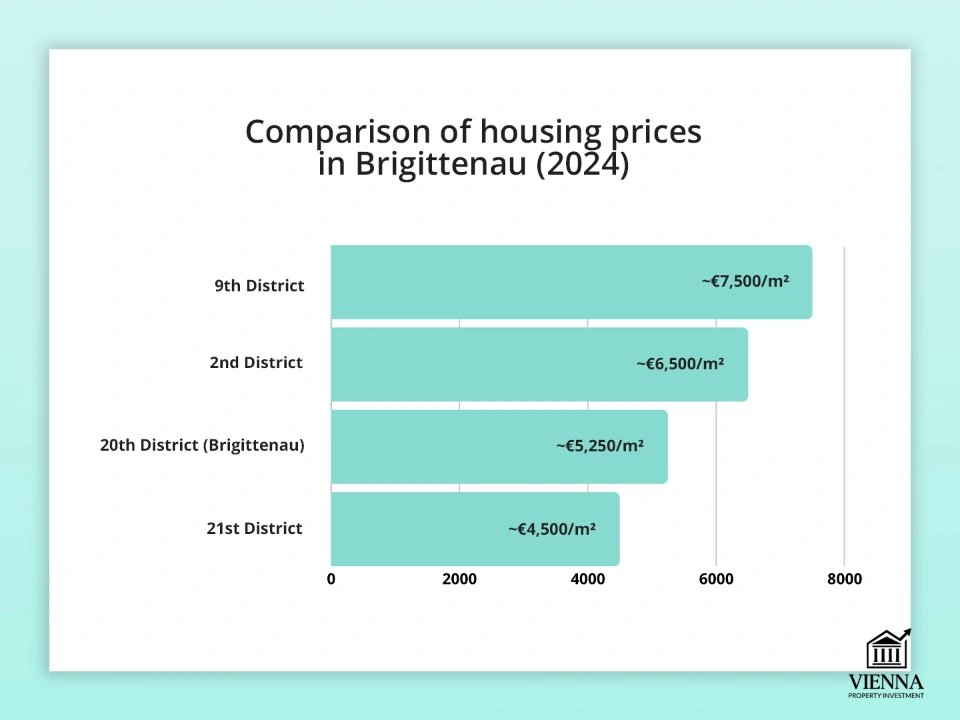
Comparison with other districts. In terms of investment attractiveness, Brigittenau ranks between the "high-end" districts (9th and 2nd) and the "sleeper" districts (21st and 22nd). It has a chance to replicate the success of the 2nd district (Leopoldstadt), which has evolved from a "working class" to a "fashionable" district in 20 years.
Growth factors:
- Nordwestbahnhof project
- Increasing proportion of young professionals and expats
- The city's investment in infrastructure and green spaces
Conclusion: Who is Brigittenau suitable for?
To summarize: Brigittenau is a rapidly changing neighborhood of contrasts. It appeals to a variety of residents and investors:
- Families. There are lots of schools, kindergartens, and parks here. Yes, not everything is perfect, but the area is getting more and more comfortable.
- Young professionals. Excellent transport accessibility, proximity to the city center, modern projects.
- Investors. Comparatively low purchase price with high rent and significant growth potential.

Advantages of the area:
- Proximity to the center and good transport accessibility
- Green areas and the Danube
- A variety of housing options: from affordable to premium
- Large-scale development projects
- Multicultural atmosphere
Possible disadvantages:
- High population density
- The area still carries a reputation for being disadvantaged, although the situation has changed
- Parking and infrastructure load