Leopoldstadt is one of Vienna's most unique and contrasting districts, deservedly called a "city within a city." It's the Austrian capital's second district, located just 1 km from the historic center— Innere Stadt—and yet surrounded by water: the Danube Canal on one side and the main channel of the Danube on the other. Due to this geographical location, the district is often perceived as a separate "island," connected to the rest of Vienna by a network of bridges and embankments.
This location makes Leopoldstadt not only an important transportation hub but also a place where nature and city life blend. It is home to the famous Prater Park, Vienna's largest and most popular green space, visited by tourists and locals alike.
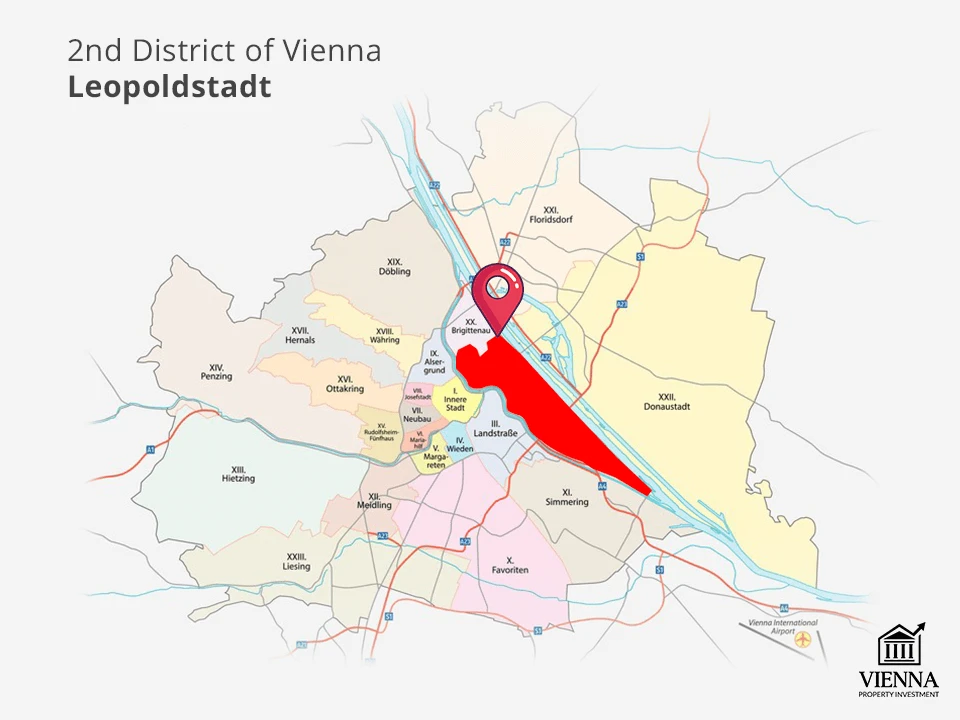
Leopoldstadt is a district of contrasts. Here you'll find:
- ancient buildings with rich facades and Jewish architectural heritage;
- modern premium residential complexes with views of the Danube;
- office buildings and international business centers, including UNO-City (Vienna International Centre) – the UN headquarters in Vienna.
The district is actively developing, combining historical traditions with modern urban developments. Its prestigious embankments along the Danube Canal (Donaukanal) have become a zone for promenades, gastronomy, and cultural events, while former industrial areas are being transformed into modern residential neighborhoods.
The key goal of this article is to show Leopoldstadt in all its diversity:
- tell the story of the area, from the first settlements along the Danube to modern urban projects;
- explore its infrastructure, cultural diversity and tourist attractions;
- analyze the real estate market and investment opportunities in the area.
This is especially useful if you're comparing neighborhoods and planning to buy an apartment in Vienna near the city center. For tourists, locals, and investors, Leopoldstadt is a space that simultaneously captures the spirit of old Vienna and showcases the dynamism of a modern metropolis.
History of Leopoldstadt

Leopoldstadt is a district with a rich historical heritage, which has been formed over several centuries.
The Middle Ages and the First Settlements. The first settlements in the area of today's Leopoldstadt appeared in the Middle Ages. Fishermen and traders settled on small islands in the Danube, taking advantage of their convenient location for transporting goods and fishing. These settlements became the foundation of the future neighborhoods of the district.
The 17th century – the formation of the district. In the 17th century, the district began to actively develop as a suburb of Vienna. During this period, Jewish communities migrated there en masse, and the district acquired the unofficial nickname "Little Jerusalem." Leopoldstadt became an important center of Jewish life in Europe, with synagogues, schools, and cultural centers.
However, in 1670, by decree of Emperor Leopold I, the Jewish population was temporarily expelled, and the area received its official name - in honor of the monarch.

The 19th century was a golden age and cultural flourishing. The 19th century saw industrialization and a flourishing of leisure. In 1873, the Leopoldstadt hosted the World's Fair, cementing the district's status as a cultural center. At the same time, the Prater was developed, becoming a favorite recreational spot for the Viennese.
In 1897, the famous Giant Ferris Wheel (Riesenrad) was built, becoming a symbol not only of the district, but of all of Vienna.
During this time, residential buildings, theaters, restaurants, and hotels were actively built to serve both local residents and tourists.
The 20th century – wars and transformation. The region experienced severe trials in the 20th century.
During World War II, the Jewish community was almost completely destroyed and many buildings were destroyed.
After the war, Leopoldstadt saw a massive influx of migrants from Eastern Europe and the Balkans, making it one of Vienna's most multinational districts.
Modern stage (21st century). Since the early 2000s, the area has been undergoing active renewal:
- old houses are being reconstructed;
- industrial zones are being transformed into modern residential areas and business parks;
- The embankments are becoming centers of gastronomic and cultural life.
Today, Leopoldstadt is a district that combines history and innovation, tradition and modern urban trends.
Geography and structure of the region
Leopoldstadt is Vienna's second-largest district, covering an area of 19.27 km². As of 2025, the district is home to approximately 105,000 people, making it one of the most densely populated in the city.

Key geographical features:
- The area is bordered on one side by the Danube Canal (Donaukanal) and on the other by the main channel of the Danube, making it perceived as a separate island.
- On its territory is the Old Danube (Alter Donau), a natural reservoir popular for walking, swimming and water sports.
- The main green artery of the district is Prater Hauptallee, which stretches through the entire Prater park.
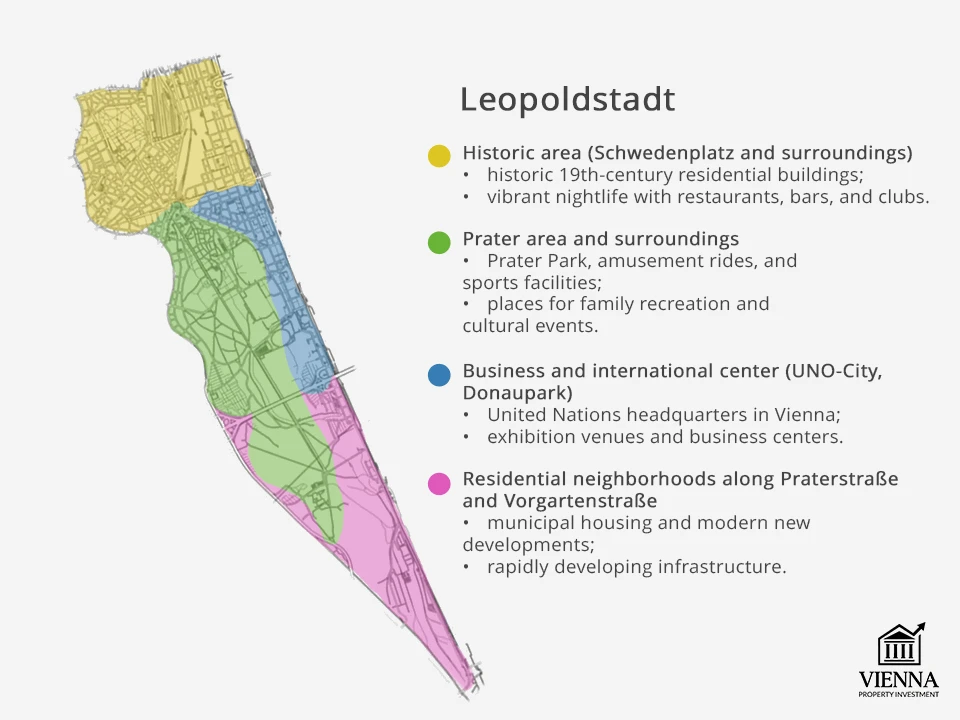
Zoning of the district. Leopoldstadt is divided into several distinct functional zones:
- Historical part (Schwedenplatz and surrounding area)
- old residential buildings of the 19th century;
- active nightlife, restaurants, bars and clubs.
- Prater area and its surroundings
- Prater park, attractions and sports facilities;
- places for family recreation and cultural events.
- Business and International Center (UNO-City, Donaupark)
- UN headquarters in Vienna;
- exhibition complexes and business centers.
- Residential areas along Praterstraße and Vorgartenstraße
- municipal houses and modern new buildings;
- actively developing infrastructure.
| Parameter | Meaning (2025) |
|---|---|
| Area of the district | 19.27 km² |
| Population | ~105,000 people |
| Population density | ~5,450 people/km² |
| Main parks | Prater, Augarten |
| Main transport hubs | Praterstern, Messe-Prater |
Population and social structure of Leopoldstadt

Leopoldstadt is rightfully considered one of Vienna's most multicultural districts . Its population has evolved over centuries through migration and historical events. Today, it is home to approximately 105,000 people (estimated for 2025), and the district continues to grow rapidly thanks to its proximity to the historic city center, its well-developed infrastructure, and its unique blend of tradition and modernity.
One of Leopoldstadt's key characteristics is its high proportion of residents of foreign origin – over 40% of the population holds foreign citizenship or roots in other countries. This figure is significantly higher than the Vienna average of approximately 34%. The district can be called a true cultural mosaic.
The largest groups are from the Balkan countries, primarily Serbia, Bosnia and Herzegovina, and Croatia. The Turkish community is also prominent, actively developing small businesses, including cafes, restaurants, and shops selling traditional products.
Over the past ten years, the number of migrants from Syria and other Middle Eastern countries has increased significantly, and since 2022, there has been a surge in the number of residents of Ukraine and the former Soviet Union, many of whom arrive as temporary migrants, students, or young professionals.
Ethnic composition
The area is home to numerous diasporas, each of which leaves a noticeable mark on the cultural and gastronomic life of the neighborhoods:
- The Balkan countries: Serbia, Bosnia and Herzegovina, Croatia – together form the largest migration group.
- The Turkish community is actively developing small businesses: restaurants, grocery stores, and services.
- Syria and the Middle East is a relatively new group associated with post-2015 migration.
- Ukraine and the former Soviet Union – significant growth after 2022; many arrive as temporary migrants or students.
- The Jewish diaspora is historically strong. Before World War II, the area was called "Little Jerusalem" due to its high concentration of Jewish residents, synagogues, and cultural centers. Today, traditions are carried on through cultural events and religious communities.
Age structure of the population

The older neighborhoods, with their abundance of municipal housing, are home to a large number of older people, many of whom have been connected to the area for generations. Meanwhile, modern residential complexes near the Danube Canal and the Vienna International Centre are home to young families, students, and professionals working in IT, tourism, and the creative industries. This trend toward a younger population makes the area particularly attractive to investors and businesses.
According to Statistik Wien , the average income in Leopoldstadt is somewhat lower than in Vienna's central districts, but higher than in the suburbs. The district is actively developing thanks to tourism, the service sector, logistics, and modern professions. The growth in the number of specialists in IT and creative industries is particularly noticeable, stimulating the development of cafes, coworking spaces, and startup hubs.
Public initiatives and integration of migrants
Leopoldstadt is one of Vienna's most multicultural districts, with over 40% of the population having foreign roots. This distinctiveness leaves its mark on the district's social structure: people from the EU, the Balkans, the Middle East, and the former Soviet Union coexist here.
City authorities and NGOs are actively implementing migrant integration programs to maintain harmony and safety in the neighborhood. One of the key centers is Integrationshaus Wien , which provides free German language courses, employment assistance, and psychological support.
Areas of work:
- Language adaptation: German courses for adults and children.
- Employment: assistance for migrants in finding work in the service, IT, and tourism sectors.
- Cultural exchanges: national cuisine festivals, events for children and families.
- Social programs for women and youth: creation of safe zones and educational courses.

The district is also known for its projects that engage local residents and migrants in joint activities. An example is the Kulturen verbinden , held annually at Karmelitermarkt , which showcases the cuisines and traditions of dozens of countries.
The effect of integration programs:
- Reducing social tensions in areas with a high percentage of migrants.
- Improving the image of the district among Viennese residents.
- Creating new cultural initiatives that make Leopoldstadt more attractive to tourists and investors.
Housing: from historic buildings to modern complexes
Leopoldstadt is known for one of the most diverse housing stocks in Vienna. It harmoniously blends historic buildings from the Viennese Art Nouveau era, municipal housing ( Gemeindebauten ), and modern residential complexes built in the last two decades. This mix makes the district attractive to both residents and investors.
| Type of housing | Description |
|---|---|
| Gemeindewohnung | Municipal housing provided by the City of Vienna. Available to citizens with a certain income and length of residence in the city. |
| Genossenschaftswohnung | Housing from non-profit housing associations. Designed for a wide range of citizens, including families and seniors. |
| Private rental | Apartments rented by individuals or agencies. May be furnished or unfurnished. |
| Short-term rental | Accommodation rented for periods ranging from a few days to several months. Often used by tourists and business travelers. |

Municipal housing plays a key role in the district's structure. Historically, Leopoldstadt was the center of the "Red Vienna" social programs of the 20th century, which saw the construction of large housing complexes for working-class families. One such example is the Nordbahn-Hof, which remains an important part of the city's housing system to this day. Today, approximately 18-20% of housing in the district is social housing.
Since 2020, the city has been actively implementing renovation programs for old buildings, modernizing their façades, utility systems, and courtyard landscaping. These projects are aimed at increasing energy efficiency and improving residents' quality of life.

Modern, premium-class homes have sprung up along the Danube Canal and central streets like Praterstraße . These buildings feature spacious apartments, panoramic windows, and water views, making them particularly attractive to expats and affluent buyers.

One of the most notable projects of recent years has been the Nordbahnhofviertel , built on the site of former industrial areas. This quarter combines residential and commercial spaces, green areas, and modern infrastructure, including schools and shops.
Housing prices in Leopoldstadt continue to rise in 2025, reflecting high demand for real estate near the city center.
| Type of housing | Average price €/m² | Notes |
|---|---|---|
| Social housing, old stock | from 3,800 €/m² | Often requires repairs |
| Standard housing in new buildings | ~6,200 €/m² | Average price in the area |
| Luxury apartments near the Danube Canal | up to 10,000 €/m² | Panoramic views and premium locations |
According to Vigo Immobilien , the housing market in the area is experiencing steady growth. On average, prices are expected to increase by 5-7% annually, especially in the premium segment and new developments along the Danube. The area is becoming increasingly popular among both local residents and foreign investors thanks to its convenient location and modernizing infrastructure.
Renting a house in Leopoldstadt

Renting housing in Vienna's 2nd district, Leopoldstadt, offers several options: municipal apartments (Gemeindewohnung), housing association apartments (Genossenschaftswohnung), private apartments, and short-term rentals. For long-term rentals, the main factors influencing the price are the apartment's size, condition, and location.
The average rental price for private apartments in the area is around 13.5 euros per square meter , making Leopoldstadt more affordable than central Vienna, where prices can reach 16.5 euros per square meter.
Municipal apartments and housing associations are provided at subsidized prices, often significantly below market rates. Access to these options requires registration with the municipality and meeting certain criteria, such as income, marital status, or length of residence in Vienna.
Short-term rentals through platforms like Airbnb and Booking are popular among tourists, students, and business travelers. They offer flexible stays, fully furnished apartments, and a wide range of additional services (internet, appliances, and sometimes utilities included). During high season or for short-term rentals, the cost can significantly exceed long-term rentals.
In addition to the rent, the tenant must factor in utilities (heating, water, garbage collection), which typically cost €100-€200 per month , as well as internet, which costs approximately €15-€35 per month . If the apartment is rented unfurnished, there may be a one-time cost for furnishings.
| Rental type | Area (m²) | Average rental price (EUR/m²) | Notes |
|---|---|---|---|
| Gemeindewohnung | 40-70 | 4-6 | Significantly below market value. |
| Genossenschaftswohnung | 50-80 | 6-8 | Often below market value, but higher than Gemeindewohnung. |
| Private rental | 30-70 | 11.8-13.5 | Average rent in the area. |
| Short-term rental | 30-60 | 15-20 | Depends on the season and duration of the rental. |
Education and educational institutions
Leopoldstadt occupies a key position in Vienna's educational system. The district offers a wide range of educational institutions for both local residents and international families. This makes it particularly attractive to young families and expats relocating to Vienna for the long term.

One of the leading educational institutions in the area is BG/BRG Leopoldstadt , a grammar school known for its high level of education and in-depth foreign language programs.

For teenagers interested in technical professions, HTL Donaustadt , training specialists in engineering and IT fields.
The area has numerous primary schools ( Volksschulen ) and kindergartens ( Kindergärten ), which is particularly important given the multicultural population. They implement multilingual education programs and support the integration of children from migrant families.

In addition to public schools, Leopoldstadt is also home to a growing number of private and international educational institutions offering English-language and IB ( International Baccalaureate ) programs. These institutions are popular among the children of expats and foreign professionals working at the Vienna International Centre and other international organizations.

The district's proximity to Vienna's university campuses makes it a convenient location for students and researchers. The main campus of the University of Vienna, as well as the research centers located at the Vienna International Centre , are just 15 minutes away by metro. This creates a favorable environment for the development of science and innovation.
The district's education system is actively developing towards inclusivity. Much attention is paid to creating comfortable conditions for children from diverse cultural and linguistic backgrounds. Since 2024, schools in the district have been actively implementing programs to support Ukrainian children and other displaced persons. Furthermore, the district has become a leader in implementing career guidance projects for teenagers, particularly in information technology and creative professions.
Architectural heritage and contemporary projects

Leopoldstadt is a district where history and modernity literally coexist. Strolling its streets, you'll see classic 19th-century apartment buildings, majestic buildings in the Viennese Art Nouveau style, and around the corner, ultra-modern residential complexes with green roofs and completely eco-friendly infrastructure.
This architectural contrast reflects not only the history of the district, but also the dynamics of its development: from a working-class suburb and industrial zone of the 19th century to one of Vienna's most modern districts in the 21st century.
Historic buildings. The neighborhood near Schwedenplatz and Praterstraße is particularly rich in historic architecture. Here, buildings with characteristic Viennese Art Nouveau façades have been preserved: stucco moldings, high ceilings, and wide arched windows. Many buildings are protected as cultural heritage sites.
Since 2015, the Grätzl Initiative Wien has been undertaking a large-scale renovation of historic housing stock. As a result, these historic buildings not only retain their original appearance but also receive modern utilities, energy-efficient heating systems, and elevators, making them highly sought after on the real estate market.
Iconic objects of historical architecture:
- The Vienna Ferris Wheel (Riesenrad) – built in 1897, it is not only a symbol of Leopoldstadt, but also one of the main attractions of Vienna.

- The Praterstein Bridge is an important 19th-century transport artery that connected the district with the city centre.
- Old synagogues and churches, such as the Leopoldskirche, are reminiscent of the area's multinational history.
- Prater Hauptallee is a green avenue lined with historic buildings, restaurants and recreation areas.
The area's historic architecture plays a significant role in its tourist appeal. The neighborhoods around Schwedenplatz are particularly popular among foreign homebuyers who appreciate the atmosphere of old Vienna.
Modern redevelopment projects
Along with preserving its historical heritage, Leopoldstadt is actively developing as a model district for sustainable urban planning. In recent years, large-scale redevelopment projects have been implemented here, transforming former industrial and transport areas into modern residential and business districts.
Nordbahnhofviertel
This is the largest redevelopment project in Vienna for 2023–2030.
- The development area is approximately 85 hectares.
- The project includes more than 5,000 new apartments, schools, kindergartens, business centers and parks.
- Particular attention is paid to sustainable ecology: green courtyards, solar panels, rainwater collection systems.
- Integration with metro lines U2 and U1 is planned, making the area one of the most convenient in terms of transport accessibility.
Leopold Quartier

The first completely car-free eco-district in Austria.
- Vehicle traffic is underground; at street level, only pedestrians and cyclists are allowed.
- The buildings are equipped with green roofs, which act as natural thermal insulation.
- Renewable energy sources are used, including solar panels and heat pumps.
- The space includes residential buildings, childcare facilities, shops and offices.
Architectural zones of Leopoldstadt
| Zone/Project | Main characteristics | Year of implementation |
|---|---|---|
| The historic center at Schwedenplatz | 19th-century apartment buildings, cultural facilities, clubs and restaurants | Renovation since 2015 |
| Nordbahnhofviertel | Modern residential buildings, offices, parks, transport hubs | 2023–2030 |
| Leopold Quartier | Eco-zone, no cars, green roofs, solar panels | 2024 |
Impact on the real estate market
- The development of modern projects significantly increases the cost of housing in the area.
- The average price per square meter in new buildings is from €6,200, in luxury projects – €8,000-10,000.
- In the old building after renovation – around €4,000-4,500.
- Areas near the Nordbahnhofviertel show annual price increases of 7-9%.
- These projects make Leopoldstadt one of Vienna's most attractive districts for both living and investment.
Transport and infrastructure

Leopoldstadt plays a key role in Vienna's transportation system, serving as a crucial hub for urban and regional travel. Situated between the historic city center and major highways, the district connects various parts of Vienna and the surrounding suburbs. Residents and tourists alike have access to a wide range of transportation options, from the metro and train to ferries across the Danube.

The district's transportation network is based on the U-Bahn ). The U1 and U2 lines pass through Leopoldstadt, providing quick access to Vienna's city center and key landmarks. The most important stations are Praterstern, a transfer hub, and Messe-Prater, located near the exhibition center and business districts.
Praterstern station S-Bahn trains and regional rail routes connecting Vienna with other Austrian states.
The Praterstern railway hub serves S-Bahn routes (specifically lines S1, S2, and S3), as well as regional connections to Lower Austria and Slovakia. This makes the area convenient for those working in Vienna but living outside the city.
Ground transportation consists of tram lines and buses. Trams remain an important element of the city's network, connecting the district's historic quarters with business and residential areas. Buses provide access to more distant areas, including the Prater embankments and parklands. Ferries across the Danube operate extensively in the summer, connecting the left and right banks of the city, creating an alternative to road bridges and attracting tourists.
Parks and green spaces
Leopoldstadt is a unique district of Vienna for its abundance of green spaces and natural areas. It is home to the Prater , the city's largest park, covering over 6 square kilometers.
This green oasis is divided into several zones: the Wurstelprater with attractions and restaurants, the Hauptallee —a long promenade for strolling and exercising, and numerous sports complexes and playgrounds. The Prater is not only a recreational center but also an important part of the city's ecosystem, supporting biodiversity and improving air quality.

The district's second major natural area is the Donauinsel (Danube Island) , created as part of the city's flood protection system. Today, it has become a popular destination for active recreation, boasting beaches, picnic areas, and cycling and jogging trails. In summer, the island becomes a cultural hub thanks to festivals and open-air concerts, including the city's largest musical event, the Donauinselfest.
As part of the STEP 2025 strategy, Leopoldstadt is actively developing a network of greenways and eco-projects . In 2025, the expansion of pedestrian and bicycle paths through the Prater and along the Danube Canal began. Modern playgrounds and sports areas, as well as recreation areas with outdoor exercise equipment and yoga stations, will be installed along the new routes.
The city is focusing not only on large parks but also on microgreen spaces . For example, old parking lots are gradually being transformed into mini-parks and gardens. One innovative program is the creation of "green roofs" on new residential and commercial buildings, which helps reduce temperatures in the city and improve the climate.
| Green zone | Square | Main purpose |
|---|---|---|
| Prater | 6 km² | Walking, sports, attractions |
| Donauinsel | 21 km long | Active recreation, concerts, beaches |
| Microparks (STEP 2025) | up to 500 m² | Landscaping of courtyards and streets |
Environmental initiatives and sustainable development
Leopoldstadt is actively involved in the STEP 2025 (Stadtentwicklungsplan 2025) environmental programme, which aims to develop a sustainable urban environment by preserving affordable housing, expanding green spaces and improving mobility.
The city is investing heavily – around €3.3 billion – in developing infrastructure and improving the quality of urban life.
Specific environmental projects :
LeopoldQuartier is a new residential complex recognized as sustainable: green roofs, bionic facades, cradle-to-cradle principles, a car-free zone, spaces for e-mobility, car- and bike-sharing
“Out of the Asphalt!” is an urban climate change initiative that includes the creation of a cycle route along Praterstraße, transforming the street into an “urban oasis” for cyclists.
Financing green infrastructure – more than 320 projects to green streets, courtyards, and parks with a budget of €100 million have been launched in Vienna by 2025.
New park areas: The Freie Mitte (93,000 m²) and Meiereistraße Park projects in Leopoldstadt develop green spaces and promote biodiversity.
Brief overview of environmental initiatives
- STEP 2025 – strategic framework: housing, green spaces, sustainable mobility.
- LeopoldQuartier – a model of sustainable construction: certifications, green architecture, eco-urbanism.
- Bike lane Praterstraße is a safe and green bike route.
- $100 million for green infrastructure – plants, shade zones, water features in public spaces.
- Freie Mitte and Meiereistraße Park are large green projects within the district.
These measures make Leopoldstadt one of Vienna's most environmentally friendly and comfortable districts, attractive to residents who value a sustainable lifestyle.
STEP 2025 Development Programs

Within the framework of the long-term urban strategy STEP 2025 (Stadtentwicklungsplan Wien ) , Leopoldstadt is considered an area with high potential for the development of transport and environmental infrastructure. Key development areas include:
New Cycle Routes through the Prater – the project aims to create safe and convenient cycle paths connecting the central part of Vienna with residential areas and the Danube embankments.
Reconstruction of metro stations, including the modernization of Praterstern and Messe-Prater , with improved conditions for passengers with reduced mobility and an increase in passenger flow.
Upgrading bridges across the Danube will reduce traffic congestion and improve transport safety.
Development of "green transport", including electric buses and a system of urban electric bicycles.
| Project | Status as of 2025 | Impact on the area |
|---|---|---|
| New cycle routes through the Prater | Construction, 60% complete | Improving the environmental situation, developing tourism |
| Reconstruction of the Praterstern | Completed in 2024. | Increase in node throughput |
| Electric bus routes | Pilot project | Reducing air pollution levels |
According to EHL Immobilien , transport modernisation increases the attractiveness of the area for investors and contributes to rising property prices.
Parking and parking management policies
Parking in Leopoldstadt is strictly regulated due to its high population density and proximity to Vienna's city center. The district is part of the Parkraumbewirtschaftung (Parking Zone Management System), a comprehensive parking management program that operates throughout the city's central districts.
Residents of the district are entitled to a special Parkpickerl —a parking permit that allows them to park their car within a designated area without time restrictions. This is especially important in older neighborhoods, where street parking is scarce. A Parkpickerl can be obtained through the City of Vienna's online service, and the cost depends on the district and the validity period.
Parking for visitors and non-residents is available in paid zones with time limits, typically up to two hours. Parking costs in 2025 average €2.20-2.40 per hour , and payment can be made either through dedicated machines or through the Handyparken system, a mobile app that allows you to pay for parking remotely and extend your parking time with just a few clicks.
Modern underground parking garages are rapidly developing in the area, particularly near the Vienna International Centre , major shopping malls, and new residential complexes. These garages are often equipped with electric vehicle charging stations, in line with the city's strategy to promote eco-friendly transportation.
An interesting trend in recent years has been the creation of "green" public spaces in place of old surface parking lots. As part of the city's sustainable development policy, some of the old parking areas are being converted into mini-parks, playgrounds, and pedestrian streets. This approach improves quality of life and the environment.
| Parking type | Cost (2025) | Restrictions |
|---|---|---|
| Parkpickerl for residents | from €10/month | Only in the residential area |
| Paid parking | €2.20-2.40/hour | Time – up to 2 hours |
| Underground garages | €3.50-5.00/hour | No time limits |
Religion and spiritual life
Leopoldstadt is not only a transportation and cultural hub, but also a district with a rich spiritual life, reflecting its multicultural character. Various religions are represented here, each with its own temples, cultural centers, and communities.

Historically, the district was closely associated with the Catholic Church . The district's main church is the Pfarrkirche St. Leopold, built in the Baroque style. This church remains an important center of spiritual life for the Catholic community and the venue for major celebrations.
The Jewish community holds a special place in Leopoldstadt's history . Today, Jewish cultural organizations, such as the Jewish Community Center, are active here, as are modern synagogues that not only serve religious functions but also serve as centers for preserving historical memory and integrating new community members.
With the growing number of migrants from Turkey, Syria, and other Middle Eastern countries, mosques and Muslim cultural centers . These institutions play an important role not only in spiritual life but also in social integration, offering educational programs and support to new residents.
The presence of Buddhist and Hindu temples reflects the area's global character. These centers attract not only Asian migrants but also locals interested in Eastern philosophy and meditation practices.
Leopoldstadt's religious institutions actively participate in social projects and integration programs . Many collaborate with city authorities, offering German language courses, cultural events, and support for new immigrants. Thus, the district's spiritual life becomes an important element of its social fabric and cultural richness.
Culture, Leisure and Events
Leopoldstadt is one of Vienna's most dynamic districts, where cultural life intertwines with history and contemporary trends. Its main calling card is the Prater, a vast park and cultural center that has become the district's symbol and one of Austria's most famous landmarks.

The famous Giant Ferris Wheel ( Wien er Riesenrad), built in 1897 and one of Vienna's most recognizable symbols, is located here. The Prater is not only a place for strolling and relaxing, but also a whole world of entertainment: rides, restaurants, sports fields, and the Pratermuseum , which tells the park's history and its role in the city.
The district has a vibrant theater and music scene. Among the most prominent theaters is the Klezmer Theater , which hosts performances and concerts dedicated to Jewish culture.

Leopoldstadt also boasts numerous independent art spaces and experimental scenes, such as the Teater Nestroyhof Hamakom , which attract creative audiences and young directors. The district's theater scene is diverse, featuring both classical productions and contemporary performances.
Leopoldstadt's museum network reflects its historical and cultural diversity. Besides the Pratermuseum, the Museum of Jewish Culture, dedicated to the life and traditions of the Jewish community, which played a significant role in the district's history, is of particular interest.
These institutions not only preserve cultural heritage but also actively engage with contemporary themes, organizing temporary exhibitions and educational programs.
Leopoldstadt's cultural life is particularly vibrant during the warmer months, when district festivals, carnivals, and open-air events are held. Among the most popular events are summer open-air film screenings, food festivals, and music evenings in the Prater.
Thanks to its multicultural structure, the area is known for its diversity of traditions : Turkish, Serbian, Jewish and Austrian holidays take place here side by side, creating a unique atmosphere.
Galleries and art spaces hold a special place, shaping the district's creative image. Along the embankments of the Danube Canal, modern art studios and exhibition halls are located where local artists present their work.
This sector is actively supported by city authorities and investors as part of the strategy to develop Vienna as a European Capital of Culture.
| Object | Main function | Peculiarities |
|---|---|---|
| Pratermuseum | History of the area and park | Exhibitions about the development of the Prater |
| Klezmer Theater | Theatre and musical performances | Focus on Jewish culture |
| Museum of Jewish Culture | Cultural and historical center | Permanent and temporary exhibitions |
| Art galleries along the Danube Canal | Contemporary art | Young artists and art residencies |
Economy and business zones
Leopoldstadt is not only a cultural and tourist center but also an important economic hub for Vienna. The district's economy is diverse, with small businesses, the tourism industry, and major international projects all actively developing here.
Small businesses comprise cafés, restaurants, family-run shops, and artisan workshops, lending the district its distinctive character. The culinary scene around Praterstrasse and the embankments of the Danube Canal is particularly vibrant. Here you'll find both traditional Viennese coffee houses and restaurants serving cuisine from around the world, reflecting the district's multicultural character.
Tourism is a key economic sector in Leopoldstadt. The proximity of the Prater makes the area attractive to tourists, with numerous hotels, hostels, and entertainment complexes catering to both families and business travelers. The opening of new exhibition and convention centers, which attract international events and foster the growth of the hotel industry, has been a key factor in the development of tourism infrastructure.

largest business zone is UNO-City, home to the offices of international organizations, including the UN headquarters and related entities. This creates high demand for residential and office space in the immediate vicinity. Nearby is Messe Wien , Austria's largest exhibition complex, which hosts global congresses, trade fairs, and business forums. These facilities shape the district's business landscape and account for a significant portion of its economic turnover.
The presence of international organizations has a significant impact on the district's development. It fosters the growth of the expat community, enhances Leopoldstadt's prestige, and stimulates investment in real estate and the service sector. According to the Vienna Business Agency , the number of business residents in the district has increased by 15% over the past five years, and revenue from international tourism has grown steadily by 8-10% annually.
| Economic sector | Examples | Impact on the area |
|---|---|---|
| Small business | Cafes, shops, craft workshops | Job creation, local culture |
| Tourism | Hotels, Prater, Donauinsel | Income growth, infrastructure development |
| International business | UNO-City, Messe Wien | Attracting investment, demand for housing |
Tourism and hospitality sector
Leopoldstadt is firmly among the top three Viennese districts for tourist numbers, thanks to its unique combination of entertainment options and prime location. The main draw is the Prater, with its famous Riesenrad Ferris wheel, historic Amusement Park, and extensive green space, which attracts millions of visitors annually.
Another plus is the proximity to the historic center: Schwedenplatz and Praterstern are the starting points for many tourist routes.
The hotel sector is represented in a highly diversified manner:
- Chain brands: such as Hilton or Novotel, target business guests and provide a high standard of service.
- Small, family-run hotels: offer cosy accommodation and a personal touch, often with a historic charm, such as the Austria Classic Hotel Wien on Praterstraße, which has been in business since the 19th century.
Aparthotels and short-term rentals are rapidly growing, including through platforms like Airbnb. They are convenient for expats, tourists, and business travelers, but sometimes raise prices for long-term rentals for locals.
Tourist routes in the area:
- The historic area around Schwedenplatz features narrow streets, old buildings and cafes.
- Walking tours on the Donauinsel – an island on the Donau with nature trails and water activities.
- The Prater and the Riesenrad Ferris wheel are classics of Viennese leisure.
- The routes along the Danube Canal are a great combination of nature and urbanism.
| Accommodation type | Target audience | Peculiarities |
|---|---|---|
| Chain hotels | Business guests, tourists | High standardization, comfort |
| Family hotels | Tourists who appreciate the atmosphere | Individual style, often historical |
| Aparthotels / Airbnb | Expats, tourists, business travelers | Flexibility, convenience, higher price |
One of the key challenges for the sector's development is the regulation of short-term rentals: the overabundance of Airbnb and aparthotels puts pressure on rental prices in the area, which can lead to negative perceptions among long-term residents.
If you're planning a trip or considering a real estate investment, Leopoldstadt offers far more flexible accommodation options than a strictly tourist center.
Gastronomy and culinary traditions of the region

Leopoldstadt is renowned for its vibrant, multicultural gastronomic scene: traditional Viennese coffee houses, Turkish eateries, Syrian bakeries, and Jewish restaurants coexist here. A particularly striking center of this diversity is the Karmelitermarkt—more than just a market, it's the soul of the district's culinary scene.
Operating since 1891, it combines historic charm with contemporary local culture, offering everything from organic produce to kosher delicacies, and cozy cafes with a casual atmosphere.
The area can be divided into several gastro-segments :
Karmelitermarkt: farm products, artisan stands, kosher bakeries, and delicatessen shops. Open from morning until late evening, especially busy on Fridays and Saturdays.
Restaurants and cafes along Praterstrasse and the Danube Canal embankments are young gastronomic hotspots where tourists, locals, and expats meet. These are corners where tradition and modernity coexist.
Jewish cuisine and kosher establishments are an important part of the area's historical heritage, with many of these places retaining their authenticity and cultural significance.
Street food culture: Food trucks and food festivals in the Prater park or around the market create a relaxed and lively atmosphere.
Culinary locations in Leopoldstadt
| Place | Characteristic |
|---|---|
| Karmelitermarkt | A historic market with farmers' produce, kosher shops, and cafes |
| Praterstraße and Danube Canal | Modern cafes and restaurants for locals and tourists |
| Jewish restaurants and bakeries | Preserving cultural heritage – kosher and traditions |
| Street food and food trucks | Festivals, outdoor parties, dynamic street food |
Safety and quality of life
Vienna consistently ranks among the most livable cities in the world – its quality of life index is extremely high, with significant improvements in safety, healthcare, and the environment.
In particular, the Crime Index for Vienna remains low (~28), while the Safety Index remains high (~71-72).
Leopoldstadt, like most of the city, is considered safe. However, pickpocketing is occasionally reported near major transportation hubs (such as the Praterstern), especially during public events.
Safety improvement measures and programs:
- Active police and social services presence in key areas.
- Improving street lighting and introducing video surveillance in high-traffic areas.
- High quality of life index – thanks to the availability of green spaces, medical infrastructure and cultural diversity.
On a freelance basis, NGOs and city initiatives actively support the integration of migrants and promote the creation of safe public spaces, which contributes to a greater sense of security and community.
Sports and active recreation
Leopoldstadt is one of the centres of Vienna's sporting activity, thanks to the size and possibilities of the Prater:

Prater Hauptallee is a 4.4-kilometer-long path popular with runners, cyclists, and Nordic walkers. It's especially lively in the summer and has even been designated a World Athletics Heritage Plaque for its historic running value.
Sports infrastructure: football and tennis courts, golf courses, disc golf course, skate parks, etc. (see information about football and tennis facilities inside the Prater).
Cultural and sports facilities:
- Ernst-Happel-Stadion is the largest stadium in Austria, hosting football matches and major events.
- Sportcenter Praterstern – includes a bowling alley, fitness rooms, saunas, and recovery areas after training
- Sportcenter Donaucity.
- The KSV Sports Center near Hauptallee offers tennis, football, mini golf, running and much more.
Competitions and mass events:
- The Leopoldi Run 2025, the half marathon and other distances around Prater Hauptallee are a highlight of the region's sporting events.
| Object / Event | Description |
|---|---|
| Prater Hauptallee | 4.4 km trail for running and walking |
| Ernst-Happel-Stadion | National Stadium, a range of events |
| Sportcenter Praterstern | Fitness, sauna, bowling |
| KSV Sports Center | Tennis, football, mini golf |
| Leopoldi Run | Annual running event around the Prater |
Leopoldstadt is the perfect place for an active lifestyle, where sporting opportunities blend with history and nature. Professional athletes, families with children, and healthy lifestyle enthusiasts will all find something to do here.
Modern projects and development of the area
Leopoldstadt is currently one of Vienna's key districts in terms of urban development investment. The most ambitious project of recent years has been the Nordbahnhofviertel, the city's largest redevelopment program , being implemented on the site of the former Nordbahnhof railway junction. This project covers an area of over 85 hectares and is planned for several phases, with the main work scheduled for completion by 2030.
The goal of Nordbahnhofviertel is to create a modern, environmentally friendly, and livable district that will unite residential, commercial, and public spaces. The project includes multifunctional residential complexes with green courtyards, schools, and kindergartens. The concept is based on sustainable development principles: buildings are designed using energy-efficient technologies, and public spaces are created with pedestrians and cyclists as a priority.
Particular attention is being paid to transport integration . New bridges and pedestrian and bicycle routes are being built in the district, connecting Leopoldstadt with other parts of Vienna, including the historic center. The development of the bicycle network is part of the city's STEP 2025 , which aims to increase the share of environmentally friendly transport and reduce dependence on cars.
Environmental initiatives are central to the district's development strategy. Along the Danube Canal and within the Nordbahnhofviertel, projects are underway to create green spaces and micro-parks, as well as a system of "green roofs" and facades to reduce summer temperatures. Furthermore, plans are underway to develop eco-friendly parking lots and electric vehicle stations.
| Direction of development | Project examples | Target |
|---|---|---|
| Housing construction | New quarters of Nordbahnhofviertel | Affordable housing and a comfortable environment |
| Transport | New bridges, bike routes | Connection with the center and neighboring areas |
| Ecology | Green roofs, parks, eco-parking lots | Reducing pollution and improving quality of life |
These projects make Leopoldstadt a district of the future, focused on modern living standards and sustainable development.
Investment attractiveness
Leopoldstadt is one of Vienna's most promising neighborhoods for real estate investment. Its key advantages include its proximity to the historic city center and excellent transportation access thanks to the metro, the Praterstern railway hub, and an extensive tram network. These factors ensure consistent interest from renters and homebuyers.
The area is actively developing, leading to a gradual rise in real estate prices. According to Vigoimmobilien, annual price growth in Leopoldstadt is 6-8%, making it attractive for long-term investment. Apartments near the Prater and along the Danube Canal, where natural areas, tourist attractions, and developed infrastructure combine, are particularly sought after.
In recent years, interest in tourist apartments and short-term rentals has grown significantly. The large influx of tourists visiting the Prater, Donauinsel, and Messe Wien ensures high occupancy rates. Investors are also interested in long-term contracts targeting expats and employees of international organizations operating in UNO-City and other business centers in the area.
Examples of successful investment projects include new residential complexes in the Nordbahnhofviertel area, as well as the renovation of older housing along Praterstrasse. These properties combine modern housing standards with high capital appreciation potential.
| Indicator | Meaning (2025) |
|---|---|
| Average price per m² | ~6 200 € |
| Luxury waterfront housing | up to €10,000 per m² |
| Average annual price increase | 6–8% |
| Average rental yield | 3.5–5% per annum |
Technology and innovation: shaping the modern image of the district
Leopoldstadt is not only a cultural and tourist hub, but also a promising spot on Vienna's technology map. The district is actively integrating into the Smart City Wienprogram, which aims to develop sustainable technologies, digitalize the urban environment, and create jobs in the innovation sector.
In recent years, the area has become attractive to startups , fintech companies, green tech companies, and creative industries. Coworking spaces, innovation clusters, and business support centers are popping up here.

A particularly significant project was TechBase Nordbahnhof , a technology park located on the site of a former railway station. Its goal is to bring together startups, research organizations, and investors in a single space.
International coworking spaces such as Impact Hub Vienna and Talent Garden Vienna are also actively developing, attracting freelancers, IT specialists, and entrepreneurs from various countries.
Examples of innovative infrastructure:
| Object | Main purpose | Peculiarities |
|---|---|---|
| TechBase Nordbahnhof | Startup incubator, offices | Focus on IT and environmental projects |
| Impact Hub Vienna | Coworking and accelerator | International startup community |
| Talent Garden Vienna | Flexible office spaces | Cooperation with universities and business schools |
| Wirtschaftsagentur Wien | Business support and grants | Public funding of innovation |
The development of the innovation ecosystem is having a positive impact on the area's real estate market: demand for office space and housing for young professionals is growing, particularly in the Praterstern and Vorgartenstraße neighborhoods.
According to viennabusinessagency.at , the number of startups in the area has grown by 27% over the past five years.
Impact on the area:
- Influx of young professionals and expats.
- Rising rent prices near technology hubs.
The emergence of new jobs in high-tech sectors.
Shopping and retail infrastructure
Leopoldstadt is Vienna's major commercial hub, offering a wide range of shopping experiences, from modern malls to historic markets with a unique atmosphere. This diversity stems from the mix of historic quarters, tourist areas, and new residential developments.
Large shopping centers

The most famous and largest complex in the area is the Stadion Center, located next to the U2 Stadion metro station.
- More than 80 stores, including international brands – H&M, MediaMarkt, Intersport.
- Restaurants and cafes with cuisines from around the world.
- Entertainment area for children and families.
- Multi-level parking for 800 spaces.
Praterstraße is also rapidly developing in the area, gradually becoming the main shopping street. It is home to fashion boutiques, designer clothing and accessories stores, furniture stores, and cozy cafes.
Markets and local shops
Markets are an important part of life in Leopoldstadt, reflecting its multiculturalism.
Karmelitermarkt is the central gastronomic market of the district:
- Shopping arcades with organic products, farm goods and delicacies.
- Street food from different cultures – Jewish, Turkish, Syrian, Italian cuisine.
- Annual gastronomic festivals attract tourists.
Vorgartenmarkt is a small market popular with locals. Here you can find fresh vegetables, meat, dairy products, and handicrafts.
Key shopping spots in the area
| Location | Format | Key Features |
|---|---|---|
| Praterstraße | Shops and boutiques | Local brands, cafes, design studios |
| Stadium Center | Shopping mall | International chains, restaurants, entertainment |
| Karmelitermarkt | Market | Organic products, street food, festivals |
| Vorgartenmarkt | Market | Local products and handicrafts |
The area as a center of gastronomy and shopping
Its proximity to Vienna's city center makes Leopoldstadt a popular destination for tourists seeking unique souvenirs and experiences. Local shops blend with international brands to cater to a diverse range of shoppers, from students to affluent expats.
Moreover, the development of shopping areas has a positive impact on the region's economy: the number of jobs increases, the flow of tourists grows, and real estate near large shopping centers becomes more expensive.
Nightlife and entertainment

Leopoldstadt is one of Vienna's main nightlife centers, where the action continues even after midnight. The district attracts young people, tourists, and creative types thanks to its diverse offerings, from bustling clubs to atmospheric summer bars on the banks of the Danube Canal.
Main areas of evening activity
- Embankment of the Danube Canal (Donaukanal)
- From May to September, dozens of summer bars and restaurants open on open terraces.
- Popular locations: Strandbar Herrmann, Badeschiff Wien – a floating bar and restaurant on a ship.
- Evening film screenings, gastronomic festivals and concerts are held regularly.
- Schwedenplatz and Praterstrasse
- An area with many pubs, restaurants and bars.
- Students and expats love to meet here.
- A great place for those who want to combine dinner and nightlife.
- Prater Park
- Night attractions and evening shows.
- Space for open-air festivals and fairs.
Popular clubs and establishments:
- Flex is a legendary nightclub with live music and sets by famous DJs.
- Pratersauna is a club located in a former sauna building, famous for its theme parties.
- Grelle Forelle is a place for lovers of electronic music and alternative concerts.
Key nightlife locations
| Place | Format | Peculiarities |
|---|---|---|
| Flex | Nightclub | Electronic music, concerts |
| Pratersauna | Club | Open-air venues, theme parties |
| Donaukanal Bars | Summer bars | Panoramic views of the canal, seasonal events |
| Grelle Forelle | Club | Alternative music, international DJs |
According to vienna.info , the annual growth rate of tourists attending evening events in Leopoldstadt is 8-10%. Nightlife is becoming an important part of the district's economy, attracting investment in restaurants, bars, and hotels.
Furthermore, open-air events on the Danube Canal embankment promote social integration – they bring together residents of different cultures and nationalities, creating an atmosphere of openness and friendliness.
Conclusion: Who is Leopoldstadt suitable for?
Leopoldstadt is a district that successfully combines natural resources, a historic atmosphere, and the modern amenities of a metropolis. It is equally attractive to families, investors, and creative professionals.
For families, the area offers extensive parks such as the Prater and Donauinsel, modern schools and kindergartens, and convenient transportation links. Quiet residential areas combine with opportunities for active recreation and leisure.
investors high yield potential thanks to its large tourist flow and stable rental demand. Infrastructure development and the implementation of major projects such as the Nordbahnhofviertel are ensuring long-term growth in real estate prices.
For expats and creative industries, the district will become a hub of cultural diversity and innovation. Its thriving arts scene, hosting festivals and exhibitions, and its proximity to the city center make it a convenient place to live and work.
Overall, Leopoldstadt is a space where nature meets urban dynamism, and investment potential combines with a high quality of life. The district is already an important center of Vienna and continues to develop rapidly, offering new opportunities for residents, businesses, and investors.