Vienna's 18th district, known as Währing, occupies the northwestern part of the city and borders the 9th, 17th, and 19th districts. It's a place where vibrant city life meets green parks and tranquil streets.
The district boasts a successful combination of urban infrastructure and natural surroundings: just a few minutes' drive from the city center, you can find quiet neighborhoods with villas, gardens, and vineyards. This location makes Währing in Vienna particularly attractive for those who value a balance between the comforts of the big city and a secluded atmosphere.
Historically, Währing developed as a bourgeois and prestigious suburb. Wealthy families, scientists, architects, and members of the 19th-century Viennese intelligentsia flocked here. The neighborhood still retains this spirit—elegant villas, Art Nouveau buildings, and country residences stand side by side with modern residential complexes. At the same time, a university influence is also felt here: the campuses of the University of Vienna and research institutes have imbued Währing with an academic aura.
The district's most important feature is its green spaces . Türkenschanzpark, Pötzleinsdorfer Schlosspark, and the vineyards of Neustift am Walde have become the district's calling card. Walks, family celebrations, and wine festivals take place here, creating a unique blend of urban life and nature. It's no wonder Währing is often called the "garden district" and one of Vienna's most picturesque corners.

Waring's social structure also deserves attention. Unlike the central districts, which have a younger and more multicultural population, it is dominated by families, professionals, and high-income expats. This creates a demand for prestigious housing—from historic villas to modern apartments overlooking vineyards. Despite its elite status, the area remains open: schools, kindergartens, cultural centers, and numerous cafes provide a cozy and vibrant atmosphere.
In this article, we'll take a detailed look at the development of Währing, from a rural community to one of Vienna's most respectable districts. We'll explore its history, urban structure, housing market, transportation, and educational institutions. Particular attention will be paid to the investment potential that makes the 18th district not only a prestigious place to live but also a promising destination for those planning to invest in real estate .
How Prestige Was Formed: The History of Vienna's 18th District

Vienna's 18th district, or Währing, has a unique history that largely determines its current appearance. Unlike the central districts, whose history is closely linked to the imperial court and trading centers, Währing developed as a group of small rural settlements located on the picturesque slopes of the Vienna Woods.
Until the late 19th century, separate villages existed here: Weinhauser, Gersthof, Pötzleinsdorf, Neustift am Walde, and Salmannsdorf. These names remain today as place names within the region, recalling the area's farming and winemaking past.
From rural settlements to prestigious suburbs
Winemaking and horticulture have been the backbone of the local economy for centuries. Neustift am Walde and Salmannsdorf are renowned for their heuriger—traditional wine taverns that continue to attract visitors to this day. In the 19th century, wealthy families from central Vienna began moving here, seeking fresh air and peace. Gradually, Währing developed into a prestigious suburb, home to villas and summer residences.
The final change in status occurred in 1892, when Währing, along with several other suburbs, was incorporated into Vienna. This was part of a major urbanization reform, when the capital expanded its boundaries into its suburbs. At that time, the principle of dividing the city into numerical districts was established: Währing received the number 18. From then on, it officially became part of the larger city, while retaining its distinctive atmosphere.
The influence of the bourgeoisie and architectural heritage
Since the late 19th century, the district has been actively developing bourgeois villas and country houses. Many of these were designed by prominent architects. Währing is associated with the names of Otto Wagner and Josef Hoffmann, representatives of the Viennese Art Nouveau and Art Nouveau movements. Their works shaped the district's distinctive architectural landscape: elegant mansions surrounded by gardens, refined facades, and a harmony with nature. Clients interested in investing in historic homes in Währing today often remark that the district has an "almost old Vienna" atmosphere.
World War II and post-war reconstruction
During World War II, Währing, like many districts of Vienna, suffered from bombing, but not as severely as the central quarters. Many villas survived, although some buildings were destroyed or damaged. Postwar reconstruction of the district was gradual: new residential complexes appeared in the 1950s and 1960s, but the spirit of the bourgeois suburb was preserved.
Unlike some other parts of the city, which over time have come to be considered disadvantaged areas of Vienna, Währing has always maintained its prestige and popularity. Its history and architectural heritage create a high level of cultural and residential value, which positively impacts its investment appeal.
Academic and cultural Waring
Another important chapter in the district's history is connected to science and education. At the beginning of the 20th century, university faculties and research centers were established here. Türkenschanzpark and the adjacent buildings became the site of biological and botanical research at the University of Vienna. This gave the district an academic flair, further enhancing its prestige.
| Period / Date | Events and Transformation | Architectural and cultural features | Impact on the modern real estate market |
|---|---|---|---|
| Middle Ages – 18th century | Rural settlements developed: Weinhauser, Gersthof, Pötzleinsdorf, Neustift am Walde, and Salmannsdorf. The main economic activities were viticulture and agriculture. | Traditional wine houses, taverns (Heuriger). | The remaining wine villages contribute to the area's green image and ensure high demand from buyers seeking privacy. |
| 19th century (first half) | The popularity of Vähring as a suburban area for the Viennese bourgeoisie. | Construction of the first villas and country residences. | The foundations of prestige were laid: it was during this period that properties emerged that today belong to the premium segment. |
| 1892 | Waring was incorporated into Vienna during the administrative reform and became the 18th district of Vienna. | Official integration into the urban structure. | Increasing land value and active urbanization. |
| Late 19th – early 20th century | Architectural heyday: the influence of Otto Wagner, Josef Hoffmann and the architects of the Vienna Secession. | Villas, mansions, residential buildings with Art Nouveau elements. | Today, these buildings are exclusive properties, sought after by investors and collectors. |
| World War II (1939–1945) | Moderate damage compared to the city center. Some buildings were damaged, but the main villas remained. | A combination of historical buildings and post-war houses. | The area has retained its prestige, unlike some others that are considered disadvantaged areas of Vienna. |
| 1950s–1970s | Post-war reconstruction. New construction, including apartment buildings. | Modernist residential complexes alongside historic villas. | More affordable apartments near Gürtel still form the "middle segment" of the market. |
| 21st century | Growing interest in prestigious neighborhoods with green spaces has cemented Waring's status as a neighborhood for families, expats, and the scientific elite. | Preservation of historical parks (Türkenschanzpark, Pötzleinsdorfer Schlosspark), Neustift vineyards. | Prices exceed the city average: €6,500/m² on average, with premium prices reaching €10,000–12,000/m². The area consistently ranks among the most expensive districts in the city. |
The Geography of Vienna's 18th District: Where Urbanism Meets Nature
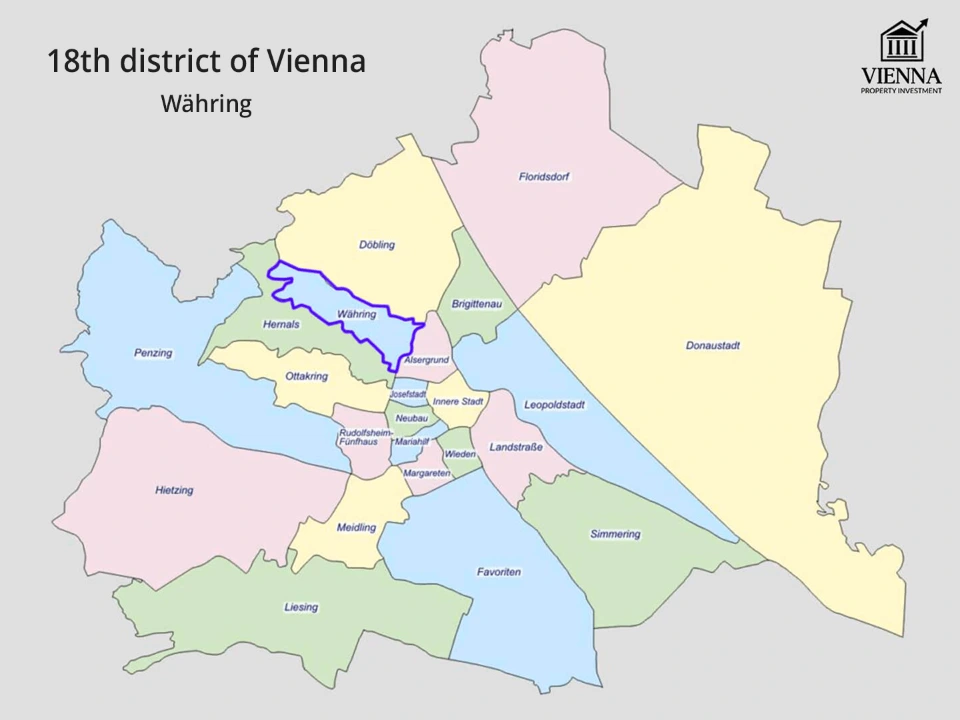
Vienna's 18th district (Währing) covers an area of approximately 6.28 km² and has a population of approximately 51,000 (Statistik Austria, 2024). In terms of population density, the district is considered "medium"—around 8,100 people per km²—significantly lower than central districts like Margareten or Ottakring, but higher than the "wine-growing" district of Döbling. This figure directly reflects the district's structure: Währing is not a monotonous mass of buildings, but a mosaic of dense neighborhoods near the Gürtel and spacious villas in the northern part.
Urban contrasts: from Gersthof to Pötzleinsdorf
Along the Gürtel, one of Vienna's main thoroughfares, Währing has the appearance of a classic urban district: it's dominated by apartment buildings from the late 19th and early 20th centuries, shops, restaurants, and tram stops. This section of the district is closer in spirit to the central districts and creates a more urban atmosphere.
The northern neighborhoods of Pötzleinsdorf and Neustift am Walde create a completely different impression. Here, villas nestle in gardens, narrow streets, and vineyards that climb the slopes of the Vienna Woods. This area is often called the "green heart of Währing." My Dutch clients, who bought a family home in Pötzleinsdorf, remark that in the mornings, "the view of the vineyards and mountains is more reminiscent of Italian Tuscany than the Austrian capital.".
Zoning by quarters
Vienna's 18th district (Währing) is unique in that it combines different development types, creating a sharp contrast between dynamic city streets and quiet, leafy suburban neighborhoods. This multi-layered nature creates demand for housing among a wide range of buyers and renters.
Gersthof and Währing er Straße are denser urban areas, dominated by multi-apartment tenement buildings from the late 19th and early 20th centuries. The housing is more compact and prices are lower than in the villa areas, making apartments popular with students, young professionals, and families who want to live in a prestigious area but closer to city amenities. The average price per square meter in these locations is around €5,500–6,500 per square meter, significantly lower than in the villa areas.
Pötzleinsdorf is the calling card of Währing. The neighborhood is known for its luxurious villas, gardens, and proximity to Pötzleinsdorfer Schlosspark. It is home to members of the Viennese intelligentsia, business owners, and expats. Villas in this area can reach prices of €10,000 per square meter and above, and rentals are almost always in the premium segment. One of my clients, an Austrian professor, bought a house here specifically for the quietness and access to green spaces, while the city center is just a 20-minute tram ride away.
Neustift am Walde and Salmannsdorf are historic wine villages integrated into the urban fabric. Heuriger (traditional wine taverns) are still active here, and the landscape literally blends into the Vienna Woods. These areas are attractive to those seeking a "countryside" atmosphere within the capital. For investors, this is a long-term strategy: prices are high, supply is limited, and liquidity persists for decades.
Weinhauser and, to some extent, Gersthof are intermediate neighborhoods offering more affordable housing while still offering quick access to the city center. They are a popular choice for families with children due to their proximity to schools and kindergartens. The market in this part of Vähring is stable: prices are rising moderately, but the risk of decline is minimal.
According to Statistik Austria and ImmoUnited, Währing is among the most prosperous districts of Vienna, where housing prices are steadily rising by 3-5% per year. Unlike some crime-ridden areas of Vienna (for example, parts of the 10th and 20th districts), the level of safety here remains high, further enhancing the district's appeal.
Population and social dynamics of Waring

Vienna's 18th district (Währing) has always been considered one of the most prosperous areas of the city, and its social structure confirms this status. Unlike more dynamic and youthful districts like Leopoldstadt or Favoriten, it boasts a more stable and mature population with a distinct academic and family focus. It's one of those livable districts in Vienna where prestige and tranquility create a stable social balance.
Demographic portrait
According to Statistik Austria (2024), Vienna's 18th district has a population of approximately 51,000. The population density is approximately 8,100 people/km², lower than in Leopoldstadt or Margareten, reflecting the presence of villas, green spaces, and a less dense urban fabric.
- The average age of residents is 43.7 years (in Vienna - 41.1).
- Families with children make up approximately 24% of households. For many, the proximity of schools (including prestigious grammar schools like Währinger Gymnasium) and parks plays a key role in choosing a neighborhood.
- Elderly people (65+) make up more than 20% of the population, which is higher than the city average.
- Students and researchers form a significant group thanks to the proximity to BOKU, the University of Vienna campus, and research institutes.
I can confirm this from my own experience: several of my clients are professors and researchers who chose Vienna's 18th district precisely for the balance between peace, prestige, and access to universities.
Dynamics and trends:
- Waring's population has been growing slowly, by only 1.5% over the past 10 years, indicating stability.
- The proportion of elderly people will increase: according to forecasts from MA23 (Stadt Wien, Statistik), by 2035 more than 25% of the population will be over 65 years old.
- For the real estate market, this means stable demand for high-quality apartments of medium and large sizes, as well as for barrier-free houses (barrierfreie Wohnungen).
Ethnic and cultural structure
Unlike Vienna's Arab districts, such as parts of the 10th (Favoriten) or 20th (Brigittenau), Währing has a different ethnic balance.
- The share of foreigners is about 25% (slightly lower than the city average of 30%).
- Among them, German-speaking expats (especially from Germany and Switzerland) predominate, as do people from Turkey.
- The presence of specialists from Eastern Europe and Asia engaged in IT and scientific projects is growing.
According to the WienIntegration Monitor 2023 report, Vähring demonstrates one of the highest levels of social integration: it has a lower concentration of "closed" communities than more crime-ridden areas of Vienna, such as parts of the 15th or 20th districts. Crime in the 18th district is 20-30% lower than the Vienna average. This confirms its status as a safe location and makes it attractive for families.
Social status and income
In socio-economic terms, Vienna's 18th district stands out for its high level of prosperity.
- The average income per capita is about €28,000 per year (for comparison: in Vienna it is €24,500).
- A high proportion of residents with higher education (more than 40% versus 33% in the city as a whole).
- Strong presence of representatives of the scientific and cultural elite.
This is also confirmed in the real estate market. In my experience, one family from Germany chose a villa in Pötzleinsdorf as their permanent residence, citing not only the quality of the property but also the social environment: "Here we are among professors, doctors, and architects, and this is felt even in everyday life.".
A balance of tradition and modern mobility
Unlike neighborhoods where short-term renters predominate (such as students in Ward 9), Waring has a high proportion of long-term homeowners. Over 55% of residents have lived in their apartments or houses for over 10 years. This creates a stable community and helps preserve traditions.
However, mobility is still growing. With increasing rental demand, especially for two- and three-bedroom apartments along the Gürtel and Gersthof, young IT and medical professionals are increasingly moving here.
The housing market: from council houses to prestigious villas

Vienna's 18th district (Währing) occupies a special place in the capital's real estate landscape. It's often considered one of Vienna's prestigious districts, along with the 19th ( Döbling ) and 13th ( Hietzing ), but it also boasts its own social balance. Unlike the less desirable neighborhoods on the outskirts, Währing offers a wide range of housing options: from a limited supply of municipal apartments to unique villas overlooking vineyards. Therefore, those planning to buy an apartment in Vienna should carefully consider this district. An important practical point: some categories of buyers may be subject to restrictions on foreigners purchasing real estate in Austria , so it's best to check this before choosing a property.
Social housing and the affordable segment
Despite its status as a "bourgeois district," Vähring also has social housing. According to Wiener Wohnen (2024), the share of municipal apartments is approximately 10-12% of the total housing stock. This is significantly lower than the city average (approximately 25%), but provides a certain level of affordability for less affluent groups.
- Social housing is mainly concentrated along the Gürtel, where apartment buildings were historically built.
- Typical apartments here are 40–70 m², with rents around €7–9/m².
I've encountered situations where university students and young professionals chose this segment for temporary housing. However, given the limited supply, demand always exceeds supply.
Luxury housing: villas and residences
The symbol of Währing is, of course, its villas in Pötzleinsdorf and Neustift am Walde. These areas initially developed as suburban resort areas for the 19th-century Viennese bourgeoisie, and this image has endured to this day.
- The villas were often designed by famous architects (Otto Wagner, Josef Hoffmann), and many of the buildings are architectural monuments.
- Today, such houses are luxury residences of 300–600 m² with gardens, swimming pools, and views of vineyards.
- The price of such properties starts from €10,000/m², and exclusive options exceed €15,000/m².
Compared to the neighboring 19th district (Döbling), where luxury housing costs on average 10-15% more, Vähring appears more affordable, but no less prestigious.
From my experience, one Austrian family bought a house in Neustift precisely because of its unique combination—peace, vineyards, proximity to mountain trails, and yet still only a 20-minute drive from the center of Vienna. They noted that "this area gives the feeling of a resort, but with the convenience of a city.".
The rental market: a stark contrast
The rental market in Waring is very diverse:
- Along Gürtel, mid-range apartment rents are around €14–16 per square meter. This is slightly lower than in central areas, making it attractive to students, university staff, and young professionals.
- In Pötzleinsdorf and Gersthof, rents for luxury apartments and houses can reach €25–30/m² and above.
- In mansions and villas, rent amounts to several thousand euros per month.
For my German clients, renting a house in Gersthof proved to be a temporary solution before purchasing—they used the time to search for a suitable villa. Interestingly, renting here gives them the opportunity to "try out" the area before buying.
| Segment | Location | Average purchase price | Average rent | Peculiarities |
|---|---|---|---|---|
| Social apartments | Gürtel, partly Gersthof | 3,500–4,500 €/m² | 7–9 €/m² | Low share, high demand |
| Old Fund | Along the Gürtel | 4,800–5,500 €/m² | 14–16 €/m² | Historical buildings |
| New buildings | Gersthof, Währinger Straße | 7,000–8,500 €/m² | 16–20 €/m² | Modern complexes |
| Luxury apartments | Pötzleinsdorf, Neustift | 9,500–12,000 €/m² | 20–25 €/m² | Panoramic views, prestige |
| Villas and residences | Neustift, Pötzleinsdorf | 10,000–15,000+ €/m² | 4,000–6,000 €/month | Unique objects |
Education: From Kindergartens to University Campuses
Währing has long been considered not only one of Vienna's most prosperous neighborhoods but also an area with a rich educational infrastructure. All levels of education are represented here, from kindergartens and primary schools to university faculties and research institutes. This is why many families consider Währing in Vienna an ideal neighborhood to live in, especially if they have school- or college-aged children.
Kindergartens and primary education

There are approximately 30 kindergartens (Kindergarten) in the district, both public and private. According to the Magistrat der Stadt Wien (MA 10), the availability of kindergarten places in Währing is above the city average, reducing the burden on parents.
- In Vähring there is a network of municipal kindergartens (Städtischer Kindergarten), which are free of charge; parents only pay for food (80–120 € per month).
- Private childcare centers, such as Kindergruppe Währing or Bilingual Kindergarten, are popular among expat families. Prices range from €400–€600 per month for German-language kindergartens to €700–€1,200 per month for international ones.
Many of my clients relocating with children from Germany and Switzerland have noted that, unlike other districts of Vienna, it's easier to find a place in a kindergarten with a German-English focus. This makes Währing particularly convenient for international families.
Primary schools (Volksschule) are public and free, with small expenses for food and teaching materials (€200–€300 per year). For example, Volksschule Semperstraße is known for its high-quality mathematics and language instruction. The area also has private primary schools with extensive language or religious programs, which can cost between €3,500–€8,000 per year.
Grammar schools and secondary education
Waring is home to the following well-known grammar schools:
- Bundesgymnasium und Bundesrealgymnasium Wien Währing (Döblinger Strasse 24)
- GRG 18 Bergheidengasse (Bergheidengasse 41–45).
These schools offer both classical and real gymnasium education. Tuition at state gymnasiums is free, with additional costs for travel, extracurricular activities, and teaching materials ranging from €300–€600 per year.
Music education is also highly regarded. The municipal Musikschule Währing offers lessons for €200–€400 per semester, while private lessons with teachers cost €40–€70 per hour.
Universities and research centers
The Währing district is home to university campuses, including the faculties of the University of Vienna (botany, biology), research centres in Türkenschanzpark, and departments of the Academy of Fine Arts (Akademie der bildenden Künste Wien).
For EU students, tuition at Austrian universities is virtually free (the administrative fee is approximately €20 per semester). For students from outside the EU, tuition is €726 per semester, making Vienna competitive with other European capitals.
Infrastructure and transport accessibility

Vienna's 18th district is known for its balanced combination of urban development and green spaces, boasting a well-developed yet human-oriented transportation system. The emphasis here is not only on public transportation , but also on cycling infrastructure and walking accessibility. For those choosing a Vienna district to live in, the transportation network is a decisive factor: it offers convenient access to the city center, university campuses, and neighboring prestigious neighborhoods.
Metro and urban rail: access nearby, but not inside
There's no direct metro service to Währing, a feature that shapes the district's unique character. However, the U6 station Währinger Straße–Volksoper and the Michelbeuern–AKH hub are located literally on the edge of the district. This allows residents to quickly connect to transfer hubs and reach the center of Vienna in 10–15 minutes.
In my experience, clients often note that the lack of a deep metro line is compensated for by a well-developed tram and bus network. One buyer from Switzerland told me, "I didn't want to live right on a U-Bahn line because of the noise and crowded conditions. But here I get a tram right at my door and a quiet neighborhood.".
Trams: convenient access to the university and the city center
Trams play a key role in the transport structure of Waring:
- Line 40 – connects Gersthof with the city centre (Schottentor, next to the main university).
- Line 41 goes via Türkenschanzplatz, making it convenient for students and teachers.
- Line 42 connects the area with the university districts and the Innerer Stadt.
The tram system operates reliably: according to Wiener Linien, the average wait time during rush hour is 3–5 minutes, making it comparable in convenience to the metro.
Buses and alternative mobility
The district also has several bus routes connecting the outskirts of Waring with neighboring neighborhoods and parks. This is especially important for families with children and older residents: unlike the metro and trams, buses reach deeper into the district's inner courtyards.
In recent years, Vienna has been actively developing its network of bicycle routes. New dedicated bike lanes have been added along Währinger Straße and toward Türkenschanzpark. According to statistics from MA 18 (Stadtentwicklung Wien), the share of bicycle trips in the district has increased from 7% in 2015 to over 12% in 2023.
STEP 2025 and development plans
According to the city's STEP 2025 development plan, Währing is included in the "short-distance city" (Stadt der kurzen Wege) strategy. This means that pedestrian areas and bicycle routes will be expanded in the coming years, and environmentally friendly transportation will be prioritized. Specifically, modernization of tram lines and the creation of "green transport corridors" toward Türkenschanzpark are under discussion.
Expert opinion. From a transportation perspective, Währing is a compromise: there's no metro line within the district, but it's well-connected via trams, buses, and nearby U-Bahn stations. For families and those working or studying in central Vienna, this is the ideal solution.
In practice, I've noticed that clients choosing Waring value balance: convenient access without excessive city noise. This directly impacts the real estate market. Apartments near tram hubs and U6 stations are more valuable: rents here are 8-12% higher than in the district's more remote neighborhoods. Thus, transportation becomes an additional driver of investment.
Parking space and environmental policy in Waring

Parking in Vienna is a topic that directly reflects the balance between resident comfort and sustainable urban development. In this regard, Vienna's 18th district demonstrates an approach typical of upscale residential areas: an emphasis on convenience for residents and reducing the burden of transit traffic.
For investors, parking isn't just a logistical issue; it's a factor in the property's liquidity. Apartments and houses with a private garage or underground parking options sell for an average of 8-12% more.
Parkpickerl: Residents' Pass
Since 2017, Vienna's 18th district has been offering a Parkpickerl (parking pass) for residents. It costs approximately €10 per month (€120 per year), allowing parking throughout the entire district. By comparison, guest parking is more expensive—an average of €2.20 per hour (data from the WienMagistrates' Office).
One of my clients, a family from Germany who bought an apartment in Pötzleinsdorf, noted that the Parkpickerl arrangement saved them from the daily search for a free space.
New garages and underground parking
The city is actively developing underground garages and Park & Ride parking facilities along the Gürtel and at key transportation hubs (Volksoper, Michelbeuern). Rents for a space in these facilities range from €90 to €140 per month, depending on the location. This is popular among apartment renters, as many buildings in the historic district lack their own off-street parking.
Reducing street parking and green projects
The city's policy is aimed at reducing on-street parking and greening streets. For example, under the "Supergrätzl Währing" program, which began in 2023, some streets are being converted into pedestrian zones with additional trees and bike lanes. For car owners, this means fewer free parking options, but increased property values with green surroundings.
My observation: buyers considering the 18th district as a place to live long-term are increasingly valuing quiet, car-free courtyards where children can play safely.
Religious diversity and cultural heritage of Waring
Vienna's 18th district (Währing) is known not only for its green parks and prestigious villas, but also for its rich religious and cultural heritage. Here, Catholic traditions, Protestant communities, Orthodox parishes, and Jewish cultural sites harmoniously blend. For many families who choose to live in Vienna's 18th district, the spiritual and cultural infrastructure is an important factor. Historically, Vienna, and especially Währing, remains Catholic in spirit.

Religious statistics in Vienna's 18th district:
- Catholics: 52.8%
- Orthodox Christians: 6.2%
- Muslims: 6.0%
- Protestants: 5.9%
- No religious affiliation: 21.4%
- Other religion: 1.8%
- Unknown: 5.7%
Several temples representing different architectural eras have survived in the area:
Catholic Churches:
- Pfarrkirche Währing (Church of St. Gertrude and St. Lawrence). This is one of the oldest churches in the district, mentioned as early as the 13th century. The current building was constructed in 1753 and significantly expanded in 1934. The church combines late Baroque and neo-Gothic elements. The interior features antique altars and an organ, as well as memorials related to the district's history.
- Lazaristenkirche (Church of St. Severian). Located in the Ganselberg district, this church was built in the neo-Gothic style by the architect Friedrich von Schmidt. It is dedicated to St. Severian of Noricum. The church was consecrated in 1880 and is the center of the Catholic community served by the Lazarist Congregation.
- Pfarrkirche Weinhaus (St. Joseph's Church). Located on Gentzgasse, the church was built between 1883 and 1889. It is dedicated to St. Joseph, the patron saint of workers and families. The church is known for its historicist architecture and is an important religious center for the local community.
Protestant and other Christian communities:
- The Lutherkirche (Lutheran Church) in Währing is an important center for the Evangelical community. Built in the Historicist style in 1898, it has become not only a place of worship but also a venue for cultural concerts and educational events.
- There are no Orthodox churches in Vienna's 18th district. However, several Orthodox churches serving various Orthodox communities are located in neighboring districts.
Jewish and interfaith initiatives:
- The Jewish Cemetery in Währing. Opened in 1784, this cemetery served as the primary burial site for members of the Israelite Cult Community of Vienna. Despite its closure in the 1880s and subsequent destruction during the Nazi era, the cemetery remains an important historical monument.
- In recent years, interreligious dialogue projects have been actively developing in the district. Catholic parishes, the Evangelical community, and Orthodox initiatives participate in joint cultural and charitable events. Programs such as "Lange Nacht der Kirchen" (Long Night of Churches) allow residents and visitors to experience the diversity of spiritual life.
The living cultural heart of Vienna's 18th district

Vienna's 18th district, Währing, is renowned not only as a prestigious residential area but also as a cultural hub with a rich history, architecture, and diverse leisure activities. For residents and investors, this means not only prestige and comfort but also a high quality of life, prized by expats and Viennese families.
Volksoper Wien – the heart of the cultural scene
The Volksoper Wien is the district's main attraction, renowned both in Austria and far beyond. The theater annually presents around 300 productions, from operettas and classical operas to ballet and musicals.
- Ticket prices range from €75 to €144 depending on the seat.
- Young spectators under 30 can take advantage of the U30 program and purchase a ticket for €15.
- A family pass costs €30 per season, offering discounts of up to 75% for children and significant discounts for adults.
One of my clients, a family who bought an apartment near the Volksoper, notes that the proximity to the theater has become more than just a convenience for them, but a true lifestyle—they choose new productions every week, and the area is perceived as a cultural center, not just a place to live.
Small theaters and cultural clubs
In addition to the Volksoper, the district is home to a vibrant community of smaller stages, cultural clubs, and literary societies. The Gersthof and Pötzleinsdorf neighborhoods host chamber performances, lectures, and musical evenings. This local cultural scene is prized by young families and university students, and it also enhances the district's investment appeal: real estate surrounded by such spaces is always in demand.
Galleries and architectural heritage
The 18th arrondissement contains numerous historic villas and buildings with 19th- and 20th-century architecture, many of which are open to public exhibitions.
- Schloss Pötzleinsdorf is a former residence and now a venue for exhibitions and chamber concerts.
- In Gersthof you can visit small private galleries of contemporary art, where works by local artists are exhibited.
For homebuyers, this means added value: many are looking not only for square footage, but also for the opportunity to live in a cultural environment.
Festivals and events: from wine festivals to street parades
One of the most famous events remains the Neustifter Kirtag, a wine festival held in August in Neustift am Walde. Although this quarter is administratively part of Döbling, it has historically close ties to Währing.
- Kirtag attracts up to 150,000 visitors annually.
- Entry is free, and there are market stalls, tastings, and traditional processions.
Another important cultural element is Vienna Wine Hiking Day. The route begins in the Neustift area and leads through vineyards, with stops in Heuriger. In 2025, the event will take place on September 27–28, and participation is free.
My clients who purchased townhouses in this part of the area note that the influx of tourists during the holidays not only creates a special atmosphere but also increases the profitability of short-term rentals.
Waring Parks and Vineyards

Vienna's 18th district has always been considered one of the greenest and most tranquil parts of the city. Situated between the bustling Gürtel and the edge of the Wiener Wald, its combination of developed urban infrastructure and abundant parks consistently ranks it among the best districts in Vienna to live in. Green spaces occupy approximately 30% of the district's area, significantly higher than the average for other central districts of the capital.
Türkenschanzpark – the symbol of Vähring
Türkenschanzpark is the district's largest park and one of the most beautiful in Vienna. Its history dates back to the 19th century, when a landscaped park with ponds, rare trees, and viewing platforms was established here
- Area: about 150,000 m².
- More than 400 species of plants grow here, including rare Asian and American trees.
- The park contains a Japanese garden, a gift to Vienna from the city of Yokohama.
My clients who bought apartments near Türkenschanzpark note that the ability to walk out of their building and be in a green area within five minutes was the deciding factor in their choice of apartment. Moreover, apartments with park views consistently cost 10-15% more than similar properties in neighboring neighborhoods.
Pötzleinsdorfer Schlosspark – History and Nature
In the northern part of the district is Pötzleinsdorfer Schlosspark, a former palace residence now open to the public. It features preserved linden tree alleys and is also a venue for chamber concerts and summer events.
- The park covers more than 400,000 m², making it one of the largest “urban forests”.
- Jogging, dog walking and picnics are permitted on the premises.
- The prestigious residential area of Pötzleinsdorf is located nearby, where property prices are traditionally higher than the average for the area.
Währinger Park and Setagayapark
- Währinger Park is a green oasis closer to the Gürtel, popular with students and young families. It features sports fields and quiet reading areas.
- Setagayapark is a small Japanese garden symbolizing the friendship between Vienna and the Japanese city of Setagaya. It is especially popular in the spring during cherry blossom season.
The presence of such unique spaces creates a distinct identity for the neighborhood. For investors, this means steady demand from renters seeking housing with access to parks.
Neustift and Salmannsdorf vineyards
On the northwestern outskirts of Währing are the quarters of Neustift am Walde and Salmannsdorf, famous for their vineyards and traditional wine taverns – Heuriger.
- There are tens of kilometers of walking trails here, some of which are part of the famous Wiener Weinwanderweg.
- In summer and autumn, the vineyards become a cultural centre: wine festivals attract tourists and Viennese from all over the region.
- Apartments and houses in these neighborhoods are particularly popular among affluent families who value the combination of nature and proximity to the city.
New greening projects
District authorities are actively developing programs to improve the urban environment:
- creation of green courtyards and green roofs,
- installation of "green facades" on new buildings,
- expansion of pedestrian zones and reduction of street parking in favor of green spaces.
According to the latest data from Stadt Wien (2024), Währing ranks among the top three districts in terms of per capita investment in environmental projects. This directly impacts prices: new residential complexes with green courtyards sell for an average of 8-12% more than similar ones without eco-infrastructure.
Small business, science and international relations

Vienna's 18th district, Währing, is often associated with green parks, prestigious residential areas, and wine taverns. But it's not just a "quiet" residential area; it's also a significant business cluster, where small businesses, research centers, and the service sector are actively developing. According to Magistratsabteilung 23 (Wirtschaft, Employment, and Statistics), Währing is home to over 2,800 registered companies, approximately 85% of which are small and medium-sized businesses.
Small Business and Gastronomy: Heuriger and Family Restaurants
A special place in the district's economy is occupied by traditional wine taverns (Heuriger), concentrated in the Neustift am Walde and Salmannsdorf neighborhoods. These establishments are more than just restaurants, but rather part of Viennese cultural identity, serving local wine and seasonal dishes.
- There are more than 60 Heuriger operating in Währing, and during wine festivals their turnover increases by 30–40% (data from Wiener Wirtschaftskammer, 2023).
- In addition to taverns, Währinger Straße and the surrounding streets are also home to a growing number of cafés, pastry shops, and small gastropubs catering to locals and students.
One of my clients purchased commercial space for a restaurant near Türkenschanzpark. Due to the steady flow of customers, the rental yield is around 5.5% per annum, which is higher than the average for residential properties in the area.
Universities and research centers
Währing is closely linked to the academic and scientific sectors. It is home to departments of the University of Vienna, including the Institutes of Biology and Chemistry, as well as several private research laboratories.
- The University of Vienna has over 90,000 students, some of whom live in the 18th district.
- The area is also home to the Institut für Höhere Studien (IHS), one of Austria's leading think tanks engaged in economic and social research.
This concentration of educational institutions increases demand for rental apartments near campuses. My clients renting apartments in the Gersthof area to students and young professionals achieve stable occupancy rates even with relatively high rents (starting at €15 per square meter).
Business activity and office areas
The main axes of business activity in Währing run along Gürtel and Währinger Straße.
- Gürtel remains a traditional transport and commercial corridor, home to medium-sized offices, medical practices and service companies.
- Währinger Straße is a dynamic shopping street where not only shops but also coworking spaces popular with freelancers and startups are actively developing.
According to ImmobilienScout24 (2024), office rents in Vähring range from 13 to 19 € per m², making the area more affordable compared to Innere Stadt (20–30 € per m²).
Modern projects and investments
Waring is now perceived not only as a traditionally prestigious residential area, but also as an area undergoing active architectural and environmental transformation. The area is gradually being renewed, preserving its historical character while offering housing and infrastructure that meet modern standards of comfort.
Reconstruction of historical buildings
One of the key trends in Vienna's 18th district remains the renovation of historic Gründerzeit houses and villas from the late 19th and early 20th centuries.
- According to WienReal Estate Market 2024, the share of renovated properties in the premium segment of Vähring has increased by 18% over the past five years.
- Many historic buildings are being expanded with penthouses, underground parking, and upgraded heating systems.
One of my clients purchased an apartment in a renovated apartment building near Währinger Park in 2021. Following the renovation, the property's value increased by more than 35%, and rental rates now reach €22–24 per square meter, making such projects a profitable long-term investment.
New residential complexes in Gersthof and along the Gürtel

The Gersthof district has become a magnet for new development projects, with boutique residential complexes offering apartments in the mid- to high-end price ranges being built here.
- The average price of new housing in Gersthof today is €8,500–€10,200 per m², which is somewhat lower than in Döbling, but higher than in neighboring Hernals.
- Along the Gürtel, modern mixed-use projects are emerging, combining apartments, offices, and service areas.
From an investment perspective, such properties are attractive due to their higher liquidity and stable demand among middle-class families.
Environmental initiatives and energy-efficient housing
Waring actively supports the "Smart City Wien" program. In recent years, projects have been implemented to expand green courtyards, install solar panels, and implement stormwater drainage systems.
- According to Stadt Wien (2023), around 20% of new residential projects in Vienna's 18th district are certified according to energy efficiency standards (klimaaktiv Gold or Passivhaus).
- This directly impacts prices: energy-efficient housing in Waring sells for an average of 10–12% more than similar traditional housing.
Such projects are particularly attractive to long-term investors, as energy efficiency reduces residents' utility costs and increases the property's attractiveness on the rental market.
Why Vienna's 18th district is consistently a top choice for investors
Vienna's 18th district, Währing, has long established itself as one of the capital's most prestigious and stable residential areas. Unlike Vienna's newer districts, which are being actively developed from scratch (Seestadt Aspern, Sonnwendviertel), Währing offers investors a mature market with limited supply, a high level of infrastructure, and a unique blend of cultural and natural heritage.

Price stability and limited supply
According to Immobilienpreisspiegel 2024, the average price of apartments in Vienna's 18th district ranges from €7,500 to €11,000 per square meter, while luxury villas can exceed €15,000 per square meter. Moreover, the supply of historic villas is extremely limited: less than 3% of the district's total housing stock enters the market annually.
Popular with families, expats and researchers
Waring enjoys steady demand among families with children (its proximity to international schools), researchers (universities and research centers nearby), and expats. This creates a balanced pool of high-income tenants.
Rental rates here average €16–22 per m², reaching €25–28 per m² in the premium segments. For long-term investors, this means not only a stable cash flow but also a low risk of vacant properties.
Prestige and green spaces as a demand factor

On the urban map, Währing stands out for its ecology: approximately 30% of the area is occupied by parks, vineyards, and green spaces. Türkenschanzpark and Pötzleinsdorfer Schlosspark enhance the district's appeal for families and those seeking a balance between urban infrastructure and proximity to nature.
These factors contribute to Waring's image as one of the best areas to live in, which directly translates into stable demand and minimal risk of price correction.
Long-term growth in villa prices
Particular attention should be paid to the villa segment in Vienna's 18th district. Here, price dynamics demonstrate steady, multi-year growth rather than short-term fluctuations. There are several reasons for this:
- limited supply (most villas are located in protected areas and are not subject to mass reconstruction);
- high demand from families, expats and members of the scientific elite;
- the prestige of the location, which has been built up over decades.
According to the RE/MAX Wohnbarometer 2024, villa prices in Vienna's 18th district have increased by an average of 65–70% over the past 10 years, exceeding the city average of around 45%.
| Type of apartment/housing | Area (m²) | Purchase price (€) | Rent (€ / month) | Peculiarities |
|---|---|---|---|---|
| Garsoniere (studio) | 30–40 m² | 250 000 – 320 000 | 700 – 900 | Popular with students and researchers, quickly rented out, but with limited price growth. |
| 2-room apartment | 50–70 m² | 420 000 – 600 000 | 1 100 – 1 500 | Ideal for young couples and expats, with high demand for long-term rentals. |
| Family apartment (3-4 rooms) | 80–120 m² | 750 000 – 1 200 000 | 1 900 – 2 800 | They are especially valued near parks (Türkenschanzpark, Pötzleinsdorfer Schlosspark), and are often purchased by families with children. |
| Penthouses and luxury apartments | 120–200 m² | 1.8 – 3.5 million | 4 000 – 6 500 | Terraces overlooking Vienna Woods, highly marketable, often purchased by expats and the business elite. |
| Villas (Gersthof, Neustift, Pötzleinsdorf) | 200–400 m² | 3 – 6 million (rarely up to 10 million) | 8 000 – 15 000 | Limited supply, high-status properties. Prices are steadily rising, making them attractive for long-term investment. |
Conclusion: Who is Waring suitable for?

Vienna's 18th district (Währing) isn't a choice for everyone, but for those who consciously seek comfort, prestige, and long-term value. The district boasts a relaxed pace of life, abundant green spaces, and a blend of historic architecture and contemporary design.
Above all, Vähring is ideal for families with children and those with high incomes who value safety, peace, and access to nature. Walks in Türkenschanzpark or Pötzleinsdorfer Schlosspark become part of everyday life, and prestigious schools and proximity to universities make the area especially convenient for families with children of all ages.
For investors, Währing is attractive due to its stability: the premium housing market here is developing smoothly, without any sharp declines, and prices for villas and large apartments are steadily rising. Unlike Vienna's newer districts, which are still developing their infrastructure, Währing offers an established balance: a well-developed social and transportation network, cultural institutions, restaurants, and wine taverns create a comfortable living environment.
Expats and researchers also find ideal living conditions here. The area borders university campuses and research centers, and the international community maintains an open and multilingual atmosphere. In my experience, several clients from Germany and Switzerland have chosen Vähring specifically to combine prestigious living with proximity to work and the university community.
In short, Vienna's 18th district is a haven for those who value quality over compromise: spacious housing, leafy streets, prestigious schools, and guaranteed investment liquidity. It's one of Vienna's best neighborhoods for living, where comfort and status go hand in hand, and buying real estate becomes not just about living but also about your future strategy.