Hernals (German: Hernals) is Vienna's 17th district, located in the northwest part of the city. Here, you can fully experience the big city atmosphere and enjoy the proximity to nature. The district is crossed by key transport routes.
Here you can stroll along bustling shopping streets and enjoy the green hills of the Vienna Woods, surrounded by the famous Viennese vineyards. Thanks to its convenient location, Hernals remains attractive both for living and for tourism.
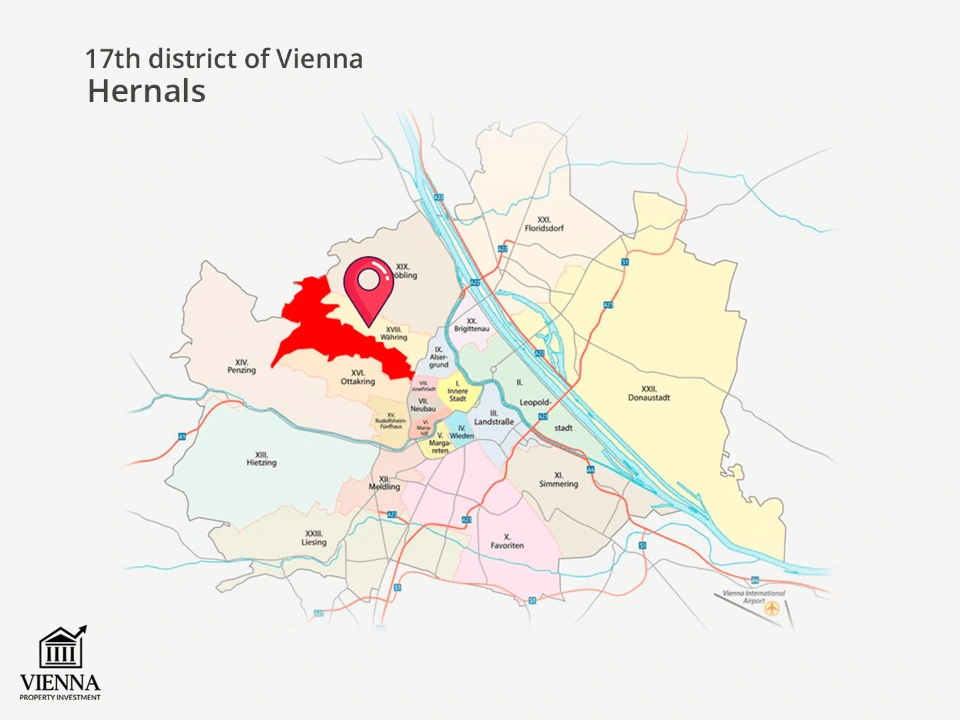
Looking at Vienna's districts on a map, you'll see that Hernals borders Ottakring (16th district) to the south and Wöhring (18th district) to the east. Its central neighborhoods are located along Hernals er Hauptstraße, the district's main street, which has historically been an important trade route. Thanks to its proximity to the city center (approximately 4-5 km to the Rathaus) and its well-developed transportation network, Hernals attracts families with children, students, and investors.
Hernals is a district in Vienna that has long been known as a center of winemaking and recreation . Traditional Austrian taverns, or Heurige, were built here, and many Viennese enjoyed strolling through the surrounding area. With the onset of industrialization in the 19th century, new residential areas began to appear in the district, and industry emerged. In the 20th century, the district went through various stages. During the "Red Vienna" era, many social housing units were built, and post-war reconstruction began in the second half of the 20th century.
Modern Hernals is a multicultural district where contemporary cultural initiatives thrive alongside Austrian traditions. Real estate values are steadily rising here. In this article, we'll explore the diversity of Hernals, as well as its historical heritage, infrastructure, housing market, cultural life, and investment potential.
History of the area

The history of Hernals dates back to the Middle Ages. The first mentions of settlements in the area of today's district date back to the 12th century. At that time, farms began to appear in the vicinity of Vienna, and vineyards were planted in the hills of the Vienna Woods, which remain an important part of the local economy to this day. Traditional wine taverns (Heurige) became vibrant hubs of social life.
19th century: industrialization and growth
From the mid-19th century, Vienna's 17th district experienced rapid development thanks to the Industrial Revolution. The first factories and workshops were built in the eastern part of Hernals. This had a positive impact on population growth, as many people from rural Austria moved there in search of work.
In the 1860s and 1870s, the transportation network rapidly expanded. Tram lines were built, connecting Hernals with central Vienna. This contributed to the emergence of dense residential development, which still influences the architectural appearance of the district's central quarters.
Incorporation into Vienna
In 1892, Hernals, along with the suburban villages of Dornbach and Neuwaldegg, officially became part of Vienna. This process marked the next stage of Vienna's expansion, known as "Groß-Wien." Following this, the area saw rapid infrastructure development and the emergence of new buildings.
The era of social democratic reforms
At the beginning of the 20th century, Hernals, like other districts of the city, embraced the ideas of "Red Vienna" (Rotes Wien). During this period, social housing (Gemeindebauten) was actively built. These were large residential complexes offering affordable apartments for workers and their families.
A typical example of the architecture of this period is Hernalser Hof, built in the 1920s. These residential complexes featured spacious courtyards and convenient infrastructure. Playgrounds were built nearby.
World War II and Reconstruction
During World War II, the district suffered from bombing, with the industrial eastern section suffering particularly severe damage. After the war, the city focused on rebuilding damaged buildings and the transportation network. In the 1950s and 1960s, old residential areas were actively modernized and new buildings were erected.
The current stage of development
Today, Hernals's architectural landscape is rapidly changing. Modern residential complexes and coworking spaces are being built in former industrial areas. A visit to the traditional wine districts near Neuwaldegg offers an unforgettable historical ambiance.
The city is actively investing in developing environmentally friendly transportation and expanding green spaces. This is reflected in its strategic development plan, STEP 2025 (Scribd – STEP 2025).
Modern Hernals cannot be imagined without its rich historical heritage and modern urban projects.
Zoning of the area
Hernals's history has influenced its functional division into zones and its contemporary development. The district is simultaneously part of Vienna's urban fabric and a gateway to the Vienna Woods. As a result, it combines all the hallmarks of a modern European city. It is always bustling with business activity. Furthermore, comfortable housing and natural recreation are available here.
The entire district is roughly divided into three main zones: central, eastern, and western. Each zone is distinguished by its own architectural features and development patterns.
The central part of the district is the historical core and business zone

The central quarters of Hernals are located along the main street, Hernalser Hauptstraße. Historically, it was the main trade route connecting Vienna with settlements in the northwest.
Located here:
- administrative buildings;
- shops and restaurants;
- cultural objects;
- municipal institutions.
This part of the district is distinguished by its dense 19th- and early 20th-century development. Many buildings were constructed here in the Viennese Historicist style, giving the streets a unique atmosphere. Elements of Classicism, Baroque, and Art Nouveau can be seen on the facades.
The central zone contains:
- Shopping streets such as Elterleinplatz and Kalvarienberggasse;
- Educational institutions, including gymnasiums and colleges;
- Municipal houses (Gemeindebauten) built during the period of "Red Vienna".
It is also home to key transport hubs, including tram lines that connect Hernals with the city centre and surrounding areas.
Please note: housing in the central areas of the district has high investment potential due to its convenient location and stable demand.
The eastern part consists of former industrial zones and modern residential areas.

Historically, the eastern quarters of Hernals were a vast industrial area. In the 19th and early 20th centuries, factories, small workshops, and warehouses were built here.
This area offers a wealth of insight into industrial :
- Textile and mechanical engineering factories operated in Wattgasse and its surroundings;
- The breweries supplied their products to local Heurige and bars.
Following the industrial decline of the 1970s and 1980s, many buildings were abandoned. Today, these structures are being actively renovated. Old factory buildings are being converted into new facilities:
- Modern residential complexes;
- Offices and coworking spaces;
- Art spaces and workshops for artists.
The green modernization of buildings and neighborhoods is a priority
An example: the renovation project on Wattgasse, where a former industrial site was converted into a residential complex with underground parking and green recreation areas.
This part of Hernals is often home to young professionals and their families. They are attracted by the affordable and modern housing. Rents and real estate costs here are lower than in central areas. Furthermore, it is much safer than Vienna's less desirable neighborhoods.
Comparative characteristics of zones
| District zone | Main functions | Character of development | Target audience |
|---|---|---|---|
| Central part | Administration, trade, culture | Historical buildings of the 19th–20th centuries, municipal houses | Workers, students, entrepreneurs |
| Eastern part | Housing, creative spaces | Modern houses, reconstructed factories | Young families, freelancers |
| Western Zone | Nature, winemaking, recreation | Villas, low-rise buildings | Families, pensioners, tourists |
Western Zone – Natural Areas and Vineyards of Neuwaldegg

The western part of Hernals is a true oasis of nature within the city limits. Here you'll find :
- hills of the Vienna Woods;
- vineyards;
- park areas.
Neuwaldegg is located in this area. Historically, country villas and wineries were built in this area. Winemaking traditions are still preserved here. Wine taverns (Heurige) remain an important part of the area's cultural and culinary life.
This natural area is popular with sports and outdoor enthusiasts. Here you'll find:
- Hiking tourist routes;
- Bicycle paths;
- Areas for family recreation and picnics.
The architecture of this part of the district is characterized by low building density . The predominant architectural styles here are:
- Private houses and villas;
- Low-rise residential complexes.
The western zone lacks busy shopping streets and industrial sites. These neighborhoods are ideal for a quiet lifestyle and ecotourism.
Interesting fact: according to Wien 's 17th district one of the greenest in the city.
Key areas and streets of the district
The area includes several distinct zones, each of which plays its own role in its life:
| Zone / object | Characteristic |
|---|---|
| Thaliastraße | A smooth shopping street with a variety of shops, cafes and restaurants, reflecting the multicultural atmosphere of the area. |
| Ottakringer Platz | The cultural heart of the area, home to festivals, concerts and community events. |
| Wilhelminenberg | An area of green hills and vineyards with panoramic views of Vienna, a popular holiday destination. |
| Brunnenmarkt | One of the largest markets in Vienna, a symbol of cultural diversity and gastronomic traditions. |
| Gürtel | The southern border of the district and an important transport hub with numerous metro stations and tram lines. |
The importance of zoning for district development
The functional division of Hernals influences not only its architecture but also its development strategy . The central quarters have become the district's signature landmark. It is here that the main administrative and cultural facilities are concentrated.
The eastern neighborhoods are becoming a hotbed for new projects. Innovative residential complexes and business centers are being built here. Residents of the western neighborhoods enjoy close proximity to nature. This part of the district has unique tourism potential.
The city administration is consistently implementing the STEP 2025 strategy, which is aimed at:
- Improving transport accessibility between parts of the district;
- Development of environmentally friendly transport;
- Preservation of natural and historical heritage.
Population and social structure of the Hernals district

Hernals boasts a vibrant multicultural environment, shaped over decades by migration and the fusion of cultural traditions. Situated between the bustling city centers and the Vienna Woods, the neighborhood is beloved by both locals and visitors from around the world.
Hernals is interesting not only for its cultural environment but also for its unique social structure. This also influences the formation of urban policy.
Ethnic composition
Hernals is home to a diverse mix of ethnic groups. In particular, many migrants have moved here from the following regions:
- Turkey and the Balkan countries (Serbia, Bosnia and Herzegovina, Croatia);
- Eastern Europe, especially Poland, the Czech Republic, Slovakia and Ukraine;
- Middle East and North Africa.
According to Stadt Wien Statistik , the proportion of foreigners will be around 30–32% in 2025. This figure is slightly higher than the Vienna average of around 28%.
Hernals thrives on cultural diversity. A variety of languages can be heard in shops and cafes. The streets are lined with ethnic food shops, cultural centers, and religious organizations representing various faiths.
Age structure
This area has a fairly balanced age structure. However, certain characteristics are worth noting:
- There are many families with children in the area, who are attracted by the presence of schools, kindergartens and parks;
- There are also a lot of elderly people here. About 23% of the population is over 65 years old;
- Young people and students rent housing in this area because it is affordable and has easy access to higher education institutions.
Recently, the number of young professionals from the creative and IT industries has increased. They prefer to live in Hernals because they appreciate its unique atmosphere and easy access to the city center.
Income and standard of living

The income level of the population of Hernals is close to the Vienna average. However, it is lower than in central districts such as the 1st (Innere Stadt) or the 7th (Neubau).
Housing in the eastern neighborhoods, located closer to Hernalser Gürtel, is more affordable. This is where people with lower incomes live.
At the same time, the western districts located near the Vienna Woods, such as Neuwaldegg, are considered more expensive and prestigious. The standard of living here is significantly higher.
Average annual household income:
| Indicator | Eastern part | Central part | Western part (Vienna Woods) |
|---|---|---|---|
| Average household income (€ per year) | 38 000 | 44 000 | 56 000 |
Social contrasts
The social structure of the region is quite heterogeneous.
- The eastern part. These neighborhoods have a high population density. This part was built up earlier. People with lower incomes, including migrants, live here. Many people rent housing.
- The western part. Apartments here are more spacious, and houses and villas were built more recently. The population density here is low, and the standard of living remains high.
This contrast creates challenges for urban policy. Authorities strive to integrate migrants, ensure equal access to education and healthcare, and create new jobs for residents.
The role of students and creative youth
Vienna's 17th district attracts many students, young professionals and creative professionals.
This area is located close to Vienna's cultural centers, and convenient metro and tram lines make it an excellent option for this category of people.
Convenient transportation links facilitate the development of coworking spaces, cafes, and cultural spaces, ensuring the area is always bustling with young people.
Security and law and order
Hernals is considered one of the safest neighborhoods in Vienna, making it attractive to families with children and older residents. Law and order are maintained in the neighborhood by several police departments. It also actively participates in the city's "Gemeinsam Sicher" program, which aims to increase trust between residents and law enforcement. This contributes to improved safety in the city's neighborhoods.
One of the key safety measures is youth prevention programs aimed at reducing juvenile delinquency and engaging young people in sports and cultural activities. These programs help children and adolescents develop social skills and gain information about laws and safety rules.
Infrastructure is equally important for creating a safe urban environment . CCTV cameras have been installed in the central areas of Hernals, allowing police to respond promptly to crime. Significant attention is also paid to the lighting of streets, parks, and pedestrian areas. Well-lit streets create a sense of security and reduce the risk of crime.
The high level of safety in Hernals is confirmed by statistics. According to 2024 data, the crime rate in the district is 15% lower than the Vienna average. The main reason for these figures is the successful social integration of migrants. This is also facilitated by preventative measures and the creation of a modern technological infrastructure. Local initiatives aim to bring together residents of different cultures and nationalities. This approach helps strengthen social ties and reduce conflict.
Unlike Vienna's Arab neighborhoods, Hernals boasts a diverse and multicultural community. Hernals police actively engage with local communities. Law enforcement officials organize meetings with residents, provide advice on safety issues, and hold events that promote trust in law enforcement. Seniors can participate in special programs to learn how to avoid scams and navigate the neighborhood safely.
Vienna's 17th district has achieved success thanks to modern safety measures, proactive prevention, and a high level of social integration. The district remains a comfortable place to live and visit.
Housing: social and modern complexes

Hernals's housing stock is strikingly diverse. The neighborhood's architectural appearance reflects its rich history and contemporary urban trends. Here you'll find historic 19th-century buildings, municipal housing from the 1920s, and modern residential complexes built in recent years.
Social housing (Gemeindebauten)

Social housing accounts for approximately 20% of the district's total housing stock. Many of these buildings were built as part of the famous "Red Vienna" (Rotes Wien) program, which aimed to provide workers and low-income families with affordable housing.
The most famous examples are:

- Hernals er Hof is one of the largest municipal complexes in the area;
- Balderichgasse Wohnanlage is a residential complex known for its spacious courtyards and playgrounds.
City authorities are actively renovating many buildings: updating facades, installing solar panels, and improving thermal insulation.
Modern projects and renovations

In recent years, the area has seen a surge in the construction of modern residential complexes. Most of these have been built in the prestigious western neighborhoods near Neuwaldegg .
Key trends:
- Implementation of green technologies: energy-efficient heating systems, solar panels, and rainwater collection systems are installed;
- Use of environmentally friendly materials in construction;
- Maintaining a balance between nature and the urban environment means creating parks and creating squares in courtyards.
A popular trend is the conversion of former factory buildings into loft apartments. This type of housing remains highly attractive to investors and creative industries.
Real estate market
Housing prices in Hernals can be considered moderate compared to central Vienna.
The average property price in 2025 was approximately €5,300/m². Rents ranged from €14–16/m², making Hernals one of Vienna's best neighborhoods to live in.
Prices are higher in prestigious neighborhoods near the Vienna Woods. The environment here is more favorable, so apartments and houses are in high demand.
| Property type | Price per m² (purchase) | Rent per m² |
|---|---|---|
| Social housing | 3 800 – 4 200 € | 8 – 10 € |
| New buildings | 5 500 – 6 000 € | 15 – 18 € |
| Premium neighborhoods | 6 200 – 6 500 € | 20 €+ |
Demand and Prospects:
- There remains high demand for rental properties among students and young professionals;
- A gradual increase in prices in the western quarters is expected (about 4–5% per year);
- Many investors are showing interest in renovating old buildings and converting them into premium housing.
Education and educational institutions
Hernals boasts a well-developed network of educational institutions, making it a popular choice for families with children, students, and young professionals. Vienna's 17th district plays a key role in the capital's education system. Here you'll find public schools, specialized upper secondary schools, vocational colleges, and continuing education centers.
In recent years, the city's Bildung Wien 2030 program has been actively implementing innovative teaching methods, digital technologies, and international programs. This has a positive impact on the integration of migrants and contributes to the development of a young generation that is competitive in the labor market.
The school network is the basis of the education system
The area offers a variety of educational institutions for children of all ages, from preschoolers to teenagers.
Main types of schools:

- Volksschulen (primary schools) – basic education for children aged 6 to 10 years.
In Hernals, education is available in multiple languages. This is especially important for children from migrant families. A number of schools offer early learning programs for English and French.
- Mittelschulen (secondary schools) are where children aged 10–14 receive an education. The main focus is on preparing them for admission to gymnasiums or colleges.
- Gymnasien (grammar schools) provide advanced education in the natural sciences, languages, and humanities.
Prestigious schools in the area:
- Rainergymnasium Hernals is one of Vienna's most renowned educational institutions. The school specializes in foreign language studies and international exchange programs. It actively collaborates with educational institutions across Europe through its participation in the Erasmus+ program.
- BG & BRG Hernals is a high school with a strong focus on natural sciences and innovative teaching practices.
- Volksschule Kalvarienberggasse is a primary school with digital integration into the teaching process.
| School level | Age of students | Example of institutions in Hernals |
|---|---|---|
| Volksschule (primary) | 6–10 years | Volksschule Kalvarienberggasse |
| Mittelschule (secondary) | 10–14 years | Mittelschule Geblergasse |
| Gymnasium (grammar school) | 11–18 years old | Rainergymnasium Hernals |
Kindergartens and preschool education

Hernals boasts a well-developed network of kindergartens, both public and private. This helps ensure the area remains attractive to families with young children.
An important feature of these educational institutions is that they offer special programs for children from multicultural families.
Some kindergartens offer instruction in German and English or German and Turkish. This allows children to adapt more quickly to society.
In recent years, the city has been actively investing in modernizing preschools. Safe play areas are being created, environmental education programs are being implemented, and a healthy nutrition system is being introduced.
Vocational schools and colleges

The area itself is home to numerous technical and vocational schools that train specialists who will later work in key sectors of the Vienna economy.

- HTL Wien Ottakring is a large technical school near Hernals, where students study mechanical engineering, IT, robotics and industrial design.
- BHAK/BHAS Wien 17 is a commercial college that offers programs in business, accounting, and management.
- The Vienna Academy of Tourism is a popular educational institution among students planning a career in the hotel and tourism industry.
Many colleges have entered into partnerships with companies and startups, allowing students to gain internships and experience while studying.
| Educational institution | Main specialization | Number of students |
|---|---|---|
| HTL Wien Ottakring | Technical sciences, IT | ≈ 2 500 |
| BHAK/BHAS Wien 17 | Business, management, accounting | ≈ 1 200 |
| Akademie für Tourismus Wien | Tourism, hotel management | ≈ 800 |
Further education and adult education
Adult locals and migrants can attend continuing education centres, which offer a wide range of courses:
- German language courses for integration into society;
- Professional retraining for in-demand professions;
- Courses in web design, programming, online marketing and other digital skills;
- Theatre groups, fine arts and music clubs.
The VHS Hernals Centre (Volkshochschule Hernals) is considered the main educational hub of the district.
Over 200 courses are offered annually, including:
- Courses to prepare for Austrian citizenship;
- Programs for seniors that enable everyone to actively practice a healthy lifestyle;
- Evening classes for working students.
Accessibility of universities and higher education
Although there are no major universities in Hernals itself, many students live in the area because it is easy to get anywhere thanks to the well-developed transport system.
From Hernals, you can take a tram or metro and reach Vienna's largest universities in 15–20 minutes:

- The University of Vienna (Universität Wien ) is the main scientific center of Austria;
- The Technical University of Vienna (TU Wien ) is a leading university in engineering and IT fields;

- The Academy of Fine Arts Vienna (Akademie der bildenden Künste Wien ) is a popular educational institution among those who want to pursue a creative profession.
Prospects for the development of the educational system
Bildung Wien 2030 program, the district plans to:
- Construction of new kindergartens and schools in the western part of Hernals;
- The use of “green technologies” for the reconstruction of educational buildings, in particular the installation of solar panels and energy-efficient heating systems;
- Increasing the number of language courses for children from migrant families;
- Modernization of libraries and creation of youth cultural and educational centers.
These initiatives are expected to increase the attractiveness of the area for families with children and create conditions for the development of a new generation of Hernals residents.
Infrastructure and transport of Hernals

Hernals's transportation system plays a key role in the neighborhood's life. Thanks to its well-developed public transportation system, everyone can easily reach Vienna's city center and suburbs. Metro, tram, and bus services are available. The area also boasts numerous modern bike paths.
Residents and tourists alike can quickly access shopping centers, residential complexes, and the Vienna Woods. The city government is actively investing in developing Hernals's transportation network. The STEP 2025 strategic plan aims to create an environmentally friendly and convenient urban environment.
Metro
The U6 metro line, which runs along Hernalser Gürtel, has become a vital element of the district's transportation system. It provides connections from Hernals to key areas of Vienna, including the Westbahnhof and central districts. The largest number of passengers board at Alser Straße, which serves the eastern residential and business districts, and Michelbeuern-AKH, located near the Allgemeines Krankenhaus Wien, the country's largest hospital.
The metro makes this area very convenient for medical students and healthcare workers. The metro connects you to the city center in 20 minutes with one transfer, making it a popular choice for both locals and tourists.
Trams

In addition to the metro, residents of the district can also use the tram. It is traditionally considered the symbol of Viennese public transportation. Trams 43 and 44 offer quick access from the western and eastern districts of Hernals to the center of Vienna. Route 43 is considered one of the most popular in the city, as it passes through densely populated areas. It is the preferred choice of residents of the western districts and tourists visiting the Vienna Woods.
Tram route 44 runs through the eastern districts and is frequently used by those commuting to work and school. Tram route 2 also runs through the district, connecting Ringstraße with transportation hubs in western Vienna. Trams operate daily from early morning until midnight, with intervals of approximately five minutes during rush hour.
There are no tram lines in the western and northwestern parts of the district, so bus routes account for the bulk of the transportation. They are especially important for residents of sparsely populated areas near the Vienna Woods and for tourists who want to stroll through the forest park and vineyards. Routes 10A and 42A provide quick access to the forest from the metro and stations located in the eastern part of the district. Buses also play a vital role in the development of tourism, providing quick access to popular hiking trails and pedestrian areas.
Bicycle transport
In recent years, the city of Hernals has been actively developing its cycling infrastructure. As part of the STEP 2025 program, the city is investing in new bike paths connecting densely populated areas with parks and the Vienna Woods.
Bicycle routes are becoming part of pedestrian streets and spaces near schools. They are completely safe and convenient for travel. Routes along Dornbacher Straße and near Schafbergpark are particularly popular. Additionally, special bicycle parking areas are being created at metro stations and near schools.
The district plans to develop its transportation network and modernize key hubs. It is expected that more people will switch to eco-friendly modes of transportation. A large-scale reconstruction Hernalser Gürtel is planned for 2027. Tram lines will be upgraded, pedestrian areas will be expanded, and modern stops with electronic information boards will be installed.
A project to create eco-friendly bicycle routes is also under development in the district, connecting the district's central streets with the forested parklands of the Vienna Woods. In the long term, city authorities plan to implement smart traffic control systems. This will reduce congestion and improve road safety.
Hernals's transportation system is rapidly developing. Residents can use traditional modes of transport and innovative eco-friendly solutions. This makes the area very convenient for living, working, and visiting. Furthermore, the investment appeal of real estate has increased.
Parking and city parking policy
In Hernals, as in other districts of Vienna, a convenient parking system was created. This has made the area more attractive to car owners. At the same time, the district has gained more convenient and accessible public spaces. Vienna's 17th district is actively implementing a "smart parking management" strategy. Its goal is to reduce street traffic and encourage those using public transportation or cycling.
One of the key elements of this system is a special parking permit— the Parkpickerl . It allows parking near your home. As of 2025, the cost of such a permit will range from 120 to 150 euros per year. It can be obtained online through the wien.gv.at wien or at municipal district offices.

Short-term parking zones are available along Hernalser Hauptstraße and in other central and shopping areas of the district. These zones allow parking for up to two hours. This is especially convenient for visitors to shopping centers and cafes.
The cost is approximately €2.50 per hour. Parking can be paid for using the modern Handyparken Wienmobile app. This innovation helps make parking spaces accessible and encourages the use of public transportation for longer trips.
New residential complexes and modern business centers in Hernals are designed with car owners in mind. Many buildings feature underground parking equipped with charging stations for electric vehicles. This is especially important given the growing popularity of electric transportation in Vienna.
The city is also piloting green roof projects in multi-story parking garages. This reduces building temperatures in the summer and improves environmental conditions. Initiatives like these place Hernals among Vienna's best neighborhoods.
In the long term, municipal authorities plan to gradually reduce the number of on-street parking spaces. In their place, green spaces, playgrounds, and expanded bike paths will be created.
This approach has already been implemented in some neighborhoods, where former parking spaces have been converted into public recreation areas. Such solutions enhance the aesthetic appeal of the area and make it safer for pedestrians.
| Parking type | Description | Cost (approximate) | Time of action | Peculiarities |
|---|---|---|---|---|
| Parkpickerl (resident permit) | Annual permit for area residents to park near their home. | 120–150 €/year | Constantly, without restrictions | Confirmation of registration at the residential address is required. |
| Short-term parking (Kurzparkzone) | Parking in central and commercial areas for visitors to shops and cafes. | 2.50 € / hour | Mon–Fri: 9:00–22:00, Sat: 9:00–18:00 |
Payment via the Handyparken Wien app or parking meters. |
| Underground garages | Modern indoor parking near residential complexes and shopping centers. | 3.00–4.50 €/hour, 120–170 €/month |
24/7 | Often equipped with charging stations for electric vehicles. |
| Multi-level parking garages with green roofs | New projects with ecological infrastructure. | 3.50–5.00 €/hour, 150–190 €/month |
24/7 | Reducing the temperature on city streets in summer, integrating green areas. |
| Parking at the Vienna Woods (rest area) | Parking near natural areas and tourist routes. | 1.50–2.00 €/hour | Mon–Sun: 7:00–21:00 | Often seasonal rates, popular with tourists and cyclists. |
| Electric car stations (Carsharing) | Special places for electric vehicles and car sharing. | Free for season ticket holders. Everyone else pays ~€1.50/30 min. | 24/7 | Mainly near metro stations and residential complexes. |
Religion and religious institutions
Vienna's 17th district is known for its rich religious and cultural history. Representatives of various faiths coexist harmoniously here. The district's religious institutions fulfill an important spiritual function and play a key role in the social integration of migrants and the development of local communities.
The area is home to Catholic churches, Orthodox parishes, Muslim cultural centers, and Buddhist and Jewish organizations. Each organization contributes to the area's cultural diversity.

Catholicism remains the dominant religion in Hernals. Among the most famous churches is the Kalvarienbergkirche . It is the spiritual center of the district and a popular venue for the annual Kalvarienbergmarkt. This festival attracts both locals and tourists, reminding visitors of the district's rich traditions and contributing to the city's contemporary culture.

The Pfarrkirche Dornbach is located in the western part of the district. This church is known for its historic architecture. It also hosts charitable projects aimed at supporting low-income families and the elderly.
Orthodox parishes also play a significant role. Their membership includes representatives from the diaspora from Eastern Europe and the Balkans. The Serbian Orthodox Church regularly hosts cultural events and services, uniting the Serbian community of Hernals.
The Romanian parish is actively involved in educational activities. Free German language courses are available. The parish also provides assistance with the integration of new residents in the area. The Greek Orthodox Center serves as a meeting place and cultural initiatives for the Greek diaspora. These organizations foster ties between different ethnic groups and help preserve cultural traditions.
The Muslim community is represented by several mosques and cultural centers. In addition to religious services, integration courses and German language classes are available. Employment counseling is also provided. Thus, the mosques serve not only as spiritual but also as social centers, facilitating the successful integration of migrants into Austrian society.
Buddhist organizations, though smaller in number, play an important role in the neighborhood's cultural life. They are popular among students and creative youth. They offer meditation and Eastern philosophy classes, as well as intercultural exchange events. Jewish organizations, despite their small community, actively participate in educational projects and promote interreligious dialogue.
Hernals's religious institutions serve not only a spiritual but also a social function. Many of them provide free legal consultations, German language courses, job search assistance, and leisure activities. Thus, they become an important part of the neighborhood's social infrastructure and contribute significantly to creating an atmosphere of trust, tolerance, and mutual support.
Culture, Leisure and Events
Hernals is considered one of Vienna's most prosperous neighborhoods. It boasts a vibrant cultural scene, thriving thanks to its traditions. Here you can experience the atmosphere of old Vienna, visit wine taverns, and enjoy performances in small theaters. Numerous cultural events and projects are also held here. This neighborhood offers something for everyone, from locals to tourists seeking a true Vienna experience.
The Kulisse Theatre is one of the city's main cultural centers. It is known for its chamber productions. It also hosts stand-up comedy and musical concerts. The theater often serves as a venue for independent companies, offering innovative interpretations of classical works and contemporary productions.
Besides Kulisse, the area boasts several small independent stages where young directors stage plays and musicians and dance groups perform. These spaces positively influence the development of the area's cultural community.

Metropol Kino occupies a special place in Hernals's cultural life . This cinema has become a venue for concerts and themed festivals. It regularly hosts retrospective screenings of old films, discussions about cinema, and events at international film festivals such as Viennale.
Metropol also frequently hosts live concerts, such as jazz and blues nights, making it an important cultural hub for the area.

The Bezirksmuseum Hernals is considered the center of Hernals's museum life . Here, you can learn more about the area's history: from the first wine-growing villages to its transformation into part of modern Vienna. The museum displays antique photographs, maps, and household items that help better understand the area's development.
In addition, Hernals boasts small art galleries showcasing local artists and photographers. These galleries often collaborate with young artists and host workshops.

One of the most memorable events of the year is the Kalvarienbergfest . This traditional spring festival takes place near the Kalvarienberg Church. The event features open-air theater performances, craft fairs, and musical performances.
In summer, the district's cultural life becomes even more vibrant thanks to concerts held in parks and open spaces, such as Schafbergpark . These events are free and attract hundreds of spectators.

Wine taverns (Heurige) occupy a special place in Hernals' cultural life. Here, you can sample local wines and soak up the atmosphere of old Vienna. At Heurige, you can enjoy live music and sample traditional cuisine.
This offers locals and tourists a unique experience. Wine taverns play an important role in preserving the area's cultural heritage, with many of them having existed for generations.
| Location / object | Type | Description | Address / District | Peculiarities |
|---|---|---|---|---|
| Theater Kulisse | Theatre, concert venue | Chamber performances, stand-up comedy, musical evenings | Rosensteingasse 39, 1170 Wien | Independent plays and comedy shows |
| Metropol Kino | Cinema, concert hall | Film festivals, retrospective screenings, jazz and blues concerts | Hernalser Hauptstraße 55, 1170 Wien | Center for Cultural Events |
| Bezirksmuseum Hernals | History Museum | Exhibitions on the history of Hernals and Vienna | Hernalser Hauptstraße 72, 1170 Wien | Excursions and historical exhibitions |
| Kalvarienbergkirche | Cultural and religious center | The venue of the traditional Kalvarienbergfest | Kalvarienberggasse 25, 1170 Wien | Spring festival and fairs |
| Brunnenmarkt | Market, cultural space | A meeting place for cultural events, gastronomy and street concerts | Near Hernalser Hauptstraße | Cultural diversity and gastronomic tourism |
| Heurige 17th district | Wine taverns | Traditional wineries with local cuisine and music | Neuwaldegg Vineyards, Dornbach | Preserving wine culture |
| Schafbergpark Open-Air Stage | Open stage in the park | Summer concerts, theatrical performances | Schafbergpark, western part of the district | Free open-air events |
Parks and green spaces
Hernals is rightfully considered one of Vienna's greenest neighborhoods. Its proximity to the Vienna Woods allows everyone to enjoy city life and relax in nature. Hernals boasts numerous forests and parks, ensuring fresh air. Furthermore, green spaces have become an important element of the urban ecosystem.
There are several main green areas in the area:
- The Vienna Woods is the largest natural area in the western part of Vienna, part of which is located in Hernals. The forest covers over 1,000 hectares and is ideal for hiking, cycling, and jogging. It also hosts environmental education programs for children and schoolchildren.
- Schafbergpark is known for its observation decks offering views of Vienna. The park covers approximately 5 hectares and features sports areas, playgrounds, and picnic areas. In the summer, it hosts open-air concerts and theater performances.

- Neuwaldegger Park is a small but cozy park ideal for family recreation. It features play areas for children, walking paths, and quiet corners for secluded relaxation.
| Park / area | Square | Peculiarities |
|---|---|---|
| Vienna Woods | 1000+ hectares | Forests, hiking trails, ecological paths |
| Schafbergpark | 5 hectares | Panoramic views, sports and children's areas |
| Neuwaldegger Park | 3 hectares | Family recreation, playgrounds |
New landscaping projects
As part of the STEP 2025 program, the Vienna City Council is actively investing in the creation of parks and greening of city streets. One of the priorities is the conversion of old parking areas into green spaces. For example, in the eastern part of Hernals, a new 1.2-hectare park was opened in 2024, created on the site of an abandoned parking lot.
Like other new districts in Vienna, Hernals actively uses ecological technologies in construction, for example, green roofs and vertical gardens on the facades of new buildings.
Vineyards are considered one of the unique assets of this area. The western part of Hernals is home to Vienna's oldest vineyards, where traditional wines are still produced. Not only do they contribute significantly to the economy, but they are also popular tourist destinations. The vineyards can be visited during a tour of the Vienna Woods. They have become part of Vienna's cultural heritage.
Economy and business activity
The economy of Vienna's 17th district thrives thanks to the profitability of traditional small businesses, the contribution of creative industries, and urban investment. The district is known for its cafés, wine taverns (Heurige), and family-run shops. As a result, the local retail network is quite extensive. Most of the shops and offices are located along Hernalser Hauptstraße, the district's main commercial artery.
Creative workshops and artisan businesses play a special role in the economy. Furniture production, art studios, and design ateliers are actively developing here. These businesses not only contribute to the economy but also enhance the cultural value of the district, attracting tourists and shoppers from all over Vienna.

In recent years, Hernals has become home to numerous small and medium-sized companies, particularly in the IT and creative industries. New office spaces have been created in renovated buildings along Hernalser Gürtel and near transport hubs.
The convenient location allows companies to reduce rental costs. Prices here are lower than in Vienna's 1st and 7th districts.
| Business sphere | Examples of enterprises | Role for the district |
|---|---|---|
| Gastronomy | Wine taverns, family cafes | Preservation of cultural traditions, tourism |
| Craft workshops | Carpentry and ceramic workshops | Development of the local economy |
| IT and creative industries | Design studios, startups | Innovation and jobs |
| Retail | Shops along Hernalser Hauptstraße | Convenience for residents and tourists |
Residents can quickly reach Vienna's business districts thanks to its well-developed transportation infrastructure. Metro line U6 and tram routes 43 and 44 provide quick connections to the city center and other districts.
Hernals carefully preserves its centuries-old traditions and is actively building a modern economy, making it a great place to live.
Tourism and gastronomic offers

In Hernals, tourists can fully experience the atmosphere of traditional Austrian culture. The area attracts not only locals but also visitors interested in its history, nature, and culinary offerings. Hernals's main attraction is its wine taverns, known as Heurige. Here you can sample local wines and snacks prepared according to centuries-old recipes.
Many of these establishments are located near vineyards. Their visitors can enjoy the natural beauty and historical atmosphere of Old Vienna. Here, you can relax on the terrace, admiring the green slopes and listening to traditional music.
Besides Heurige, Hernals offers many other establishments. The area also hosts food festivals in the spring and fall, where local producers sell their wines, cheeses, sausages, and bread. These events not only offer a chance to sample Austrian delicacies but also serve as cultural experiences that bring together locals and tourists.
For those seeking a more active experience, tours of wineries and vineyards are available, where experienced guides explain the winemaking process, as well as the local climate and grape varieties. These tours often include tastings right at the winery, making the trip a true immersion into the region's culture.
Beyond gastronomy, Vienna's 17th district is rich in historical and cultural attractions. The district's historic streets, narrow alleys, and ancient buildings create a unique atmosphere that tourists especially appreciate. Cultural tours include visits to old churches, museums, and city squares, where workshops and folk art exhibitions are held.
Restaurants place special emphasis on partnering with local farmers and wineries. This helps support the local economy and develop environmentally friendly food production.
This approach improves the quality of dishes offered in restaurants, helping to fuel the growth of gastronomic tourism. Tourists can sample fresh seasonal produce, learn about traditional cooking techniques, and even participate in cooking master classes.
Modern projects and investments

In recent years, Hernals has been actively involved in the implementation of Vienna's sustainable development strategy. The district is implementing key urban initiatives aimed at improving quality of life, enhancing the environment, and attracting investment. By combining traditional and modern approaches to urban planning, Hernals is becoming attractive not only to residents but also to investors.
Particular attention is being paid to the development of the western part of the district, Neuwaldegg . New residential complexes utilizing green technologies are being actively built here. These projects include the installation of solar panels and rainwater collection systems, and are being constructed using energy-efficient materials.
If you're looking for the best neighborhoods to live in Vienna, consider Hernals, as it's actively developing. For example, construction of a 150-apartment residential quarter began in 2025. A kindergarten and pedestrian areas are also being built in the quarter. The buildings will have green roofs. The goal of such projects is to create a comfortable and environmentally friendly environment for families with children and young professionals.
An equally important area is the renovation of old industrial buildings. The eastern part of the district was formerly home to factories and workshops. Now, it's being actively developed with residential complexes, coworking spaces, and creative hubs. Loft apartments and offices in former industrial buildings are in demand among IT professionals and freelancers. Renovating residential buildings allows us to preserve the district's historical character while simultaneously breathing new life into it.
Hernals is actively involved in the implementation of the city's STEP 2025 program, which aims to achieve the following goals:
- Increasing the area of green spaces;
- Improving pedestrian accessibility;
- Expansion of the network of bicycle paths connecting the area with the Vienna Woods and the central part of Vienna.
The city is also actively investing in the creative and tourism sectors. The development of wine routes and gastronomic tourism helps preserve the area's cultural traditions and attract new visitors.
| Project | Description | Status |
|---|---|---|
| Neuwaldegg Green Living | 150 apartments, green roofs, a kindergarten, parking | Under construction (2025) |
| Reconstruction of factories on Wattgasse | Lofts, coworking spaces, cafes | Completion - 2026 |
| STEP 2025 – Bicycle Infrastructure | New routes to the Vienna Woods, areas for electric scooters | Implementation |
Investment attractiveness of the area

Hernals remains one of Vienna's most promising neighborhoods for long-term investment. Its key advantage is its prime location. The neighborhood borders the Vienna Woods, making it particularly attractive to families and individuals who value a tranquil atmosphere and proximity to nature. Furthermore, it is located just 15–20 minutes from Vienna's city center.
Rental demand in Hernals is consistently high. It's primarily rented by students, young professionals, and families with children. The area offers quick access to universities thanks to a well-developed public transportation system, which positively impacts rental demand. The average rental yield in the area is 3.8–4.5% per annum, comparable to neighboring Ottakring. However, Hernals is considered a more reliable option due to its more prestigious location and proximity to nature.
According to expert forecasts, housing prices in Vienna are expected to rise by 4-6% annually . The price increases will be particularly noticeable in the western districts, near the Vienna Woods and vineyards. This area attracts the wealthiest buyers, driving up property prices. The eastern part of the district, where industrial buildings have been renovated, is gradually becoming popular among creative young people and startups, making it an even more lucrative investment opportunity.
Thanks to infrastructure development, property values are rising. STEP 2025 programs and transportation improvement projects have a particularly significant impact on housing values. The addition of new bike paths and green streets are creating a modern and environmentally friendly look for the area.
| Factor | Impact on investment |
|---|---|
| Proximity to the center | Reduced commuting time, increased demand for housing |
| Green areas and the Vienna Woods | Attracting families with children and premium customers |
| High demand for rentals | Stable income for investors |
| Infrastructure projects | Growth of real estate capitalization |
Conclusion: Who is Hernals suitable for?
In Hernals, you can enjoy nature, enjoy city life, and discover a wealth of modern development opportunities. This neighborhood offers both densely populated areas and green spaces near the Vienna Woods. It's suitable for a wide range of residents and investors.
Families choose Hernals for its tranquil atmosphere, well-developed network of schools, kindergartens, and sports fields. Its proximity to natural areas allows residents to enjoy the outdoors. Parks and bike trails are ideal for those who lead a healthy lifestyle. The neighborhood is also known for its low crime rate and safe environment, which is especially important for parents with children. These advantages make it one of Vienna's most prestigious neighborhoods.
Investors are attracted to Hernals by its stable rental market and the prospect of price growth. Since the area is popular with students and young professionals, homeowners will always be able to find tenants. Thanks to renovation projects and transportation initiatives, property values are rising year after year.
Students and creative professionals appreciate the area's well-developed transportation infrastructure, affordable housing, and vibrant cultural scene. Hernals offers easy access to universities, coworking spaces, and cultural centers, making it a great place to live and work.
Overall, Hernals can be described as a district that combines the best of Vienna. It brims with the vibrancy of a large city, while its natural beauty and strategic development prospects enhance its appeal. It's a place equally comfortable for living, relaxing, and long-term investment. Its future looks stable and promising.