Vienna is a city with a unique blend of history and modernity, where each district reveals itself like a separate chapter in a centuries-old book. When viewing Vienna's districts on a map, the 12th district, known as Meidling, emerges as one of the most striking examples of how tradition, architecture, and cultural diversity create a unique atmosphere.
Meidling (German: Meidling ) is located in the southwest of Vienna, between the Wien River and the green spaces of Schönbrunn Palace. This district is known for its striking contrasts: monumental buildings from the "Red Vienna" era, cozy flower-filled courtyards, and modern buildings with energy-efficient homes.
Here, tourists enjoy strolling the streets, residents appreciate the convenience and well-developed infrastructure, and investors appreciate the stable demand for housing and transport accessibility.
Meidling covers an area of 8.21 square kilometers and is one of the most densely populated districts: over 100,000 residents live here in close proximity, yet maintain the comfort and tranquility of their courtyards. The district is also notable for its ethnic diversity: representatives of dozens of countries live here, making it a multicultural and vibrant place.
Story

The history of Vienna's 12th district, Meidling, is the story of the transformation of rural settlements into a modern, densely populated urban district that combines Baroque palaces, industrial traditions, "Red Vienna" and post-war housing estates.
Ancient settlements and first mentions
The area where Meidling now stands was inhabited as early as the Roman era: archaeological finds indicate roads and small farms. The villages of Altmannsdorf and Hetzendorf are first mentioned in medieval sources. Their names remain today as the names of neighborhoods. These were small rural communities that made their living from agriculture and viticulture. Even then, the future Meidling was used as a recreational area: its fields, gardens, and proximity to the Wien River made it attractive to residents of the city center.
The era of palaces and estates
The 18th century saw the flourishing of estate culture. Palaces and country residences for the nobility were built on the site of the future Meidling.
- Schloss Hetzendorf is a Baroque complex that at various times belonged to the Habsburgs, including Maria Theresa. In the 19th century, its walls housed the residence of Archduchess Sophie, and later the palace was used as a girls' school. Today, it houses the renowned Modeschule Wien , a fashion school that trains designers and costume designers for the theater.
- Schloss Altmannsdorf is a chamber palace in the Biedermeier style. In the 19th and 20th centuries, it served as a meeting place for politicians, and in the 20th century, it was converted into an educational center and conference venue.
The presence of such ensembles created a “palace aura” in the area, which has survived to this day.
19th century industrialization
By the mid-19th century, Meidling ceased to be a purely rural area. The arrival of the railway and its proximity to Vienna's rapidly growing center made it a convenient location for factories, workshops, and workers' housing. The first apartment buildings appeared on the district's map, and the population began to grow rapidly.
By the end of the 19th century, Meidling was already a densely populated residential area, home to artisans, workers, and low-level employees. At this time, construction began on Meidling er Hauptstraße —the main commercial artery that connected the neighborhoods and formed the district's commercial center.
"Red Vienna" and the construction of the Gemeindebauten
Following World War I and the fall of the Habsburg Empire, Vienna entered an era of social democratic governance known as "Red Vienna" (Rotes Wien ). In the 1920s and 1930s, the city actively built social housing to improve living conditions for workers and families. Meidling became one of the prime locations for the construction of such housing complexes.
Gemeindebauten were more than just houses. They were built with courtyards, gardens, arches, laundries, and medical facilities. The architecture of these complexes was monumental, with elements of modernism and functionalism. For residents, this represented a genuine improvement in their quality of life.
To this day, such buildings remain an important part of the district's architectural and social identity. They not only provided housing for tens of thousands of people but also symbolized a new urban policy—one that prioritized caring for ordinary residents.
World War II and post-war reconstruction
During World War II, Meidling, like other districts of Vienna, suffered greatly. Bombings destroyed some residential areas and industrial buildings. After the war, the district required extensive reconstruction.
In the 1950s and 1960s, Meidling underwent a revival: new residential complexes were built, public utilities were modernized, and transportation infrastructure was expanded. The district became a typical residential area of post-war Vienna, with apartment buildings, schools, shops, and convenient connections to the city center.
1970s–1990s: Motorization and Modernization
The second half of the 20th century brought the automobile era to Meidling. Many streets were converted into parking lots, and courtyards and squares lost some of their greenery. Tram lines were cut back, replaced by the U4 and U6 . Bahnhof Meidling became an important transportation hub for the entire southern part of the city.
However, cultural life is developing in parallel: theaters, clubs, and cultural centers are opening. The area is becoming attractive not only as a place to live but also as a place to spend leisure time.
21st Century: New Projects and Green Policy
Since the early 2000s, Meidling has been experiencing a new wave of change. The city is implementing the STEP 2025 program, aimed at improving quality of life:
- restoration of green areas, de-asphalting of courtyards;
- creation of bicycle infrastructure;
- development of public transport;
- construction of new residential complexes with energy-efficient technologies.
Meidling is becoming a district where old buildings from the "Red Vienna", historic palaces and modern residential complexes harmoniously combine.
Geography, zoning and structure
Vienna's 12th district, Meidling, covers an area of 8.21 square kilometers . While this may not seem like much at first glance, considering its population of over 100,000, the population density exceeds 12,500 residents per square kilometer.
This makes Meidling one of the most compact and densely populated districts in the capital. However, the area doesn't feel overcrowded: its urban layout, with green courtyards, wide streets, and parks, maintains a balance between urbanization and comfort.
Borders and neighbors
Meidling is located in the southwest of Vienna. To the east, it is bounded by the Wien River and the Gürtel belt, which forms the transport boundary of the "inner" city. To the west lies the Schönbrunn Palace and Park complex and the Hietzing district, while to the south lies the residential area of Liesing. Its northeastern neighbor is Margareten (5th arrondissement) , and its southeastern neighbor is Favoriten (10th arrondissement) .
This location makes Meidling a unique "transitional" neighborhood: close to the city center, yet close to the green spaces of the western suburbs. For many families and renters, this is a welcome compromise— living close to the center but away from its hustle and bustle.
Internal zoning
The area is heterogeneous: it can be divided into several distinct zones, each with its own character.
- Meidling er Hauptstraße. This is the "spine" of the district—a long shopping street lined with shops, pharmacies, cafes, restaurants, bakeries, and service outlets. It's always bustling, especially during rush hour. Meidling er Hauptstraße feels like the district's "little center," where all everyday needs are addressed: from buying bread to getting your phone repaired.
- Bahnhof Meidling and its surroundings. One of Vienna's most important transportation areas, it is home to the U6 metro line, long-distance and regional rail lines, and city buses. The area around the station is being actively developed with new residential and office complexes. This neighborhood is more dynamic and business-oriented, with a high proportion of renters and students.
- Hetzendorf. The historic part of the district, home to the Baroque palace Schloss Hetzendorf and green parks, offers more green space and less noise. The architecture is mixed, from old manors and palace complexes to 19th-century apartment buildings. Hetzendorf evokes historic chic and a tranquil atmosphere.
- Altmannsdorf. A more intimate and residential neighborhood that has preserved the spirit of an old suburb. It features many quiet streets, private homes, small apartment buildings, and green courtyards. Altmannsdorf is traditionally considered one of the most comfortable neighborhoods for families.
- Residential quarters of "Red Vienna." A distinct dimension of Meidling is the quarters containing municipal complexes built in the 1920s and 1930s. They occupy a significant portion of the district and shape its architectural character. These are massive buildings with arched passages, interior gardens, and courtyards, still bustling with life today.
Main indicators of Meidling:
| Indicator | Meaning |
|---|---|
| Square | 8.21 km² |
| Population | ≈ 102,000 people |
| Population density | 12,500 people/km² |
| Key nodes | Bahnhof Meidling, Längenfeldgasse, Hauptstraße |
Streets and urban fabric
of perimeter development is evident throughout buildings form closed blocks with inner courtyards, and their facades line the streets in neat lines.
This structure makes the area recognizable: wide sidewalks, cobblestone streets, rows of trees and a sense of rhythm that can be felt even in the busiest areas.
- The streets along Meidling er Hauptstraße are vibrant, with shops and restaurants.
- The inner quarters are quieter, with green courtyards and laundry drying on balconies.
- Hetzendorf and Altmannsdorf are more spacious and have a suburban feel.
Meidling is also a district of contrasts. Along the main streets, there's bustling commerce and the noise of traffic, while just beyond the first row of houses, there are cozy courtyards and quiet streets where you can hear birdsong. This structure allows residents to choose the kind of Vienna they want to live in: dynamic and urban, or quiet and almost rural.
Green areas and ecology
Although the area is considered densely populated, it boasts numerous green spaces. These include palace parks, public gardens, and modern courtyard de-asphalting projects. The area actively participates in the city's STEP 2025 program, which aims to increase green space and improve air quality.
Meidling's special pride is its proximity to Schönbrunn. This palace and park complex formally belongs to neighboring Hietzing, but Meidling's residents consider it "their park." The opportunity to stroll along the avenues of Schönbrunn makes life here special.
Social structure of space
Interestingly, the zoning of the area coincides with the social structure:
- near Bahnhof Meidling live tenants, students and visitors;
- in Altmannsdorf and Hetzendorf - families and elderly residents;
- Gemeindebauten are mixed communities where both hereditary Viennese and new immigrants live.
Thus, Meidling is not just a geographical territory, but a “mosaic” of social and cultural worlds connected in one area.
Population and social structure

Meidling is one of Vienna's densely populated districts with a pronounced social mosaic. Over 102,000 residents live within an area of 8.21 square kilometers, resulting in an average density of 12,500 people per square kilometer. By comparison, this is several times higher than in the suburban districts of Liesing or Döbling, but lower than in some inner districts around the Gürtel.
The ethnic composition here is diverse. When looking for Vienna's neighborhoods with a multicultural atmosphere, Meidling will always be at the top. More than 30% of residents have foreign citizenship or origins. The most prominent groups are those from the Balkans, Turkey, and Eastern Europe, but there are also communities from the Middle East and Asia.
Age structure
Meidling's population pyramid reflects a typical picture of Vienna:
- about 15% of the population are children and adolescents under 15 years of age;
- approximately 65% is the working-age population aged 20 to 64 years;
- about 20% are elderly residents over 65 years old.
It's a balanced neighborhood where several generations meet: young families, older couples, and students. Unlike some of Vienna's "prestigious" neighborhoods, where the population is aging faster (for example, Döbling), there's a stable youth population, making the neighborhood more dynamic.
Ethnic and cultural diversity
Meidling is one of Vienna's most multicultural districts. More than 30% of residents hold foreign citizenship, and if second-generation residents (those born in Austria to immigrant families) are included, the proportion of the multicultural population is even higher.
Largest ethnic groups:
- people from the Balkan countries (Serbia, Croatia, Bosnia and Herzegovina);
- Turkish community (including the Kurdish population);
- immigrants from Eastern Europe (Poland, Czech Republic, Slovakia, Ukraine);
- in recent decades - people from the Middle East and Asia.
This diversity is reflected in the street culture. Meidling er Hauptstraße is home to Austrian bakeries, Turkish bakeries, Balkan grill bars, and Asian cafes. In the evening, dozens of different languages can be heard near the metro stations, and this has become part of the neighborhood's identity.
Social differences
In terms of income, Meidling ranks among the "middle third" of Vienna's districts. It lacks the sharp concentration of wealth found in Vienna's "prestigious districts," but it also lacks the high poverty levels found in some parts of Favoriten.
- Middle-income families are the largest group. They live in both classic 1900s houses and municipal apartments.
- Migrants and young professionals often rent housing near the metro or near Bahnhof Meidling .
- Elderly residents – many still live in Gemeindebauten, where rent remains affordable.
The neighborhood's social structure is relatively stable: "disadvantaged areas of Vienna" as residents of larger cities understand them are rare here. Even in areas with below-average incomes, safety and order are maintained.
Lifestyle and leisure
Residents of Meidling lead an active urban lifestyle. Thanks to its convenient transportation links, many work downtown but return to the quieter area in the evenings. Popular neighborhoods within the district include:
- walks in parks and Schönbrunn;
- meetings in the cafe on Hauptstraße;
- classes in sports clubs and fitness centers;
- participation in cultural events at district venues.
Integration and Community
Meidling is often called a "miniature model of Vienna." Here, one can observe how migrants integrate into the urban environment: children attend local schools, young people work in cafes and shops, and families participate in neighborhood festivals. This gives Meidling a vibrant and open feel, where it's easy to experience "Viennese everyday life."
Housing: social and luxury segments
Housing in Meidling is a multi-layered structure that reflects the various stages of the neighborhood's development. Here you'll find everything from classic 1900s houses and Krasnovenskoye Gemeindebauten (Gemeindebauten) to modern, energy-efficient new buildings. This diversity creates a wide range of prices and conditions, making the neighborhood attractive to both renters and buyers.
According to real estate agencies, the average price per square meter in Meidling in 2024–2025 ranges from €4,800–€5,200 per square meter. For rent, the typical price for a one-bedroom apartment is €850–€1,100 per month, while a spacious three-bedroom apartment can cost between €1,400 and €1,800, depending on location and condition.

Social Housing: The Legacy of "Red Vienna"
Large Gemeindebauten ( ), built in the 1920s and 1930s, remain an important part of the housing stock. These buildings are characterized by spacious courtyards, arches, green spaces, and accessibility. They were built for working-class families, but today they house a diverse population.
While such apartments aren't always attractive to investors due to restrictions on resale and rental, they play a vital role in the neighborhood's social sustainability. The neighborhood maintains a "neighborhood spirit" with common spaces, playgrounds, and neighborhood clubs.
Classic collection from the early 20th century
Much of Meidling is lined with tenement houses from the 1890s to 1910s. These buildings feature high ceilings, spacious rooms, and inner courtyards. After renovations, they are being transformed into comfortable apartments with modern amenities while retaining their "Viennese charm.".
The price of such apartments is usually higher than the neighborhood average, especially if the building has undergone major renovations, including window replacement, elevators, and updated facades. Many buyers value the ambiance of older buildings, so demand remains high.
New buildings and business class
Over the past twenty years, Meidling has seen a surge in infill development projects. Modern residential complexes are emerging on the sites of old factories and warehouses. Locations near Bahnhof Meidling and along the U6 subway line are particularly attractive.
These houses offer:
- energy efficient technologies (solar panels, ventilation systems);
- underground parking;
- terraces and balconies;
- courtyards with playgrounds and recreation areas.
Prices in new buildings are higher: €5,500–6,000/m² , but they are in demand among tenants, especially expats and young professionals.

Zoning
- Near Bahnhof Meidling there is modern development, active rental activity, and higher prices.
- Meidling er Hauptstraße is an older building, popular among both families and tenants.
- Hetzendorf is more prestigious, has more greenery and a calm atmosphere.
- Altmannsdorf is a quiet, family-friendly area with mostly classic houses and low-rise buildings.
Tip: If you're considering buying an apartment in Meidling for rental purposes, it's best to choose smaller apartments near the U4 and U6 metro stations. These apartments have the shortest vacancies and stable demand.
Education

Meidling's educational infrastructure is one of its strengths. Families choosing Vienna's 12th district to live primarily value the proximity of schools and kindergartens: most institutions are within walking distance. Looking at Vienna's districts on a map, you'll notice that Meidling boasts a high density of educational facilities: kindergartens in residential areas, schools along main streets, and specialized colleges near transportation hubs.
The district serves not only local residents but also families from neighboring districts (Hietzing, Favoriten, Liesing). This is especially true for its unique institutions, such as the renowned fashion school in Hetzendorf, which attracts students from all over Austria.
Kindergartens and preschool education
Meidling is valued by families precisely because of its good coverage of preschools. The district boasts several dozen Pfarrkindergarten (parish preschools), municipal institutions, and private preschools. Unlike the central districts, where preschool enrollment must be planned one to two years in advance, Meidling is more secure: the densely populated area and numerous preschools offer parents more choice.
A distinctive feature of the kindergartens in this area is their multicultural environment. Children hear German, Serbian, Turkish, and sometimes Russian or Arabic from a young age. This fosters tolerance and openness, which later becomes the norm at school.

Schools
There are dozens of Volksschulen operating in the area , each with its own focus.
- Volksschule Meidling er Hauptstraße is a school with a focus on languages: children learn English from the first grade and can later choose a second foreign language.
- Volksschule Hetzendorf is known for its strong music program: it has a choir, a violin ensemble, and its own school orchestra.
- Volksschule Altmannsdorf – focuses on sports and physical development, organizing district competitions.
Primary schools in Meidling actively collaborate with extracurricular activities, such as clubs, sports clubs, and music schools. This creates opportunities for children to develop in a variety of ways.
Secondary schools
After Volksschule, children move on to Neue Mittelschule (NMS) or Gymnasium. NMS Meidling on Steinbauergasse focuses on practical subjects: economics, home economics, and computer science. It prepares students for vocational training.
Rainergymnasium is a classical gymnasium attended by many children from Meidling. It is known for its emphasis on the humanities and foreign languages. NMS Hetzendorf offers arts programs, including drawing, theater, and speech.
Grammar schools and colleges
- Rainergymnasium attracts many students from Meidling.
- HTL Wien 12 trains future engineers and IT specialists. Many graduates go on to study at the Technical University of Vienna.
- Modeschule Wien im Schloss Hetzendorf is a unique fashion and costume school. Here, students sew theatrical costumes, create fashion collections, and collaborate with the Vienna State Opera. This makes Meidling a unique institution on the Vienna educational map.
Adult education
Volkshochschule Meidling is an adult education center. Here you can:
- study foreign languages (from English to Arabic);
- attend programming and office software courses;
- learn to draw, sew, cook;
- do fitness and yoga.
The education system in Meidling is well-balanced. Families can find kindergarten and school within walking distance, teenagers have a choice between technical and humanities programs, and adults can pursue advanced training. This makes the area particularly convenient for long-term living.
Infrastructure and transport

Finding yourself in Meidling means finding yourself at the center of Vienna's transportation network. Many joke, "If you live in Meidling, you have no excuse for being late." Indeed, you can get anywhere from here—from the city center to the airport and even beyond Austria's borders.
Railway junction
Meidling Station is more than just a station. It's a living organism that never sleeps. Every morning, streams of people converge here: students rushing to class, families with suitcases heading off on vacation, and business people with laptops boarding the train to Graz or Salzburg.
over 60,000 passengers pass through the station daily While Hauptbahnhof is the city's official gateway, Bahnhof Meidling is the workhorse of southern Vienna. Regional S-Bahn lines, ÖBB trains, and international routes stop here. Imagine: you live in Meidling and decide to go to Budapest for the weekend on Saturday. Just walk a few blocks and you're on a train.
Metro
Meidling is one of the few districts where two metro lines converge.
- U4 (green): In 10 minutes you'll be at Karlsplatz near the Opera House, and in 15 minutes you'll be at St. Stephen's Cathedral. In the other direction, just three stops and you'll be at Schönbrunn, strolling along the avenues of the Imperial Park.
- U6 (brown): one of the city's longest lines, running north to south. It provides connections to both the student district of Alsergrund and the major shopping centers on the outskirts.
The transfer between them is at Längenfeldgasse station. This station is a veritable anthill: every morning, tens of thousands of people rush here to change lines. In terms of passenger traffic, Längenfeldgasse is comparable to central hubs like Stephansplatz.
Trams and buses
If the metro and the train station in Meidling are high-speed highways, then the trams and buses are the very “capillary network” without which it is impossible to imagine everyday life.
Meidling's tram lines are a classic example of Viennese culture. Line 62, for example, runs along FavoritenStraße and connects Meidling with the city center. It's more than just transportation: it's a kind of tour of "living Vienna." Boarding a vintage tram in the morning, you'll pass small bakeries, old houses with arched windows, and leafy courtyards.
For many residents, this is a familiar route to work or school, but for tourists, it is an opportunity to see the city from a different perspective, without the glitz of tourist brochures.
Tram lines 62 and the Badner Bahn (WLB) also run through the area The latter is more than just urban transport: it connects Vienna with the suburbs of Lower Austria. Essentially, it's a "city train," but with a tram-like atmosphere. The Badner Bahn runs directly through Meidling, allowing residents to reach Trachtendorf or Baden, famous for its thermal springs, in half an hour.
Bus routes cover parts of Meidling not served by the metro or tram. The lines to Altmannsdorf and Hetzendorf are particularly important. These neighborhoods resemble quiet suburbs, and buses connect them to the train station and metro. Buses run regularly, and residents report that delays are rare—Vienna's public transportation network operates smoothly in this regard.
Bicycles and walking routes
Vienna is gradually becoming a cycling city, and Meidling plays a significant role in this. The district is actively involved in the STEP 2025 program, which aims to increase the share of bicycle trips to 15% of all city trips.
In Meidling this is expressed in concrete changes:
- along Meidling er Hauptstraße .
- Every metro station and train station now has convenient bicycle parking.
- "Quiet dual streets" have been created, allowing cyclists to safely travel parallel to major highways.
Routes leading to Schönbrunn are particularly popular. In just 10 minutes, you can cycle from the central part of Meidling to the palace park, where you can cycle along the avenues and enjoy the views of the imperial residence.
Interestingly, cycling in Meidling is not only a way to save time and money, but also a way of life. Young families and students are increasingly choosing cargo bikes (bicycles with baskets for children and shopping), giving the area a Scandinavian feel.
Interesting fact: in 2022, Meidling opened its first "green route"—a street where car traffic is restricted and bicycles and pedestrians are given priority. This is part of the city's efforts to improve air quality.
Hiking Trails: The Walking Area
Meidling is a pleasant place to stroll. The area isn't as touristy as the city center, and that's precisely its advantage. Wide sidewalks, numerous benches, outdoor cafes, and illuminated alleys make strolling comfortable.
If you start from Meidlinger Hauptstraße and head towards Hetzendorf, you'll find yourself in a true "Vienna palette": from bustling shops and cafes to quiet courtyards and old villas. Schools and kindergartens are easily accessible on foot, so many families consciously forgo driving: why sit in traffic when you can walk there in 10 minutes?
Routes to parks are particularly popular Schönbrunn Palace is literally adjacent to the neighborhood, and many residents go there in the evening for a stroll or jog. Older residents find the quieter parks in Altmannsdorf and along the "Red Vienna" residential complexes attractive.
Walking routes aren't limited to recreation. The district is actively implementing the concept of "walkability," which means schools, shops, pharmacies, and cafes are located within a 10-15-minute walk.
Parking and parking policy

While Meidling's public transportation system is its pride and joy, parking is its biggest headache. As in many densely populated areas of Vienna, there are plenty of cars and few parking spaces. This is especially true near Bahnhof Meidling and along Meidling er Hauptstraße, where residential buildings are closely located to offices, shops, and restaurants.
History of Parking Policy
Until the 1990s, most of Meidling's streets were cluttered with cars. Cars were parked in courtyards, along tram lines, and even in green squares. As the population grew, the problem became critical: residents had no space to walk, and children found it unsafe to play in the courtyards.
Therefore, since the late 1990s, the city has been gradually introducing the Parkpickerl —residential passes for residents. The concept is simple: residents pay a fixed fee and gain the right to park in their neighborhood without time restrictions. For visitors, parking becomes paid and limited by the hour. This has helped relieve congestion on the streets and made the neighborhood more comfortable for residents.
Current situation
Today, Meidling has a citywide parking policy:
- Residents purchase an annual pass (around €120 per year) and can park without restrictions.
- Visitors to the area must pay for parking using parking meters or an app.
- Long-term parking for visitors is virtually impossible—the system is designed to encourage the use of public transport.
As a result, the situation has improved: it's now easier to find a spot in the courtyard than it was twenty years ago. However, tension remains, especially during rush hour, when many residents are returning from work.
It's important to note that in Meidling, owning a car is no longer a necessity. Thanks to the U-Bahn (U4, U6), S-Bahn, and train station, residents can easily reach any point in the city and beyond. A car is becoming more of an option than a necessary part of life. Therefore, many young families and students are consciously forgoing cars, saving on parking and the ParkPicker subscription.
Religion and religious institutions

Meidling is a unique mirror of modern Vienna: Catholics, Orthodox Christians, Muslims, and Buddhists live side by side here. On the street, you can easily encounter an elderly Austrian woman heading to a Catholic church, a young Turkish family heading to a mosque, or an Eastern European student visiting an Orthodox parish.
Catholic Vienna in the heart of Meidling
Catholicism traditionally remains the most prominent denomination. The area is adorned with churches, each with its own history:
- St. Johann the Evangelist is one of the largest churches in the area. It hosts not only services but also organ concerts, attracting locals and visitors alike.
- Kirche Hetzendorf is an ancient church in a leafy part of the district. Inside, unique 18th-century frescoes have been preserved. Locals love this church for its homely atmosphere: services are intimate, and almost all the parishioners know each other.
Interestingly, Meidling's Catholic parishes often become hubs of social life. The churches host clubs, charity fairs, and children's events. This helps bring together even those who don't attend services regularly.
Orthodox parishes
Since the late 20th century, the number of Eastern Europeans in Meidling has increased significantly. Along with them, Orthodox parishes have emerged. Today, you can find Serbian and Romanian churches, as well as small Russian-speaking Orthodox communities.
These parishes are especially lively on major Orthodox holidays: Easter, Christmas, and Epiphany. On such days, you can see families in the area with traditional Easter cakes, painted eggs, and even processions around the churches. For many migrants, this is not only a religion but also a way to preserve their cultural identity and pass it on to their children.
On Easter night, several hundred people gather near the Serbian church in Meidling—not only parishioners, but also Catholic neighbors who come to observe the traditions. It has become a kind of "bridge" between cultures.
Islamic centers
The large Turkish and Arab communities in Meidling have made Islam an important part of the area's spiritual landscape. Several mosques and prayer houses operate here.
They are often located in modest buildings without minarets, but inside, life is in full swing: Friday prayers, children's activities, and Ramadan celebrations take place. During Eid al-Fitr (the end of the fast), festive treats and lively family gatherings can be seen around the mosques.
Importantly, Islamic communities actively collaborate with city authorities and other religious organizations. Joint events dedicated to tolerance and integration have become commonplace.
Buddhist center
Few people know that Meidling also has a Buddhist center. It's a small studio offering meditation and yoga classes. It's popular among students and young professionals seeking work-life balance. Although there aren't many Buddhists in the area, their presence underscores Meidling's diversity.
Multi-confessional atmosphere
The most interesting thing about Meidling isn't the number of churches, but the way different religious communities coexist. Around the area, you can see posters where a Catholic parish invites you to its Christmas market, a nearby Islamic center holds an open day, and a cultural club hosts an icon exhibition.
This atmosphere makes Meidling one of Vienna's most prosperous neighborhoods in terms of cultural coexistence. Religious conflicts are virtually nonexistent here. Moreover, many residents note that this diversity is precisely what gives the neighborhood its unique vibrancy.
Tip: If you're a tourist or just moving to Meidling, stop by the market at St. Johann the Evangelist Church or the Ramadan feast at the local mosque. These are the best places to get a feel for the neighborhood and meet your neighbors.
Culture, Leisure and Events

Meidling doesn't claim to be Vienna's cultural center—that's the reputation of the first district, with its opera, theaters, and museums. But it's here that one truly experiences the city's "everyday culture." These aren't grand facades and concerts attended by thousands, but rather chamber theaters, street festivals, flea markets, small cafes offering poetry readings, and concerts in modest halls where the audience and the artists often know each other personally.
Theaters and stages
The area boasts several theaters that shape the local cultural scene. Rather than competing with the city's major stages, they create their own atmosphere of "homegrown arts.".
- Spektakel is a theater and cultural venue on Meidling er Hauptstraße. Here you can see everything from classical plays to contemporary avant-garde productions. In the evenings, the hall fills with students, young families, and retirees—a mixed crowd that creates a special charm. After the performance, audience members often stay in the theater bar, discussing what they saw with the actors and directors, and sometimes even participating in impromptu discussions themselves.
- The Scala Theater is a chamber stage featuring small troupes. Unlike the Spektakel, it emphasizes original plays and productions by little-known directors. It's in these venues that new talent is often born. The repertoire changes rapidly: today it's a social drama, tomorrow an absurdist comedy.
- Amateurbühne Hetzendorf is an amateur theater in Hetzendorf. Schoolchildren, students, and local residents put on performances here. The atmosphere is reminiscent of a "village theater in a big city": audiences come not only for the art but also to support their neighbors. What matters here is not professional performance, but the community itself, the desire to share creativity.
Cinema and art spaces
Although there are no large cinemas in Meidling, small art spaces successfully fill the cultural niche. For example, an old building near Bahnhof Meidling houses a cinema screening art-house films and documentaries. After the screenings, discussions with directors or experts often take place, transforming a simple screening into a full-fledged cultural evening.
Open-air screenings are especially popular in the summer Projectors are set up in residential courtyards, school playgrounds, or public gardens. Residents bring folding chairs, blankets, and food, and entire neighborhoods gather outdoors. It's not just a movie screening, but a neighborhood celebration where everyone feels part of the community.
Cafes and gastronomic culture
Meidling's gastronomy is a cultural hub in itself. The district is a perfect place to gather over a cup of coffee or a glass of wine.
- Café Raimann is a cozy spot that serves classic Viennese coffee and strudel during the day, and hosts literary evenings in the evening. Poets, musicians, and even small theater troupes perform here. For locals, this place has long been a symbol of the area's cultural life.
- Café Nahid is a café with an oriental theme. Live music is played on Fridays, and on certain evenings, storytelling sessions are held, where residents share personal stories. The atmosphere is reminiscent of old salons, where decor is more important than heartfelt words.
- Ignaz & Rosalia is a restaurant serving traditional Austrian cuisine. It's often visited by families after Sunday church or by older couples who have long-standing habits of dining here.
Besides these, the side streets are lined with Turkish baklava bakeries, Balkan grill restaurants, and Italian pizzerias. All of this makes Meidling's gastronomy multicultural and reflects the neighborhood's social makeup.
Street festivals and celebrations

Meidling is a district that loves celebrations. Each neighborhood tries to organize its own event, be it a summer market or a winter fair.
Summer markets on Meidling er Hauptstraße transform the main street into a pedestrian promenade. Food stalls, performance stages, and street musicians pop up. Families with children stroll until late in the evening, while neighbors discuss the news over a glass of wine.
Flea markets near the train station attract collectors and lovers of antiques. Here you can find records, books, antique furniture, and toys from the last century. For many residents, this isn't so much a shopping experience as a Sunday morning tradition.
Community celebrations in Meidling are particularly diverse. Islamic centers host festivals at the end of Ramadan, Catholic parishes organize Christmas markets with mulled wine and Viennese carols, and Orthodox parishes hold Easter markets. These events take place almost simultaneously, and residents of the district often wander from one market to the next, as if traveling between cultures.
District museums and cultural clubs
Meidling also has its own museums, albeit small ones. The Bezirksmuseum Meidling preserves documents and photographs telling the story of the district's past. Here you can see what Meidling was like before World War II, how the first municipal housing was built, and how the district gradually transformed into the one it is today.
Additionally, the area is home to small galleries that support young artists. They host photography exhibitions, installations, and graphic art shows. These spaces provide an opportunity for emerging artists to establish themselves and find their first audiences.
Everyday leisure
Meidling's culture isn't just about theaters and festivals. It's also about how residents spend their free time every day.
Some play chess in street cafes, others sing in the local choir, and still others attend evening dances at clubs. There are many gyms, yoga studios, and craft and drawing clubs. Schools and parishes host children's clubs, which become social hubs for entire families.
In the evening, the neighborhood's streets come alive with music. A school orchestra rehearses in one building, jazz plays in another café, and a street musician plays in the square. All of this creates the feeling that in Meidling, culture isn't somewhere "out there," in museums and theaters, but right here, in every courtyard and on every street.
Parks and green spaces

On a map of Vienna, Meidling appears as a compact, densely built-up area, but stroll its streets and you'll discover that greenery is woven into the urban fabric much more deeply than it appears. There are no gigantic gardens like the Prater, but there are dozens of squares, shady courtyards, and access to one of Europe's most famous parks, Schönbrunn.
It is the green spaces that give the area balance: noisy transport hubs and dense residential areas are balanced by quiet alleys, old trees and green courtyards.
| Name / zone type | Location | Peculiarities | Use by residents |
|---|---|---|---|
| Schönbrunn | On the border with Hietzing | Imperial Park, tens of hectares | Jogging, walking, picnics |
| Schloss Hetzendorf | Hetzendorf | A baroque palace with linden alleys | Quiet walks, student meetings |
| Altmannsdorf Squares | Altmannsdorf | Small courtyard squares | Children's games, recreation for pensioners |
| Gemeindebauten courtyards | Inside residential complexes | Green courtyards of "Red Vienna" | Children's games, neighbors' meetings |
| New Green Streets (STEP 2025) | Along Hauptstraße | Deasphalting zone | Bicycle paths, benches, rest areas |
Schönbrunn – the imperial park on the doorstep
For the residents of Meidling, the main park is undoubtedly Schönbrunn Park. Formally, it belongs to Hietzing, but residents of the 12th district consider it "their own." A few metro stops or a 15-minute walk away, tens of hectares of paths, fountains, and historic pavilions open up before you.
In the mornings, you can see runners and Nordic walkers here. At lunchtime, the park fills with office workers and students, who bring snacks and have mini-picnics. In the evening, families stroll with children, and elderly couples sit on benches, discussing the news.
Hetzendorf: the greenery of the old palace
Hetzendorf is home to the park at Schloss Hetzendorf Palace. Its atmosphere is distinct from the grand Schönbrunn Palace. There are fewer tourists here, and it's more quiet and intimate. The avenues of old linden trees provide shade even on a hot day, and the palace itself, now home to a fashion school, adds a special charm to the place.
Altmannsdorf: Squares and Everyday Life
Altmannsdorf doesn't boast large parks, but it does have many small squares nestled right into the residential development. These spaces are especially valuable: they're easily accessible on foot, always nearby, and are where children swing and seniors sit on benches with a book.
Gemeindebauten courtyards
A special green category in Meidling is the courtyards of municipal buildings built during the "Red Vienna" era. Architects of the 1920s and 1930s included spacious courtyards with trees, flowerbeds, and playgrounds in their designs. These spaces have survived to this day and continue to serve their purpose: residents use them as meeting places, play spaces, and recreation areas.
Modern initiatives
The city is actively working to increase the proportion of green space. In Meidling, de-asphalting projects are underway—removing excess concrete and turning areas into mini-parks. Flowerbeds, lawns, and playgrounds are being created where parking lots used to be.
The presence of green spaces in Meidling serves more than just aesthetic appeal. They improve the neighborhood's microclimate, reduce traffic noise, and create opportunities for social interaction. On hot summer days, parks provide a welcome escape from the heat. Furthermore, the city is actively introducing vertical gardening and green roofs in new residential complexes, further enhancing the natural presence in the urban environment.
Economy and business life

Meidling is primarily a residential area, but its economic life is much richer than it might initially appear. Thanks to its favorable location, the Bahnhof Meidling transportation hub, and the high population density, a stable network of small businesses, service companies, and local industries has developed here.
The area may not be Vienna's financial center, but it is here that the city's everyday economy unfolds: from bakeries and workshops to modern offices and co-working spaces.
Small business and trade
Small shops and family-run businesses form the backbone of Meidling's business life Meidling er Hauptstraße, the district's main thoroughfare, is home to dozens of shops: bakeries, pastry shops, butchers, and bakeries offering Turkish and Balkan products Meidling
Unlike Vienna's main streets, where international brands dominate, local retail thrives here. Many shops have been around for decades and are passed down from generation to generation. This creates a sense of stability for residents: customers know the seller by name, and the seller remembers the tastes of their regular customers.
The market near Meidling plays a special role , offering fresh vegetables, fruits, meat, and spices. This market serves not only local residents but also those visiting the area for work or business.
Services and workshops
Meidling is rich in artisan workshops. Shoemakers, tailors, appliance repair shops, and jewelry ateliers operate here. Such businesses are gradually disappearing in other districts, but in Meidling they remain thanks to steady demand.
Additionally, the area boasts numerous service providers, including dental clinics, medical centers, pharmacies, and beauty salons. All of this provides convenience for residents, who don't need to travel to the city center.
Offices and modern companies
Thanks to the Bahnhof Meidling transport hub, the area also attracts offices. It houses offices of logistics and consulting companies, IT offices, and co-living spaces for young professionals.
Several factors are important for business:
- proximity to the center (10–15 minutes by metro);
- the presence of a railway station with international routes;
- Relatively affordable rental prices compared to districts 1–4.
Tourism and hotel business
Although Meidling is not a tourist destination, it benefits from its proximity to Schönbrunn. The area boasts mid-range hotels and aparthotels, popular with tourists seeking a more relaxing getaway. These hotels are also a convenient option for business travelers.
Key features of the region's economy
- The area remains a "livable area" but also provides ample employment opportunities for local residents.
- Small businesses and workshops create a unique identity and prevent Meidling from becoming a residential area.
- The Bahnhof Meidling transport hub makes the area attractive for offices and hotels.
- High population density ensures stable demand for goods and services.
- Unlike Vienna's more upscale districts, rental prices here are lower, which encourages the development of new companies.
Investment attractiveness of the area

Meidling has been increasingly mentioned in conversations among investors and realtors in recent years. Just ten years ago, this area was considered a residential area and not particularly attractive for investment: dense development, low incomes, and a lack of large-scale projects.
However, the situation is rapidly changing. For those looking to buy an apartment in Vienna with a 7-10-year horizon, Meidling offers a combination of a transportation hub, stable rental demand, and a moderate entry barrier compared to the central districts. The district is becoming one of the most promising in southern Vienna, and this is due to several factors.
Housing price and availability
Meidling's main advantage is its price-quality ratio. While prices per square meter in upscale neighborhoods like Döbling or Alsergrund have soared well beyond €8,000–10,000, housing in Meidling remains relatively affordable. New apartments here average €4,800–5,200 per square meter. For Vienna, this is considered "middle class": not cheap, but not elite either.
Meidling is also attractive to renters: a modern two-bedroom apartment can be rented here for €950–€1,100 per month, while similar accommodations in central areas would cost at least a third more. This affordability is what attracts young professionals, students, and families with children.
Transport and the economy as growth drivers
Investors see a key advantage in Meidling: Meidling train station . It's not just a transportation hub, but a center of economic development. The closer a home is to the station or the U4/U6 metro lines, the higher its value and marketability. People are willing to pay a premium for the opportunity to spend less time commuting, and this trend is only growing.
The presence of jobs in the area is another factor. Small businesses, offices, and services create a stable demand for rental housing. Many rent apartments in Meidling because they live and work in the same area: this saves time and makes life more convenient.
Comparison with other areas
When comparing Meidling with neighboring Favoriten, long considered one of Vienna's "distressed" neighborhoods, the differences become clear. In Favoriten, housing prices are slightly lower, but demand is volatile, and investors often fear an overcrowded market. Meidling, on the other hand, combines affordability with a reputation for being quieter and more family-friendly.
Meidling doesn't try to compete with prestigious districts like Währing or Döbling, but that's precisely its advantage. There, housing is becoming unaffordable even for the middle class, while Meidling maintains a balance: the district remains attractive to a wide audience.
The Future of Prices
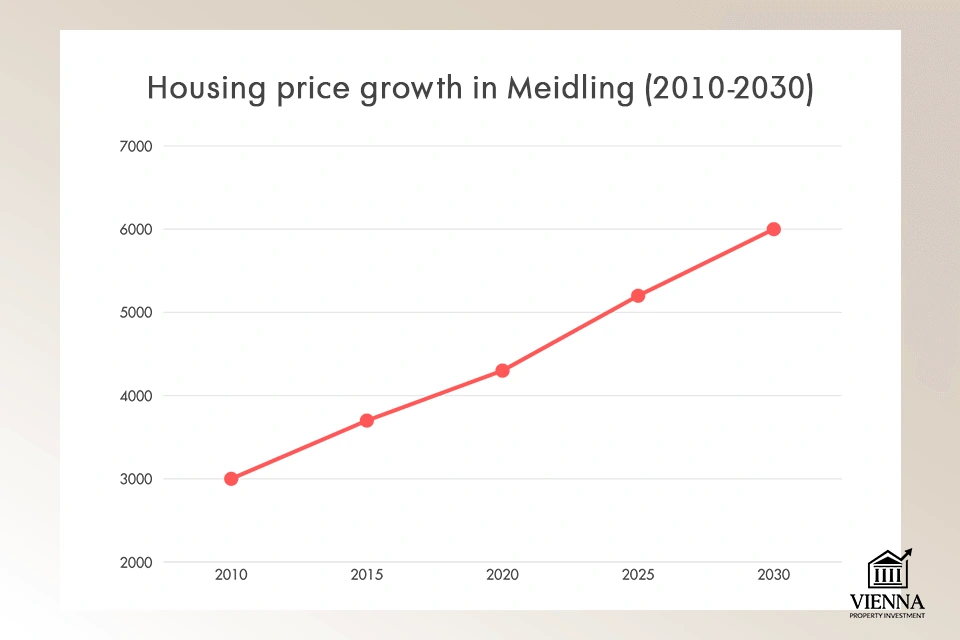
The housing market in Meidling is showing steady growth. Analysts estimate annual price increases in the area at 3-5%. This is lower than in the hottest areas near the city center, but more stable. For investors, this means minimal risk and gradual capital growth.
New buildings with underground garages and green courtyards are particularly attractive. These apartments are easily rented out to expats and young professionals, and their resale prices rise faster than those of older buildings without modernization.
Life for renters
In addition to buying and selling, the rental market is booming in Meidling. The area is ideal for those who work in the city center but want to pay less for housing and live in a quieter atmosphere. Apartments near metro stations and the train station are particularly popular.
Students from the University of Vienna and the Technical University of Vienna often choose Meidling: the commute takes only 15–20 minutes, and housing prices are lower than in the 5th or 6th districts.
Investments in commercial real estate
Commercial space shouldn't be forgotten either. New cafes, pharmacies, and coworking spaces are popping up on the ground floors of buildings and quickly finding tenants. The area remains ideal for small businesses: the high population density and constant traffic near the train station ensure a steady flow of customers.
Forecasts
Meidling's value will continue to rise in the coming years. The STEP 2025 program will add green spaces, improve transportation, and reduce traffic noise. All of this will make the area more attractive to families and young professionals. By 2030, the average home price here is expected to reach €6,000 per square meter, while the rent for a two-bedroom apartment will approach €1,300.
Who is Meidling suitable for?
Vienna's 12th district, Meidling, is a unique "universal construction kit." It doesn't have a uniform character like the touristy first district or bourgeois Döbling, and this is precisely what makes it convenient for a wide range of population groups. Everyone finds something here: some value transportation, others the affordable housing, some the green spaces, and still others the multicultural atmosphere.
Families with children
For families, Meidling is a real compromise between affordability and comfort.
- The area offers a wide selection of schools, kindergartens, and extracurricular activities. Children can attend gymnasiums, music schools, and sports clubs—all within walking distance.
- The most important argument for parents is the parks and green spaces. They may be small, but there are plenty of them, and Schönbrunn Castle is nearby, perfect for weekend getaways with the whole family.
- Unlike central areas, where rent is prohibitive, here you can find a spacious apartment at a reasonable price.
Life in Meidling for a family looks like this: in the morning, the child goes to kindergarten or school in the neighboring neighborhood, the parents either work in the neighborhood or quickly commute to the city center by metro, and in the evening, the whole family meets at a park or café. It's a scenario of a quiet, yet urban life, where everything is within easy reach.
Students and young professionals
Students at the University of Vienna and the Technical University of Vienna have long discovered Meidling. Thanks to the U4 and U6 subway lines, the campuses are a 15-20-minute commute, and housing prices here are significantly lower than in the trendy Margareten or Mariahilf neighborhoods.
Young professionals also choose Meidling because of its modern coworking spaces, offices, and convenient transportation infrastructure. It's a neighborhood where you can work during the day and relax in a small café or exercise in one of the fitness centers in the evening.
Studio apartments near the train station and Meidlinger Hauptstraße are particularly attractive. They are easy to rent out and rarely empty: demand among students and young couples is consistently high.
Elderly residents
Meidling is also suitable for those seeking a quieter life. Hetzendorf and Altmannsdorf have retained their suburban rhythm: narrow streets, small squares, and quiet evenings. Here, you can live far from the noise of the train station while still having access to all the area's amenities.
Medical infrastructure is also important for seniors: Meidling has clinics, pharmacies, and dentists. All are within a few minutes' walk or bus ride.
Investors and realtors
For investors, Meidling is a stable area. There are no price hikes, but there is steady growth. Housing in the area is increasing in price by 3-5% annually, and experts predict prices will reach €6,000 per square meter by 2030.
Investing in new buildings with underground garages and green courtyards is particularly profitable. Such apartments are easily rented out to expats and young professionals, and their prices appreciate faster than the market.
Meidling is also attractive for commercial real estate investment : shops, cafes, and services are always in demand here. The high population density and constant passenger traffic at the train station create stable demand.
Creative and multicultural residents
Meidling's special audience is creative professionals and people who value multiculturalism. The district is full of small theaters, galleries, art spaces, and cafes that host concerts and literary evenings.
Artists, musicians, and designers live and work here. They value affordable housing and studio space compared to central areas, and the neighborhood's atmosphere offers a sense of freedom.
Meidling is also famous for its multicultural environment: Austrians, Turks, Serbs, Romanians, and dozens of other nationalities live side by side here. For some, this is a drawback, but for others, it's a huge advantage: the neighborhood resembles a miniature Babylon, where everyone can find their community.
Tourists and business travelers
Although Meidling isn't a tourist destination, it's convenient for those visiting Vienna for a few days. Mid-range hotels and aparthotels are cheaper here than in the city center, but guests still have easy access to the entire city via the train station and metro. This is especially important for business travelers: you can live in Meidling but work in the city center.
Strengths and weaknesses of Meidling
Vienna's 12th district, Meidling, is neither a glamorous downtown nor an elite suburb. It's a livable neighborhood where everything is convenient, practical, and tailored to the daily needs of its residents. It combines historic architecture, a multicultural atmosphere, and modern infrastructure, all while remaining affordable.
The Benefits of Meidling
- Transport connections: Meidling train station , underground lines U4 and U6, trams and buses allow you to get anywhere in minutes.
- Affordable housing: apartment prices and rent are lower than in the city center, while the quality of life remains high.
- Multicultural environment: A rich mix of cultures makes the area dynamic and modern.
- Parks and green spaces: The proximity to Schönbrunn and numerous public gardens allows for relaxation and exercise in the fresh air.
- Social infrastructure: schools, kindergartens, medical centers – everything is within walking distance.
- Economic resilience: Small businesses, workshops and offices provide jobs and stable rental demand.
- Cultural life: theatres, cafes with music and poetry evenings, street festivals create the atmosphere of a “living district”.
Disadvantages of Meidling
- Parking issues: street spaces are scarce, and underground garages are available mainly in new buildings.
- Noise near the station: proximity to a transport hub provides convenience, but deprives of peace.
- High population density: the area remains congested, with streets and transport overcrowded during rush hour.
- Risk of tourist pressure: The proximity of Schönbrunn attracts a stream of visitors, which sometimes disrupts local life.
- The architecture is varied: restored houses stand side by side with older buildings, creating a varied appearance on the streets.
Conclusion
Meidling is ideal for those seeking a balance between comfort and affordability. It's a neighborhood for families with children, students, young professionals, and seniors seeking a comfortable, yet not exclusive, living space. Investors are drawn to it due to its stable price growth and high rental demand.
You could say Meidling is Vienna in miniature: it has everything you need for life, from theaters and markets to the train station and parks. It's neither the most prestigious nor the most tranquil district, but that's precisely its strength: it's vibrant, diverse, and open to everyone.