Many tourists arriving in Vienna first see St. Stephen's Cathedral, Schönbrunn Palace, and the classic imperial streets of the city center. But the city has another face—industrial, working-class, with a hint of a harsh past and surprisingly modern projects. This is precisely how Simmering Simmering Vienna's 11th district , located in the southeast of the capital, presents itself to residents and visitors.
At first glance, it's far from a "postcard from Vienna" image. Here, factories sit alongside residential areas, railway lines run through the heart of the district, and the streets appear more utilitarian than those in the more bourgeois districts.
However, take a closer look and Simmering reveals a completely different side: a district where old gas holders have been transformed into a futuristic residential and cultural complex, and green parks sit alongside industrial sites.
The district covers 23.3 square kilometers —a significant area for Vienna. It is home to over 105,000 people , and that number is steadily growing. The density is approximately 4,500 people per square kilometer, making Simmering less "compressed" than the densely populated Favoriten district, but livelier than the outlying districts.
Simmering is a place of contrasts. On the one hand, it's known as a "working-class suburb" and sometimes considered one of Vienna's "underprivileged areas." On the other, it's home to the Zentralfriedhof, the city's largest park, modern residential complexes near the Gasometer, and strategically important transportation hubs (the U3 metro line, Schwechat Airport, and Simmering ).
Thus, the 11th arrondissement can be described as a "city within a city": it offers housing, employment, transportation, parks, cultural facilities, and even its own tourist attractions. For some, it's a place stereotyped as a "crime-ridden neighborhood," while for others, it's a convenient and affordable place to live.
Story

-
Key stages in the history of Simmering:
- The 13th century is the first mention of the village.
- 19th century – industrialization, construction of gas holders.
- 1892 – inclusion into Vienna.
- 1920s – construction of workers’ hofs during the “Red Vienna” era.
- World War II - destruction and reconstruction.
- 2001 – reconstruction of gasometers, creation of Gasometer City.
- 2020s – new residential projects, growing investment interest.
The region's history stretches back to the Middle Ages. The first mention of a settlement on the site of today's Simmering dates back to the 13th century. Back then, it was a small village where residents engaged in agriculture and viticulture.
19th century: industrialization
The situation changed dramatically in the 19th century. Vienna was rapidly growing, and its eastern outskirts began to develop into an industrial zone. Brickworks, workshops, factories, and, especially, the famous Gasometers —enormous cylinders, nearly 70 meters tall, that stored gas for street lighting and home heating—appeared in Simmering.
In 1892, Simmering officially became part of Vienna. From then on, it became a typical working-class district, attracting migrants from the Czech Republic, Hungary, Croatia, and other parts of Austria-Hungary. The district grew rapidly, with new homes, shops, and schools being built.
20th century: working class district and wars
In the first half of the 20th century, Simmering cemented its status as a working-class district. During the "Red Vienna" , communal hofs (houses) were built here, providing affordable housing for low-income families. The district gained a reputation as an industrial center, employing tens of thousands of workers.
During World War II, Simmering was a target of air strikes : the factories, gas holders, and power plant were of strategic interest. Many neighborhoods were destroyed, but they were rebuilt in the postwar years.
Late 20th – 21st centuries: a new life for gasometers
By the end of the 20th century, the gas holders were obsolete: they were no longer used for gas storage. The question arose: demolish or preserve? Ultimately, the decision was made to reconstruct them.
In 2001, the former industrial giants were transformed into the Gasometer City . It housed apartments, student dormitories, offices, shops, a cinema, and a concert venue. The facades retained their historical appearance, while the interiors became emblematic of modern architecture. This project became a true "rebranding" of the district: for the first time, Simmering began to be perceived not only as a working-class suburb but also as a zone of the future.
Geography, zoning and structure
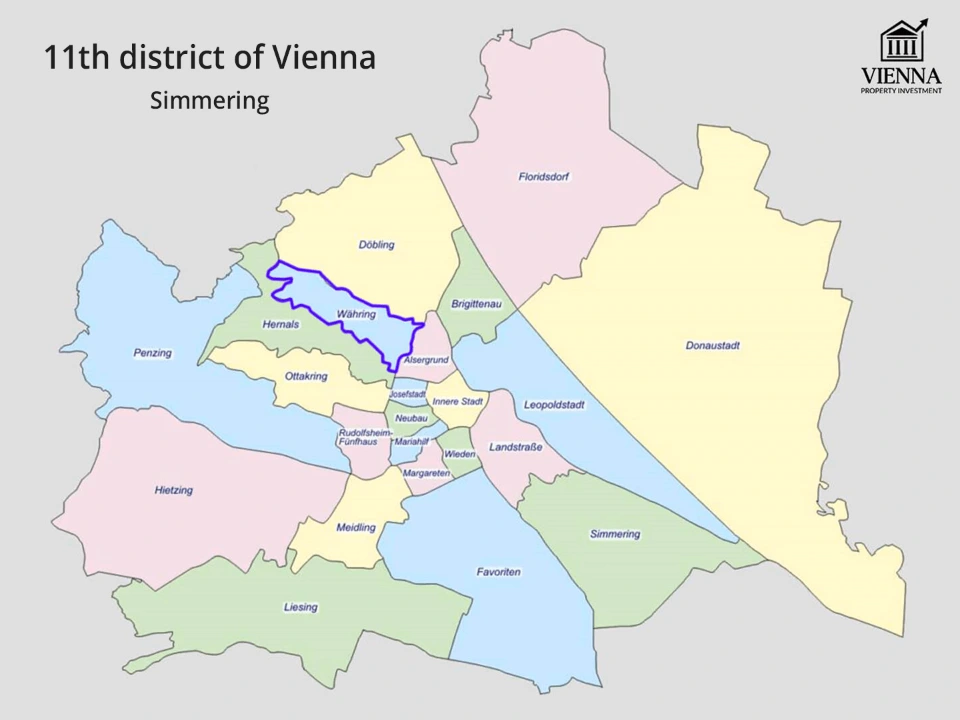
Simmering occupies the southeastern part of Vienna and is considered a gateway to the city. The district borders the 10th Favoriten to the west, the 3rd Landstrasse and the 2nd Leopoldstadt to the north, and extends to the capital's border to the east. It is here that the highways leading to Schwechat International Airport begin, and industrial areas are located.
The district's total area is 23.3 square kilometers , making it one of the most spacious districts within the city limits. The population is approximately 105,000 , and it is growing thanks to new residential developments and migration.
Three main Simmering zones
Simmering is hardly homogeneous. Within it, several distinct areas can be identified, each with a distinctly different atmosphere, architecture, and standard of living:
-
- The Northern Zone (Gasometer, Erdbergstraße, Nähe U3).
This is the face of the "new Simmering." It is home to four famous gas holders, converted into residential and cultural complexes, as well as modern neighborhoods with new buildings, offices, and shopping centers. This part of the district is closest to the concept of "prestigious districts of Vienna" within the district. - The central part (Enkplatz, Geiselberg, Simmering er Hauptstraße). A classic working-class district, where 20th-century communal buildings, old apartment buildings, markets, and inexpensive shops have been preserved. It is densely populated, with many migrants and students.
This area is often considered "multicultural" or even "disadvantaged" in Vienna, although for many families it remains the most affordable in terms of housing. - The southern part (Zentralfriedhof, Albern, Laaer Wald).
A green and tranquil area, home to the Zentralfriedhof, the city's largest park and cemetery, wooded areas, and lower-density residential areas. This area attracts families with children and those who value peace and quiet but are willing to tolerate a distance from the city center.
- The Northern Zone (Gasometer, Erdbergstraße, Nähe U3).
Territory of contrasts
Simmering's defining characteristic is its stark contrast within a single district. To the north and west, futuristic buildings and new neighborhoods can be seen near Gasometer City: gleaming glass facades, clubs, concert halls, and modern apartments.
This piece of Simmering is perceived almost as a “new Vienna”, aimed at young people, expats and those who want to live in stylish and comfortable complexes.
But walk just a few kilometers into the district, and the picture changes. Old working-class neighborhoods with buildings from the late 19th and early 20th centuries are reminiscent of the district's past. Here you can still find farmsteads with peeling facades, narrow courtyards, small shops, and cheap cafes. For some, this is the "atmosphere of true Vienna," while for others, it's a reminder that not all of the district has survived the renovation.
The southern part of Simmering has a truly tranquil, almost rural atmosphere. The Zentralfriedhof and adjacent parks create a sense of coziness and tranquility. Here you can stroll along the long avenues, ride a bike, or have a picnic. Many families choose this part of the district because it combines affordable housing with proximity to nature.
Urbanists often call Simmering a "mini-Vienna." It has it all: industry, residential development, creative spaces, and extensive green spaces. The district is difficult to describe in a single word: it is multilayered, vibrant, and constantly changing. This combination makes it attractive to residents, investors, and tourists.
Population and social structure

Simmering is home to approximately 105,000 people , and this number is growing year after year. The district has a medium-density development —approximately 4,500 residents per square kilometer. This makes it less densely populated than neighboring Favoriten, but still quite lively. The district feels vibrant thanks to the dense development along the main streets and the multicultural atmosphere fostered by the locals.
Ethnic composition
Simmering is a truly multicultural district of Vienna .
Historically, workers from Bohemia, Moravia, and Hungary migrated here. After World War II, migrant communities from the Balkans established themselves here, and beginning in the 1960s, Turks and Yugoslavs arrived en masse to the area, invited as guest workers to work in factories and construction sites.
In recent decades new waves of migration : Syrians, Afghans, Arabs, and Eastern Europeans. Thanks to its proximity to Schwechat Airport and major logistics hubs, the area has become a convenient location for expats working in the transportation and service industries.
Today, a stroll along Simmering er Hauptstraße becomes a mini-trip around the world: you can hear Turkish, Serbian and Croatian dialects, Arabic, and, of course, German. Halal restaurants, oriental spice shops, traditional Viennese "beissels" (bakery shops) and bakeries are all located here. This cultural mix is both a treasure and a challenge for the district.
Age and education
Compared to "bourgeois" districts like the 1st ( Innere Stadt ) or the 19th ( Döbling ), Simmering is noticeably younger .
- Young people come here because of the lower rent prices.
- Students choose apartments close to the U3 metro station or near the FH Campus Wien , which is located very close by.
- Young families with children find a compromise between price and convenience here: the area has many schools, kindergartens, and green spaces.
At the same time, Simmering remains home to retirees who have lived in the same farmsteads for decades. This generational contrast shapes the neighborhood's distinctive character: students and elderly Viennese may live in one building, while large immigrant families live in the next.
Income and social differences
In terms of income level, the district is considered to be in the city's "middle third." There's no concentration of exclusively rich or exclusively poor people, but the gap is noticeable:
- In older areas, rents can start from €11–12/m², making housing affordable for students and workers.
- In new complexes near Gasometer City, prices are approaching those in prestigious areas: €16–18/m² for rent, while purchase prices reach €6,000–7,000 per m².
This price range demonstrates that Simmering is neither a completely disadvantaged area of Vienna nor a prestigious one. It's a neighborhood where a simple five-story building with affordable housing can stand side by side with a modern residential complex with designer apartments.
Social portrait
If we divide the district's population into groups, we get an interesting picture:
- Workers and migrants
make up the bulk of the residents. Many work in factories (Siemens, LEO Pharma), logistics, or construction. Their families have long been established in the area and shape the "everyday life" of Simmering: markets, small shops, cafes. - Students and young professionals.
Thanks to the proximity of universities and lower rents, they make up a significant portion of the renters. They can be found in Gasometer City, student dorms, and apartments near the metro. - Middle-income families.
They often settle in the southern part of the city, closer to the Zentralfriedhof and green areas. They value quiet, parks, and access to schools. - Expats and investors.
New residents who buy apartments in prestigious complexes from Gasometer. They value modern housing and convenient transportation to the city center and the airport.
Mix of "old" and "new"
Simmering is a neighborhood where historical layers and new developments are especially clearly intertwined. In one neighborhood, you'll find communal housing units inhabited by families for three generations, while in another, you'll find the glass Gasometer towers, home to young IT professionals and international specialists.
This contrast creates an atmosphere of diversity : the district may seem noisy, even chaotic, but that's precisely where its energy lies. For some, this is a drawback—Simmering feels like a "working-class suburb." For others, it's a plus: it offers the true rhythm of life of a large European city, without the glitz, but with promise.
Housing: social and luxury segments

Simmering's housing stock is characterized by a diversity rare in Vienna. Here you'll find everything from old workers' quarters and municipal buildings from the "Red Vienna" era to modern business-class residential complexes near Gasometer City. This is why the area is considered both affordable and a promising investment opportunity. If you're considering where to buy an apartment in Vienna , Simmering is convenient because it's easy to compare older buildings and new construction within the same district—both in terms of price and quality of living space.
Its development is closely linked to history: once an industrial outskirts where workers moved, today it is one of the districts where the old coexists with the ultra-modern.
Social housing
Simmering is among the districts where municipal apartments— Gemeindebau —occupy a significant market share. According to Stadt Wien , approximately 20–22% of the district's housing stock is owned by the city and rented to residents at preferential rates.
These complexes were built back in the 1920s and 1930s, during the "Red Vienna" era. They are large residential blocks with courtyards, green spaces, and convenient infrastructure. These apartments remain in demand today: they are home to retirees, students, young families with children, and workers.
Social housing makes the area attractive to those looking for low rents with good transport links .
Old houses and renovations

A significant portion of Simmering's residential stock consists of buildings from the late 19th and mid-20th centuries . Many were built as apartment buildings or as housing for factory and mill workers. The architecture here is largely utilitarian, without unnecessary ornamentation, reflecting the working-class character of the district.
However, in recent decades, city authorities have been actively investing in the renovation of old buildings . The program includes:
- restoration of facades,
- insulation and energy efficiency improvement,
- improvement of courtyards and public spaces,
- opening of cafes and shops on the ground floors.
Such projects help to shed the reputation of being a "bad neighborhood" and transform old housing stock into comfortable housing with modern amenities.
New projects and luxury segments
Over the past two decades, Simmering has become the site of major urban development experiments that have completely transformed the perception of the area. While it was once associated exclusively with factories and working-class neighborhoods, today it is home to some of the capital's most unusual and prestigious residential complexes.
- Gasometer City is a unique project to renovate four former gas holders. Inside, there are apartments, student dormitories, a cinema, shops, a fitness center, and a concert hall. It houses both students and wealthy professionals.
- The residential complexes near Simmering Bahnhof and Enkplatz are modern buildings with underground garages, green terraces, and business-class apartments.
- Grenze Albern's projects are low-rise residential complexes located close to green areas, aimed at families.
Thus, Simmering is gradually emerging from the category of "working-class suburb." New developments are making it attractive to affluent Viennese and investors, although the area's overall image remains mixed: older working-class neighborhoods sit alongside prestigious new developments.
Average prices and rent
The real estate market in Simmering is highly heterogeneous.
- Buying a home:
- in old farmsteads and houses of the 19th–20th centuries – from €4900 per m²,
- In new complexes at Gasometer - €6000–7000 per m².
- Housing for rent:
- in old houses - 11–12 €/m²,
- in new apartments - 15–18 €/m².
Interesting fact: in 2024, the average home price in Simmering increased by 6.8%, higher than the Vienna average. Experts attribute this to the area's appeal to investors, who increasingly view Gasometer apartments as a reliable asset.
Thus, the difference between the old and new segments can reach 40–50%. This is a unique feature of Simmering: it simultaneously remains an affordable housing area and a promising investment zone.
Who chooses housing in Favoriten?
The social profile of the district's residents is diverse, and this is what gives the area its particular dynamism.
- Students and young professionals rent apartments near Gasometer and metro stations. They value proximity to universities and the opportunity to live in a modern neighborhood at a relatively affordable price (in dorms or student apartments).
- Workers and migrants traditionally settle in municipal apartments and old buildings. Many families have lived here for generations and support local shops, cafes, and workshops.
- Middle-income families choose the southern neighborhoods, closer to the Zentralfriedhof and green areas. It's quieter, calmer, and has more schools and parks, making these areas child-friendly.
- Investors and expats prefer the new developments near U3 and Gasometer City. They enjoy a combination of comfort, status, and convenient transportation to the city center and the airport.
Tips for those looking for housing in Vienna's 11th district
Simmering is a district of contrasts, and your choice of housing here depends heavily on your lifestyle. To avoid making a mistake, it's important to understand in advance what you expect from an apartment and the district.
- Students and young professionals will appreciate apartments near the Gasometer and Simmering Bahnhof . These areas are well connected to the city center via the U3 line and offer numerous student residences and apartments. In the evenings, the area is lively, with bars, a cinema, and concert venues, ensuring plenty of entertainment.
- Families with children should consider the southern part of the district , closer to the Zentralfriedhof and parks. It's quieter there, the air is cleaner, and there are good schools. Many parents choose the neighborhoods near Herderpark and Hyblerpark, which are convenient for walks with children and safe in the evenings.
- Investors are best off looking at new developments near Gasometer City and along the U3. These complexes offer high rental yields, and apartment prices are rising faster than the Vienna average. Small studios and two-bedroom apartments are particularly attractive, as they easily rent to students and expats.
- Retirees will feel most comfortable in older farm buildings and quiet neighborhoods closer to the border with Grenze Albern . These areas offer a slower pace of life, green spaces, and less traffic. Senior residents appreciate these buildings for their atmosphere and convenience—shops and pharmacies are always nearby.
- For those who travel frequently or work outside the city , apartments near Simmering Bahnhof or closer to the A4 highway are ideal. From here, Schwechat Airport is just 15 minutes away, making the area convenient for airline employees, pilots, flight attendants, and business travelers.
Tip: Before buying, spend a few days in different parts of Simmering. Try renting an apartment from Gasometer and then one closer to the southern neighborhoods. The difference in atmosphere will be dramatic: the first zone is more dynamic and modern, while the second is green and tranquil.
Education

Simmering is not only an industrial district but also a place with a strong educational structure. While the district doesn't have a university like Favoriten, it has many schools and gymnasiums that create a vibrant local community. Furthermore, the proximity of the FH Wien and other Viennese universities makes it attractive to students seeking affordable housing.
Schools and gymnasiums
The district is home to both public and private institutions. The core of these institutions consists of public schools and gymnasiums, which prepare students for university entrance.
Table: Main educational institutions in Simmering
| Institution | Type | Peculiarities |
|---|---|---|
| GRG 11 Geringergasse | State Gymnasium | Strong science and language programs |
| Evangelisches Gymnasium | Private gymnasium | Christian pedagogy, project-based learning |
| Volksschule Enkplatz | Primary school | Multicultural composition, language support |
| VHS Simmering | Public school for adults | Courses in German, IT, cooking, and design |
| Musikschule Wien (branch) | Music school | Classes for children and adults, concerts |
For many families, the proximity of schools is a key factor when choosing housing. Small community centers with cafes, shops, and libraries form around educational institutions.
The influence of education on the image of the district
The role of education in Simmering extends far beyond the school curriculum. For a district that was considered Vienna's industrial outskirts for decades, a strong educational foundation has been a key factor in its transformation.
- Shaping a New Identity.
Simmering was once associated with factories, tram repair shops, and gas holders. But today, local schools and grammar schools are shaping a different reality: a neighborhood where children can receive a quality education on par with those in more "bourgeois" districts. Parents are increasingly choosing apartments near schools so their children can access modern educational programs. - Multiculturalism is a plus.
Many classes in Simmering are multilingual: children from Turkish, Serbian, Arab, and Eastern European families study here. For some, this is a challenge (various levels of German proficiency and the need for integration), but for others, it's a huge plus. Children grow up in an environment where tolerance and intercultural dialogue are taught from a very early age. - Adult courses.
VHS Simmering is an important element of social policy. German language courses for migrants help new residents integrate, and vocational programs (IT, accounting, design, culinary) allow adults to change careers or improve their skills. For many families, this is a chance to improve their financial situation and, therefore, establish themselves in the area. - The cultural dimension of education.
The music school and libraries make Simmering not just an "educational district" but a true cultural hub. Student concerts, literary evenings, and teen clubs are held here. All this adds to the district's "soft power": it becomes not just a place where factories operate but also a vibrant cultural scene. - Attractiveness for families and investors.
For families with children, the "schools nearby" factor is important. Neighborhoods with strong schools and grammar schools automatically become more valuable to homebuyers. Investors also take this into account: apartments near educational institutions are easier to rent out. For families considering private schools in Vienna , the neighborhood's transportation connections and predictable infrastructure around the schools are a major plus.
Infrastructure and transport

All modes of transportation converge here: the metro, trams, buses, and the railway, and the A4 motorway and Schwechat Airport are just a few minutes' drive away. Transportation has shaped the district's development and is one of the main reasons for its popularity among students, migrant workers, and employees of international companies.
While Favoriten is known as a densely populated "city within a city", Simmering can be called a "hub" – a place where urban life intertwines with logistics and international flows.
Metro and city lines
The backbone of the transport system is the U3 line, which terminates in Simmering. This isn't just a convenience, it's a strategic advantage:
- Residents of Gasometer City can reach the center of Vienna at Stephansplatz in 12–15 minutes.
- Schoolchildren and students from Enkplatz quickly reach universities in the central districts.
- Workers and employees from the neighborhoods around Simmering combine affordable housing with direct metro access to the business districts.
U3 terminus Simmering has become a transportation hub, connecting metro, bus, and commuter trains. This keeps the area from being isolated, but rather, immersed in the city's rhythm.
Trams remain an important part of life. Line 71 is particularly symbolic: even in the 20th century, Viennese joked that "every Viennese will ride the 71 someday"—after all, the tram takes people directly to the Central Cemetery. Today, the route connects the city center with the residential areas of Simmering and remains part of the district's cultural identity.
Buses serve the outskirts and connect the district with industrial zones, the airport, and neighboring districts. Lines 76A/B and 79A/B , which connect the southern residential complexes with the metro, are particularly popular.
Rail. Wien Simmering Bahnhof station connects the metro and commuter trains. This allows residents to quickly reach Lower Austria, which is important for those working outside the capital.
Roads and exit from the city

Simmering plays a special role in Vienna's transportation system precisely because of its location. The district literally "closes off" the southeastern part of the city and controls the highway access points.
The main thoroughfare is the A4 Ost Autobahn , which connects Vienna not only to Schwechat International Airport but also to the Hungarian border. This is a huge advantage for residents and businesses:
- the airport can be reached in just 10-15 minutes,
- the trip to Bratislava takes about 40-45 minutes,
- The A4 provides easy access to the Lower Austrian countryside.
It's no coincidence that logistics centers and warehouses are rapidly developing in Simmering: companies value the proximity of the airport and the ability to quickly ship cargo abroad. The area is becoming attractive to international businesses, but this has its downside.
Cons for residents: Living near a highway comes with noise and constant truck traffic. This is especially noticeable in the eastern part of the county, closer to Albern, where industrial zones and cargo terminals are located. Despite the city actively implementing noise barriers and developing green buffers, residents still face traffic problems.
Thus, Simmering's transport accessibility is a double-edged sword: it provides economic growth and convenience for business, but at the same time creates the image of an "industrial outskirts.".
Parking and parking policy

Parking is always a pressing issue in Simmering. On the one hand, it's an industrial area with high traffic volumes. On the other, it's home to many older residential buildings, built before the era of mass car ownership, when residents simply didn't need garages.
Old neighborhoods - the problem of finding a place
Parking is a particularly pressing issue in the older neighborhoods of Simmering. This is especially true on the streets running parallel to Simmeringer Hauptstraße, where the building density is at its highest. The buildings, built in the 19th and early 20th centuries, were designed for a time when no one owned a car. The courtyards of these buildings barely have enough space for green areas and outbuildings, making it simply impossible to park cars there.
Residents of old farmsteads and apartment buildings often report that "returning home in the evening becomes a lottery"—whether they'll find a free spot near their home or have to drive around the block for 20-30 minutes. It's especially difficult for those who work downtown and return to the area after 6:00 PM, when the streets are already clogged with cars.
The situation is further exacerbated by the fact that many residents store cars they use only occasionally. Old "garage cars" take up space, even though their owners only use them on weekends. For a high-density area, this becomes a real headache.
Another problem is the narrow streets . In the historic part of Simmering, the roads were built for trams and pedestrian traffic, so now every parked car makes two-way traffic nearly impossible. Buses and trucks are often stuck until drivers can move their vehicles.
For many young families, this is the reason they move to new residential complexes with underground garages. Older neighborhoods remain attractive in terms of price, but parking often outweighs all other advantages.
Parkpickerl system
The city is addressing the issue with the Parkpickerl , a special permit for residents.
- The cost of the permit is relatively low,
- It allows residents to park on the streets of their neighborhood without fear of getting a fine,
- However, the presence of a pickerel does not guarantee free space.
In Simmering, almost the entire area falls under the Parkpickerl zone, which brings discipline to the situation, but does not relieve congestion
New residential complexes are a different story
The picture is quite different in new buildings near Gasometer City and on the southern outskirts. There, modern standards are taken into account right from the design stage:
- underground garages,
- private parking in courtyards,
- electric vehicle charging stations.
This approach saves residents time searching for a parking space in the evening and ensures their cars and bicycles are safe. Some complexes, such as Enkplatz, are also implementing additional services, including smart home systems for parking management, video surveillance, and car-sharing zones.
This is especially important for families: the ability to return home without stress, park, and immediately enter the apartment improves living comfort. For investors, it's an argument for higher rents: tenants are willing to pay more for modern housing with convenient amenities.
Green initiatives
Vienna is consistently moving toward a policy of "fewer cars, more public space ." This is particularly noticeable in Simmering: some old parking spaces have already been converted into mini-parks and playgrounds.
This approach appeals to young families, but irritates motorists, who are finding it increasingly difficult to find a place.
Religion and religious institutions
Simmering can't be called a district with a "single dominant faith." Here, as throughout Vienna, the religious landscape reflects the multinationality of the population. Catholicism, Orthodoxy, Islam, Protestantism, and even Buddhism coexist within a relatively small area. This diversity makes the district interesting, but it also leaves its mark on its image.
Catholic churches remain the main architectural accents.
- Pfarrkirche St. Laurenz is one of the oldest churches, around which "old Simmering" developed. For locals, it is not only a place of prayer but also a cultural symbol of the area.
- The St. Karl Borromäus Church in the Central Cemetery has become a true calling card for the district. This Art Nouveau church was conceived as a memorial and still impresses with its monumentality.
Orthodox parishes emerged thanks to the strong presence of the Serbian and Romanian diaspora. They became important centers of attraction: services, children's Sunday schools, and national holidays are held there, helping migrants preserve their cultural identity.
Islamic centers and mosques occupy a special place. For the Turkish and Arab communities, they are not only spiritual spaces but also social centers. They offer language courses, discuss integration issues, and assist newcomers with documentation. These institutions often serve as a "bridge" between new residents and Austrian society.
The Buddhist Center is a small but significant detail. It symbolizes Simmering's openness to traditions even exotic in Vienna. Meditations, cultural events, and Thai food and music festivals are held here.
Culture, Leisure and Events

Simmering is gradually learning to transform its industrial past into cultural heritage. Where factories and gas holders once stood, concerts, exhibitions, and festivals now take place.
Gasometer City is the district's main cultural hub. These four giant gas holders underwent a unique renovation at the beginning of the 21st century, housing apartments, student dormitories, a concert hall, a cinema, and shops. Today, this place attracts not only locals but also tourists, who come here for its unusual architecture and vibrant atmosphere.
Simmering er Hauptstraße resembles a small oriental bazaar, mixed with Viennese flair. Here you can find a Turkish kebab cafe, a Serbian grill, and a little further, a classic Austrian pastry shop. The street's atmosphere is informal, a little noisy, but that's precisely what gives it its folksy charm.

Schloss Neugebäude is an example of how a historical site can be used in a modern way. The 16th-century castle has become a venue for a summer cinema, festivals, and concerts. This is not only a cultural but also a tourist attraction for the area.
Baggerpark Wien is a unique attraction that sets Simmering apart from other districts. The chance to operate a real excavator is a thrill for both children and adults, and has become a signature attraction for the district.
Parks and green spaces
When people think of Simmering, many immediately imagine factory chimneys and busy highways. But few know that almost 40% of the district is occupied by green spaces. And these aren't just formal "parks in the courtyard," but full-fledged recreational spaces.

The most famous site is Wien Cemetery . It's more than just a cemetery: its area is comparable to an entire neighborhood (2.5 square kilometers), and the atmosphere here is reminiscent of a park. Viennese come to stroll along the long avenues, listen to birdsong, ride bicycles, and even have picnics. Beethoven, Schubert, and Brahms are buried in the necropolis, and a symbolic cenotaph has been erected for Mozart.
Other green spaces also play an important role:
- Herderpark and Hyblerpark are family parks with playgrounds and sports areas;
- Laaer Wald is a place where you can escape to forest paths a quarter of an hour from home;
- the Lobau nature complex gives residents access to the unique ecosystem of the Danube Meadows.
Vienna's Central Cemetery is officially designated an ecological reserve. It is home to over 30 bird species, including rare owls, and its flora includes dozens of plants not found in other parts of the city.
Economy, offices and international relations
Simmering is often called the "industrial heart of southeast Vienna." It still boasts strong industrial and logistics capabilities:
- Siemens AG remains the region's largest employer, producing equipment and electrical engineering.
- LEO Pharma operates in the global pharmaceutical market and is also based here.
- A4 motorway and proximity to the airport make the area a key logistics hub.
However, the 21st century has changed the economic structure. The area is gradually becoming less of a purely working-class district: modern office buildings have sprung up in Gasometer City and along the U3, housing IT companies, consulting firms, and educational startups.
Economic structure of the region (approximate estimate):
| Sector | Examples | Share |
|---|---|---|
| Industry | Siemens, LEO Pharma | ~35% |
| Logistics | Warehouses near the A4 airport | ~30% |
| Trade and service | Huma Eleven, Zentrum Simmering | ~20% |
| Culture and creativity | Gasometer, Schloss Neugebäude | ~10% |
Thus, Simmering's economy has become "mixed": the blue-collar industry remains, but alongside it, cultural and office sectors are growing. This balance attracts both blue-collar workers and white-collar workers.
Modern projects and investments
Simmering was long considered Vienna's working-class outskirts, with factories, warehouses, and dense residential development. But over the past two decades, this image has been changing. The district has become a laboratory for urban architects and developers, actively testing new formats for housing, commerce, and cultural spaces.
Gasometer City – a symbol of renovation
This project has become a signature feature of the district and Vienna as a whole. Four gigantic 19th-century gas holders, which previously supplied the city with coke gas, were completely reconstructed. The buildings' exteriors retained their historical appearance, while the interiors were updated with:
- apartments of different categories (from student dormitories to business class),
- concert hall and cinema,
- shops, gyms and office premises.
Gasometer City became not only an architectural experiment but also an example of how industrial heritage can be transformed into a driver of development for a district. Today, it is one of Simmering's most prestigious addresses, home to students, young families, and affluent professionals.
Enkplatz and Simmering Bahnhof – new residential clusters
Business-class complexes are being actively built along the U3 metro line. Their distinctive features include underground parking, energy-efficient facades, green terraces, and recreational courtyards. Architects are emphasizing "human scale": spacious apartments are combined with public spaces—gardens, playgrounds, and ground-floor cafes.
The development around Simmering Bahnhof : this transport hub has become a magnet for investment. Offices, shops, and educational centers are springing up nearby, and apartments there are in demand among both renters and buyers.
Albern - a quiet alternative
Low-rise development is developing on the outskirts of the district, closer to the Danube. Albern has become a response to the needs of families seeking housing with access to parks and schools, but without the high prices of the central districts. Modern townhouses, kindergartens, and sports areas are being built here. Improved transport accessibility is planned for the future, making the neighborhood even more attractive.
Investment attractiveness of the area
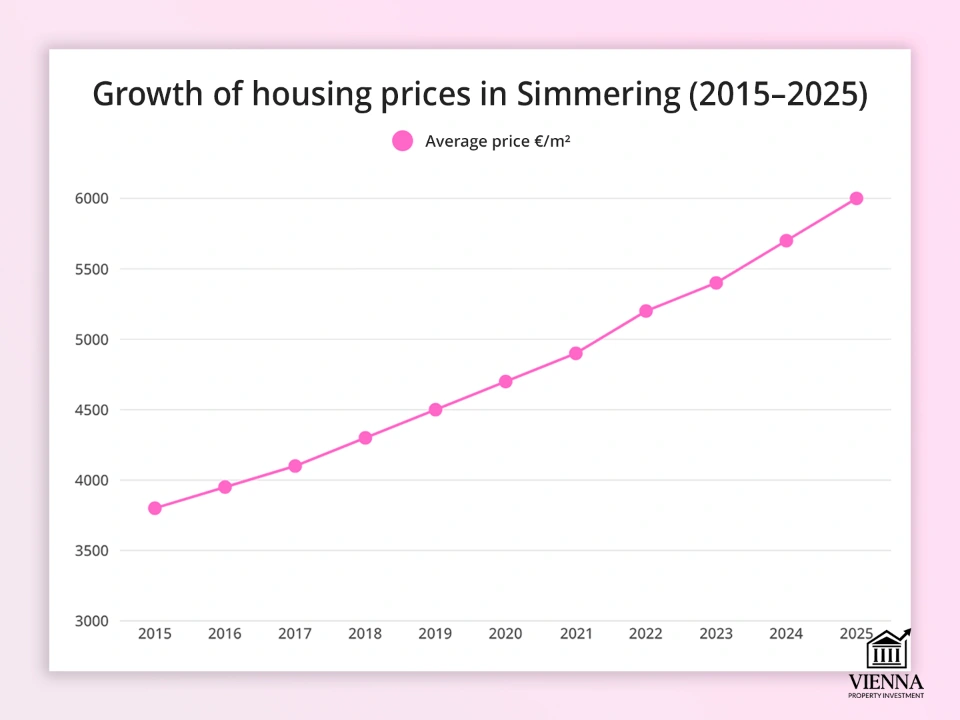
Simmering is one of Vienna's long-overlooked districts. It was associated with Siemens factories, warehouses along the A4, and the Central Cemetery. Many Viennese viewed it more as a transit area—passing through it on their way to the airport, the Danube Meadow Parks, or the outskirts of the city. But by 2025, the situation had changed significantly. While the district remains a working-class area, it is increasingly perceived as a zone of transformation , making it extremely attractive to real estate investors.

The current situation in the real estate market
Simmering's main feature is its varied prices . Here you can find affordable apartments in old farmsteads and ultra-modern apartments in Gasometer City.
- Old housing stock. 19th- and 20th-century buildings, municipal apartments ("social housing"), and standard tenement buildings. Price: from €4,900 per m².
- New projects. Modern complexes near Simmering Bahnhof and Enkplatz, Gasometer City. Price: €6,000–7,000 per m².
- Rent. In old buildings: 11–12 €/m², in new buildings: 15–18 €/m².
In the older neighborhoods around Simmeringer Hauptstraße or near Zentralfriedhof, you can find housing for €4,900–€5,200 per square meter. These are mostly older buildings built in the late 19th and early 20th centuries. The apartments are spacious but in need of renovation; elevators are often missing, and heating and utilities don't always meet modern standards. This segment remains popular among students, migrants, and retirees.
The situation is entirely different in new developments like Gasometer, Enkplatz, and Simmering Bahnhof. Prices there easily reach €6,000–7,000 per square meter , and sometimes even higher. These complexes include underground parking, terraces, energy-efficient systems, and apartments with smart home systems. A completely different demographic is moving in: young professionals, expats, middle-class families, and investors.
It's important to understand that within a single area, price differences can reach 40–50%, and this is a unique opportunity for a flexible investment strategy.
Investor categories and strategies
Investors looking to Simmering range from young private buyers to international funds. Each group has its own rationale and goals, and this is precisely what makes the area unique: it allows for a variety of strategies based on budget and investment horizon.
1. Private investors with limited capital
For those just entering the market, Simmering is an ideal entry point. Older apartments in municipal buildings and tenement houses near Simmeringer Hauptstraße or in the neighborhoods around Zentralfriedhof can be purchased for under €5,000 per square meter. While these properties may not be particularly attractive, they are consistently rented out: tenants include students, migrants, and retirees.
Strategy: minimal investment at the start, rent at €11–12/m², stable income, and the possibility of selling at a higher price in the future after the area is renovated.
2. Mid-level investors
These are the people considering the new developments near the U3 and Gasometer metro stations. A different scenario is already in play here: apartments are more expensive (from €6,000 per square meter), but rents are higher—up to €18 per square meter. Moreover, such apartments are easier to sell in 5-10 years, as demand from expats and families is consistently high.
Strategy: Purchase new homes in the Enkplatz, Simmering Bahnhof, or Gasometer City neighborhoods. High liquidity and higher value appreciation than older properties.
3. International investors and funds
Real estate funds and large private investors view Simmering from a different perspective—they're interested in large-scale projects, such as the redevelopment of industrial zones in Albern or participation in the construction of low-rise residential complexes. For these players, it's not just the rental income that matters, but also the capitalization over several decades.
Strategy: purchasing entire buildings, participating in development projects, focusing on long-term growth in land and housing prices.
4. Young families
Although families aren't always considered "investors" in the traditional sense, their role in the neighborhood market is enormous. They drive long-term demand for housing. Young families are increasingly choosing Albern and the southern neighborhoods of Simmering, which boast green spaces, parks, new schools, and kindergartens. For them, prices of €5,000–5,500 per square meter are an affordable alternative to neighboring Landstraße .
Strategy: Buy a home to live in, but with the understanding that the apartment will increase in value in the future and can be sold profitably.
5. Expats and specialists
This group of renters and buyers is particularly important for the district. The proximity of Schwechat Airport, convenient U3 metro access, and office buildings near the Gasometer make Simmering convenient for those working for international companies or traveling frequently. Expats are willing to pay a premium for comfortable and modern housing.
Strategy: Renting new buildings from Gasometer and Enkplatz. For investors, this means high rates (€16–€18/m²) and minimal downtime between tenants.
6. Students and young professionals
This category doesn't buy housing, but creates a steady demand for rentals . The proximity of campuses, affordable prices, and good transportation links make Simmering popular among students. Dormitories and student apartments in Gasometer City , combining convenient infrastructure with a youthful atmosphere.
Investor strategy: purchasing small studio apartments for short- and medium-term rentals. High tenant turnover is offset by stable demand.
Who is Favoriten suitable for?
Simmering isn't exactly a neighborhood for everyone. Its industrial past, proximity to the airport, and large number of factories shape its distinctive character. But it's precisely this mix of "working class" and "new developments" that makes it attractive to a wide range of social groups.
Families with children
Simmering is one of those districts where families find a balance between price and comfort. On the one hand, it offers numerous green spaces: Zentralfriedhof, Herderpark, Hyblerpark, and access to the Laaer Wald. On the other hand, new developments in Albern and near Enkplatz offer apartments with spacious courtyards, underground parking, and schools within walking distance. Parents appreciate the proximity to kindergartens, sports fields, and medical centers.
Students and youth
The gasometers have long been a symbol of "youthful Simmering." They house dormitories, student apartments, a cinema, a concert hall, and clubs. Add to this the U3 metro, which takes you to the center of Vienna in 15 minutes, and you have a neighborhood where students can live affordably while still being part of the city.
Workers and migrants
The district's industrial character and the presence of Siemens and LEO Pharma make it attractive to workers and migrants. It still boasts numerous municipal housing units and old farmsteads, where rents hover around €11–12 per square meter. This makes it one of the most affordable segments in Vienna.
Expats and specialists
For expats working for international companies, Simmering is a convenient location. It's conveniently located near the metro and just 15 minutes from the city center, while the airport is nearby. Many expats rent or buy apartments in new developments like Gasometer City or Simmering Bahnhof, appreciating the modern architecture and well-developed infrastructure.
Investors
From an investor's perspective, Simmering is now a "transitional area." Prices are even lower than in Landstraße or Favoriten, but rising faster than the city average. High rental yields (around 4.5%) and a forecast price increase to €7,500/m² by 2030 make it attractive to those looking to "catch the growth wave.".
Comparison: Simmering, Favoriten and Landstrasse
To understand where it's best to live, it's worth considering Simmering in the context of its neighboring and contrasting districts. It's most logical to compare it with Favoriten (10th district) and Landstrasse (3rd district) . These three districts are adjacent, but represent completely different "worlds" within Vienna.
Simmering (11th district)
Simmering is, first and foremost, a transitional district. It has evolved from an industrial outskirts with factories and logistics into a modern residential cluster. The main symbol of this change is Gasometer City, where the industrial past has become a cultural and residential present.
Housing prices here are significantly lower than in the city center: from €4,900 in older buildings to €7,000 in new developments. Rents range from €11 to €18 per square meter. Simmering is currently one of the leaders in terms of investment returns, outperforming central districts.
The main advantages are transport accessibility (U3, airport, A4), green spaces (Zentralfriedhof, Herderpark), multiculturalism, and rapid development. Disadvantages include highway noise, proximity to warehouses, and stereotypes of a "working class suburb.".
Favoriten (10th district)
Favoriten is Vienna's most populous district, with a population of over 210,000. It's essentially a "city within a city." The area was long considered a working-class neighborhood, but after the construction of the Hauptbahnhof, it underwent an urban revolution. Today, the Sonnwendviertel and Belvedere neighborhoods are already considered prestigious.
Housing prices in Favoriten are higher than in Simmering: from €5,500 to €7,500 per square meter, with rents ranging from €13–16 per square meter . The area is popular with students, families, and expats who want to live closer to the center but at a lower price than in the 1st–4th arrondissements.
Strengths include multiculturalism, a well-developed transport network (U1, Hauptbahnhof), and modern housing near the train station. Weaknesses include congestion, noisy streets, and a reputation for being "unfavorable" in the old part of the city.
Landstrasse (3rd district)
Landstrasse is a whole new level. The area is considered prestigious: it's home to diplomatic missions, the Belvedere, the Hundertwasserhaus, and the offices of major companies. For expats and wealthy families, the 3rd district is the choice for "classic, upscale Vienna.".
Prices here are reasonable: from €8,500 to €9,000 per square meter , with rents of €14–16 per square meter. Investing in Landstrasse is profitable in the long term, but the entry barrier is very high. Rental yields are lower (3%), but the area offers stability and high status.
Strengths include the central location, prestige, architecture, and cultural attractions. Weaknesses include high housing costs and a limited selection of "affordable" options.
Final comparison
When looking at these three counties as options for living or investment, the following picture emerges:
- Simmering is a choice for those seeking a balance: affordable prices, convenient transportation, and high growth potential. The area is still somewhat rough, but that's precisely its strength: you can buy relatively cheaply today and see significant appreciation in 5-10 years. It's ideal for students, young families, investors, and expats seeking proximity to the airport.
- Favoriten is a dynamic giant. It's bustling with life: markets, restaurants, and new neighborhoods near the train station. This is the place for those who want to live in "real Vienna," where workers, migrants, businesspeople, and students coexist. The area is more expensive and noisier than Simmering, but also closer to the center.
- Landstrasse stands for prestige and stability. This district is suitable for wealthy families, diplomats, and investors seeking security rather than maximum returns. It's a neighborhood where status is more important than price, and where Vienna reveals its "classic face."
Should you choose Simmering?
When we talk about Vienna's 11th district, as a real estate expert, I always emphasize: this is a district for those who can look 5-10 years ahead, and not just at today's stereotypes .
Simmering long bore the label of "working class suburb." Factories, the highway, and warehouses near the airport—all of this created the image of a neighborhood where logistics were more important than comfortable living. But over the past 20 years, changes have occurred here that have radically altered its prospects.
Gasometer City has become a symbol of this transformation: what was once associated with gas and industry is now perceived as a trendy cultural and residential cluster.
Who is the area suitable for?
- Families with children will appreciate the green areas (Zentralfriedhof, Herderpark), schools, and relative quiet in the southern part. Prices are lower than in Landstrasse or even Favoriten, while the infrastructure is just as good.
- Students and young people are welcome, thanks to the dorms and rentals near Gasometer. The youthful energy has noticeably revitalized the area.
- For expats and business travelers , the proximity to the airport and U3 metro line is invaluable. For those who fly frequently or work for international companies, Simmering is more convenient than many upscale districts.
- For investors , this is currently the best combination of yield and affordability. Rental yields in the area are around 4.5%, higher than in the city center. And prices are still 20-30% lower than in the "bourgeois" neighborhoods.
What should an investor expect?

If you're buying a home in Simmering in 2025, you're entering the market at a growth spurt, but not yet at its peak . Prices of €4,900–7,000 per square meter seem moderate compared to Landstrasse (€8,500–9,000). The forecast by 2030 is for prices to rise to €7,200–7,500, and even to €8,000 in premium developments. This means your investment will pay for itself not only through rent but also through capital growth .
But it's important to remember: the area is not homogeneous. The older neighborhoods around Simmeringer Hauptstraße still have a working-class feel to them. They're cheaper, but also noisier. Meanwhile, the new buildings around Gasometer and Enkplatz are already being compared to upscale neighborhoods.
Risks and limitations
Of course, one can't ignore the downsides. The A4 motorway creates noise and air pollution. The old farmsteads are sometimes in poor condition and require renovation. And the stereotype of a "bad neighborhood" will long be present in conversations about Simmering.
But, as Vienna's experience shows, it's precisely these neighborhoods that become new hubs of urban life within 10–15 years. Favoriten underwent the same transformation, and today its new neighborhoods are among the most sought-after.
Final advice
If you're looking for prestige and status , choose Landstrasse. If you're looking for dynamism and a multicultural atmosphere , Favoriten is ideal. But if you want to enter the market "before it gets expensive ," then Simmering is your option.
I would say this:
- For life “here and now,” Simmering is suitable for those who value transportation, green areas, and accessibility,
- For investment, this is one of the best spots in Vienna in 2025.
My expert forecast: in 10 years we will talk about Simmering the same way we talk about Favoriten today – “once a working-class district, now a prestigious cluster.”.