Favoriten (Vienna's 10th district) is a place that defies description. It's a striking blend of old 19th-century apartment buildings and modern neighborhoods near the new Central Station.
It is the capital's largest district by population: over 210,000 people live in an area of 31.8 square kilometers. In terms of density and size, Favoriten is comparable to entire medium-sized European cities.
When looking at Vienna's districts on a map, the 10th arrondissement stands out for its contrasting appearance. On the one hand, there are traditional Viennese hofs (traditional houses), affordable apartments, a multicultural life, markets, and Asian restaurants .
On the other hand, there are Vienna's prestigious new districts near Hauptbahnhof , where housing prices are comparable to those in the central districts. This duality makes Favoriten one of the most discussed districts: some consider it one of Vienna's disadvantaged areas, while others call it the district of the future, where the modern face of the Austrian capital will be shaped.

The district's name comes from the Favorita Palace, built in the 17th century and later converted into an educational institution. Since then, "Favoriten" has become a symbol of the constantly changing neighborhood. Today, you'll find students and expats alike, as well as families moving into new residential complexes.
Favoriten Vienna is known for its green areas of Wien and Laaer Berg, the largest thermal baths complex, Therme Wien Oberlaa, and the legendary Tichy ice cream parlor. This vibrant neighborhood, where Favoriten Straße , and on weekends, locals head to parks for picnics.
We will compare Favoriten with other Vienna districts by numbers , consider how dangerous it is in Vienna , where exactly the most prosperous areas of Vienna , and which neighborhoods should be considered promising for living and investing in residential real estate .
This way, you'll get not just the bare facts, but also a comprehensive picture: where it's best to live, where it's worth investing, which areas of Vienna the map classifies as prestigious, and which as crime-ridden or disadvantaged.
Story

The history of Vienna's 10th district dates back to the 17th century, when the Habsburg emperors built country palaces here. The most famous was the Favorita Palace, which gave the district its name. Initially, these were rural lands, fields, and vineyards outside the then-city limits. But beginning in the 19th century, as Vienna grew rapidly, Favoriten became an industrial and working-class district.
In 1874, the district officially became part of the capital. By then, it was already home to factories, brickyards, and craft workshops. The influx of workers from Bohemia, Moravia, and later Hungary made the area one of the most multinational even before the mass migrations of the 20th century.
It was during this period that the first large residential buildings began to appear – communal buildings called hofs, which still shape the architecture of the old part of the district.
At the beginning of the 20th century, Favoriten was considered a classic working-class district of Vienna. Social housing was actively built here during the "Red Vienna" era. One of its symbols was the Reumannhof, a monumental residential complex built in the 1920s. These buildings were intended for ordinary families and were intended to provide affordable housing, making the area attractive to people with lower incomes.

During World War II, the district suffered severe damage from bombing, but active restoration began in the 1950s. Gradually, Favoriten became a place where old 19th-century houses, post-war buildings, and modern residential areas coexist.
Since the 1960s, the district has become a hub for new migration: first Turks and Yugoslavs, then Syrians and people from the Middle East. This has left its mark on its culture: for this reason, Favoriten is often referred to as one of Vienna's "Arab districts.".
Turkish bakeries, halal restaurants, and mosques opened here. This multinational character was both a plus (the diversity of cultures) and a minus (the reputation of being a crime-ridden area of Vienna among some residents).
-
Key stages of Favoriten's development:
- 17th century – construction of the Favorita Palace, beginning of the development of the territory.
- 19th century – transformation into a working-class district: factories, brick factories, first farmsteads.
- 1874 – Favoriten was officially incorporated into Vienna.
- 1920s – construction of the iconic residential complexes of “Red Vienna” (Reumannhof, Metzleinstaler Hof).
- World War II - destruction and subsequent reconstruction.
- 1960s–1980s – migration of Turks, Yugoslavs and Arab families, formation of a multicultural image.
- 2000–2020 – Urban transformation: construction of Hauptbahnhof, Sonnwendviertel and business centers.
In recent decades, the district has undergone a new transformation. The construction of Vienna's main train station ( Wien Hauptbahnhof) and the Business Park Vienna complex have transformed the district's appearance. New Vienna neighborhoods , boasting modern residential buildings, business centers, and prestigious apartments. Thus, Favoriten today combines a working-class past, a multicultural present, and a promising future.
Geography, zoning and structure
Favoriten is the largest residential district within Vienna by area: 31.8 km² . For comparison, this is almost 16 times larger than the compact 5th district, Margareten. According to Stadt Wien , the 10th district is home to over 210,000 people , making it not only the most densely populated district of the capital but also essentially a separate "city within a city."
In addition to the three large zones (north, center, and south), Favoriten also has distinct neighborhoods. For example, Sonnwendviertel near the Hauptbahnhof is an example of modern urbanism, with green courtyards and innovative architecture. Oberlaa in the south is a quiet residential area reminiscent of a resort. Reumannplatz, meanwhile, remains a symbol of the old working-class district, where bustling street life reigns.
Interestingly, population density and development patterns can vary dramatically within a single district. FavoritenStraße boasts a high concentration of residential and retail space, while just a few kilometers away, spacious parks and low-rise buildings are found. This "zoning of contrasts" is what makes Favoriten unique.
Location on the city map
Favoriten is located south of Vienna's historic center. Its northern boundary runs along the Gürtel, a bustling boulevard separating the old city from the working-class districts.
In the west, the district adjoins the 12th district ( Meidling ), in the east – the 11th ( Simmering ), and in the south it extends to the green hills of Laaer Berg and the vast natural complex of Wien .

The central transportation and economic hub of the district is Hauptbahnhof Wien , which opened in 2014. This station has transformed the entire appearance of the district: the Sonnwendviertel quarter has grown around it, encompassing housing, schools, offices, hotels, and even parks. It is here that Favoriten reveals its modern side—neighborhoods with luxury housing and high prices per square meter.
However, head a little further south, and the atmosphere changes dramatically. The streets around FavoritenStraße have a different vibe: they're dominated by old buildings, small shops selling inexpensive goods, oriental cafes, and student apartments. This combination of the "new Vienna" near the train station and the "old working-class" district around FavoritenStraße makes the district truly multi-layered.

Favoriten can be described as a land of contrasts. In the north are prestigious new buildings, business districts, and modern architecture. In the center are historic workers' houses and communal farmsteads. In the south are green spaces, quiet streets, and housing for families who prefer peace and quiet.
It is this balance between urbanism and nature, old and new projects, that gives the district its character and distinguishes it from other districts of Vienna.
Zoning within the district
Favoriten can be roughly divided into three large zones:
- The northern part (near Gürtel and Hauptbahnhof).
This is the most dynamic area, where Vienna's new districts are being built. It is home to prestigious residential buildings, modern business centers, and a university campus. This area is increasingly considered one of Vienna's best neighborhoods to live in thanks to its convenient transportation accessibility and well-developed infrastructure. - The central part ( Favoriten Straße and adjacent neighborhoods).
A classic working-class neighborhood: old apartment buildings, hofs, and lively markets. It is here that Favoriten finds its multicultural atmosphere. This sector is often called "Vienna's Arab district" because it is home to shops and cafes catering to people of Middle Eastern descent. - The southern part (Laaer Berg, Wien Oberlaa)
is a greener area with parks, recreation areas, and the Therme Wien Oberlaa thermal spa. Housing here is cheaper than near the train station, but the ecology and tranquility attract families.
Architecture and planning

A distinctive feature of the 10th arrondissement is its contrasting buildings. On the same street, you can see 1920s farmsteads, 19th-century buildings with Gründertime-style façades, and new glass and concrete complexes. Many older buildings are in need of renovation, and the city is actively investing in renovation projects.
The population density here is higher than in most other districts. According to Stadt Wien, the average density is around 6,600 people per square kilometer, but in certain neighborhoods (such as around Reumannplatz), this figure is twice as high.
Favoriten Wien thus combines both high-density urban areas and more open-plan green spaces. This makes it a diverse district where every resident can find their place.
Population and social structure
Favoriten is more than just a livable district of Vienna; it's a veritable cultural kaleidoscope, where each neighborhood tells its own story. With over 210,000 residents, it's the most densely populated district in the entire Austrian capital.
By comparison, some other Viennese districts have populations two to three times smaller, meaning Favoriten can be considered a separate city within a city in terms of size.
This population size was formed historically: first, workers from factories and brick factories moved here, then, in the post-war years, the area was actively populated by immigrants from other European countries. Today, Favoriten's population is a unique blend of cultures, traditions, and ways of life.

Here you can meet old-timers who have lived in the same house for several generations, students renting small apartments, migrant families who have opened their own shops and cafes, and expats who prefer new houses near the Hauptbahnhof.
This mixed bag makes Favoriten one of Vienna's most interesting and controversial districts. On the one hand, it retains its status as a classic "working class" neighborhood with affordable housing and a vibrant street scene. On the other, modern neighborhoods and prestigious residential complexes are rapidly emerging, attracting affluent families and professionals.
Thanks to this, the district's population is constantly growing, and it is in Favoriten that one can best feel the energy of a large European city, where the future is closely intertwined with the past.
The role of migrant women in the district's economy deserves special attention. Many of them open family businesses: cafes, sewing studios, and small shops. This not only supports the local economy but also fosters an atmosphere of trust and "district unity.".
The area remains mixed in terms of income levels. In older neighborhoods, rents can reach €10–€11 per square meter, making housing affordable for students. Meanwhile, in prestigious buildings near the train station, prices approach €18 per square meter, targeting the middle class and expats.
Ethnic composition
Favoriten is traditionally perceived as the "multicultural heart of Vienna." Already in the 19th century, workers from Bohemia, Moravia, and Hungary moved here en masse. Later, in the second half of the 20th century, the main wave of migration was made up of Turkish and Yugoslav guest workers. Today, the district is often referred to as one of the "Arab districts of Vienna" because it is home to large diasporas from Syria, Afghanistan, Iraq, and Turkey.
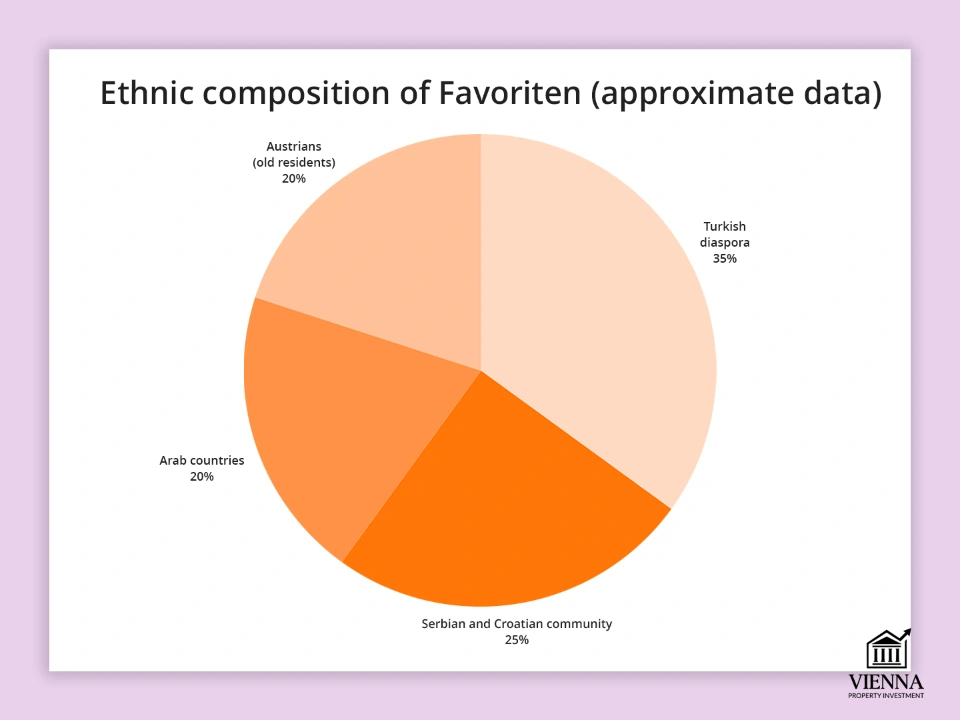
Modern Favoriten is a mix of different cultures and languages:
- Turkish speech in street markets,
- Serbian and Croatian cafes,
- Arab grocery shops,
- Austrian bakeries and traditional "beissels".
This combination makes the district unique: while strolling along FavoritenStraße, you can hear several languages at once and taste dishes from all corners of the world.
Age and education
Favoriten is characterized by a young population. Thanks to the University of Applied Sciences ( FH Campus Wien ), many students and young professionals live here. This increases demand for affordable housing and rentals. The average age of the population is lower than in "old bourgeois districts" like the 1st or 19th arrondissement.
Education in the area is contrasting: on the one hand, there are strong schools and colleges, on the other, lower academic achievement among some migrants. This creates a social mix that is simultaneously considered a challenge and an opportunity.
Income and social differences
Favoriten is considered part of "middle third" in terms of income. It's home to many workers, small entrepreneurs, and students. At the same time, the area is seeing a growing segment of affluent families buying apartments in new buildings near Hauptbahnhof.
Therefore, Favoriten is neither one of Vienna's most prosperous nor its most dangerous districts. It combines both extremes. While the central neighborhoods near the train station are considered "prestigious districts of Vienna," the outskirts near the old factories are sometimes considered "crime districts of Vienna.".
Social portrait
- Students and young professionals are attracted by the university, cheap rent, and multicultural environment.
- Migrant families. Many have lived here for generations and opened their own businesses.
- Businessmen and expats choose modern complexes near the train station.
- Pensioners. They live in old farmsteads and communal houses.
This mix makes the area vibrant, yet diverse. Some see it as the energy of the future, others as social problems.
Housing: social and luxury segments

Today, Favoriten can be called a "renovation district." Rehabilitation programs for old housing are becoming increasingly large-scale. For example, the renovation project around Gudrunstraße has transformed once-dilapidated buildings into modern homes with energy-efficient systems.
The trend toward "smart apartments" is also interesting. New complexes near Hauptbahnhof are being designed with smart home systems, underground garages, and green terraces. This completely changes the area's image in the eyes of investors.
Forecasts show that by 2030, the price per square meter in Favoriten could increase by 15–20% due to growing demand and limited available land for construction.
Social housing
Favoriten is one of Vienna's leading cities in terms of the number of communal housing units. About 25% of all apartments are city-owned and rented to residents at affordable rates.
Examples:
- The Reumannhof is a symbol of "Red Vienna." A vast building with dozens of entrances, green courtyards, and communal infrastructure.
- Metzleinstaler Hof is another housing complex from the era of social democratic reforms.
These houses were originally built for working-class families, but remain in demand. Today, they are home to students, retirees, and young families for whom renting in the city center is unaffordable.
Old houses and renovations

A significant portion of Favoriten's residential stock consists of 19th-century buildings. Many have retained their historic appearance but require major renovation. For a long time, such buildings were considered a hallmark of an "old working-class neighborhood." However, in recent years, the situation has changed: city authorities and private investors are actively funding renovations.
The area is undergoing a wave of renewal:
- the facades are being restored, returning the houses to their original beauty,
- courtyards are transformed into green public spaces,
- The ground floors are occupied by cafes, shops and cultural centers.
Thanks to these changes, Favoriten is gradually shedding its reputation as a crime-ridden area of Vienna. On the contrary, the renovations are creating new, comfortable neighborhoods where housing is becoming attractive for both renting and buying.
New projects and luxury segments
The situation changes dramatically in the northern part of Favoriten, near Hauptbahnhof. Modern residential complexes such as Sonnwendviertel , The Fave , and Musicbox , offering apartments with underground parking, rooftop gardens, and designer architecture. These neighborhoods are closer to the prestigious districts of Vienna.
Prices here are above average: in new buildings near the train station, prices per square meter can reach €7,000–8,000 , comparable to the city center. However, within a 15-minute walk, you can find housing for €5,000–5,500 per square meter .
Average prices and rent
In 2025, housing in the Favoriten district remains one of the most affordable in Vienna's central districts if you are looking for an apartment in Vienna .
- The average purchase price in Favoriten is €5,355 per m² .
- Average rent is around €14 per m² per month .
By comparison, this is lower than in the neighboring 4th district (Wieden), where prices exceed €7,000 per square meter. Therefore, many families and investors consider the 10th district as a "good location for less money" option.
It's worth noting that prices are significantly higher in the northern part of the district, near Hauptbahnhof and in the new Sonnwendviertel residential areas. New apartments there are already selling for €6,000–7,000 per square meter, which is closer to the more prestigious districts.
Thus, the Favoriten market is heterogeneous: within the same district, you can find both relatively inexpensive apartments in old farm buildings and modern business-class apartments.
Who chooses housing in Favoriten?
Favoriten remains one of Vienna's most diverse neighborhoods in terms of its residents. Completely different social and cultural groups coexist here, creating the district's unique atmosphere.
- Students and young professionals rent apartments near the FH Wien .
- Migrant families prefer the old apartments near Favoriten Straße.
- Investors buy new homes from Hauptbahnhof.
- Middle-class families settle in the southern districts closer to Wien Wienerberg and Therme Wien .
Thus, the Favoriten district combines all segments: from affordable communal apartments and old tenement buildings to prestigious apartments near the train station. Students, large families, and wealthy professionals can all find housing here.
This diverse composition makes Favoriten's real estate market both dynamic and controversial. For some, it remains a working-class neighborhood with affordable housing, while for others, it's a promising investment zone offering comfortable living in new neighborhoods.
Tips for those looking for housing in Vienna's 10th district
Favoriten is one of the capital's most contrasting arrondissements, and choosing an apartment here depends heavily on your priorities. To avoid making a mistake, it's worth considering a few key factors.
1. Determine the purpose of your stay
- Students and young professionals are best suited to apartments near FH Campus Wien or Favoriten Straße : rent is cheaper and transport links are easy.
- Families with children should consider the southern districts near Laaer Berg and Kurpark Oberlaa – they offer more greenery and peace.
- For investors , there are new buildings near Hauptbahnhof and in Sonnwendviertel , where prices are higher but growth prospects are significant.
2. Compare old houses and new complexes
- Old hofs from the 19th and 20th centuries offer atmosphere, affordable prices, and spacious apartments, but often without an elevator and with outdated utilities.
- New projects feature smart homes, underground parking, and energy efficiency, but the price per square meter here is 30–40% higher.
3. Consider transportation
If you frequently commute outside the city, choose accommodations closer to the Hauptbahnhof —this will save you dozens of hours a year. For those who value peace and quiet, neighborhoods closer to Wienerberg are better suited Wien from the train station and traffic won't disturb you.
4. Check the infrastructure
- The northern part of the area is home to a concentration of offices, universities and shops.
- In the south there are parks, thermal baths, and family areas.
- In the center, at Favoritenstraße, there are markets, shops and a multicultural atmosphere.
The choice of area within a district directly depends on what lifestyle is closer to you.
5. Evaluate rental and purchase prices
- The average rent in Favoriten is 14 €/m² , but in older buildings you can find prices as low as 11–12 €.
- New apartments near Hauptbahnhof cost 6-7 thousand €/m², while in older areas the price is around 5 thousand €/m².
- For investors, it is important to consider that rental yields in Favoriten are higher than in more prestigious areas (around 4.4% versus 3.2% in the center).
6. Advice: Come and get a feel for the area
Before making a decision, spend a week renting an Airbnb apartment or staying in a hotel in different parts of Favoriten. The neighborhood feels different day and night: the bustling streets near Reumannplatz may not be everyone's cup of tea, while the quiet neighborhoods near Oberlaa will surprise you with their peace and greenery.
Education

Favoriten can't be considered a purely "working class" district. Thanks to the development of its educational institutions, it has become a center of education and science. This is a huge advantage for families with children and students: the presence of schools, high schools, and universities within walking distance greatly enhances the district's appeal. Today, education in the 10th arrondissement can be considered a major selling point—it offers everything from kindergartens to institutes collaborating with CERN.
Schools and gymnasiums
There are several dozen Volksschulen (primary schools) and Hauptschulen (basic schools) in Favoriten. This means every family has access to education close to home. The schools in the district are multicultural: children from various countries study there, fostering an atmosphere of openness and tolerance. For many parents, this is important, as their children gain experience communicating in a multilingual environment from a very early age.
Among the most famous:
- Rainergymnasium is the oldest gymnasium in the district. The school is renowned for its emphasis on the humanities, rigorous language studies, and a rich tradition of cultural events. It frequently hosts theatrical productions and literary evenings.
- HTL Spengergasse is one of Austria's largest technical schools, with approximately 2,600 students. The school trains specialists in IT, engineering, and media technology. Graduates are in demand in the labor market, and the school maintains partnership programs with Viennese IT companies and startups.
These schools are renowned not only within the district but throughout Vienna. Favoriten's educational map is constantly being updated. In addition to large schools and universities, language courses for migrants and educational startups are actively developing. For example, Ankerbrot Fabrik offers graphic design and photography workshops for teenagers.
This integration of education into the cultural life of the district makes it particularly attractive to young families who value access to quality education.
Higher education
The district's pride and joy is the Fachhochschule Campus Wien (University of Applied Sciences). With over 8,000 students, it is one of the largest FHs in the country. It trains future professionals in medicine, social sciences, economics, and engineering.
Thanks to the campus, the area is popular with students and young professionals, which explains the high proportion of renters in the neighborhood.
Additional education
- VHS Favoriten is a public school offering courses in languages, design, and accounting.
- Polycollege is an educational center for adults.
- The Institute for High Energy Physics (HEPHY) is a research center collaborating with CERN. Its presence underscores Favoriten's status as a scientific as well as a working community.
The influence of education on the image of the district
The presence of strong educational institutions makes Favoriten attractive to families with children. Despite its reputation as a "multicultural and vibrant" district, many parents choose it for its schools and high schools.
Furthermore, student youth enliven the cultural life. Cafés, art spaces, and startups in old industrial buildings are all connected to the presence of universities.
In this way, Vienna's Favoriten district is strengthening its image as a district with educational and scientific potential.
Infrastructure and transport

Favoriten stands out from many other districts thanks to its well-developed transportation network. It is a true hub for urban and international mobility, with metro, trams, buses, rail, and convenient pedestrian areas intertwined.
The district is considered one of Vienna's key points, as it is home to the country's largest transport hub, Hauptbahnhof Wien . Its opening marked a turning point in the district's history: the station not only provided fast connections to Europe but also transformed the entire appearance of Favoriten, making it more modern and prestigious.
Favoriten is gradually becoming a car-free district. In 2025, projects began in the southern part of the district to completely close several streets to traffic and transform them into pedestrian zones with green alleys. This is in line with the STEP 2025 strategy, which prioritizes bicycles and pedestrians.
Night transportation is also being developed. Night bus lines connect Favoriten with the city center and the airport, which is especially important for students and service industry workers.
Metro and city lines
The metro system plays a central role in the life of the district. Several key lines pass through Favoriten:
- The U1 is the main artery connecting Favoriten Straße and Reumannplatz with the center and north of Vienna. This line provides quick access to the capital's tourist and business districts.
- The U2 and U3 lines are accessible via connections at Hauptbahnhof, making the station a key transfer point for residents of the entire city.
- U6 - runs along the border with the 12th district ( Meidling ) and connects Favoriten with the western districts.
Reumannplatz station is one of the busiest in the metro. It serves thousands of passengers daily, becoming the gateway to the heart of the district. Oberlaa ; its opening made it possible to reach the city center in just 15–20 minutes. This significantly increased property values in this area and made the area attractive to new residents.
Trams and buses
Favoriten's tram network is one of the densest in Vienna. The area is served by lines 6, 11, 18, 62, and 67. Line 6 is especially important, connecting FavoritenStraße with other working-class neighborhoods. Trams operate at a pace familiar to Viennese: they are convenient for short trips and complement the metro.
Buses serve as a vital link, especially for the southern outskirts. They connect residential areas near Laaer Berg and Wienwith the train station and metro stations. Thus, even the most remote areas of the district have reliable transportation connections.
Hauptbahnhof Wien
The main railway station is the heart of the district's transport infrastructure. Trains depart from here throughout Austria and to neighboring countries such as Germany, the Czech Republic, Hungary, and Italy. For district residents, this means not only convenient travel but also thousands of jobs.
The station became a catalyst for urban transformation: the modern Sonnwendviertel quarter, with housing, schools, and offices, grew around it. Thus, even if parts of the district are still perceived as disadvantaged areas of Vienna , it was Hauptbahnhof that elevated it to the status of Vienna's new prestigious districts .
Roads and ecology
The traffic situation in Favoriten is mixed. The northern part of the district—especially Gürtel and Südbahnhofstraße—is congested, with heavy traffic and noise. Meanwhile, the southern part of the district remains quiet, dominated by residential areas and green spaces.
The city is actively implementing the STEP 2025 strategy, aimed at reducing traffic and developing "green mobility." In Favoriten, new bike paths are being created, pedestrian areas are being expanded, and on-street parking spaces are being reduced.
This is gradually changing lifestyles: more and more residents prefer bicycles or public transport to private cars.
Pedestrian accessibility
Particular attention is being paid to Favoriten Straße , which has been transformed into a pedestrian zone. Today, it's not only the district's commercial artery but also a vibrant place. Here, you can stroll, shop, relax in a café, or simply enjoy the city's atmosphere. Favoriten Straße has become the true "pulse" of Favoriten and a symbol of its multicultural character.
Thus, in terms of transportation, Favoriten is among the best neighborhoods in Vienna to live in . The metro, train station, trams, and buses make it easy to get around the city and beyond.
Parking and parking policy

Parking is a sore point for residents of Favoriten. Dense buildings, narrow streets, and a large number of cars make the situation tense. Unlike some "green" neighborhoods on the outskirts, where houses have their own courtyards and parking spaces, in Favoriten, historically, most buildings were built without parking.
Parkpickerl zones
That's why the district actively uses the Parkpickerl system—special parking permits for residents. This system covers almost the entire 10th district. The idea is simple: without a Parkpickerl sticker, it's nearly impossible to park on the street, as inspectors actively inspect cars and issue tickets.
A residence permit is inexpensive and can be obtained through the city administration, but even with one, finding a free parking spot in the evening can be extremely difficult. This is especially true in the older neighborhoods around FavoritenStraße and Reumannplatz, where the population density is highest.
Paid parking zones with time limits are available for visitors to the area, which encourages them to park their cars within a short time.
Garages and underground parking
The situation is significantly better in new residential complexes. Hauptbahnhof's projects—for example, Sonnwendviertel —were designed from the start with modern requirements in mind: underground parking, enclosed courtyards, and accessible garages. This alleviates some of the stress, but only for new residents.
Residents of older buildings don't have this luxury, and they're forced to seek out street parking. To alleviate this, the city is introducing a system of "dynamic displays" that show the number of available spaces in nearby garages. This helps drivers save time and reduces congestion caused by those driving around the neighborhood looking for a spot.
Green initiatives
In recent years, some parking lots have been converted into public spaces. For example, several paved lots in the Naschmarkt area have been transformed into parks and recreation areas. More similar projects are planned in Favoriten, too: the city is prioritizing sustainability over endless parking expansion.
Therefore, the 10th district faces a dual situation: on the one hand, parking is a major problem, especially in older neighborhoods; on the other, new projects address it with underground garages. This is another contrast that distinguishes Favoriten Wien : it simultaneously reflects both long-standing problems and new approaches to urban planning.
Duality of the situation
Thus, a twofold situation arises in Favoriten:
- Cons: For residents of older neighborhoods, finding parking remains a daily stress.
- Plus: in new buildings with underground garages, this problem is solved, and the quality of life is noticeably higher.
This contrast is particularly noticeable when comparing the northern part of the district near Hauptbahnhof and the old streets around Reumannplatz. At one end are modern underground parking lots and convenient garages, while at the other are crowded streets with almost no space.
Favoriten thus reflects a general trend in Vienna: the city is shifting from a car-centric model to a pedestrian and bicycle-centric one. While parking remains a pressing issue, the direction of development is clear: fewer cars on the surface, more greenery and public spaces.
Religion and religious institutions
Favoriten is one of Vienna's most multinational and multicultural districts. This applies not only to restaurants and shops, but also to religious life. Rarely on the map of Vienna can districts boast such a diversity of faiths as the 10th district.
Catholic churches
Despite the strong presence of migrants, the Catholic tradition remains significant:
- Pfarrkirche St. Anton (Antonskirche) is a neo-Gothic church, a symbol of old Favoriten.
- Herz-Jesu-Kirche (Church of the Sacred Heart of Jesus) – built in the 1890s, it stands out for its massive brick architecture.
- The Keplerkirche is a favorite place for Viennese Catholics and is often used for organ concerts.
Orthodox parishes
Thanks to the numerous immigrants from Serbia, Romania, and Russia, there are Orthodox churches in the region. They play an important role in uniting Eastern European communities.
Mosques and Islamic centers
Favoriten is often referred to as the "Arab district of Vienna," owing to its large concentration of Muslim communities. There are at least four mosques and Islamic cultural centers serving the Turkish and Arab diaspora. Their role extends far beyond religious observance: they are places where community is built and where support is provided for new residents.
The main activities of mosques and centers in Favoriten:
- Prayer and spiritual life - daily services, holidays of Ramadan and Eid al-Adha.
- Education – classes for children and teenagers, Arabic language courses, Quran lessons.
- Social assistance – support for migrants and refugees, consultations on housing, work, and documents.
- Cultural initiatives – festivals, open days, joint events with local residents.
This activity shapes the district's distinctive character: the streets near the mosques are filled with oriental cafes, spice shops, and bakeries. Many residents call Favoriten "Vienna's little East." For some, it's an exotic and interesting experience; for others, it's a reminder of the challenges of a multicultural city.
It is the mosques and Islamic centers that make Favoriten a shining example of how different traditions and ways of life intertwine in one district, creating a unique atmosphere that cannot be found in other parts of Vienna.
Religious institutions in Favoriten:
| Confession | Examples of institutions | Role in the area |
|---|---|---|
| Catholicism | Antonskirche, Keplerkirche | Historical heritage, concerts, religious services |
| Orthodoxy | Serbian and Romanian parishes | Support for Eastern European communities |
| Islam | 4 mosques, cultural centers | Centers for spiritual and social life of migrants |
| Buddhism | Thai center | Meditation, cultural programs |
| Protestantism | Small parishes | Local communities |
Conclusion: Favoriten's religious landscape is as diverse as its population. This is why this district is often perceived as "a small world within Vienna."
Culture, Leisure and Events
Favoriten isn't just a transportation and educational hub. It's a neighborhood with a surprisingly diverse cultural scene, blending folk traditions with contemporary art. When it comes to Vienna's favorite neighborhoods for creative people to live in, Favoriten is increasingly making the list.
The area is popular for street performances, art trails, and food festivals. In 2024, for example, a major "Street Food Festival" was held, featuring cuisines from over 20 countries.
Ankerbrot Fabrik has become a hub for the creative economy, hosting several artist residencies and photography studios, as well as lectures on contemporary art.
Theaters
- Volx/ Margareten is an experimental stage with productions by young directors.
- The Scala Theatre is a chamber theatre that hosts both classical plays and children's performances.
- Spektakel is an independent venue for cabaret, musical evenings and satirical shows.
Movie
- Filmcasino is a cult art cinema with retrospectives, festivals, and discussions. It's a favorite among students and film buffs.
- Summer open-air cinemas in the Wien and Laaer Berg parks are a popular meeting place for young people.
Museums and galleries

Favoriten isn't a district filled solely with "everyday" businesses. It also boasts interesting cultural spaces that showcase history, economics, and contemporary art.
- The Bezirksmuseum Favoriten is a unique "time machine." The exhibition features photographs of old workers' quarters, factory models, and documents from the industrial era. Interactive exhibits offer a glimpse into the 19th century, when the area was just beginning to transform from a rural outskirts into an industrial hub.
- The Economic Museum Vienna makes complex concepts accessible and engaging. It features exhibitions on the development of trade, business, and technology. The exhibits are interactive, allowing you to try your hand at "managing the economy," making the museum interesting not only for adults but also for schoolchildren.
- OstLicht Galerie is a true paradise for photography enthusiasts. It showcases both renowned Austrian photographers and international masters. The gallery is known for its unafraid approach to bold themes, from documentary photography to experiments with contemporary visual forms.
- Galerie Hiliger is an art space in the former Ankerbrot bakery. This space combines the industrial charm of old brick walls with contemporary art. Exhibitions here are often experimental, targeting a young audience and creative industries.
New format spaces

The Ankerbrot Fabrik deserves special attention . It was once Vienna's largest bakery, supplying the entire city with baked goods. Today, it's a unique art space bustling with activity 24/7.
Here are the events:
- exhibitions of contemporary art and photography,
- parties with DJs and musicians,
- gastronomic festivals,
- Master classes in cooking, design and crafts.
Ankerbrot Fabrik has become a symbol of how the district can transform its past. From an industrial site, the factory has transformed into a hub for the creative economy, attracting students, artists, and tourists.
Gastronomic culture
Favoriten is a "little gastronomic map of the world" inside Vienna.
- Zum Alten Beisl is a cozy, traditional Austrian restaurant serving Wiener schnitzel, goulash, and seasonal dishes. The interior is reminiscent of old Viennese "beisls": wooden tables, warm lighting, and an intimate atmosphere.
- Tichy is a legendary ice cream parlor known far beyond the neighborhood. Its signature ice cream, "Eismarillenknödel" (cold-served dumplings with apricot jam), has become a cult Vienna dessert. Lines form outside in the summer, and the parlor itself has long been part of the neighborhood's identity.
- Konya Etli Ekmek is a Turkish restaurant specializing in etli ekmek, a thin, oven-baked, meat-filled lavash. For the local Turkish community, it's a "piece of home," and for Austrians and tourists, it's an opportunity to experience authentic, local cuisine.
Besides these establishments, FavoritenStraße and the surrounding streets are literally bursting with gastronomy: from Eastern bakeries and döner stands to Italian pizzerias and vegetarian cafes. Here, you can take a "gastronomic journey" across three continents in one evening without leaving the area.
Festivals and Events

Favoriten is a district where cultural life never wanes. Thanks to its multicultural population, dozens of festivals are held here, from traditional Austrian ones to Eastern fairs. Each year, the calendar of events expands with new initiatives, while old traditions continue to bring together residents and visitors alike.
- Neighborhood Festivals at Reumannplatz. Reumannplatz is the heart of Favoriten's social life. Festivals, concerts, children's events, and themed fairs are regularly held here.
Summer street events are especially popular, with a stage, market stalls, and seating areas set up on the square. These events are not only entertainment but also a way to bring together the neighborhood's diverse cultural communities. - Flea markets on Favoriten Straße. Favoriten Straße is a lively pedestrian street where flea markets are held every weekend. Everything from old books and records to clothing, tableware, and antiques are sold here.
The atmosphere is reminiscent of a cross between an oriental bazaar and a European fair. For students and collectors, this is a true treasure, and for tourists, it's a chance to experience the spirit of the "old working-class district." - Annual markets at the Therme Wien Oberlaa. The Oberlaa district is known for its thermal baths and parks. Every year, it hosts markets dedicated to local culture and cuisine.
Visitors can sample traditional Austrian dishes, wines, and sweets, and participate in workshops. These markets are especially popular with families: the program typically includes children's entertainment, carousels, and sports activities. - Musical evenings in Wien . Summer outdoor concerts in Wien have long been a tradition. Local bands, jazz ensembles, and sometimes even symphony orchestras perform.
The atmosphere is extremely relaxed: audience members sit right on the grass with blankets and snacks. This is one of the most intimate events, where you can experience the harmony between the city and nature.
Parks and green spaces

At first glance, Favoriten appears to be a typical urban district, with dense residential development, bustling streets, and business districts near the Hauptbahnhof. However, it is here that some of the capital's largest green spaces are located. This is a major advantage for residents: the district can be considered one of the most balanced in terms of urban dynamics and access to nature.
Share of green spaces
The total area of green space in the district is 14.25 km² , which is approximately 45% of the territory . This is significantly larger than in many central districts, where green space is limited to small squares and courtyards.
This feature makes Favoriten especially attractive to families with children, senior citizens, and those who value the opportunity to spend time outdoors without leaving the city.
Key green areas:
- Wien
- A natural park with an area of about 120 hectares .
- There are lakes, running and cycling paths, and sports grounds.
- The area is home to a variety of fauna: you can encounter pheasants, waterfowl, and even rare turtles.
- Wienerberg is particularly popular with runners and cyclists, as well as families who come here for picnics.
- Laaer Berg
- Hilly terrain with dense forests and viewing platforms.
- This is one of the most picturesque places in the area, where residents go for walks and relaxation on weekends.
- Within walking distance is Kurpark Oberlaa , a well-maintained park with alleys, flower beds, and playgrounds.
- The area also boasts the renowned Therme Wien Oberlaa —Austria's largest thermal spa, covering 75,000 m². It boasts swimming pools, saunas, and wellness areas, making the south of Favoriten not only a green but also a spa-like corner of the capital.
- Barbara-Prammer-Park (new project 2025)
- A modern park of approximately 1,500 m² , opening in 2025.
- Fourteen new trees were planted here, fountains were installed, and children's playgrounds were built.
- This project symbolizes a new urban policy: transforming former paved areas into green spaces for recreation and socializing for residents.
- Bruno-Kreisky-Park and Einsiedlerpark
- These parks have been modernized using gender-responsive design .
- Women and children were involved in the design to ensure their needs were taken into account.
- Safe zones, new playgrounds, and spaces geared toward girls, such as sports areas without an aggressive atmosphere, have been established.
- This approach makes parks modern public spaces that are comfortable for all generations.
Residents from other districts often come to Favoriten for the Therme Wien Oberlaa , Austria's largest spa complex (75,000 m²). It includes swimming pools, saunas, relaxation areas, and medical facilities, making the area particularly attractive to families and tourists.
Conclusion : Despite its reputation as a "working class and dense area," Favoriten is among the best areas to live in Vienna precisely because of its combination of green parks and convenient infrastructure.
Economy, offices and international relations
Favoriten is not only a residential and student district, but also an important economic hub of Vienna. Thanks to its location, transportation hubs, and diverse population, the district combines small businesses, modern office complexes, and international connections.
Local business
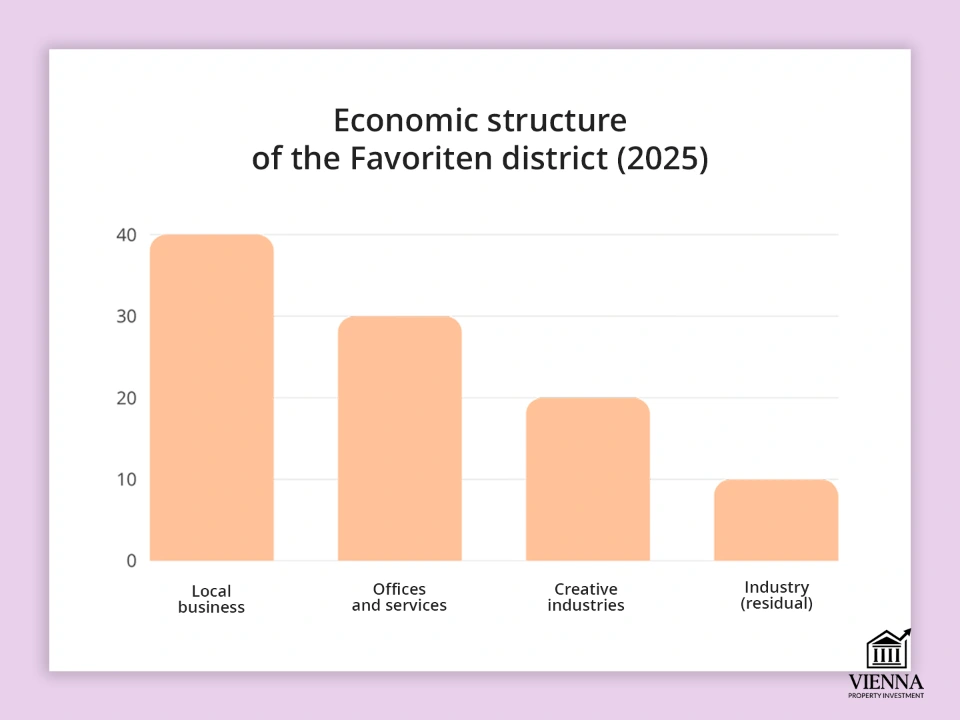
The district's economic life begins with FavoritenStraße, a long shopping street lined with hundreds of small shops, cafes, bakeries, and service providers. Family-run businesses are strong here, with many shops passed down from generation to generation. Along the streets, you'll find traditional Austrian bakeries, Asian markets, Turkish butchers, and Arabic patisseries.
This multicultural economy attracts not only migrants but also Austrians: many come here specifically for the fresh spices, exotic fruits, and inexpensive groceries. FavoritenStraße has effectively become the district's "shopping showcase," where local businesses maintain its unique atmosphere and provide hundreds of jobs.
Business centers
- Business Park Vienna is a modern office complex near Wien . It houses IT companies, banks, and consulting firms.
- Quartier Belvedere (near Hauptbahnhof) is a prestigious business district with skyscrapers, home to the offices of international corporations.
Industry
Historically, Favoriten was associated with factories, working-class neighborhoods, and industrial Vienna. However, in recent decades, the district's character has changed. Many factories have been closed or repurposed. Former industrial buildings have been transformed into cultural and creative spaces.
The best example is Ankerbrot Fabrik . It was once Vienna's largest bakery, supplying the city with its products. Today, its red-brick buildings have become an art cluster with galleries, studios, and exhibition halls. It symbolizes the transformation of Favoriten's economy: from its industrial past to a modern creative industry.
International significance
Favoriten is of strategic importance for international business.
- Hauptbahnhof connects the area to Schwechat Airport in just 15 minutes, making it convenient for business trips and visiting specialists.
- Diplomatic missions and the headquarters of international organizations are just a few metro stops away. The Vienna International Centre (UNO-City) is a short ride away, making it especially convenient for expats and corporate employees.
Thanks to this, Favoriten becomes a point of intersection of the local and the global – it houses both small Eastern shops and the offices of large global companies.
The economic portrait of the region reflects its diversity:
- Students often work part-time in cafes, shops and small services.
- Migrants own their own businesses, from grocery stores to restaurants and repair shops.
- International professionals rent apartments near Hauptbahnhof and work in office centers, combining a high standard of living with affordable rent.
This mix creates the district's economic stability: even if one sector weakens, another maintains balance. This makes Favoriten one of Vienna's most vibrant and dynamic districts.
Modern projects and investments
Favoriten can now be called a construction district. While it was once associated with factories and working farms, it is now associated with new neighborhoods and large-scale development projects.
The main driver of change is the area around Hauptbahnhof. An entire residential complex, Sonnwendviertel, has been built here, designed to accommodate thousands of residents. The architects aim to create a "city within a city": apartments with terraces, schools, kindergartens, sports fields, offices, and cafes—all within walking distance.
Notable projects of recent years include:
- The Fave is a residential complex with underground parking, green courtyards, and shops on the ground floors.
- Musicbox is a modern building with unique architecture and spacious apartments, designed for young families and professionals.
- New development on Margaretenstraße: 235 apartments, underground parking for 255 spaces, recreation areas and a crèche.
The trend is changing not only in the center but also in the outskirts. New cottage and low-rise developments are emerging in the Laaer Berg district. The city is actively investing in parks, schools, and metro expansion, enhancing the appeal of the southern part of the district.
It's important to note that these projects aren't just about building housing, but about changing the district's image. While many previously considered Favoriten to be one of Vienna's "underprivileged" neighborhoods, it's now increasingly being included on lists of "new prestigious districts.".
Investment attractiveness of the area
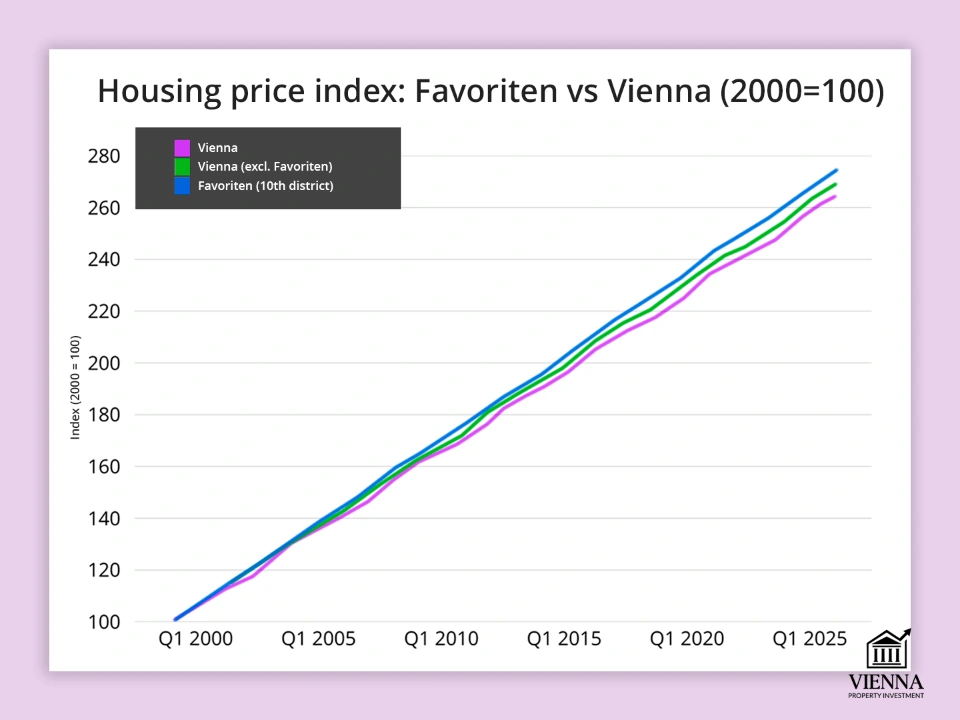
When it comes to real estate in Vienna, the question is always the same: where is it more profitable to buy or rent? And here, the 10th district holds a special place.
Favoriten remains the capital's most densely populated district. This means demand for housing here is consistently high, especially for rentals. Students, migrants, young professionals, and families are all looking for affordable options, and this district offers them.
The average purchase price in Favoriten is lower than in neighboring central districts: around €5,300 per square meter versus €7,000–9,000 in the 3rd or 4th districts. However, the district's excellent transport links make it equally convenient. For investors, this means high returns with a relatively low entry cost.

However, the market within the district is very diverse. In the older neighborhoods near FavoritenStraße, affordable housing for students and migrants can be found. Meanwhile, new buildings near Hauptbahnhof and Belvedere are already considered expensive, luxury apartments. This diversity allows investors to choose their strategy: from stable rentals to long-term capital growth.
Favoriten's prospects are also linked to its urban policy. The authorities are actively developing infrastructure, investing in parks, and modernizing schools and roads. All of this improves the quality of life and boosts real estate prices.
There are risks, too. The reputation of a "crime-ridden neighborhood" still resonates, especially when it comes to older neighborhoods. But recent experience shows that this reputation is gradually fading. New projects and the relocation of middle-class families are changing the face of the neighborhood.
The bottom line for investors is this: Favoriten is neither the most prestigious nor the most dangerous district of Vienna. It's a zone of change, where it's profitable to buy today for a return tomorrow.
Who is Favoriten suitable for?
Favoriten is a district that is spoken of in different ways. For some, it is a symbol of multicultural Vienna, with its markets, oriental cafes, and bustling FavoritenStraße. For others, it is a dynamically developing district, where new prestigious homes and offices are springing up near the Hauptbahnhof. The truth, as always, lies somewhere in the middle: the 10th district is a blend of a traditional working-class neighborhood and a modern "city of the future.".
- Families – thanks to schools, grammar schools and an abundance of green areas ( Wien , Kurpark Oberlaa, Laaer Berg).
- For students and young professionals , the area offers affordable housing and a vibrant cultural scene.
- Investors enjoy consistently high rental demand and relatively affordable purchase prices, although there are restrictions on foreigners purchasing property in Austria .
- For expats and creatives , the multicultural atmosphere and art spaces like Ankerbrot Fabrik create an open environment.
For whom the area may be difficult
- For those seeking only prestigious neighborhoods with historic architecture and expensive boutiques, Favoriten remains in the "contrast" category.
- For noise-sensitive people, FavoritenStraße and the areas near the train station are among the busiest in the city.
- For those who fear the stereotypes about Vienna's crime-ridden neighborhoods, despite improvements, the area retains a reputation for being "noisy and complex.".
Result
If you compare Vienna's districts by their numbers , Favoriten is certainly neither the most prosperous nor the most dangerous. It's a unique neighborhood where mosques and Catholic churches, working-class buildings and modern skyscrapers, bustling markets and green parks coexist. For those willing to embrace this mix of cultures and traditions, Favoriten will be a comfortable and interesting place to live.
For investors, this is one of the most promising districts: affordable prices with growing potential. For families, it offers a balanced mix of schools, parks, and transportation. For students and expats, it offers a multicultural and open environment.
Favoriten is Vienna in miniature: noisy, multifaceted, contrasting, but that’s precisely what makes it alive.