Historically, Vienna is divided into 23 unique districts. Innere Stadt, or Vienna's 1st district, is its historical and cultural center, a UNESCO World Heritage Site since 2001. It is where the centuries-old history of the Austrian capital, its political, economic, and cultural life, are concentrated within a compact area.
Vienna's central district encompasses the Ringstrasse and the Old Town, forming the core from which the city's history began. It is home to the majestic St. Stephen's Cathedral, the State Opera, the Hofburg Palace—the former imperial residence—as well as dozens of museums, theaters, and galleries.
The district's unique character: sumptuous imperial-era architecture, narrow medieval streets, prestigious boulevards, and green parks create an atmosphere where history harmoniously blends with modernity. Innere Stadt is not just a tourist destination, but also a business and diplomatic hub: it is home to the offices of international companies, banks, embassies, and Austrian government agencies.
Living in Vienna's 1st district offers access to Europe's finest restaurants, boutiques, and cultural events. However, the housing supply is limited, creating exceptional investment potential. Innere Stadt there is virtually no mass new construction, and the market is primarily represented by luxury apartments in historic buildings, often with modern interiors and panoramic views of the city. High demand from international buyers and the business elite makes this district one of the most prestigious investment destinations in Austria.
The purpose of this article is to take a detailed look at the infrastructure, housing stock, cultural and economic factors, and to assess the investment attractiveness of Vienna's central district for those considering purchasing real estate in the historic center of the Austrian capital.
History — Innere Stadt: The Heart of Vienna

Innere Stadt, or Vienna's 1st district, is the historic core of the Austrian capital. Its history spans nearly two thousand years, from the Roman camp of Vindobona to its current status as one of Vienna's most prosperous districts. Today, it is home to key architectural monuments, cultural institutions, and prestigious residential properties.
From Vindobona to the Medieval Fortress
Vienna's modern 1st district grew on the site of the Roman military camp of Vindobona, built in the 1st and 2nd centuries. It was part of the Roman Empire's defensive line on the Danube. The layout of the ancient camp is still visible on the street map: Graben, Salzgries, and Rabensteig follow the boundaries of the Roman fortifications.
After the fall of Rome, Germanic tribes began settling here, and in the 12th century, the area became the capital of Austria. In 1155, Duke Henry II of Babenberg moved his residence to Vienna, making it the political center of the region. By the 13th century Innere Stadt was already a powerful fortress surrounded by fortified walls.
In 1221, the city received the status of a free trading center (staple right), making it the main trading hub of Central Europe. Even then, Vienna's first district was not only a political but also an economic center.
The Habsburg era: the rise of architecture
From the 14th century until the end of the 19th century, Innere Stadt developed under the influence of the Habsburg dynasty. They turned Vienna into the center of the empire and established the architectural style that defines the district to this day.
- St. Stephen's Cathedral (Stephansdom) is the symbol of the city; the southern tower reaches 136 meters in height, and the roof is decorated with more than 230,000 ceramic tiles.
- The Hofburg is a huge palace complex with an area of approximately 240,000 m² and more than 2,600 rooms. It was once the residence of the Habsburgs and is now the residence of the President of Austria.
- The palaces of the nobility (Lichtenstein, Kaunitz, Kinsky) became examples of Baroque and classical architecture.
In the 17th and 18th centuries, Vienna became the cultural capital of Europe. Mozart, Haydn, Beethoven, and Strauss all worked here. Vienna's first district was home to theaters, opera houses, and concert halls, many of which are still in operation today.
The demolition of the walls and the birth of Ringstraße
In the 19th century, Emperor Franz Joseph I decided to demolish the outdated medieval walls surrounding Innere Stadt. In their place, Ringstraße was built—a luxurious boulevard stretching over 5 kilometers, framing the city center.
Buildings in the historicist style were erected along the Ring:
- The State Opera (1869) is one of the best opera houses in the world,
- Parliament (1883) - with columns in the ancient Greek style,
- Town Hall (1883) - built in neo-Gothic style,
- The Burgtheater is one of the leading theatres in the German-speaking world,
- Art and natural history museums, which are still among the most important in Europe.
Ringstraße became a showcase of imperial power and at the same time a residential area for nobility, bankers and industrialists.
World War II and Reconstruction
During World War II, Vienna suffered from Allied bombing. Buildings along the Ring were particularly damaged. For example, the Opera House was almost completely destroyed: only the façade and main hall remained. However, in the post-war years, the authorities decided to rebuild the city center as faithfully as possible to its historical design.
In 1955, coinciding with the signing of the State Treaty and the end of the occupation of Austria, the Opera was reopened, becoming a symbol of the capital's rebirth.
UNESCO and the policy of strict protection
In 2001, Vienna's historic center, including Innere Stadt and Ringstraße, was listed as a UNESCO World Heritage Site. This means any reconstruction is subject to strict controls:
- it is prohibited to build high-rise buildings,
- redevelopment and modernization of facades are limited,
- All renovations are subject to approval by city and federal authorities.
Today, Vienna's 1st district combines medieval streets, imperial palaces, and modern spaces. It is home to embassies, the headquarters of international organizations, and the finest boutiques and hotels. Real estate in Innere Stadt is considered a rare asset: demand consistently exceeds supply.
| Period / century | Events and facts | Significance for the area |
|---|---|---|
| 1st–4th centuries (Roman era) | The Vindobona military camp is founded on the site of the future Vienna. A permanent garrison of up to 6,000–7,000 soldiers is established. | The first streets, fortifications, and water supply system were laid. |
| 10th–11th centuries. | The settlement's revival after decline. Establishment of trade links. | The beginning of the transformation into the political center of the Eastern March. |
| 1155. | Duke Heinrich II Babenberg moves the capital to Vienna. | Vienna becomes the residence of the rulers, the importance of Innere Stadtincreases. |
| 12th–13th centuries. | Construction of city walls. Obtaining the right to store goods (Staple Right, 1221). | Strengthening the economy, transforming Vienna into a trade hub for Central Europe. |
| 14th–16th centuries. | Habsburg rule. Beginning of construction of St. Stephen's Cathedral (1349). | Architectural design of the center, transformation of Vienna into the capital of the empire. |
| 17th–18th centuries. | Baroque and Classicism. Construction of palaces (Kinsky, Lichtenstein, Kaunitz). Development of musical culture (Mozart, Haydn, Beethoven). | Innere Stadt is the political and cultural centre of Europe. |
| 19th century. | Demolition of the fortress walls. Creation of Ringstraße (1857–1865). Construction of the Opera House, Town Hall, Parliament, and Burgtheater. | Radical restructuring of the center, formation of an “imperial showcase”. |
| 1945. | World War II bombing. Destruction of the State Opera. | Loss of historic buildings, but plans for restoration. |
| 1955. | Restoration of the Opera, signing of the State Treaty. | Symbol of the rebirth of the capital and Innere Stadt. |
| 2001. | Inclusion of the Historic Centre of Vienna in the UNESCO list. | Strengthening the protection of monuments, ban on high-rise new buildings. |
| 21st century. | Renovation of palaces into luxury apartments, cultural festivals, and a tourist center. | The area remains the most prestigious and expensive for living and investment. |
Geography, zoning and structure of Vienna's 1st district
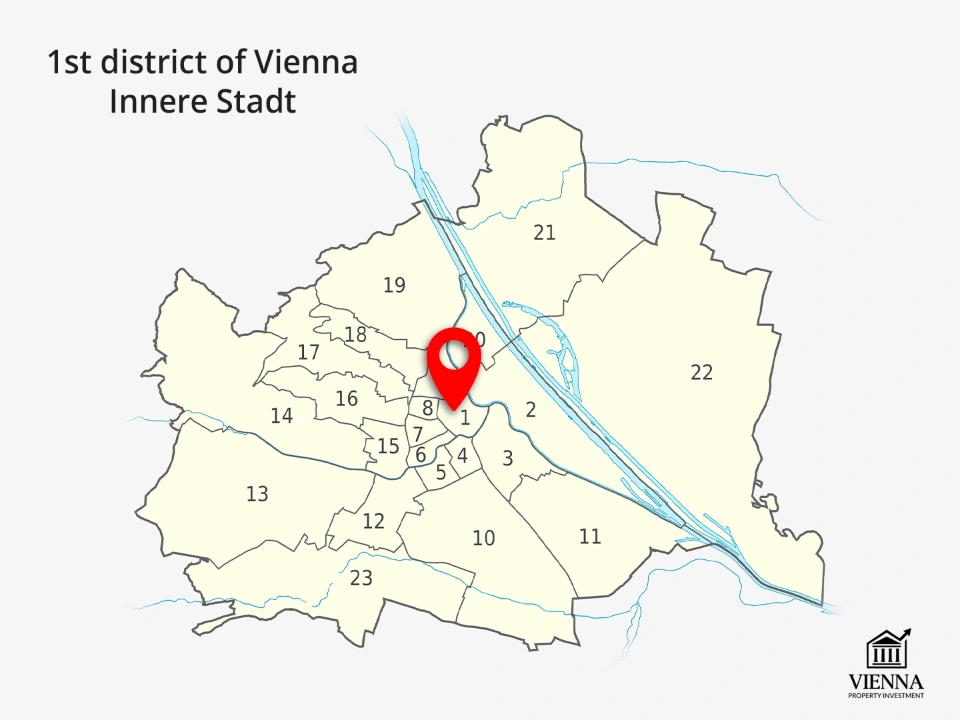
Vienna's 1st district (Innere Stadt) is the city's historic core and one of the most recognizable landmarks of European architecture. It occupies a compact area of 2.88 square kilometers, making it the smallest of Vienna's 23 districts. However, it boasts not only a unique layout but also a distinctive socioeconomic structure, characteristic of the center of an imperial capital.
Location and boundaries
Innere Stadt is located in the very center of Vienna and is surrounded by famous districts:
- Leopoldstadt (2nd district) - across the Danube Canal (Donaukanal) in the northeast,
- Landstraße (3rd district) - to the east,
- Wieden (4th district) - to the south,
- Mariahilf (6th) and Neubau (7th) - to the west,
- Josefstadt (8th) and Alsergrund (9th) - to the north.
The district's border follows natural and artificial lines: the Danube Canal, the WienRiver, Lothringerstraße, Karlsplatz, Getreidemarkt, Museumsplatz, Auerspergstraße, Landesgerichtsstraße, Universitätsstraße, and Maria-Theresien-Straße. This perimeter forms the famous Ringstraße arc, encircling the historic core of the city.
This location makes Vienna's 1st district not only a tourist destination, but also an administrative centre, home to government offices, diplomatic missions and key cultural sites.
Historical structure: from fortress quarters to modern zoning
Originally, Innere Stadt was a fortified fortress, surrounded by walls and moats. The city was divided into four historic quarters (based on the main gates):
- Stubenviertel (northeast) - a district of merchants and artisans,
- Kärntner Viertel (southeast) - leading to the Carinthian Gate,
- Widmerviertel (southwest) - the center of medieval guilds,
- Schottenviertel (northwest) - founded by Scots monks (Schottenstift).
Today, these names remain in cultural memory. Currently, the entire region is roughly divided into:
- The cultural and historical zone (Stephansplatz and surrounding area) - St. Stephen's Cathedral, museums, theaters, galleries,
- Administrative and government sector - the area of the Town Hall and the Hofburg,
- The diplomatic and financial cluster, Börseviertel, is home to banks, international companies,
- Shopping belt - Graben, Kärntner Straße, Kohlmarkt (boutiques, jewelry houses),
- Residential areas are mainly in the side streets behind the Ring, with renovated apartment buildings and penthouses.
Population density and demographic dynamics
Despite its central status, Innere Stadt is Vienna's least populated district. About 17,000 people live in an area of almost 3 square kilometers, resulting in a density of less than 6,000 people per square kilometer—a very low figure for a European metropolis.
Historically, the situation was different: in the 19th century, before the city walls were demolished, the area was overcrowded. In 1869, 68,079 people lived there, and by 1880, a record 73,000. But with the onset of urban modernization and the relocation of housing to suburban areas, the population declined. The minimum was recorded in 2011—just over 16,000 residents.
This decline is explained by high real estate prices and the predominance of offices, shops, and cultural facilities over residential buildings. Today, Vienna's 1st district combines residential properties for wealthy residents, diplomatic residences, and apartments for foreign investors.
Development: architectural integrity and premium segment
Vienna's 1st district is unique in that almost all of its residential buildings and infrastructure are protected by the state. New development is extremely limited, and high-rise construction is prohibited. The architectural landscape of Vienna's center has remained virtually unchanged since the late 19th century. The main buildings are:
- Historic palaces and mansions of the Baroque and Classical periods (Hofburg, Palais Coburg, Palais Liechtenstein),
- Tenement houses in the Gründerzeit style (period 1848–1914) with high ceilings and rich facades,
- A minimal share of new construction - rare projects are integrated into the historical fabric while preserving the facades,
- Luxury apartments from renovated palaces, often with panoramic views of the Ring or Stephansdom.
The buildings often feature modern interiors with historical elements, such as stucco, parquet floors, and marble staircases. This contributes to the image of Vienna's 1st district as the most prestigious location in the city's real estate market.
Population and social structure of the 1st district of Vienna

Vienna's 1st district is considered the city's most sparsely populated, with a density of less than 6,000 residents per square kilometer, compared to the average density for Vienna, which is four times higher. The district's social structure is unique: it boasts a high concentration of expats, diplomats, and executives of large companies. According to Statistik Austria, more than 30% of the population holds foreign citizenship, and approximately 20% of residents own premium housing or are investors in luxury real estate.
High proportion of expats, diplomats and top managers
Vienna's city center has historically attracted wealthy individuals, and this trend continues today. Expats, employees of international corporations, diplomats, and top managers make up a significant proportion of the 1st district's residents.
Reasons for popularity:
- Situated near embassies and government agencies, Innere Stadt is a diplomatic hub: it is home to the embassies of several countries, Austrian ministries, and offices of international companies.
- Cultural environment. The area is surrounded by historical monuments, museums, and an opera house, making it attractive to wealthy foreigners.
- A luxury housing market. There's virtually no mass development here, and the properties consist of restored palaces, historic homes, and modern penthouses.
According to city statistics, the share of foreign nationals among residents exceeds 30%, and among luxury real estate buyers, this figure is even higher (up to 50%). These investors are most often from Germany, Switzerland, the Middle East, Russia, and China.
Age composition: dominant mature audience
Unlike Vienna's residential areas, where there are many families with children and retirees, Innere Stadt is characterized by a predominance of an active professional audience.
Age structure:
- The main group is 30–55 years old, people connected with business, diplomacy, and culture.
- Young people (20–30 years old) are less common due to high housing prices.
- People over 65 make up a significant, but not dominant, share – they are mainly property owners who inherited their homes.
In general, Vienna's 1st district can be called a "quarter for professionals": entrepreneurs, lawyers, financiers, employees of international organizations, and artists live here.
| Age group | Population share (%) | Characteristic |
|---|---|---|
| 0–19 years old | ~9 % | Low proportion of children and adolescents; families with children are rare |
| 20–29 years old | ~13 % | Young professionals, students of elite programs, employees in the cultural sector |
| 30–44 years old | ~24 % | Active professionals: managers, lawyers, entrepreneurs |
| 45–55 years old | ~22 % | Top managers, business elite, property owners |
| 56–64 years old | ~15 % | Wealthy residents, business owners, diplomats |
| 65+ years old | ~17 % | The older generation, mostly property owners who have lived there for a long time |
Income: premium segment
Innere Stadt is Vienna's most expensive and prestigious district. The average per capita income here significantly exceeds the Viennese average. According to Statistik Austria and Viennese consulting agencies, the average annual income of residents in the 1st district is approximately €65,000–€80,000 (before taxes), while the citywide average is in the range of €35,000–€40,000.
The cost of apartments and flats reaches €20,000–25,000 per m², which creates a natural price barrier for the population and maintains the high economic status of residents.
Factors affecting profitability:
- Historical buildings (restored palaces, 19th-century apartment buildings).
- Limited supply – there are almost no new projects, but demand is consistently high.
- Strong investment appeal: the area is popular among foreign investors as a reliable asset.
According to Statistik Austria, Innere Stadt is the district with the highest concentration of wealthy residents, which is reflected not only in real estate but also in consumption: it is home to expensive boutiques, fine dining restaurants, and the city's best hotels.
Housing: Premium and Historic Apartments

Vienna's 1st district (Innere Stadt) is not only the cultural and historical heart of the city but also a center for luxury housing. Social housing is virtually nonexistent here: unlike in the outlying districts, where it accounts for up to 40% of the housing stock, the city center is dominated by the premium segment. This is due to both the historical characteristics of the development and the high cost of land.
The majority of the residential units are historic renovated apartments and attic penthouses. Many of the buildings were constructed in the 19th century and restored to meet modern standards of comfort while preserving their architectural heritage. These apartments often feature high ceilings, original decorative elements, and modern utility systems.
The average property price in the 1st district is approximately 2.5 to 3 times higher than the Vienna average. According to Statistik Austria and Austrian real estate agencies (EHL, Otto Immobilien), the average price here is €14,000–25,000/m², compared to approximately €6,000–7,000/m² in Vienna as a whole.
Those planning to buy an apartment in Vienna's 1st district should budget for this "city center premium"—it reflects limited supply, the buildings' historical value, and the strong demand from international buyers.
Housing prices:
- Renovated historic apartments: from €14,000 per m². These apartments are typically located in buildings of historical value and have undergone extensive restoration.
- New luxury apartments: from €25,000 per m². These properties offer modern amenities, high-quality finishing materials, and unique design.
- Exclusive penthouses with panoramic views of the Stephansdom or Ringstrasse: from €30,000/m², sometimes reaching €40,000/m².
Rental rates:
- The average rental rate in Vienna's 1st district is €20–30 per m² per month, which is almost twice as high as the average price in Vienna (€12–15/m²).
- For premium apartments with panoramic views or a terrace, the rate can reach €35–40/m².
Factors affecting cost:
- Location within the district: Apartments near the St. Stephen's Cathedral, the Hofburg Palace, or on the Ringstrasse are valued significantly higher than apartments on the outskirts of the 1st district.
- Floor and view from the windows: properties with terraces and views of the historic center are sold at a premium of +20–30%.
- Degree of renovation: a house with completely updated utilities and modern amenities has a higher price than a house with minimal renovation.
Investment attractiveness:
- Even with a high entry barrier, demand in District 1 remains stable: foreign investors view real estate here as a “reliable asset.”.
- According to Knight Frank, prices for luxury housing in central Vienna are steadily rising by 2–4% per year, which is comparable to other European capitals.
Education in Vienna's 1st district

Vienna's 1st district is the historical and cultural heart of the city. Its educational infrastructure boasts a high concentration of prestigious institutions, but its small area (~2.88 km²) limits its offerings. Despite this, the district offers high-quality kindergartens, schools, and university departments focused on academic excellence and international excellence.
Kindercompany kindergartens
- It has been operating since 1995 and is one of the shining examples of excellent pedagogical work in Vienna.
- The network includes 24 kindergartens, open year-round, with groups from nursery to preschool age.
- One of the main advantages is bilingual education (English/German), which allows children to easily adapt to the international environment.
- A variety of educational programs are offered, including early learning in music, art, science and sports, developing a wide range of skills.
Emperor Charles Grammar School (Akademisches Gymnasium Wien)
- It is known for its academic approach to teaching and high-quality preparation of students for university entrance.
- Located at Beethovenplatz 1, 1010 Wien, in a historic building in Innere Stadtdistrict.
- The Ukrainian Saturday School in Vienna has been operating on the gymnasium's campus for over 10 years, where children study Ukrainian language, literature, and history.
- The school actively collaborates with universities and cultural institutions in Vienna, providing students with additional opportunities for academic and creative development.
University of Vienna (Universität Wien)
- Founded in 1365, it is one of the oldest universities in Europe and the world.
- Although the main campus is located outside the 1st district, several faculties and research institutes are present in Innere Stadt, placing students and faculty at the heart of the city's cultural and scientific life.
Academy of Music and Applied Arts Vienna (Universität für Musik und darstellende Kunst Wien)
- Offers training in music, theatre, dance, opera, conducting and applied arts.
- The Academy attracts talented students from all over the world and fosters an international creative scene right in the heart of Vienna.
Infrastructure and transport
Vienna's 1st district (Innere Stadt) is not only the historical and cultural heart of the city, but also an example of a highly developed urban infrastructure focused on sustainable mobility, environmental friendliness, and the comfort of residents and visitors.
Metro: U1, U3, U4

The area is served by three main lines of the Vienna metro:
- U1 (red line): connects the north (Leopoldau) and south (Oberlaa) of the city, passing through central stations such as Stephansplatz.
- U3 (orange line): links the west (Ottakring) and east (Simmering), passing through key points including Stephansplatz.
- U4 (green line): connects the west (Hütteldorf) and the north (Heiligenstadt), also passing through central stations including Stephansplatz.
The Vienna metro is known for its punctuality and frequency: trains run every 2–4 minutes during rush hour and every 7–8 minutes in the evening.
Trams and buses
- Innere Stadt is served by several key tram routes (e.g. lines 1, 2, D), which connect the city centre with neighbouring districts.
- Bus routes mainly serve the inner quarters, historic streets and central squares, providing access to Stephansplatz, Graben and Ringstrasse.
- Tram lines are integrated with the metro, making it easy to transfer and move around the city center without using a car.
Traffic restrictions and pedestrian zones
- The Begegnungszone in the 1st district reduces the speed of vehicles to 20 km/h, with priority given to pedestrians and cyclists.
- Many streets in the historic center are closed to transit traffic, which reduces noise, improves air quality and preserves the historic atmosphere.
- Parking is strictly limited: almost all spaces are reserved for residents with Parkpickerl, with separate areas for short-term parking for a few hours.
Bicycle infrastructure
- Safe cycle routes run along the Ringstrasse and key streets Innere Stadt .
- WienMobil bike rental and dedicated parking areas make it possible to use bicycles as an additional way to get around the city centre.
- Due to the dense historical development, the number of bicycle paths is limited, but the routes are designed for the convenience of tourists and residents.
Parking and parking policy

In Vienna's 1st district (Innere Stadt), parking is a limited and expensive resource due to the high building density, the historical value of the area, and the city's desire to reduce traffic in the city center.
Underground parking
Underground parking garages, such as WIPARK Garage Am Hof and Märzparkgarage, predominate in the city center. Parking in these garages can cost between €3 and €5 per hour, making them an expensive option for longer stays. Event attendees at WienStadthalle have a flat rate of €10 per hour from two hours before the event until 2:00 AM.
Short-term parking zones
The entire 1st district is covered by a short-term parking zone system (Kurzparkzone). Parking is permitted only with a valid parking ticket or Parkpickerl permit. Parking is available Monday through Friday from 9:00 AM to 10:00 PM, with a maximum parking time of two hours.
Parking spaces for residents
In the 1st district, there are parking spaces reserved for local residents only. These areas are marked with signs with additional information, such as "Parkpickerl erforderlich" (permit required). Parking in these spaces without a permit is prohibited, even if you have a valid parking ticket.
Guest restrictions
For non-residents, parking in District 1 is limited and expensive. Long-term parking options are virtually nonexistent, and short-term parking can be expensive.
Religion and religious institutions

Vienna's first district, or Innere Stadt, is not only the city's historical and cultural center but also an important religious hub. Key Christian churches are concentrated here, reflecting Austria's rich spiritual heritage.
St. Stephen's Cathedral (Stephansdom) is the main Catholic church in Vienna and one of the most significant Gothic monuments in Central Europe. Construction of the cathedral began in the 12th century, and its current appearance developed in the 14th and 15th centuries. The south tower reaches 136 meters, and the roof features multicolored tiles that form the coat of arms of the Austrian Empire and a double-headed eagle. The cathedral has become a symbol of Vienna, and its bell tower is one of the tallest in Austria.
St. Peter's Church (Peterskirche) is located on Petersplatz, near the Graben. It is one of Vienna's most famous Baroque churches. Built in the 18th century in the Baroque style, the church boasts a magnificent interior, frescoes, sculptures, and a historic organ. The Peterskirche is actively used for religious services and musical events, becoming an important cultural center for the district.
The Court Church (Kirche am Hof) is one of the oldest churches in Vienna, founded in the 14th century. It is located on Am Hof square, in the heart of the 1st district. The Baroque renovations of the 18th century did not obscure the church's Gothic elements. Situated next to the former imperial palace, the church historically served as a spiritual center for the court elite, and its interior preserves ancient altars and Baroque artwork.
The Augustinian Church (Augustinerkirche) is located on Josefsplatz, next to the Hofburg Palace. It is of particular historical significance: the coronations of the Habsburg emperors, including representatives of the Holy Roman Empire, took place there. Its architecture combines Gothic and Baroque elements, the interior is decorated with frescoes and sculptures, and the crypt houses the tombs of members of the Habsburg dynasty.
St. Michael's Church (Michaelerkirche) is located near the Hofburg Palace. It combines Gothic and Baroque architectural elements and is renowned for its organ concerts. In the past, the church served as a court church for the spiritual care of the imperial family and Viennese aristocracy.
St. Ruprecht's Church (Ruprechtskirche) is considered the oldest church in Vienna, founded in the 12th century. It is located on Seitenstettengasse, in the historic center of the city. Its architecture combines Romanesque and Gothic elements. The church is used for regular religious services, as well as concerts and cultural events.
The Jesuit Church (Jesuitenkirche) was built in the 17th century by the Jesuit order in the Baroque style and is located next to the University of Vienna. The interior is decorated with frescoes, altars, and a historic organ. The church serves religious, educational, and cultural functions.
St. Anne's Church (Annakirche) is located on Annagasse, near the Kärntnertor Theater. This 18th-century Baroque church is actively used for parish services and cultural events, and its interior is decorated with frescoes and sculptures.
The Capuchin Church (Kapuzinerkirche) is located on Neuer Markt, next to the Hofburg Palace. Built in the 17th century by the Capuchin Order, it is famous for the Habsburg Crypt, where many emperors and members of the dynasty are buried. The architecture is austere yet refined, with Baroque and Renaissance elements. The church plays an important role in the spiritual life of the district.
Vienna's 1st district is generally Catholic in nature, but thanks to diplomatic missions, other faiths are also represented, creating a multi-confessional atmosphere. The district boasts churches and prayer houses for Protestants, Orthodox Christians, Jews, and Muslims. This diversity reflects Vienna's multicultural character and its openness to various religious traditions.
Leisure, museums and events in the heart of Vienna
Vienna's 1st district (Innere Stadt) is not only the city's historic center but also the cultural heart of Austria. It's home to leading theaters, concert halls, and world-class museums, as well as iconic festivals and seasonal events that attract both locals and tourists. In the evening, Rathausplatz comes alive with street musicians and performers, creating a unique atmosphere.
Music and theater

The Vienna State Opera ( Wien er Staatsoper) is one of the most prestigious opera houses in the world. Located on the Ringstrasse boulevard, it attracts thousands of spectators to its productions every year. Particularly noteworthy is the famous Vienna New Year's Concert, which is broadcast worldwide.
The Musikverein is a legendary concert hall renowned for its exceptional acoustics. It hosts concerts by the Vienna Philharmonic Orchestra, as well as other significant musical events. In August 2025, evening concerts featuring light classical music, often featuring performers in period costume, are planned.
The Burgtheater is Austria's national theater, founded in 1741. It is considered one of the most important theaters in the world, particularly in the German-speaking world. It stages both classical and contemporary plays, attracting audiences from around the world.
Museums
The Kunsthistorisches Museum (Art History Museum) is one of the largest and most important art museums in the world. Located on Maria-Theresien-Platz, it houses extensive collections of painting, sculpture, and decorative arts. Its exhibits include works by such masters as Bruegel the Elder, Rembrandt, Rubens, and others.
The Albertina is a museum renowned for its extensive collection of graphic art, including works by Dürer, Monet, Chagall, and many others. It also hosts temporary exhibitions of contemporary art and photography. An exhibition dedicated to Gustav Klimt, exploring his working methods, is planned for 2025.
Festivals in Vienna's 1st district

Vienna's 1st district is the historical and cultural heart of the city, home to iconic theaters, concert halls, and squares that host major festivals and seasonal events. These events make the district a magnet for both residents and tourists.
The Vienna State Opera Ball is a traditional event held in Vienna during the ballroom season. Viennese balls are listed as an intangible cultural heritage by UNESCO. Since 1935, the largest ball has been held on the Thursday before Ash Wednesday at the Vienna State Opera. This event brings together politicians, artists, and business leaders, transforming the opera house into a vast ballroom where guests waltz and enjoy performances.
Wien er Festwochen (Vienna Festival) . Every spring, usually in May and June, the 1st district hosts Wien er Festwochen, a large-scale cultural festival lasting five to six weeks. The festival encompasses a variety of artistic disciplines, including opera, theater, dance, music, and contemporary art. The main venues are located in Innere Stadt , including the Burgtheater, Musikverein, and other central theaters and concert halls.
Filmfestival Rathausplatz (Open Film Festival on Rathaus Square) . From late June to late August, the square in front of Vienna's City Hall is transformed into an open-air cinema. Audiences are shown international and classic films.
Jazz Fest Wien (Vienna Jazz Festival). Held annually in late June and early July, Jazz Fest Wien is considered one of the world's leading jazz festivals. The festival features concerts of both classical jazz and contemporary music. The main concerts and stages are located in the historic halls of the 1st district, including the Musikverein and Konzerthaus, making the festival an important part of the Innere Stadt .
Popfest Wien is a free music festival held at Karlsplatz, next to the Karlskirche, in the heart of Vienna. Austrian pop, indie, and electronic artists perform on the floating stage. The event brings a vibrant and dynamic atmosphere to the center of Vienna, especially for a younger audience.
Christmas Markets. Vienna's historic Christmas markets, including those on Rathaus Square, offer a festive cultural atmosphere with hot mulled wine, traditional Austrian souvenirs, and sweets. The tradition of Christmas markets in the capital dates back to the Middle Ages, and the city center, Innere Stadt is transformed into a festive area for strolling and cultural entertainment.
Green areas and cultural gardens
Vienna's 1st district is the historical and cultural heart of the city. Despite its relatively small size, it boasts several iconic green spaces that provide residents and tourists with opportunities for relaxation, strolls, and cultural pursuits. These green spaces underscore the district's status as one of Vienna's most prestigious districts and make it attractive to residents, tourists, and investors.
Main parks

The Burggarten is one of the most famous parks Innere Stadt , located near the Hofburg Palace. This green space features picturesque avenues, sculptures (including a monument to Mozart), and flower beds. The Burggarten is a popular spot for strolls, photoshoots, and quiet relaxation in the center of Vienna.
Volksgarten is a French-style park with a renowned rose garden and fountains. Historically part of the Hofburg complex, it is considered one of the most well-kept and aesthetically pleasing corners of the 1st district. It often hosts photo shoots, small cultural events, and outdoor musical performances.
Stadtpark is a famous park with a golden statue of Johann Strauss, a favorite spot for tourists and locals alike for walking, jogging, and exercising. Stadtpark combines historic architecture with modern amenities: paths, benches, fountains, and relaxation areas.
Rathauspark is a green space surrounding Vienna's City Hall that hosts seasonal events, festivals, fairs, and a Christmas market. It serves as a leisure hub for residents of the 1st district and tourists, creating a vibrant cultural atmosphere in the center of Vienna.
Modern projects and updates
In recent years, Vienna's city authorities have been actively investing in improving the greenery of the Ring and the historic streets of the 1st district. New art installations, fountains, and recreational areas are being created. Particular attention is being paid to preserving the historical aesthetic while introducing modern landscaping elements.
For example, along Ringstraße, paths and lawns have been renovated, and hardscapes and art objects have been added, making strolls not only pleasant but also culturally enriching. New benches, modern streetlights, and rest areas are integrated to harmonize with the imperial-era architecture, creating a welcoming atmosphere for residents and visitors alike.
Economy, offices and international relations

Vienna's 1st district is the perfect blend of financial power, diplomatic activity, small businesses, and cultural infrastructure. Historic buildings have been converted into modern offices, boutiques, and studios, and its proximity to the diplomatic quarter and major financial institutions makes Innere Stadt a unique area for living, working, and investing.
Financial institutions and business centers
Innere Stadt has traditionally attracted financial institutions. The offices of Austria's largest banks, including Erste Group Bank, Raiffeisen Bank International, and UniCredit Bank Austria, as well as international investment and insurance companies, are located here. Many of these offices are housed in renovated historic 19th-century buildings or prestigious apartment buildings.
According to the Vienna Economic Agency, approximately 35–40% of all banking offices in the central business district are concentrated in Innere Stadt. This location provides easy access to key government and financial institutions, including the Vienna Stock Exchange (Wiener Börse) and tax authorities.
Small businesses, cafes and shops
In addition to large institutions, Vienna's 1st district supports the development of small businesses. The following are located here:
- Boutiques of international and Austrian brands on Graben, Kohlmarkt and Kärntner Straße.
- Cafés and pastry shops such as Café Demel and Café Central are renowned not only for their history but also for their contemporary gastronomic reputation.
- Creative studios, galleries and craft workshops, especially in the area around Michaelerplatz and around Stephansplatz.
According to statistics WienCity Council, approximately 50% of all retail outlets and restaurants in the central district are located in Innere Stadt. This creates a unique atmosphere of a vibrant center that combines business activity with tourist and cultural attractions.
International Relations and the Diplomatic Quarter
Innere Stadt is home to most of Vienna's diplomatic missions and embassies. The district also borders the diplomatic quarter, making it a hub of international activity. The embassies of Germany, France, Italy, and other countries, as well as the offices of international organizations, create a high level of global integration.
This location makes Innere Stadt attractive to expats and international business executives, providing:
- easy access to business and cultural events,
- high level of security and infrastructure,
- Prestigious address location for offices and residences.
Investments and renovations in the center of Vienna

Vienna's 1st district is a delicate balance between history and modernity. The district is listed as a UNESCO World Heritage Site, which imposes strict restrictions on new construction. All projects must undergo rigorous review by city authorities and federal monument protection authorities. This is why the primary focus of modern investment is the renovation and restoration of historic buildings, rather than the construction of new ones.
Strict restrictions on new construction
In central Vienna, high-rise buildings or projects that violate the city's historic character are prohibited. The maximum height of new buildings in Innere Stadtis generally limited to 25 meters, and any façade modifications require approval from the Bundesdenkmalamt (Federal Office for the Protection of Monuments).
These restrictions make Vienna's 1st district particularly valuable for investors: there are almost no available plots for new construction, and existing properties have high historical and architectural significance.
Renovation of palaces and historic buildings
The bulk of the investment is directed toward the restoration and conversion of palaces and apartment buildings into luxury apartments, boutique hotels, and premium offices. Several notable projects include:
- Palais Hansen Kempinski is a former 19th-century building on the Schottenring that has been renovated into a five-star hotel and residences.
- Palais Coburg Residenz is a historic palace converted into luxury apartments with a world-class wine cellar.
- Haus am Schottentor is a large-scale reconstruction of a former bank into a representative business center with offices for international companies.
- A number of palaces on Ringstraße (Palais Liechtenstein, Palais Auersperg) are partly used for cultural events, but many of the premises have been adapted for private residences.
Such projects are creating a new market segment—palazzo apartments (palais residences), where historical interiors are combined with modern technologies: smart home systems, private spa areas, and underground parking.
I've seen projects where old mansions on Herrengasse and Kärntner Straße were transformed into ultra-modern residences. Interestingly, the apartments were snapped up before they were even completed, with many buyers purchasing them as "second homes" in Europe.
Investment attractiveness of Vienna's 1st district

Vienna's first district ( Innere Stadt ) is traditionally considered the most prestigious and expensive location for investing in Austrian real estate . Unlike other parts of the city, where the market can be subject to fluctuations, Vienna's city center enjoys high price stability, minimal risk, and consistent demand. This is due to a unique combination of factors: historical heritage, strict restrictions on new construction, UNESCO World Heritage status, and proximity to the business and diplomatic districts.
High value and stable growth
Real estate in central Vienna falls into the ultra-premium segment. According to Austrian research agencies, the average price of housing in the first district exceeds €20,000 per square meter, while luxury apartments in renovated palaces or historic buildings can reach €35,000–40,000 per square meter. Despite the high entry price, investors report stable price growth of 3–5% per year.
I've observed transactions where investors purchased apartments in historic apartment buildings on the Ring, and within 3-4 years, the price had increased by 15-20%. Moreover, properties even in "need renovation" condition find buyers in record time, highlighting their high liquidity.
Unlike the "dangerous areas of Vienna" or "bad areas of Vienna," or the outskirts, which have a more dynamic but also riskier market, the city center remains a highly predictable and liquid segment. Real estate in Innere Stadt not only maintains its value but is gradually becoming even more sought after, amid the global trend toward investment in stable European capitals.
| Type of housing | Area, m² | Price per m² (€) | Total cost (€) | Comment |
|---|---|---|---|---|
| Studio / 1-room apartment | 30–50 | 18 000 – 22 000 | 600 000 – 1 100 000 | Most often found in old apartment buildings, they are in demand for rental purposes. |
| 2-room apartment (1 bedroom) | 50–70 | 20 000 – 25 000 | 1 000 000 – 1 750 000 | A popular option among investors, often purchased by families and corporate clients. |
| 3-room apartment (2 bedrooms) | 80–120 | 22 000 – 28 000 | 1 800 000 – 3 200 000 | High demand, especially in renovated buildings near the Ring. |
| Large apartment/penthouse | 150–300+ | 25 000 – 40 000 | 4 000 000 – 10 000 000+ | Rare objects, often in reconstructed palaces, with views of the Stephansdom or Ringstraße. |
| Luxurious residences in palaces | 200–500+ | 30 000 – 45 000 | 7 000 000 – 20 000 000+ | Ultra-premium segment, exclusive projects with limited supply. |
Target audience of investors
The main buyers here are international investors, corporate clients, and members of the diplomatic community. For many, it's not just real estate but also a symbol of prestigious status. Apartments in the city center are often purchased for:
- preserving capital in a stable jurisdiction,
- use as a residence during your stay in Vienna,
- rentals for top managers and employees of international companies.
Among my clients were families from the Middle East and Eastern Europe who purchased apartments near the Vienna State Opera. The main selling points were safety and prestige, as well as the convenience of living in the center for children attending international schools.
Conclusion: Who is Innere Stadt suitable for?
Vienna's 1st district (Innere Stadt) is not just the geographical center, but the calling card of the city and all of Austria. Living here means being surrounded by imperial architecture, world-class museums, prestigious hotels, and diplomatic missions.
Who should buy or rent a home in Innere Stadt?
- For those who value status and cultural heritage. Apartments in ancient palaces with frescoes, stucco, and staterooms are not about square footage, but about a special atmosphere. Many owners of such properties consider them a part of Vienna's history.
- For investors seeking capital preservation. Prices in the 1st district are consistently high, and the market is not subject to sudden fluctuations. Rental yields are lower here than, for example, in the 2nd or 10th districts, but property liquidity is among the best in Europe.
- Diplomats, corporate clients, and top managers. Due to its proximity to government buildings, the headquarters of international organizations, and embassies, Innere Stadt remains a convenient choice for those working in diplomacy and international business.
- For those who love to "live in the heart of the action," theaters, the Vienna State Opera, festivals on Rathausplatz, and Christmas markets are all right outside your door.
In my observations, many clients view Vienna's 1st district not as a place for everyday life, but as a "second home" or an investment for future generations. These are often wealthy families from Austria, Germany, Switzerland, and the Middle East. Unlike more dynamic and residential areas, where infrastructure for families with children is important, the emphasis here is on prestige, atmosphere, and capital preservation.
It's important to understand that the 1st district is the opposite of areas known as "Arab districts of Vienna" or disadvantaged neighborhoods on the outskirts, where housing is cheaper but the level of security, infrastructure, and cultural environment is different. Innere Stadt has no "dangerous districts of Vienna" in the traditional sense, and the level of security and surveillance cameras is among the highest in the city. This makes the district attractive to foreigners seeking not only beauty but also the assurance of safety.